Introduction
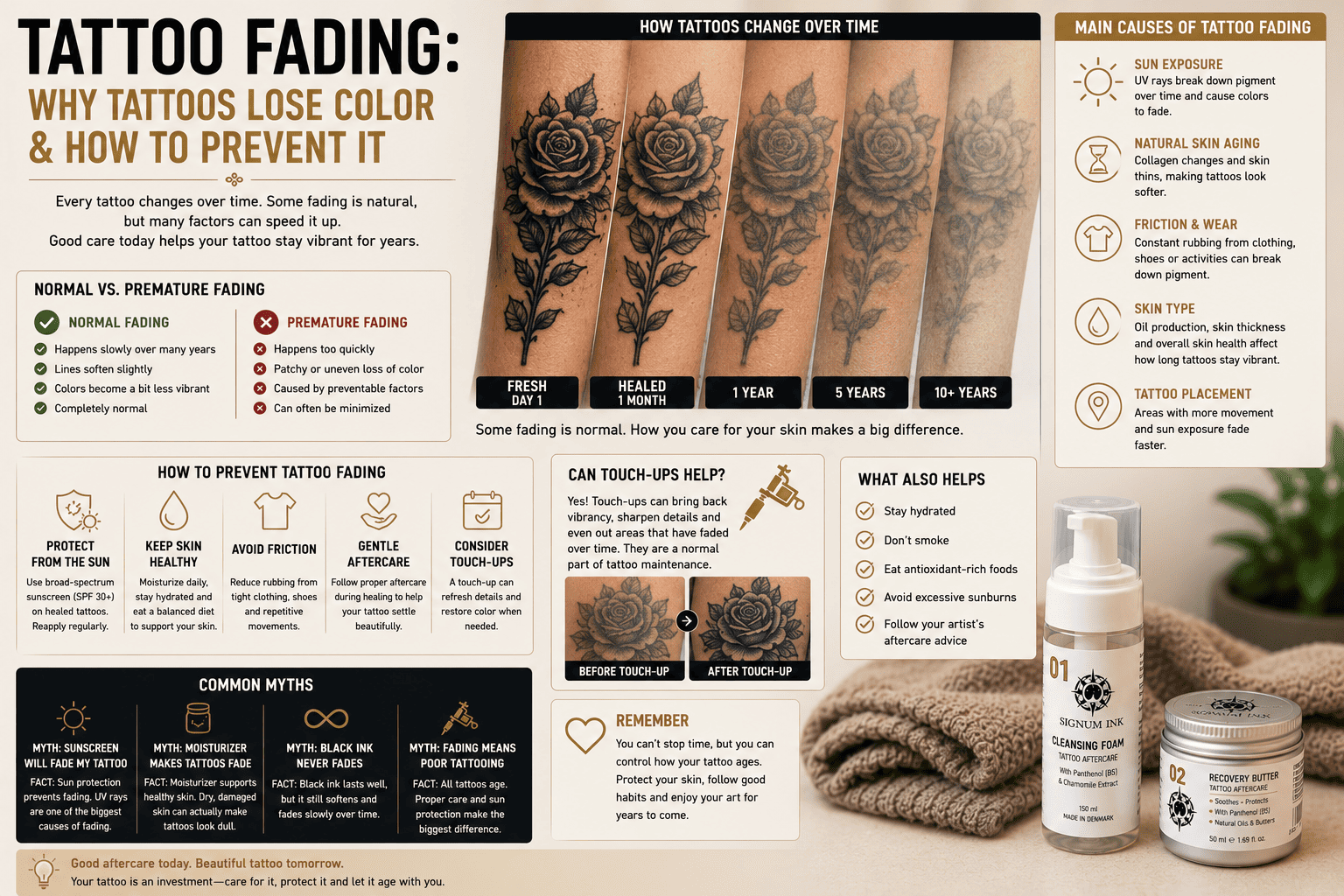
Every tattoo changes over time.
Even the most beautifully executed tattoo won’t look exactly the same ten or twenty years from now.
This is completely normal.
As your skin ages and your body continuously renews itself, tattoos naturally soften and lose some of their original sharpness.
That doesn’t mean something has gone wrong.
The key is understanding the difference between normal aging and premature fading.
With good aftercare, healthy skin and proper sun protection, you can help your tattoo stay vibrant for many years.
In this guide, we’ll explain why tattoos fade, what factors accelerate fading and what you can do to protect your artwork.
Is Tattoo Fading Normal?
Yes.
Some fading is a completely natural part of having a tattoo.
After healing, many people notice that their tattoo looks slightly softer than it did immediately after the session.
This happens because:
- The outer skin heals.
- Swelling disappears.
- The tattoo settles into the dermis.
- Light reflects differently through healed skin.
These early changes are normal and shouldn’t be confused with permanent fading.
Why Do Tattoos Fade?
Several factors influence how a tattoo changes over time.
Some are unavoidable.
Others can be reduced through proper care.
Natural Skin Aging
Your skin constantly renews itself throughout life.
As collagen changes and skin gradually becomes thinner or less elastic, tattoos naturally lose some crispness.
This process happens slowly over many years.
Sun Exposure
Ultraviolet (UV) radiation is one of the biggest causes of premature tattoo fading.
Repeated sun exposure gradually breaks down pigment and changes how the tattoo appears through the skin.
Protecting your tattoo from UV light is one of the most effective ways to preserve its appearance.
Skin Type
Every person’s skin is different.
Factors such as:
- Oil production.
- Skin thickness.
- Collagen structure.
- Natural aging.
can all influence how tattoos age over time.
Tattoo Placement
Some areas experience much more wear than others.
Examples include:
- Hands.
- Fingers.
- Feet.
- Elbows.
- Knees.
These locations are exposed to frequent movement and friction, which may cause tattoos to soften faster.
Friction
Constant rubbing from:
- Tight clothing.
- Shoes.
- Work equipment.
- Sports gear.
may gradually affect how a tattoo ages, particularly in high-friction areas.
Does Healing Affect Fading?
During healing, many tattoos temporarily look:
- Cloudy.
- Dry.
- Patchy.
- Dull.
This stage often worries people.
Fortunately, it’s usually temporary.
Once the skin barrier fully recovers, the tattoo typically regains much of its clarity.
For this reason, it’s important not to judge the final appearance until healing has finished.
Can Poor Aftercare Cause Fading?
Sometimes.
While good aftercare can’t stop natural aging, poor healing may affect how evenly pigment settles within the skin.
Problems that may contribute include:
- Picking scabs.
- Infection.
- Excessive irritation.
- Delayed healing.
Consistent aftercare supports the best possible healing result.
Most Tattoos Age Gracefully
One of the biggest misconceptions is that tattoos quickly become faded and unattractive.
In reality, well-executed tattoos that receive good aftercare and ongoing sun protection often remain attractive for decades.
Small changes are simply part of the tattoo’s natural journey alongside your skin.
How Can You Prevent Tattoo Fading?
While no tattoo stays exactly the same forever, there are several ways to help preserve its appearance for as long as possible.
The goal isn’t to stop aging—it’s to reduce unnecessary damage.
Healthy skin provides the best environment for long-lasting tattoo pigment.
Protect Your Tattoo from the Sun
If there’s one factor that consistently affects tattoo longevity, it’s ultraviolet (UV) exposure.
Over time, repeated sun exposure can gradually break down tattoo pigments and make colors appear duller.
Once your tattoo has fully healed:
- Apply a broad-spectrum sunscreen before spending time outdoors.
- Reapply sunscreen according to the product instructions.
- Wear protective clothing when practical.
- Limit prolonged sun exposure during peak UV hours.
Sun protection benefits both your tattoo and your skin.
Keep Your Skin Healthy
A tattoo lives within your skin, so caring for your skin also helps care for your tattoo.
Simple habits include:
- Moisturizing regularly.
- Drinking enough water.
- Eating a balanced diet.
- Avoiding unnecessary skin irritation.
Healthy skin often allows tattoos to look brighter and more defined.
Avoid Unnecessary Friction
Areas that experience constant rubbing may soften more quickly over time.
If possible, reduce repeated friction from:
- Tight clothing.
- Shoes.
- Protective equipment.
- Heavy manual work.
While some wear is unavoidable, reducing unnecessary irritation helps preserve fine details.
Can Touch-Ups Restore a Faded Tattoo?
Yes.
Many tattoos can be refreshed with a touch-up performed by an experienced tattoo artist.
A touch-up may:
- Restore color intensity.
- Sharpen fine lines.
- Improve small areas that healed lighter.
- Refresh an older tattoo that has naturally softened.
Touch-ups are a common part of tattoo maintenance and don’t necessarily indicate that something went wrong.
Common Myths About Tattoo Fading
Myth 1: Every Tattoo Fades Quickly
False.
Many tattoos remain vibrant for decades when they’re well executed and properly cared for.
Myth 2: Moisturizer Prevents All Fading
No.
Moisturizer supports healthy skin but cannot stop the natural aging process or protect against UV damage.
Myth 3: Black Tattoos Never Fade
False.
Black ink generally ages well, but it also gradually softens over time.
Myth 4: A Faded Tattoo Means Poor Tattooing
Not necessarily.
Every tattoo changes with age.
Natural fading is part of the normal life cycle of a tattoo.
Frequently Asked Questions
Why does my tattoo look lighter after healing?
This is often part of the normal healing process.
As swelling disappears and the outer skin repairs itself, the tattoo usually appears softer than it did immediately after tattooing.
Can sunscreen prevent tattoo fading?
Sunscreen cannot stop natural aging, but it can significantly reduce UV-related fading and help preserve your tattoo’s appearance.
How long does it take for a tattoo to fade?
Every tattoo ages differently.
Factors such as sun exposure, skin type, placement and lifestyle all influence how quickly changes become noticeable.
Do all tattoos need touch-ups?
No.
Many tattoos never require one, while others benefit from a touch-up to restore small areas after healing or years later.
Can faded tattoos be restored?
In many cases, yes.
An experienced tattoo artist can often refresh older tattoos through carefully planned touch-up work.
Conclusion
Tattoo fading is a natural part of your tattoo’s journey.
While you can’t completely prevent the effects of time, you can significantly influence how well your tattoo ages.
Protecting your skin from the sun, maintaining healthy skin and following good aftercare habits all contribute to long-lasting results.
Rather than expecting a tattoo to remain exactly as it looked on day one, it’s more realistic to think of it as artwork that evolves with your skin over time.
With proper care, that artwork can remain beautiful for many years.
Continue Learning
Want to understand why tattoos sometimes appear patchy or cloudy while they’re healing?
→ Read: Tattoo Ink Rejection: Causes, Symptoms & What Really Happens
 English
  German
  Dutch
Dutch  Danish
  Swedish
  French
  Italian