
Introduction
Few stages of tattoo healing cause as much concern as peeling.
One day your tattoo looks vibrant and sharp. A few days later, small flakes of skin begin to appear, the colours seem duller, and your tattoo may suddenly look far less impressive than it did when you left the studio.
Many people immediately worry that something has gone wrong.
Fortunately, peeling is one of the most normal parts of the tattoo healing process.
In fact, it’s often a sign that your skin is repairing itself exactly as it should.
In this guide, you’ll learn why tattoos peel, when peeling usually begins, how long it lasts, and what you should—and should never—do while your tattoo heals.
For a complete understanding of the healing process, we also recommend reading:
→ The Complete Science of Tattoo Healing: What Happens to Your Skin from Day 1 to Day 60
Why Do Tattoos Peel?
A tattoo is created by placing ink into the dermis, the layer beneath your outer skin.
During the tattooing process, the uppermost layer of skin is temporarily damaged by thousands of microscopic needle punctures.
As your body repairs these tiny injuries, it begins replacing damaged surface cells with new healthy skin.
The old skin has only one place to go:
It naturally sheds.
This shedding appears as peeling or flaking.
Although it may look alarming, the peeling skin contains only dead surface cells.
The tattoo pigment remains safely below, protected inside the dermis.
That means normal peeling does not remove your tattoo.
When Does Tattoo Peeling Usually Start?
Most tattoos begin peeling somewhere between:
Day 4 and Day 7
However, there is no exact schedule.
Some people begin peeling slightly earlier.
Others may not notice peeling until the second week.
Several factors influence the timing:
- Tattoo size
- Placement
- Skin type
- Climate
- Moisture balance
- Daily aftercare
The important point is not when peeling starts, but that it follows a gradual, natural pattern.
What Does Normal Tattoo Peeling Look Like?
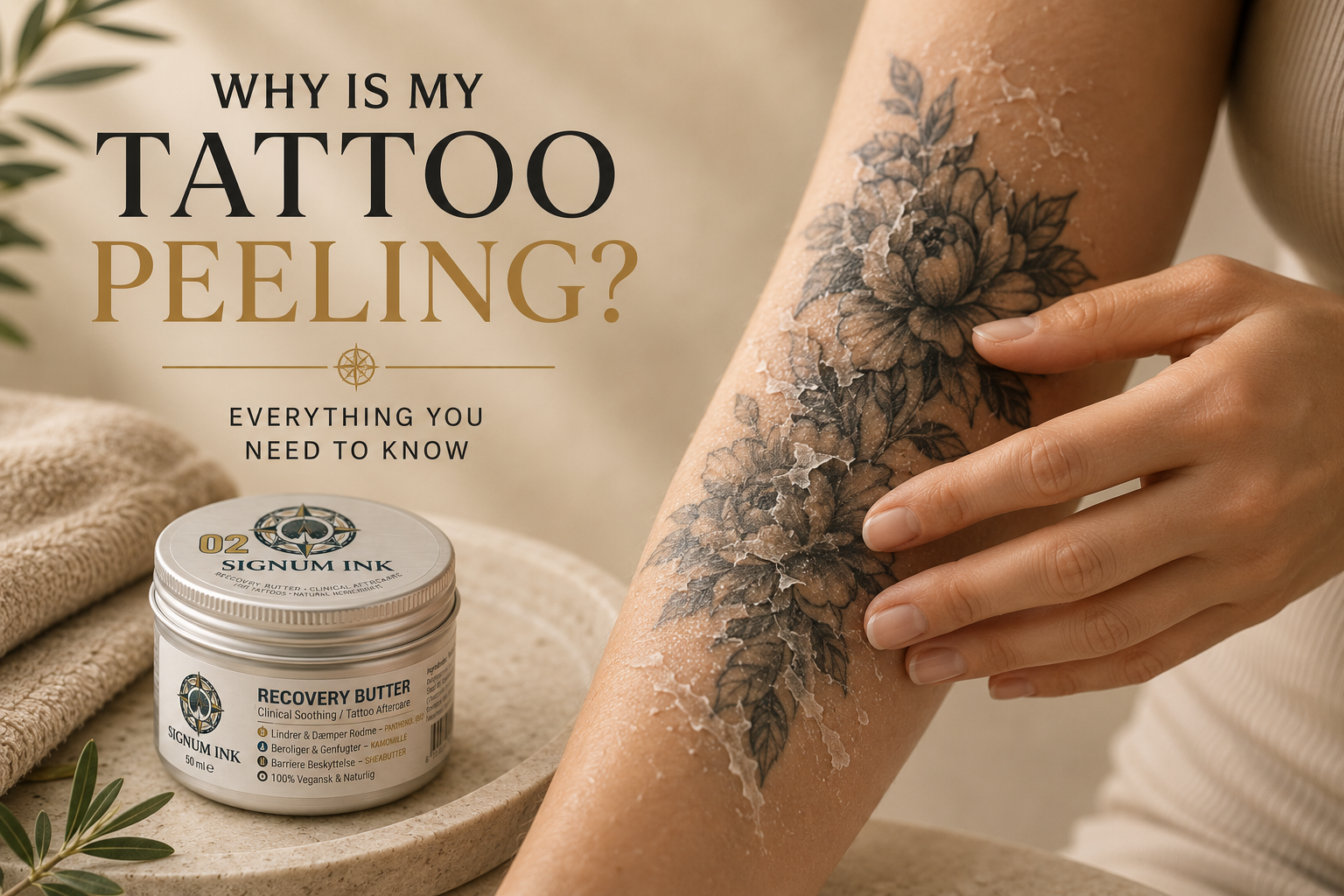
Healthy peeling usually resembles the skin shedding after a mild sunburn.
You may notice:
- Thin flakes
- Small dry patches
- Slight cloudiness
- Dull-looking colours
- Dry edges around the tattoo
This is completely expected.
As the old skin lifts away, the fresh skin underneath gradually becomes visible.
Once healing progresses, your tattoo’s colours will usually appear clearer again.
Why Does My Tattoo Look Dull While It’s Peeling?
This is one of the most common questions tattoo artists hear.
The answer is surprisingly simple.
You’re not looking directly at your healed tattoo.
You’re looking through a layer of dry, damaged skin that hasn’t finished shedding yet.
Think of it like looking through frosted glass.
The artwork underneath hasn’t changed.
Your view of it has.
Once the outer skin has completely renewed itself, the tattoo becomes noticeably sharper again.
Should I Peel the Skin Off?
No.
No matter how tempting it is.
Peeling skin should always fall away naturally.
Pulling, rubbing or picking at flakes before they’re ready may:
- Irritate the skin
- Delay healing
- Increase inflammation
- Create uneven healing
- Increase the risk of scarring
Instead, let your body decide when the skin is ready to shed.
Patience always produces better results than trying to speed up the process.
Is Heavy Peeling Normal?
Sometimes.
Large tattoos often peel more than small tattoos.
Heavily shaded areas may also produce more visible flakes.
As long as the peeling gradually improves and isn’t accompanied by worsening redness, severe pain or unusual discharge, it’s usually considered a normal part of healing.
The amount of peeling varies greatly from person to person.
Some people hardly notice it.
Others experience several days of visible flaking.
Both can be perfectly normal.
How to Care for a Peeling Tattoo
Peeling is a sign that your skin is renewing itself, not that your tattoo is being damaged.
The best thing you can do is support your body’s natural healing process without interfering.
A simple routine includes:
- Wash your tattoo gently with lukewarm water.
- Use a mild, fragrance-free cleanser.
- Pat the tattoo dry with a clean paper towel.
- Apply a thin layer of moisturizer when the skin feels dry.
- Wear loose, breathable clothing whenever possible.
Avoid the temptation to constantly check or touch the tattoo.
The less irritation you create, the more comfortably your skin can heal.
What You Should Never Do
Many healing problems begin with good intentions.
People want to “help” the peeling skin, but often end up slowing the healing process.
Avoid these common mistakes:
Picking the Flakes
Never pull away loose skin.
Even flakes that appear ready to fall off may still be attached to healing tissue underneath.
Let them detach naturally.
Scrubbing the Tattoo
During showers, avoid rubbing the tattoo with a washcloth or towel.
Gentle fingertips are more than enough.
Over-Moisturizing
Applying thick layers of aftercare won’t stop peeling.
Instead, it may leave the skin overly moist and uncomfortable.
Your tattoo should feel hydrated—not greasy.
Letting the Tattoo Dry Out Completely
The opposite mistake is avoiding moisturizer altogether.
Extremely dry skin often feels tighter and itchier, making the peeling stage more uncomfortable than necessary.
Balance is the goal.
Normal Peeling vs. Peeling That May Need Attention
Most peeling looks similar to dry skin after a mild sunburn.
Typical signs include:
- Thin flakes
- Dry skin
- Mild itching
- Temporary dull appearance
These are expected.
However, peeling accompanied by the following symptoms deserves closer attention:
- Increasing redness after the first few days
- Thick yellow or green discharge
- Severe swelling
- Fever
- Strong unpleasant odour
- Pain that continues getting worse
These symptoms are not typical of normal tattoo peeling and should be assessed by a healthcare professional.
Does Moisturizer Stop Peeling?
No.
And it shouldn’t.
Peeling is a natural part of healing.
The goal of moisturizer isn’t to prevent peeling.
Its purpose is to:
- Reduce tightness
- Improve comfort
- Support the skin barrier
- Help the skin retain moisture
Even with excellent aftercare, your tattoo will usually peel.
That’s perfectly normal.
Frequently Asked Questions
Is tattoo peeling always normal?
For most people, yes.
Peeling during the first one to two weeks is one of the expected stages of tattoo healing.
Can peeling remove tattoo ink?
No.
The peeling skin contains dead surface cells.
Your tattoo pigment remains safely beneath the surface in the dermis.
Why does my tattoo look faded while peeling?
Dry, shedding skin temporarily covers the tattoo.
Once this layer has naturally disappeared, the tattoo usually looks clearer again.
Can I speed up peeling?
Not safely.
Your skin heals at its own pace.
Trying to remove peeling skin manually often causes more harm than good.
How long does peeling last?
Most tattoos peel for several days, although the exact duration varies from person to person.
Large tattoos often peel for longer than smaller ones.
Conclusion
Tattoo peeling can look dramatic, but in most cases it’s simply your skin doing exactly what it was designed to do.
As damaged surface cells are replaced, the old skin naturally sheds to make room for healthy new skin underneath.
The best approach is surprisingly simple:
Keep the tattoo clean.
Keep it comfortably moisturized.
Avoid picking.
Be patient.
Your tattoo isn’t losing ink.
It’s revealing the healed artwork beneath.
Continue Learning
Want to understand every stage of tattoo healing?
→ Read: The Complete Science of Tattoo Healing: What Happens to Your Skin from Day 1 to Day 60
 English
  German
  Dutch
Dutch  Danish
  Swedish
  French
  Italian