Introduction
Most tattoos heal without any serious complications.
Occasionally, however, some people develop an allergic reaction to one or more of the pigments used in tattoo ink.
This can be confusing because allergic reactions don’t always appear immediately.
Some develop within days, while others may not occur until months—or even years—after the tattoo was completed.
Although tattoo allergies are relatively uncommon, recognizing the symptoms early can help you understand what’s happening and know when it’s appropriate to seek medical advice.
In this guide, we’ll explain what tattoo allergies are, why they happen and how they’re different from normal tattoo healing.
What Is a Tattoo Allergic Reaction?
An allergic reaction occurs when the immune system reacts to a substance it identifies as foreign.
With tattoos, the reaction is usually directed toward one or more pigments within the ink rather than the tattooing process itself.
Unlike temporary irritation that occurs during normal healing, an allergic reaction may persist or return long after the tattoo appears healed.
The severity can vary considerably.
Some reactions cause only mild itching, while others require assessment by a healthcare professional.
What Causes Tattoo Allergies?
Tattoo ink contains a variety of pigments and ingredients.
Although modern tattoo inks are generally considered safe, no pigment is completely free from the possibility of causing an allergic response.
The exact trigger differs from person to person.
Factors may include:
- Individual immune response.
- Certain pigment ingredients.
- Previous sensitivities.
- Rare delayed immune reactions.
In many cases, it’s impossible to predict whether someone will develop a tattoo allergy before getting tattooed.
Which Tattoo Colors Cause Allergic Reactions Most Often?
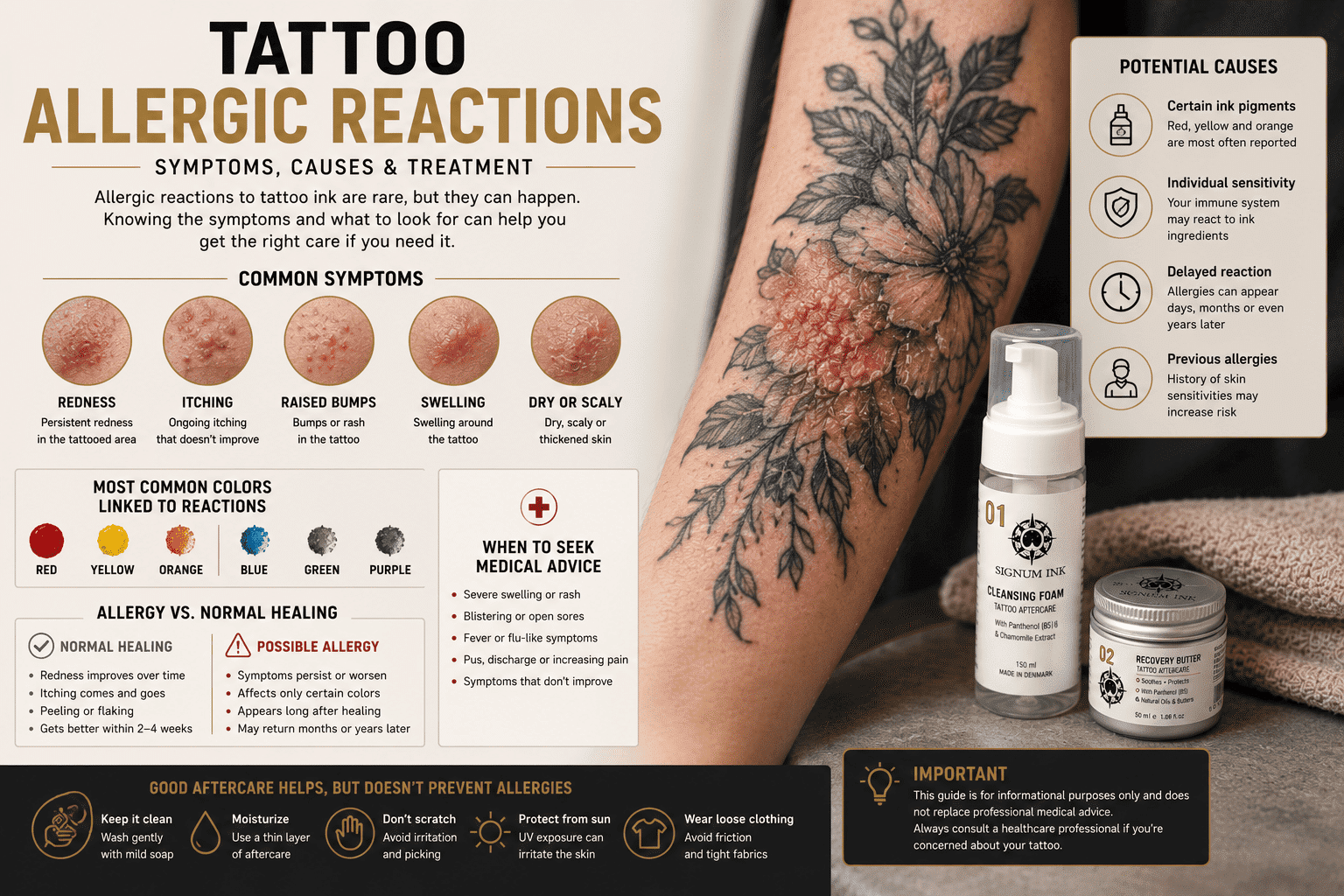
All tattoo colors have the potential to trigger an allergic reaction.
Historically, however, reactions have been reported more frequently with certain pigments.
These include:
- Red.
- Yellow.
- Orange.
Less commonly, reactions may also occur with:
- Blue.
- Green.
- Purple.
- Black.
It’s important to remember that millions of tattoos heal normally every year without any allergic complications.
Common Symptoms of a Tattoo Allergy
Symptoms vary from person to person.
Some of the most common include:
- Persistent itching.
- Localized redness.
- Raised skin.
- Swelling.
- Small bumps.
- A rash limited to one color of the tattoo.
Unlike normal healing, these symptoms often continue beyond the expected healing period or return after the tattoo has already healed.
Tattoo Allergy vs. Normal Healing
This is one of the biggest challenges.
A fresh tattoo naturally becomes:
- Red.
- Tender.
- Slightly swollen.
- Itchy.
These symptoms usually improve over the first few weeks.
An allergic reaction may instead:
- Continue for weeks or months.
- Return after healing.
- Affect only specific colored areas.
- Become more noticeable over time.
This difference in timing often helps distinguish normal healing from a possible allergy.
Can Tattoo Allergies Appear Years Later?
Yes.
One of the unusual characteristics of tattoo allergies is that they can sometimes develop long after the tattoo was completed.
Although uncommon, delayed reactions have been reported months or even years after tattooing.
Researchers don’t fully understand why this happens, but it’s thought to involve changes in the immune system over time.
For this reason, a tattoo that healed perfectly initially isn’t necessarily immune to future reactions.
Not Every Itchy Tattoo Is an Allergy
Fortunately, most itchy tattoos are simply healing normally.
Itching is one of the most common stages of tattoo recovery.
Before assuming an allergy, consider:
- How old the tattoo is.
- Whether symptoms are improving.
- Whether only one pigment is affected.
- Whether other symptoms are present.
If you’re uncertain, your tattoo artist or a healthcare professional can help assess the situation.
How Are Tattoo Allergic Reactions Treated?
The appropriate treatment depends on the type and severity of the reaction.
Mild reactions may improve with conservative care, while more significant or persistent symptoms should always be evaluated by a healthcare professional.
Treatment may include:
- Monitoring the affected area.
- Avoiding scratching or irritation.
- Following appropriate skincare advice.
- Prescription medications if recommended by a healthcare professional.
Avoid attempting to self-treat persistent reactions with home remedies that haven’t been recommended by a qualified professional.
Should You Remove the Tattoo?
Not necessarily.
Many allergic reactions can be managed without removing the tattoo.
Removal is generally considered only if:
- Symptoms are severe.
- The reaction keeps returning.
- Medical treatment isn’t effective.
- A healthcare professional recommends it.
Laser removal isn’t always straightforward in cases of tattoo allergy, as breaking up pigment particles may sometimes complicate the immune response.
Treatment decisions should always be made together with a qualified healthcare professional.
When Should You See a Healthcare Professional?
You should seek medical advice if you experience:
- Persistent swelling.
- Severe itching that doesn’t improve.
- A widespread rash.
- Blistering.
- Open sores.
- Symptoms that continue long after healing should have finished.
You should also seek prompt medical attention if symptoms are accompanied by:
- Fever.
- Increasing pain.
- Significant redness.
- Pus or unusual discharge.
These signs may indicate an infection rather than—or in addition to—an allergic reaction.
Can Tattoo Allergies Be Prevented?
Unfortunately, there is no guaranteed way to prevent a tattoo allergy.
However, you can reduce uncertainty by:
- Choosing a reputable tattoo studio.
- Discussing previous allergies with your tattoo artist.
- Informing your artist about known skin conditions.
- Following proper aftercare instructions.
Although some people ask about patch testing tattoo ink beforehand, there’s currently no universally reliable test that can predict every future tattoo allergy.
Living With a Tattoo Allergy
Many people who experience mild tattoo allergies continue to live comfortably with their tattoos.
Some reactions settle with treatment.
Others may come and go over time.
The most important thing is to:
- Avoid unnecessary irritation.
- Monitor changes.
- Seek professional advice if symptoms worsen.
Managing a tattoo allergy is often about understanding your skin rather than panicking.
Common Myths About Tattoo Allergies
Myth 1: Every Itchy Tattoo Is an Allergy
False.
Itching is one of the most common stages of normal tattoo healing.
An allergy is usually more persistent and often affects specific pigments.
Myth 2: Only Red Ink Causes Allergies
False.
Red pigments have historically been associated with more reported reactions, but allergies can occur with any tattoo color.
Myth 3: Tattoo Allergies Always Appear Immediately
Not true.
Some allergic reactions don’t develop until months or even years after tattooing.
Myth 4: You Must Remove the Tattoo
Not necessarily.
Many allergic reactions can be managed without tattoo removal, depending on their severity and the advice of a healthcare professional.
Frequently Asked Questions
How common are tattoo allergies?
Tattoo allergies are considered relatively uncommon compared with the large number of tattoos performed every year.
Most tattoos heal without allergic complications.
Can a tattoo allergy appear years later?
Yes.
Although uncommon, delayed allergic reactions have been reported months or even years after a tattoo was completed.
Does red ink always cause allergies?
No.
While red pigments have historically been linked with more reported reactions, any tattoo pigment has the potential to trigger an allergic response.
Will an allergic reaction go away on its own?
Some mild reactions may improve over time.
Persistent or worsening symptoms should always be assessed by a healthcare professional.
Can I get another tattoo if I’ve had an allergic reaction?
Possibly.
If you’ve previously experienced a tattoo allergy, discuss it with both your tattoo artist and a healthcare professional before getting another tattoo.
Conclusion
Tattoo allergic reactions are uncommon, but they can happen.
The key is recognizing the difference between expected healing and symptoms that continue long after your tattoo should have recovered.
Most tattoos heal without problems.
If you do develop a suspected allergic reaction, early professional advice can help you understand the cause and identify the most appropriate treatment options.
Being informed allows you to respond calmly and protect both your skin and your tattoo.
Continue Learning
Not sure whether you’re dealing with a normal healing symptom or something more serious?
→ Read: The Complete Guide to Common Tattoo Problems: Causes, Symptoms & Solutions
 English
  German
  Dutch
Dutch  Danish
  Swedish
  French
  Italian