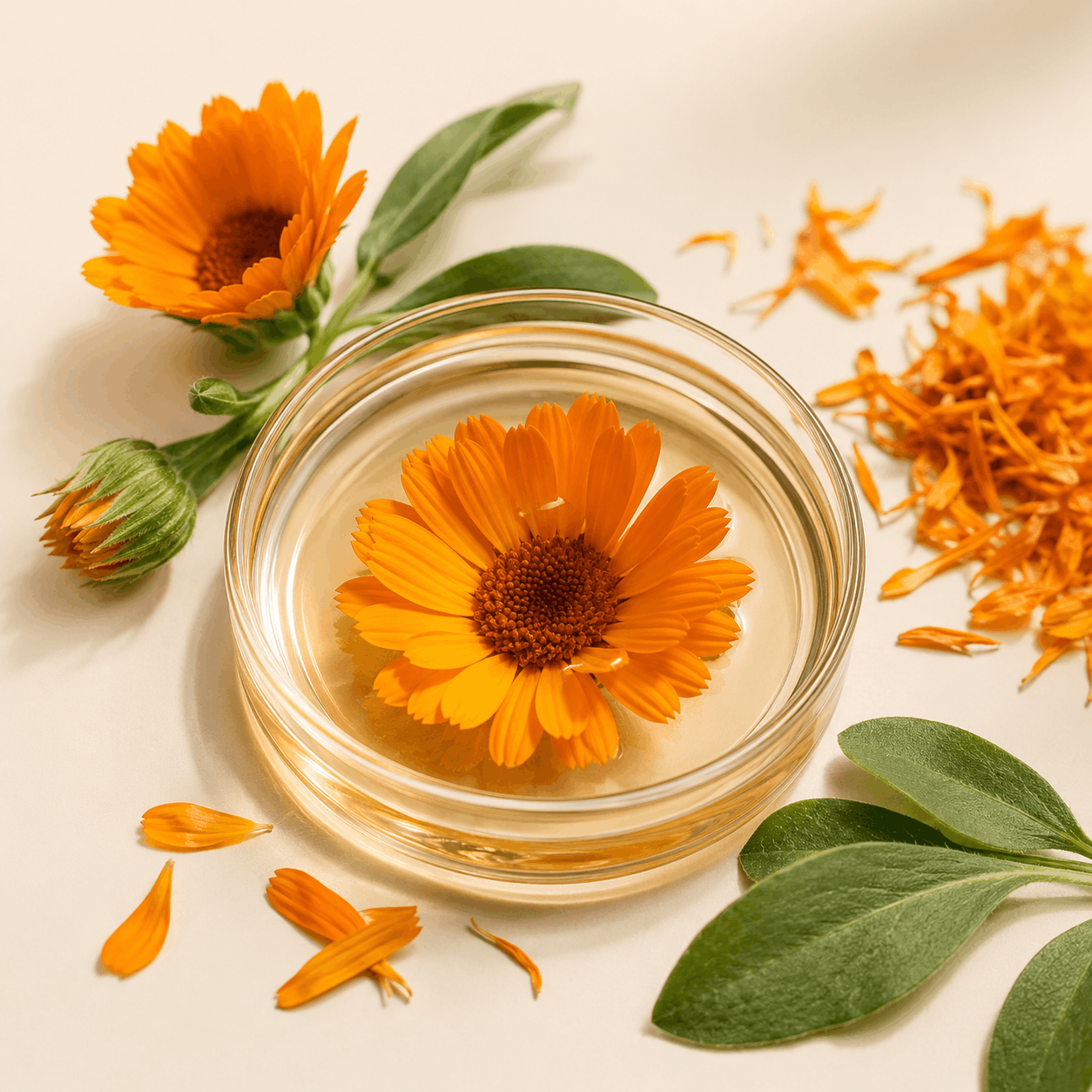
For centuries, Calendula has been one of the most respected botanical ingredients used in skincare.
Known for its bright golden-orange flowers and long history in traditional herbal medicine, Calendula has become a familiar ingredient in products developed for sensitive and delicate skin.
Today, modern skincare formulators continue to include Calendula because of its excellent skin compatibility and its ability to complement scientifically established skincare ingredients.
For tattoo aftercare, this makes Calendula particularly interesting.
Freshly tattooed skin experiences temporary stress while rebuilding its protective barrier. During this period, skincare products are designed to help maintain hydration, support the skin barrier, and keep the skin feeling comfortable.
Although Calendula is not intended to replace proven moisturizing or barrier-supporting ingredients, it provides valuable botanical support that contributes to the overall skincare experience.
Its greatest strength lies not in acting alone, but in working together with ingredients such as Panthenol, Glycerin, Beta-Glucan, Allantoin, and Ceramides.
Quick Facts
Ingredient Type
Botanical Plant Extract
Primary Benefits
Skin Comfort • Botanical Skin Care • Hydration Support
Best For
Fresh Tattoos • Sensitive Skin • Dry Skin • Daily Skincare
Found In
Recovery Creams • Moisturisers • Botanical Skincare • Tattoo Aftercare Products
Suitable For
Most Skin Types
Typical Cosmetic Concentration
0.1–5%
Pairs Well With
Panthenol • Glycerin • Beta-Glucan • Allantoin • Ceramides
Scientific Support
★★★★☆
Did You Know?
Calendula belongs to the daisy family and has been used in European skincare traditions for hundreds of years. Today, it remains one of the most widely recognised botanical extracts in products developed for sensitive skin.
What Is Calendula?
Calendula, scientifically known as Calendula officinalis, is a flowering plant native to Southern Europe and widely cultivated around the world.
Its vibrant orange and yellow flowers have long been valued in traditional herbal preparations.
In modern skincare, however, Calendula is used in a much more controlled way.
Manufacturers produce carefully standardized extracts to ensure consistent quality, stability, and compatibility with cosmetic formulations.
Depending on the product, Calendula may appear as:
- Calendula Flower Extract
- Calendula Officinalis Flower Extract
- Calendula Oil Infusion
- Calendula CO₂ Extract
Each form offers slightly different characteristics depending on how it has been processed.
This is one reason why two products containing Calendula may perform differently.
The quality of the extract and the overall formulation often have a greater impact than the ingredient name itself.
How Does Calendula Work?
Unlike ingredients such as Glycerin, which primarily attract moisture, Calendula is valued for its botanical skin-conditioning properties.
Its flowers naturally contain compounds including:
- Flavonoids
- Triterpenoids
- Carotenoids
- Plant sterols
- Polyphenols
These naturally occurring compounds have made Calendula one of the most extensively studied botanical extracts in cosmetic science.
Within skincare formulations, Calendula contributes to products designed to support skin comfort while complementing ingredients responsible for hydration and barrier support.
Rather than acting as a primary moisturizer, Calendula enhances the overall formulation by contributing a gentle botanical element that is particularly well suited for sensitive skin.
Why Fresh Tattoos Benefit from Calendula
Healing skin often becomes more delicate than usual.
As the skin repairs itself, maintaining hydration is only one part of effective tattoo aftercare.
Supporting overall skin comfort is equally important.
This is where Calendula fits naturally into modern tattoo aftercare formulations.
Its gentle botanical profile makes it a valuable complementary ingredient in recovery creams developed for healing skin.
When combined with ingredients such as Panthenol, Beta-Glucan, and Allantoin, Calendula contributes to products designed to support the skin throughout the entire healing journey.
Rather than providing dramatic short-term effects, Calendula is appreciated because it helps create balanced formulations that feel pleasant and comfortable during repeated daily use.
Why Calendula Has Remained Popular in Modern Skincare
Despite the rapid development of cosmetic science, Calendula continues to appear in premium skincare products around the world.
Professional formulators value Calendula for several reasons.
Botanical Heritage
Few skincare ingredients have such a long history of cosmetic use.
Its traditional reputation continues to appeal to consumers seeking plant-derived skincare ingredients.
Excellent Skin Compatibility
Properly formulated Calendula extracts are generally well tolerated by most skin types.
This makes the ingredient particularly suitable for products developed for sensitive skin.
Complements Modern Active Ingredients
One of Calendula’s greatest strengths is its ability to work alongside scientifically established skincare ingredients.
It is frequently combined with:
- Panthenol
- Glycerin
- Beta-Glucan
- Allantoin
- Ceramides
- Aloe Vera
Together these ingredients create formulations that combine botanical extracts with modern cosmetic science.
Pleasant Consumer Experience
Beyond its functional role, Calendula contributes to the sensory experience of a skincare product.
Consumers often associate botanical ingredients with gentle daily skincare, making Calendula a natural choice for premium recovery creams and moisturizers.
Why Professional Formulators Continue Choosing Calendula
Modern skincare formulations are rarely built around a single ingredient.
Instead, formulators select ingredients that support one another.
Within this philosophy, Calendula offers something unique.
It bridges traditional botanical skincare with evidence-informed cosmetic science.
Rather than relying on folklore alone, today’s formulations use carefully standardized Calendula extracts that integrate naturally with modern humectants, barrier-supporting ingredients, and skin conditioners.
This balanced approach explains why Calendula continues to earn its place in sophisticated skincare products developed for sensitive and healing skin.
Calendula in Recovery Cream: Botanical Support for Healing Skin
Recovery creams are designed to do more than simply moisturize the skin.
Following a tattoo session, the skin enters a natural repair process that temporarily weakens its protective barrier. During this time, a well-balanced recovery cream should help maintain hydration, support the skin barrier, and provide a comfortable skin feel.
This is where Calendula contributes to the overall formulation.
Unlike ingredients such as Glycerin, which primarily function as humectants, or Ceramides, which reinforce the skin barrier, Calendula provides botanical skin-conditioning benefits that complement these scientifically established ingredients.
Its role is not to replace hydration or barrier-supporting actives, but to enhance the overall skincare experience.
Professional formulators often choose Calendula because it blends naturally with modern recovery cream formulations while maintaining an elegant, lightweight texture.
When combined with ingredients such as Panthenol, Beta-Glucan, and Allantoin, Calendula helps create products designed to keep healing skin feeling soft, balanced, and comfortable throughout recovery.
Calendula in Tattoo Foam Soap
Cleansing is one of the most important steps in tattoo aftercare.
Fresh tattoos should be washed regularly to remove plasma, excess ink, sweat, and daily impurities while preserving the skin’s natural moisture balance.
Modern tattoo cleansers therefore aim to do much more than simply clean the skin.
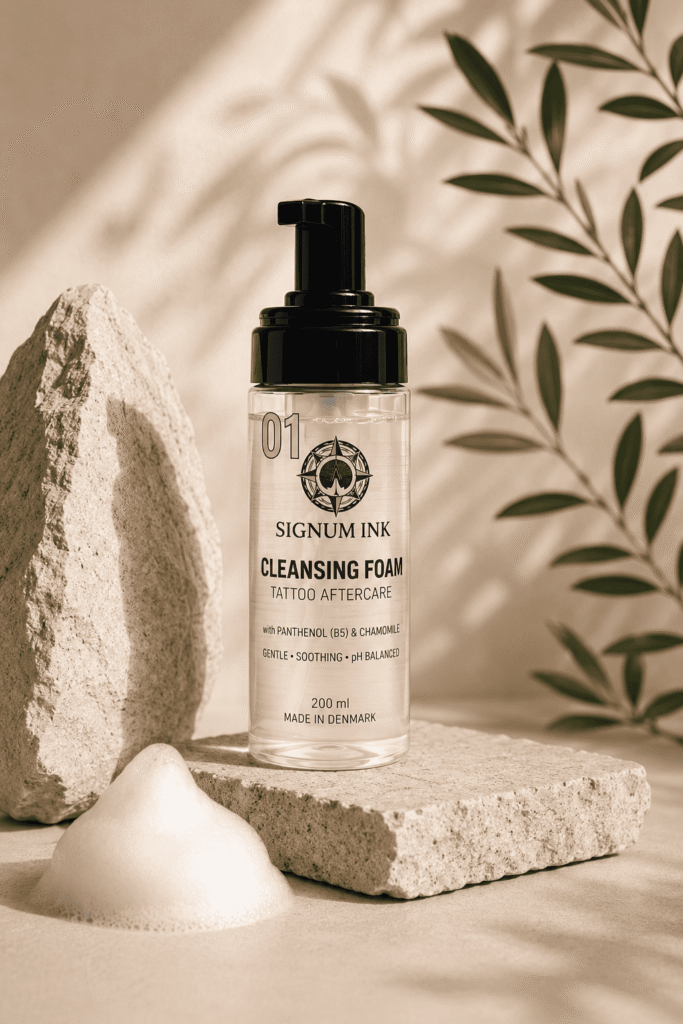
Including Calendula in a foam cleanser contributes to a gentle, skin-friendly cleansing experience.
Although a cleanser remains on the skin for only a short period, botanical extracts such as Calendula help shape the overall sensory profile of the product.
When combined with mild cleansing agents and moisturizing ingredients, Calendula contributes to a formula that feels comfortable during repeated daily use.
This is particularly valuable during tattoo healing, when freshly tattooed skin is naturally more delicate than usual.
What Does the Research Say?
Unlike many traditional botanical ingredients, Calendula has been the subject of a growing number of scientific studies within cosmetic and dermatological research.
Researchers have investigated the naturally occurring compounds found in Calendula officinalis, particularly its flavonoids, triterpenoids, carotenoids, and polyphenols.
Current research suggests that topical Calendula formulations may contribute to:
- Supporting skin comfort.
- Helping maintain the skin’s natural barrier.
- Supporting hydration when used as part of balanced formulations.
- Helping maintain healthy-looking skin.
- Providing antioxidant activity that helps protect cosmetic formulations and supports overall skin care.
While research into Calendula continues to evolve, most dermatological experts consider it a valuable complementary botanical ingredient rather than a replacement for clinically established moisturizers or barrier-supporting actives.
This balanced understanding has helped Calendula remain relevant in modern skincare for both sensitive and healing skin.
Research Snapshot
| Research Area | Evidence |
|---|---|
| Skin Comfort | ★★★★★ |
| Sensitive Skin | ★★★★★ |
| Botanical Skincare | ★★★★★ |
| Antioxidant Activity | ★★★★☆ |
| Barrier Support | ★★★☆☆ |
| Tattoo Aftercare | ★★★☆☆* |
*Note: Scientific studies specifically investigating Calendula in tattoo aftercare are limited. Most available evidence relates to its use in cosmetic skincare and products developed for sensitive skin rather than tattoos specifically.
Calendula Compared with Other Popular Botanical Ingredients
Every botanical extract contributes something different.
Professional formulators select botanical ingredients based on how they complement one another within the overall formulation.
Calendula vs. Aloe Vera
Both ingredients have long histories in skincare.
Aloe Vera is primarily valued for lightweight hydration and its refreshing skin feel.
Calendula is appreciated for its botanical skin-conditioning properties and excellent compatibility with sensitive skin.
Together they create formulations that feel both refreshing and comforting.
Calendula vs. Allantoin
Although often associated with similar skincare products, these ingredients are quite different.
Allantoin is a well-established skin-conditioning ingredient with decades of dermatological use.
Calendula is a botanical extract containing naturally occurring plant compounds.
Professional formulations frequently combine both ingredients to benefit from their complementary strengths.
Calendula vs. Centella Asiatica
Both botanical ingredients are increasingly popular in premium skincare.
Centella Asiatica has become well known for its extensive research in barrier-focused skincare.
Calendula contributes a long history of cosmetic use together with excellent skin compatibility.
Many advanced skincare formulations include both botanical extracts because they provide complementary benefits.
Calendula vs. Chamomile
Consumers often compare Calendula with Chamomile because both belong to the daisy family and are commonly used in skincare.
However, they contain different naturally occurring compounds and are selected for different formulation goals.
Rather than competing, these ingredients are often used together in products developed for sensitive skin.
Why Botanical Extracts Still Matter in Modern Skincare
The skincare industry has seen remarkable advances in cosmetic science over the past several decades.
Ingredients such as Ceramides, Panthenol, and Beta-Glucan are now supported by substantial scientific research.
Yet botanical extracts continue to play an important role.
Professional formulators increasingly view plant extracts as complementary ingredients that enhance a formulation rather than replacing evidence-based skincare actives.
This philosophy has helped Calendula remain relevant.
Its combination of botanical heritage, excellent skin compatibility, and formulation versatility allows it to integrate naturally into modern skincare products.
For tattoo aftercare, this means Calendula is best understood as one valuable piece of a larger formulation strategy—working alongside hydration-focused, barrier-supporting, and skin-conditioning ingredients to create a balanced product that supports healing skin.
Frequently Asked Questions About Calendula
What is Calendula?
Calendula, also known as Calendula officinalis or pot marigold, is a flowering plant widely used in skincare. Its flower extracts have been included in cosmetic formulations for generations because of their excellent compatibility with sensitive skin and their contribution to overall skin comfort.
Why is Calendula used in tattoo aftercare?
Fresh tattoos temporarily place the skin under stress while it rebuilds its protective barrier.
Calendula is commonly included in tattoo aftercare products because it complements moisturizing and barrier-supporting ingredients while contributing to a gentle, botanical skincare experience.
Is Calendula suitable for sensitive skin?
Generally, yes.
Properly formulated Calendula extracts are well tolerated by most skin types and are frequently found in products developed for sensitive skin.
However, because Calendula belongs to the daisy (Asteraceae) family, individuals with allergies to plants in this family should use caution and perform a patch test before regular use.
Does Calendula moisturize the skin?
Not in the same way as ingredients such as Glycerin.
Calendula is primarily a botanical skin-conditioning ingredient.
It performs best when combined with humectants, emollients, and barrier-supporting ingredients that provide long-lasting hydration.
Can Calendula replace Panthenol or Beta-Glucan?
No.
Each ingredient performs a different role.
Panthenol supports hydration and the skin barrier.
Beta-Glucan contributes hydration and barrier support.
Calendula complements these ingredients by adding botanical skin-conditioning properties.
Professional formulations combine these ingredients because they work together rather than competing.
Is Calendula only used in tattoo skincare?
Not at all.
Calendula is widely used in:
- Facial moisturizers
- Body lotions
- Baby skincare
- Hand creams
- Botanical serums
- Barrier creams
- Sensitive skin products
Its versatility explains why it continues to appear in modern skincare formulations.
Is natural Calendula better than standardized extracts?
Not necessarily.
Professional cosmetic formulations use standardized extracts because they provide consistent quality, stability, and predictable performance.
The effectiveness of a product depends on the complete formulation rather than simply using a natural plant extract.
Can Calendula be used every day?
Yes.
Its excellent skin compatibility makes Calendula suitable for products intended for regular daily skincare.
Why is Calendula often combined with Aloe Vera?
These botanical ingredients complement each other beautifully.
Aloe Vera contributes lightweight hydration and a refreshing skin feel.
Calendula provides botanical skin-conditioning properties.
Together they create formulations that feel gentle, balanced, and pleasant to use.
Why do formulators continue choosing Calendula?
Professional formulators appreciate Calendula because it combines:
- Excellent botanical heritage.
- High consumer recognition.
- Good formulation compatibility.
- Gentle skin-conditioning properties.
- Strong synergy with modern skincare ingredients.
Its role is not to replace evidence-based skincare ingredients but to enhance well-designed formulations.
Common Myths About Calendula
Myth 1: Calendula is only a traditional herbal remedy.
Reality:
Although Calendula has centuries of traditional use, it is also incorporated into many modern cosmetic formulations using standardized extracts and quality-controlled manufacturing processes.
Myth 2: Botanical ingredients are always better than scientifically developed ingredients.
Reality:
Modern skincare combines the strengths of both.
Professional formulations often include botanical extracts alongside ingredients such as Panthenol, Ceramides, Glycerin, and Beta-Glucan.
Myth 3: More Calendula means better results.
Reality:
The effectiveness of a skincare product depends on the entire formulation.
Professional formulators carefully balance ingredient concentrations to achieve optimal performance.
Myth 4: Every Calendula product performs the same.
Reality:
Different extraction methods, concentrations, raw material quality, and formulation strategies all influence the final performance of a product.
Research Snapshot
| Research Area | Evidence |
|---|---|
| Traditional Use | ★★★★★ |
| Cosmetic Research | ★★★★☆ |
| Sensitive Skin | ★★★★★ |
| Skin Comfort | ★★★★★ |
| Barrier Support | ★★★☆☆ |
| Tattoo Aftercare | ★★★☆☆* |
*Current evidence for tattoo aftercare is largely indirect and based on Calendula’s documented role in cosmetic skincare and products developed for sensitive skin. Direct tattoo-specific research remains limited.
Level of Evidence
| Evidence Source | Strength |
|---|---|
| Traditional Herbal Use | ★★★★★ |
| Modern Cosmetic Science | ★★★★☆ |
| Clinical Dermatology | ★★★☆☆ |
| Tattoo-Specific Studies | ★★☆☆☆ |
Why this matters:
Understanding where the evidence comes from helps set realistic expectations. Calendula has a long history of traditional use and encouraging cosmetic research, but fewer clinical studies specifically examining tattoo aftercare. This distinction helps consumers make informed skincare decisions.
Ingredient Performance Snapshot
| Category | Rating |
|---|---|
| Skin Comfort | ⭐⭐⭐⭐⭐ |
| Sensitive Skin | ⭐⭐⭐⭐⭐ |
| Botanical Value | ⭐⭐⭐⭐⭐ |
| Hydration Support | ⭐⭐⭐☆☆ |
| Barrier Support | ⭐⭐⭐☆☆ |
| Daily Use | ⭐⭐⭐⭐⭐ |
| Scientific Evidence | ⭐⭐⭐⭐☆ |
Formulator’s Perspective
Calendula is at its best when it supports a complete formulation—not when it carries one on its own.
Experienced formulators rarely choose botanical extracts because of tradition alone. Instead, they select ingredients based on how well they work together.
Calendula adds botanical value, pleasant skin feel, and excellent compatibility to formulations that also include proven ingredients such as Glycerin, Panthenol, Beta-Glucan, Allantoin, and Ceramides.
This synergy creates products that feel elegant while supporting hydration, skin comfort, and the skin’s natural barrier.
Expert Tip
When evaluating botanical skincare ingredients, focus on the complete formula—not just the headline ingredient.
A well-designed tattoo aftercare product combines humectants, emollients, barrier-supporting ingredients, and carefully selected botanical extracts. Calendula is most effective when it complements this balanced approach rather than being presented as a stand-alone solution.
Ingredient Verdict
| Category | Rating |
|---|---|
| Overall Rating | ⭐⭐⭐⭐☆ |
| Best For | Sensitive skin, fresh tattoos, daily skincare |
| Scientific Confidence | Moderate to High |
| Formulator Recommendation | Excellent complementary botanical ingredient |
| Works Best With | Panthenol, Glycerin, Beta-Glucan, Allantoin, Ceramides |
Final Thoughts
For hundreds of years, Calendula has been valued as one of the world’s most recognised botanical skincare ingredients. Today, its role has evolved from traditional herbal preparations to carefully standardized cosmetic extracts used in premium formulations.
Modern skincare no longer relies on folklore alone. Instead, formulators combine trusted botanical ingredients with evidence-supported cosmetic actives to create products that deliver balanced, reliable performance.
Within this approach, Calendula plays an important supporting role. Its excellent compatibility with sensitive skin, pleasant sensory characteristics, and ability to work alongside scientifically established ingredients make it a valuable addition to modern tattoo aftercare.
Rather than promising dramatic results on its own, Calendula demonstrates why thoughtful formulation is more important than any single ingredient. It is this formulation-first philosophy that helps create skincare products designed to support healthy-looking skin throughout every stage of tattoo healing.
 English
  German
  Dutch
Dutch  Danish
  Swedish
  French
  Italian