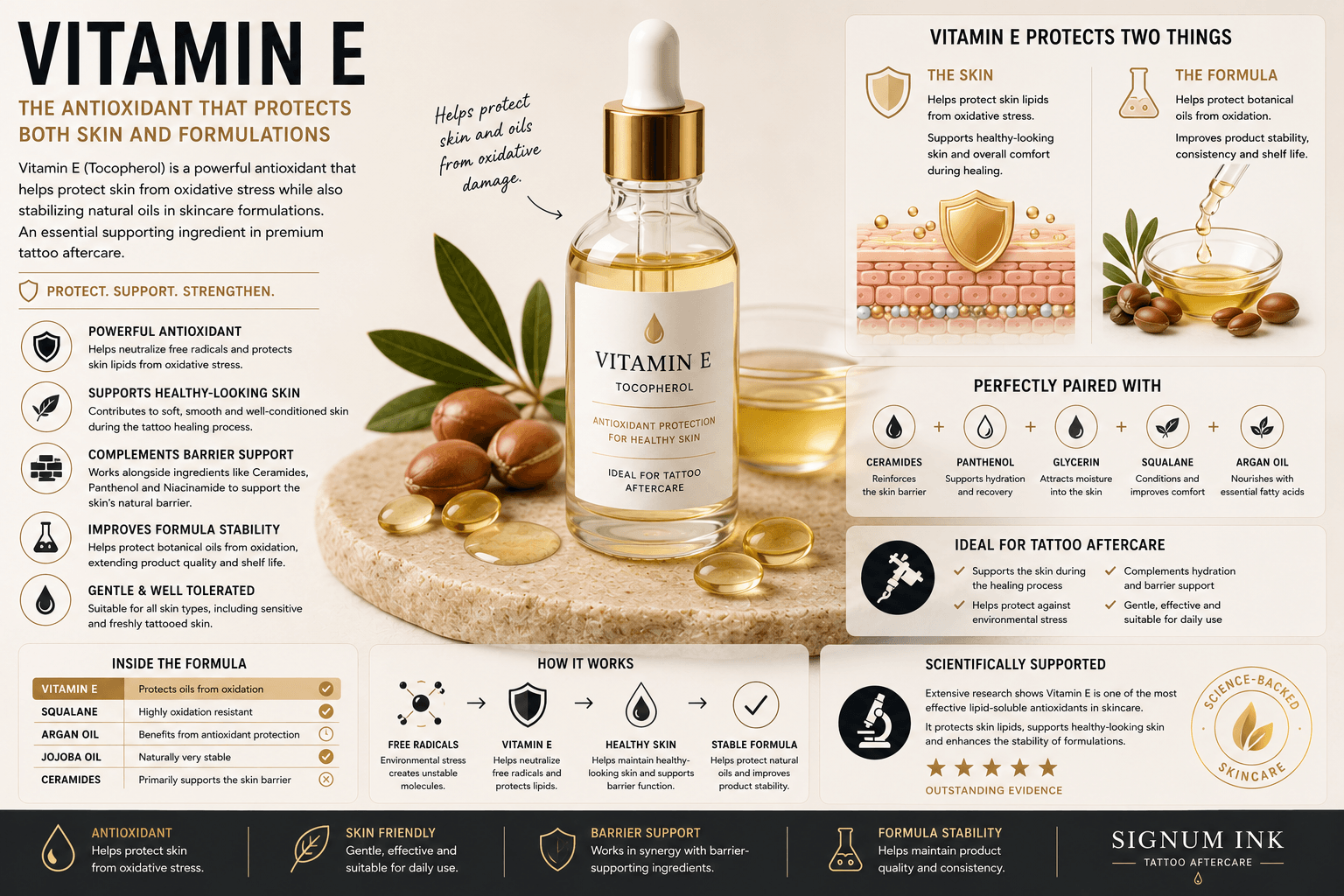
Few skincare ingredients have earned as much recognition as Vitamin E.
For decades, it has been included in moisturizers, recovery creams, facial oils, and barrier-focused skincare because of its remarkable antioxidant properties and excellent skin compatibility.
Unlike humectants that attract moisture or lipids that reinforce the skin barrier, Vitamin E primarily helps protect both the skin and the formulation itself from oxidative damage.
This dual role makes it one of the most valuable supporting ingredients in modern skincare.
Freshly tattooed skin is temporarily more vulnerable while its natural barrier recovers.
During this period, maintaining hydration, supporting the barrier, and protecting the skin from environmental stress all contribute to healthy-looking healing.
Within this strategy, Vitamin E complements ingredients such as Ceramides, Panthenol, Glycerin, Squalane, and Argan Oil, creating balanced formulations designed for long-term skin comfort.
At the same time, Vitamin E helps stabilize delicate botanical oils, making it one of the most important formulation ingredients used in premium recovery creams.
Quick Facts
Ingredient Type
Antioxidant (Vitamin)
Primary Benefits
Antioxidant Protection • Skin Conditioning • Formula Stability
Best For
Fresh Tattoos • Dry Skin • Sensitive Skin • Daily Moisturising
Found In
Recovery Creams • Facial Oils • Moisturisers • Barrier Creams • Tattoo Aftercare
Suitable For
All Skin Types
Typical Cosmetic Concentration
0.2–2%
Pairs Well With
Argan Oil • Squalane • Jojoba Oil • Ceramides • Panthenol • Glycerin
Scientific Support
★★★★★ Outstanding
Did You Know?
Vitamin E is actually a family of compounds. In skincare, the most common form is Alpha-Tocopherol, although Tocopheryl Acetate is also widely used because of its excellent stability in cosmetic formulations.
What Is Vitamin E?
Vitamin E is a group of naturally occurring fat-soluble compounds known as tocopherols and tocotrienols.
In skincare, the two forms most commonly used are:
- Alpha-Tocopherol – the biologically active form found naturally in the skin.
- Tocopheryl Acetate – a stabilized form widely used in cosmetic products.
Both forms contribute antioxidant protection, although they differ slightly in formulation characteristics.
Vitamin E naturally occurs in many botanical oils, including:
- Argan Oil
- Sunflower Oil
- Wheat Germ Oil
- Almond Oil
- Avocado Oil
Because of its antioxidant activity, Vitamin E helps protect both skin lipids and cosmetic oils from oxidation.
How Does Vitamin E Work?
Every day, the skin is exposed to oxidative stress caused by factors such as UV radiation, pollution, and normal cellular metabolism.
These processes generate molecules known as free radicals.
Free radicals are unstable molecules that can damage lipids, proteins, and other cellular structures if left unchecked.
Vitamin E functions as an antioxidant.
It helps neutralize free radicals before they can contribute to oxidative damage.
In cosmetic skincare, Vitamin E contributes by helping:
- Protect skin lipids.
- Support healthy-looking skin.
- Complement barrier-supporting ingredients.
- Improve formulation stability.
- Protect delicate botanical oils from oxidation.
Its dual function explains why it remains one of the most respected supporting ingredients in premium skincare.
Why Fresh Tattoos Benefit from Vitamin E
Tattoo healing places increased demands on the skin barrier.
While hydration and barrier support remain the highest priorities, antioxidant protection also plays an important supporting role.
Vitamin E contributes by complementing ingredients responsible for hydration and moisture retention.
Professional tattoo aftercare formulations often combine Vitamin E with:
- Ceramides — to reinforce the skin barrier.
- Panthenol — to support hydration and barrier function.
- Glycerin — to attract moisture.
- Squalane — to improve skin comfort.
- Argan Oil — to provide essential fatty acids and naturally occurring antioxidants.
- Jojoba Oil — to support surface lipids.
Together these ingredients create balanced formulations designed to support healthy-looking skin throughout the healing process.
Why Vitamin E Has Remained a Skincare Favourite for Decades
Unlike many trending skincare ingredients, Vitamin E has remained popular because its benefits are supported by both cosmetic science and dermatological research.
Powerful Antioxidant
Vitamin E helps protect skin lipids against oxidative stress.
Excellent Skin Compatibility
It is well tolerated by most skin types and is suitable for long-term daily use.
Protects Cosmetic Oils
Professional formulators frequently add Vitamin E to products containing botanical oils because it helps slow oxidation and improves shelf stability.
Works Beautifully with Other Active Ingredients
Vitamin E is commonly combined with:
- Ceramides
- Panthenol
- Glycerin
- Squalane
- Argan Oil
- Jojoba Oil
- Niacinamide
- Beta-Glucan
Rather than replacing these ingredients, it enhances the overall formulation.
Why Professional Formulators Continue Choosing Vitamin E
Vitamin E is one of the few skincare ingredients that benefits both the user and the product itself.
It helps support healthy-looking skin while simultaneously protecting sensitive oils from oxidative degradation.
For tattoo aftercare, this makes Vitamin E an excellent supporting ingredient in premium recovery creams.
Rather than functioning as a stand-alone active, it complements hydration, barrier support, and skin conditioning while helping maintain the quality and stability of the formulation throughout its shelf life.
Vitamin E in Recovery Cream: Antioxidant Protection for Healing Skin
A premium recovery cream should do more than simply moisturize the skin.
Following a tattoo session, the skin’s protective barrier is temporarily weakened, making it more vulnerable to moisture loss and everyday environmental stress.
While ingredients such as Glycerin attract water and Ceramides reinforce the skin barrier, Vitamin E provides antioxidant support that complements these hydration-focused ingredients.
Its primary role is not to increase hydration directly.
Instead, Vitamin E helps protect the skin’s natural lipids while contributing to a healthy environment for barrier recovery.
Because it is oil-soluble, Vitamin E blends naturally with botanical oils and emollients, making it particularly valuable in recovery creams.
Professional tattoo aftercare formulations frequently combine Vitamin E with:
- Ceramides to reinforce the skin barrier.
- Panthenol to support hydration and skin conditioning.
- Glycerin to attract moisture.
- Squalane to improve skin comfort.
- Argan Oil to provide nourishing fatty acids.
- Jojoba Oil to support the skin’s surface lipids.
Rather than replacing these ingredients, Vitamin E helps create a more complete formulation designed to support healthy-looking skin throughout the healing process.
Vitamin E in Tattoo Foam Soap
Foam cleansers remain on the skin for only a short time.
For this reason, antioxidant ingredients generally have less opportunity to provide their full cosmetic benefits than they do in leave-on products.
Nevertheless, some premium tattoo foam soaps include Vitamin E to complement mild cleansing systems and contribute to overall skin conditioning.
Its presence may also help improve the stability of botanical oils included in the formulation.
After cleansing, the skin is prepared for the application of a recovery cream, where Vitamin E can continue supporting the overall skincare routine.
What Does the Research Say?
Vitamin E has been studied extensively in both dermatology and cosmetic science.
Research demonstrates that Vitamin E is one of the skin’s primary lipid-soluble antioxidants.
Healthy skin naturally contains Vitamin E within its outer lipid layers, where it helps protect skin lipids from oxidative damage caused by environmental stress.
Topical Vitamin E has been investigated for its ability to:
- Support the skin’s natural antioxidant defenses.
- Help protect skin lipids from oxidative stress.
- Improve skin conditioning.
- Complement barrier-supporting skincare.
- Enhance the stability of cosmetic formulations containing botanical oils.
Although Vitamin E is not a replacement for humectants or barrier lipids, its antioxidant activity makes it an important supporting ingredient in modern skincare.
Why Vitamin E Helps Protect the Formula
One aspect of Vitamin E is often overlooked by consumers.
Professional formulators frequently add Tocopherol (Vitamin E) to formulations containing botanical oils because it helps reduce oxidation.
Many natural oils gradually react with oxygen during storage.
This process can affect product quality over time.
Vitamin E helps slow this process by protecting sensitive lipids from oxidative degradation.
As a result, it contributes to:
- Improved formulation stability.
- Better preservation of botanical oils.
- Longer product quality during normal shelf life.
- Consistent sensory performance.
This dual function—protecting both the skin and the formulation—is one reason Vitamin E remains indispensable in premium skincare.
Research Snapshot
| Research Area | Evidence |
|---|---|
| Antioxidant Activity | ★★★★★ |
| Skin Conditioning | ★★★★★ |
| Cosmetic Stability | ★★★★★ |
| Barrier Support | ★★★★☆ |
| Sensitive Skin | ★★★★☆ |
| Tattoo Aftercare | ★★★☆☆* |
*Direct clinical studies investigating Vitamin E specifically in tattoo aftercare remain limited. Most available evidence relates to antioxidant protection, skin conditioning, and formulation stability.
Vitamin E Compared with Other Antioxidants
Modern skincare contains several antioxidant ingredients.
Each performs a different role.
Vitamin E vs. Vitamin C
These vitamins are often used together because they complement one another.
Vitamin C is water-soluble.
Vitamin E is oil-soluble.
Together they help protect different parts of the skin from oxidative stress.
Vitamin E vs. Squalane
Although both are oil-soluble ingredients, they perform different functions.
Squalane primarily conditions the skin and helps reduce moisture loss.
Vitamin E provides antioxidant protection while also helping stabilize oils within the formulation.
Vitamin E vs. Niacinamide
Both ingredients are widely respected in modern skincare.
Niacinamide supports the skin’s biological barrier processes.
Vitamin E contributes antioxidant protection.
Together they create complementary barrier-focused formulations.
Vitamin E vs. Coenzyme Q10
Both ingredients function as antioxidants.
Vitamin E has a much longer history of use in cosmetic formulations and is particularly valuable for protecting skin lipids and botanical oils.
Coenzyme Q10 is often included as an additional antioxidant in advanced formulations.
Why Vitamin E Has Remained Essential in Modern Skincare
Some ingredients become popular because of marketing.
Vitamin E remains popular because it consistently performs.
Professional formulators continue choosing Vitamin E because it offers:
- Excellent antioxidant protection.
- Outstanding skin compatibility.
- Natural synergy with botanical oils.
- Improved formulation stability.
- Broad compatibility with modern skincare actives.
These qualities explain why Vitamin E remains one of the most widely used supporting ingredients in premium moisturizers, recovery creams, and tattoo aftercare products.
Ingredient Classification
| Property | Classification |
|---|---|
| Origin | Naturally occurring fat-soluble vitamin |
| Chemical Family | Tocopherols / Tocotrienols |
| Primary Function | Antioxidant |
| Water Soluble | ❌ No |
| Oil Soluble | ✅ Yes |
| Skin Barrier Role | Protects lipid components from oxidation |
| Scientific Support | ★★★★★ Outstanding |
Frequently Asked Questions About Vitamin E
What is Vitamin E?
Vitamin E is a group of naturally occurring fat-soluble compounds known as tocopherols and tocotrienols.
In skincare, the most commonly used forms are Alpha-Tocopherol and Tocopheryl Acetate, both valued for their antioxidant properties and excellent skin compatibility.
Why is Vitamin E used in tattoo aftercare?
Fresh tattoos temporarily weaken the skin’s protective barrier.
Vitamin E helps protect skin lipids from oxidative stress while complementing ingredients responsible for hydration, barrier support, and skin conditioning.
Its antioxidant role makes it an excellent supporting ingredient in recovery creams.
Is Vitamin E an antioxidant?
Yes.
Vitamin E is considered one of the skin’s primary lipid-soluble antioxidants.
It helps neutralize free radicals that can contribute to oxidative stress in the skin.
Does Vitamin E moisturize the skin?
Not directly.
Unlike Glycerin, which attracts water, or Squalane, which conditions the skin, Vitamin E primarily supports skin health through its antioxidant activity.
However, because it is oil-soluble, it also contributes to a softer, smoother skin feel.
What is the difference between Tocopherol and Tocopheryl Acetate?
Both are forms of Vitamin E used in skincare.
- Tocopherol is the naturally active form and is commonly used to protect both the skin and cosmetic oils from oxidation.
- Tocopheryl Acetate is a more stable derivative that is converted into active Vitamin E within the skin over time.
Both are widely used in modern skincare formulations.
Is Vitamin E suitable for sensitive skin?
Generally, yes.
Vitamin E is well tolerated by most skin types and is commonly included in products designed for dry, sensitive, and compromised skin.
As with any cosmetic ingredient, individual sensitivities may occur, so patch testing is advisable when trying a new product.
Why is Vitamin E added to botanical oils?
Professional formulators often include Vitamin E (Tocopherol) because it helps slow the oxidation of delicate plant oils.
This helps maintain product quality, stability, and shelf life.
Can Vitamin E be combined with other skincare ingredients?
Absolutely.
Vitamin E works particularly well with:
- Ceramides
- Panthenol
- Glycerin
- Squalane
- Argan Oil
- Jojoba Oil
- Niacinamide
- Beta-Glucan
Its excellent compatibility makes it one of the most versatile supporting ingredients in skincare.
Is more Vitamin E always better?
No.
Professional formulations use carefully balanced concentrations.
Higher amounts do not necessarily improve performance and may affect the texture or stability of the finished product.
A well-balanced formulation is more important than maximizing the concentration of a single ingredient.
Why do formulators continue using Vitamin E?
Professional formulators value Vitamin E because it:
- Supports healthy-looking skin.
- Provides antioxidant protection.
- Helps stabilize botanical oils.
- Works with almost every major skincare ingredient.
- Improves both formulation quality and long-term product performance.
Common Myths About Vitamin E
Myth 1: Vitamin E is only added to moisturize the skin.
Reality:
Although Vitamin E contributes to skin conditioning, its primary cosmetic role is antioxidant protection for both the skin and the formulation.
Myth 2: All forms of Vitamin E are identical.
Reality:
Different forms of Vitamin E have different formulation characteristics.
Tocopherol and Tocopheryl Acetate are the two most commonly used forms in cosmetic skincare.
Myth 3: Vitamin E works best alone.
Reality:
Professional formulations combine Vitamin E with humectants, barrier lipids, botanical oils, and other antioxidants to create balanced skincare products.
Myth 4: Vitamin E is only useful in facial skincare.
Reality:
Any skin that benefits from hydration, barrier support, and antioxidant protection—including freshly tattooed skin—may benefit from formulations containing Vitamin E.
Research Snapshot
| Research Area | Evidence |
|---|---|
| Antioxidant Protection | ★★★★★ |
| Skin Conditioning | ★★★★★ |
| Cosmetic Stability | ★★★★★ |
| Sensitive Skin | ★★★★☆ |
| Barrier Support | ★★★★☆ |
| Tattoo Aftercare | ★★★☆☆* |
*Most published evidence relates to antioxidant protection, cosmetic dermatology, and formulation stability. Dedicated tattoo-specific clinical studies remain limited.
Level of Evidence
| Evidence Source | Strength |
|---|---|
| Skin Biology | ★★★★★ |
| Cosmetic Science | ★★★★★ |
| Clinical Dermatology | ★★★★☆ |
| Traditional Use | ★★★★★ |
| Tattoo-Specific Studies | ★★☆☆☆ |
Why this matters:
Vitamin E is one of the longest-established ingredients in skincare. Its antioxidant activity, excellent skin compatibility, and role in protecting both skin lipids and cosmetic oils are supported by decades of dermatological and cosmetic research.
Ingredient Classification
| Property | Classification |
|---|---|
| Origin | Naturally occurring fat-soluble vitamin |
| Chemical Family | Tocopherols / Tocotrienols |
| Primary Function | Antioxidant |
| Water Soluble | ❌ No |
| Oil Soluble | ✅ Yes |
| Skin Barrier Role | Helps protect skin lipids from oxidative stress |
| Scientific Support | ★★★★★ Outstanding |
How It Works in a Formula
| Role | Function |
|---|---|
| Humectant | ❌ |
| Emollient | ⚪ Mild |
| Occlusive | ❌ |
| Antioxidant | ✅ Primary |
| Barrier Support | ✅ Complementary |
| Formula Stabilizer | ✅ Primary |
Formulation Insight:
Vitamin E serves two important purposes. It helps protect the skin’s lipids from oxidative stress while also helping stabilize delicate botanical oils within the formulation. This dual role makes it one of the most valuable supporting ingredients in premium recovery creams.
Ingredient Performance Snapshot
| Category | Rating |
|---|---|
| Antioxidant Activity | ⭐⭐⭐⭐⭐ |
| Formula Stability | ⭐⭐⭐⭐⭐ |
| Skin Compatibility | ⭐⭐⭐⭐⭐ |
| Sensitive Skin | ⭐⭐⭐⭐☆ |
| Formulation Versatility | ⭐⭐⭐⭐⭐ |
| Scientific Evidence | ⭐⭐⭐⭐⭐ |
Why Formulators Choose Vitamin E
| Formulation Benefit | Why It Matters |
|---|---|
| Powerful antioxidant | Helps protect skin lipids and botanical oils from oxidation. |
| Excellent compatibility | Blends seamlessly with oils, butters, and active ingredients. |
| Formula stability | Helps maintain product quality throughout shelf life. |
| Skin conditioning | Contributes to a smoother, more comfortable skin feel. |
| Trusted ingredient | One of the most established antioxidants in modern skincare. |
Formulator’s Perspective
Vitamin E is one of those rare ingredients that benefits both the user and the product itself.
From a formulation perspective, it helps slow the oxidation of delicate botanical oils, contributing to product stability and consistency. From a skincare perspective, it provides antioxidant support that complements hydration and barrier-focused ingredients such as Ceramides, Panthenol, Glycerin, Squalane, and Argan Oil.
This combination of biological and formulation benefits explains why Vitamin E has remained a cornerstone of premium skincare for decades.
Expert Tip
The best recovery creams combine multiple protective systems.
Humectants such as Glycerin attract moisture, Ceramides reinforce the barrier, Squalane conditions the skin, and Vitamin E helps protect both the skin and the formulation from oxidative stress.
Together, these ingredients create a balanced approach to supporting healthy-looking skin throughout the tattoo healing process.
Ingredient Synergy
| Combines Especially Well With | Why |
|---|---|
| Argan Oil | Helps protect this nutrient-rich botanical oil from oxidation while complementing its skin-conditioning properties. |
| Jojoba Oil | Enhances overall lipid stability and contributes to a smooth skin feel. |
| Squalane | Combines excellent stability with antioxidant support for elegant formulations. |
| Ceramides | Ceramides reinforce the barrier while Vitamin E helps protect lipid components. |
| Panthenol | Supports hydration while Vitamin E contributes antioxidant protection. |
| Glycerin | Glycerin hydrates; Vitamin E helps protect the skin’s lipid environment. |
Ingredient Verdict
| Category | Rating |
|---|---|
| Overall Rating | ⭐⭐⭐⭐⭐ |
| Best For | Dry skin, fresh tattoos, antioxidant-rich recovery creams |
| Scientific Confidence | Outstanding |
| Formulator Recommendation | Essential supporting antioxidant for premium formulations |
| Works Best With | Ceramides, Panthenol, Glycerin, Argan Oil, Squalane |
Final Thoughts
Vitamin E has remained one of the most trusted ingredients in skincare because it performs two essential roles exceptionally well. As a powerful lipid-soluble antioxidant, it helps protect the skin from oxidative stress while also preserving the quality of delicate botanical oils within a formulation.
For tattoo aftercare, Vitamin E is most effective as part of a carefully balanced recovery cream. It complements humectants, barrier-supporting lipids, and emollients to create products that help maintain hydration, reinforce the skin’s protective barrier, and support healthy-looking skin throughout the healing process.
Rather than serving as a stand-alone hero ingredient, Vitamin E demonstrates one of the key principles of modern formulation science: the strongest skincare products are built from ingredients that work together, each contributing a specific role to the overall performance of the formula.
 English
  German
  Dutch
Dutch  Danish
  Swedish
  French
  Italian