After getting a tattoo, most people expect some redness, peeling, and itching.
But what happens when small scabs begin to appear?
For many first-time tattoo owners, this can be worrying.
“Is my tattoo healing properly?”
“Should a tattoo scab at all?”
“Will the scabs pull out the ink?”
The answer is more nuanced than many people realize.
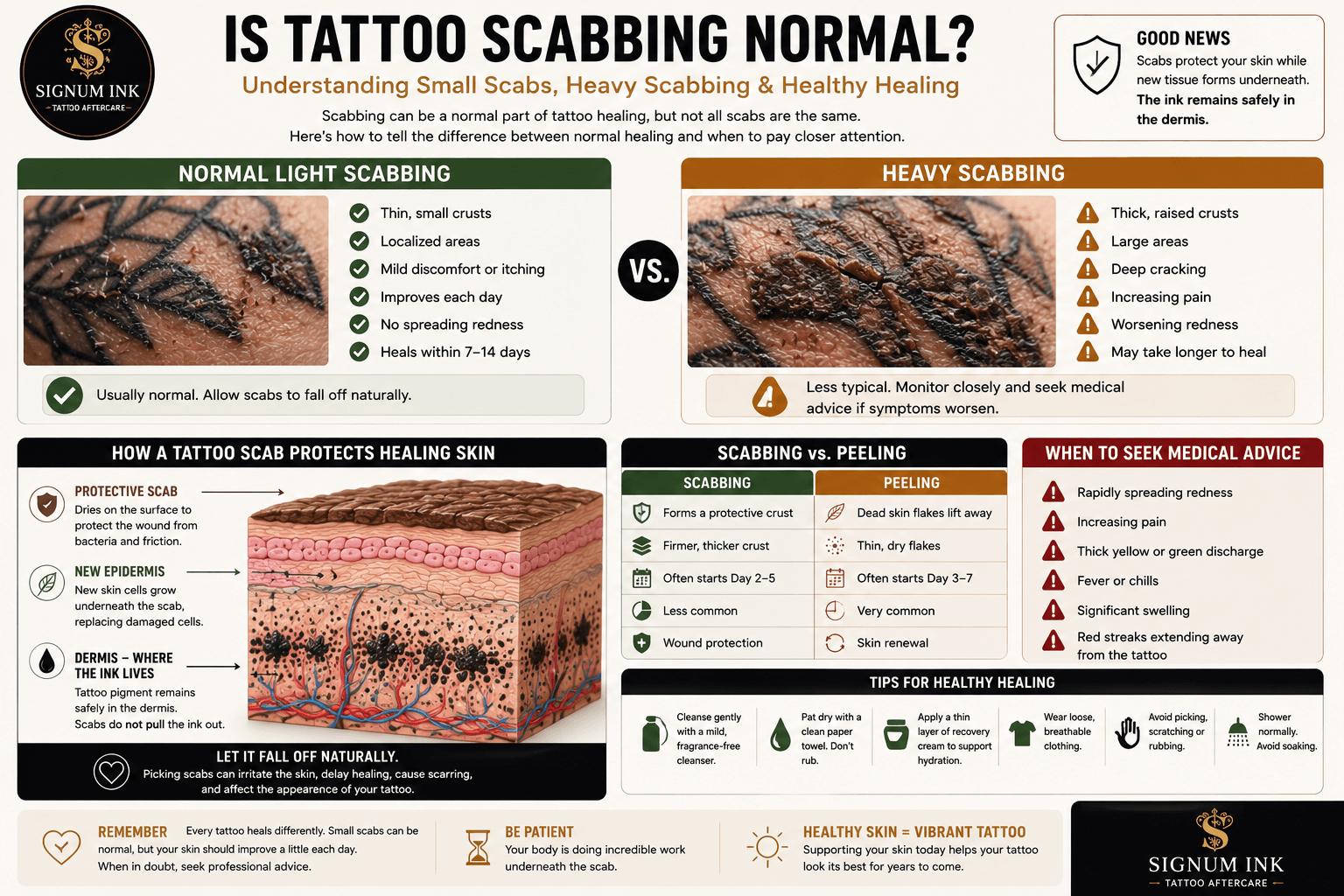
Light scabbing can be a normal part of tattoo healing, particularly in areas where the skin experienced more trauma during the tattoo session.
However, heavy, thick scabbing is generally less typical and may suggest that the skin has experienced more extensive injury or that the healing environment has been less than ideal.
Understanding the difference between normal light scabbing and excessive scabbing helps you support your skin while avoiding unnecessary worry.
Quick Answer
Is tattoo scabbing normal?
Yes—but usually only light scabbing.
Small, thin scabs may develop on parts of a fresh tattoo, especially after larger tattoos, heavy shading, or solid colour work.
Large, thick, raised scabs are less common and may deserve closer attention, particularly if they are accompanied by increasing pain, worsening redness, swelling, or discharge.
Quick Facts
Light Scabbing
✅ Can be normal
Heavy Thick Scabbing
⚠️ Less typical
Usually Begins
Days 2–5
Typically Resolves
Within 1–2 weeks
Never Do
❌ Pick or pull off scabs
What Is a Scab?
A scab is the body’s natural protective covering that forms over a wound.
It develops when blood, plasma, and proteins dry on the skin’s surface.
The purpose of a scab is to:
- Protect healing tissue.
- Reduce the risk of contamination.
- Provide a temporary barrier while new skin forms underneath.
Tattooing creates thousands of microscopic wounds.
Because these wounds are very small, many tattoos heal with only minimal scabbing—or none that is particularly noticeable.
Why Do Some Tattoos Develop Scabs?
Every tattoo is different.
Several factors influence how much scabbing occurs.
Tattoo Technique
Some areas of a tattoo require more needle passes than others.
Heavy shading, colour packing, and solid black work may create more temporary skin trauma than fine-line tattoos.
This can increase the likelihood of small scabs forming.
Tattoo Size
Larger tattoos naturally affect more skin.
The greater the treated area, the more healing activity occurs, making light scabbing somewhat more likely.
Body Location
Areas exposed to constant movement or friction often experience more mechanical stress during healing.
Examples include:
- Elbows
- Knees
- Ankles
- Feet
- Hands
- Ribs
These areas may develop slightly more visible scabbing than regions that remain relatively still.
Individual Healing Response
Everyone heals differently.
Some people experience almost no visible scabbing.
Others naturally produce slightly more protective crusting while the skin repairs itself.
Neither pattern automatically indicates a problem.
What Happens Beneath the Scab?
Although the scab is visible on the surface, the real healing takes place underneath.
Several important biological processes continue at the same time.
New Skin Cells Form
Fresh epidermal cells gradually migrate upward beneath the scab.
Once the new surface is ready, the scab naturally loosens and falls away.
Collagen Repair Continues
Within the dermis, fibroblasts continue producing and organizing collagen.
This strengthens the skin while the tattoo stabilizes.
The Skin Barrier Rebuilds
The protective barrier gradually restores its natural structure.
As this happens:
- Moisture retention improves.
- Sensitivity decreases.
- Water loss slows.
- The skin becomes more resilient.
Why You Should Never Pick a Tattoo Scab
One of the biggest mistakes during healing is removing a scab before it is ready to separate naturally.
A scab protects delicate tissue underneath.
Picking it away prematurely may:
- Delay healing.
- Cause unnecessary bleeding.
- Increase irritation.
- Raise the risk of introducing bacteria.
- Potentially affect the even appearance of the healed tattoo.
Allow your body to decide when the scab is ready to detach.
Does Every Tattoo Scab?
No.
Many tattoos heal with very little visible scabbing.
Instead, they move directly into the peeling phase, where thin flakes of dead skin gradually separate from the surface.
This is why people often confuse peeling with scabbing.
Although both are part of healing, they represent different biological processes.
Scabbing vs. Peeling
Understanding the distinction is important.
| Peeling | Scabbing |
|---|---|
| Dead surface skin lifting away | Protective crust formed from dried plasma and blood |
| Thin flakes | Firmer crust |
| Usually starts Day 3–7 | Often begins Day 2–5 |
| Very common | Less common |
| Indicates skin renewal | Indicates wound protection |
Both can occur during healing, but peeling is generally more common than noticeable scabbing.
Supporting Healthy Healing
The goal is not to prevent scabs from forming.
Instead, focus on creating conditions that allow the skin to heal naturally.
Helpful habits include:
- Gently cleansing the tattoo.
- Patting the skin dry.
- Applying a thin layer of recovery cream.
- Avoiding friction.
- Wearing loose clothing.
- Allowing scabs to detach naturally.
Supporting the skin barrier helps maintain comfortable healing while reducing unnecessary irritation.
Light Scabbing vs. Heavy Scabbing
Not all tattoo scabs are the same.
Some tattoos develop only a few small, thin scabs.
Others may form larger or thicker crusts.
Understanding the difference helps you know what is generally expected during healing.
Light Scabbing
Light scabbing is often considered a normal part of tattoo healing.
It typically appears as:
- Small, thin crusts.
- Localized areas.
- Minimal discomfort.
- Gradual improvement each day.
Once new skin has formed underneath, these small scabs naturally loosen and fall away.
Heavy Scabbing
Heavy scabbing is generally less common.
It may involve:
- Thick, raised crusts.
- Large sections of the tattoo.
- Deep cracking.
- Increased discomfort.
Heavy scabbing does not automatically mean something is wrong, but it deserves closer observation—especially if it is accompanied by increasing redness, swelling, pain, discharge, or other concerning symptoms.
Can Tattoo Scabs Pull Out Ink?
This is one of the most common concerns during healing.
The reassuring answer is:
Normally, no.
Tattoo pigment is deposited within the dermis, well below the surface where the scab forms.
A healthy scab protects the healing skin while the pigment remains deeper in the tissue.
However, if a scab is picked off prematurely, it may interrupt the normal healing process and could potentially affect the appearance of the healed tattoo.
For this reason, it is always best to allow scabs to detach naturally.
Scabbing vs. Infection
A scab alone is not a sign of infection.
Many tattoos develop small protective crusts without any complications.
The important question is how the tattoo changes over time.
Normal Healing
Usually includes:
- Thin or small scabs.
- Gradually improving redness.
- Mild tenderness.
- No fever.
- No spreading redness.
- Healthy skin developing underneath.
Symptoms That Need Medical Assessment
Prompt medical evaluation is appropriate if scabbing is accompanied by:
- Rapidly spreading redness.
- Increasing pain.
- Thick yellow or green discharge.
- Fever or chills.
- Significant swelling.
- Red streaks extending away from the tattoo.
- A foul odor coming from the wound.
These symptoms do not automatically confirm an infection, but they are not typical of uncomplicated tattoo healing and should be assessed by a healthcare professional.
Why Do Some Areas Scab More Than Others?
Different sections of the same tattoo may heal differently.
Several factors can influence this.
More Needle Passes
Areas with dense shading or solid colour often require repeated needle passes.
This creates more temporary skin trauma and may increase the likelihood of light scabbing.
Movement
Skin that bends frequently experiences more mechanical stress.
This includes tattoos on:
- Elbows.
- Knees.
- Fingers.
- Ankles.
- Wrists.
Repeated movement can sometimes delay the natural separation of small scabs.
Friction
Tight clothing or repeated rubbing may further irritate healing skin.
Reducing unnecessary friction supports a healthier healing environment.
What Does the Research Say?
Scab formation is a normal part of wound healing.
Following skin injury, platelets and clotting proteins help seal damaged blood vessels while dried plasma forms a temporary protective covering over the wound.
Scientific studies on wound healing show that this protective layer helps shield newly forming tissue while epidermal regeneration continues underneath.
As healing progresses:
- New skin cells migrate beneath the scab.
- Collagen continues reorganizing.
- The skin barrier gradually recovers.
- The scab naturally detaches when it is no longer needed.
This controlled process explains why prematurely removing a scab may interfere with normal healing.
How Modern Tattoo Aftercare Supports Healing
Modern tattoo aftercare does not attempt to prevent every scab from forming.
Instead, it focuses on supporting healthy skin while natural healing progresses.
A balanced routine includes:
- Gentle cleansing.
- Maintaining comfortable hydration.
- Supporting the skin barrier.
- Avoiding unnecessary irritation.
- Allowing the body to complete the healing process naturally.
Rather than forcing the scab off, the goal is to create an environment where it can separate on its own.
Common Mistakes That Make Scabbing Worse
Many problems arise not because the tattoo was done incorrectly, but because healing skin is unintentionally disturbed.
Common mistakes include:
Picking Scabs
Removing a scab too early exposes delicate new skin and may delay healing.
Scratching
Itching is common during healing, but scratching may loosen protective scabs before the skin is ready.
Overwashing
Excessive washing can dry the skin and increase irritation.
Using Harsh Soaps
Strong cleansers may disrupt the rebuilding skin barrier.
Tight Clothing
Repeated rubbing may prolong irritation and increase mechanical stress on healing skin.
Ignoring Hydration
Healthy hydration supports the skin barrier and helps maintain flexibility while healing continues.
Research Snapshot
| Research Area | Evidence |
|---|---|
| Wound Healing Biology | ★★★★★ |
| Skin Barrier Recovery | ★★★★★ |
| Epidermal Regeneration | ★★★★★ |
| Tattoo Aftercare | ★★★★☆ |
| Scab Formation | ★★★★★ |
| Tattoo-Specific Scabbing Studies | ★★★☆☆ |
Frequently Asked Questions About Tattoo Scabbing
Is it normal for a tattoo to scab?
Yes.
Small, thin scabs can be a normal part of tattoo healing, especially after larger tattoos, heavy shading, or areas that required multiple needle passes.
Many tattoos develop only very light scabbing—or none that is particularly noticeable.

How long do tattoo scabs last?
Most light scabs begin forming between Days 2 and 5.
They usually loosen and fall away naturally within 7–14 days, depending on the size and location of the tattoo and your individual healing response.
Can tattoo scabs remove the ink?
Normally, no.
Tattoo pigment is stored within the dermis, while scabs form on the surface of the skin.
When a scab falls off naturally, the ink remains in place beneath the healed epidermis.
What happens if I accidentally pick a scab?
Picking a scab too early may interrupt the healing process.
It can:
- Irritate newly formed skin.
- Delay healing.
- Increase the risk of introducing bacteria.
- Cause unnecessary bleeding.
- Potentially affect the even appearance of the healed tattoo.
If you accidentally catch a small scab on clothing or bedding, don’t panic. Simply keep the area clean and continue following your normal aftercare routine. If you notice increasing redness, pain, swelling, or other concerning symptoms afterward, seek medical advice.
Why are only certain parts of my tattoo scabbing?
Different areas often receive different amounts of tattooing.
Sections with:
- Heavy shading.
- Solid black.
- Dense colour packing.
may develop slightly more noticeable scabbing than fine-line sections.
This variation is generally normal.
Is thick scabbing normal?
Heavy, thick scabbing is generally less typical than light scabbing.
Although it does not automatically indicate a problem, it deserves closer attention—particularly if it is accompanied by increasing redness, swelling, severe pain, discharge, or fever.
Does moisturizing prevent scabs?
No.
The purpose of moisturizer is not to eliminate scab formation.
Instead, it helps maintain hydration and supports the skin barrier while natural healing continues.
Even well-moisturized tattoos may develop small protective scabs.
Can showering make scabs come off?
Normal showering with lukewarm water is unlikely to harm a healing tattoo.
Avoid:
- Very hot water.
- Long soaking sessions.
- Scrubbing with a washcloth.
- Picking softened scabs after showering.
Pat the tattoo dry gently with a clean towel.
Should I cover a scabbing tattoo?
Once the initial protective dressing has been removed according to your tattoo artist’s instructions, most tattoos benefit from being kept clean and protected without routine re-covering.
Unless advised otherwise by your tattoo artist or healthcare professional, allowing the skin to breathe while protecting it from unnecessary friction is generally sufficient.
When should I contact a healthcare professional?
Seek prompt medical assessment if you notice:
- Rapidly spreading redness.
- Increasing pain after the first few days.
- Thick yellow or green discharge.
- Fever or chills.
- Red streaks extending away from the tattoo.
- Significant swelling that worsens.
- Large, painful scabs associated with worsening symptoms.
These findings are not typical of uncomplicated tattoo healing and should be professionally evaluated.
Common Myths About Tattoo Scabbing
Myth 1: Every tattoo should develop thick scabs.
Reality:
Many tattoos heal with very little visible scabbing.
Light peeling is generally more common than heavy scab formation.
Myth 2: Picking a scab helps the tattoo heal faster.
Reality:
Scabs protect the delicate tissue underneath.
Removing them too early may delay healing and increase the risk of skin damage.
Myth 3: Scabs contain the tattoo ink.
Reality:
The pigment remains in the dermis.
The scab forms on the surface and protects the healing skin above the tattoo pigment.
Myth 4: Thick scabs always mean the tattoo is ruined.
Reality:
Not necessarily.
Some tattoos simply experience more surface trauma than others.
What matters most is whether healing gradually improves over time or whether concerning symptoms develop.
Healing Timeline
| Time After Tattoo | Typical Changes |
|---|---|
| Day 1 | Redness, mild swelling, plasma leakage |
| Days 2–5 | Light scabbing may begin |
| Days 3–7 | Peeling often starts |
| Week 2 | Most light scabs naturally detach |
| Weeks 3–4 | Surface healing largely complete |
| Weeks 6–8 | Deeper skin remodeling continues |
Research Snapshot
| Research Area | Evidence |
|---|---|
| Wound Healing Biology | ★★★★★ |
| Epidermal Repair | ★★★★★ |
| Skin Barrier Recovery | ★★★★★ |
| Scab Formation | ★★★★★ |
| Tattoo Aftercare | ★★★★☆ |
| Tattoo-Specific Scabbing Research | ★★★☆☆ |
Expert Tip
A healthy tattoo scab is temporary—but the skin beneath it is doing the real work.
As difficult as it can be, resist the urge to pick or scratch. Every day the scab remains undisturbed allows new skin to mature underneath, helping the healing process progress naturally.
Signs of Healthy Scabbing
✅ Small, thin scabs.
✅ Gradually improving appearance.
✅ Mild tenderness.
✅ No increasing redness.
✅ Healthy skin visible as scabs naturally loosen.
Signs That Need Medical Assessment
⚠️ Thick yellow or green discharge.
⚠️ Rapidly spreading redness.
⚠️ Fever or chills.
⚠️ Increasing swelling.
⚠️ Severe or worsening pain.
⚠️ Red streaks extending away from the tattoo.
⚠️ Scabs associated with worsening rather than improving symptoms.
These signs do not automatically mean an infection is present, but they are not typical of uncomplicated tattoo healing and should be evaluated by a healthcare professional.
Why the Skin Barrier Matters During Scabbing
Scabs protect the surface of the wound, but the skin barrier continues rebuilding underneath.
Modern tattoo aftercare supports this process by helping maintain hydration and skin comfort.
A balanced recovery cream often combines ingredients such as:
| Function | Example Ingredient |
|---|---|
| Attracts moisture | Glycerin |
| Supports barrier lipids | Ceramides |
| Barrier support | Niacinamide |
| Skin conditioning | Panthenol |
| Lightweight emollient | Squalane |
| Smooth application | Caprylic/Capric Triglyceride |
| Botanical support | Madecassoside |
| Antioxidant support | Vitamin E |
| Skin comfort | Allantoin |
Together, these ingredients help maintain a healthy environment for healing while the skin naturally repairs itself.
Final Thoughts
Seeing a scab on a new tattoo can be unsettling, but in many cases, light scabbing is simply another stage of the body’s remarkable healing process.
The scab acts as a temporary protective covering while new skin forms beneath it. As healing progresses, it naturally loosens and falls away, revealing healthy new skin while the tattoo pigment remains safely stored within the dermis.
The most important thing you can do is allow the process to unfold naturally. Avoid picking, scratching, or trying to speed up healing. Gentle cleansing, appropriate hydration, and patience give your skin the best opportunity to recover.
Understanding the difference between normal light scabbing and heavier scabbing that may require closer attention allows you to care for your tattoo with greater confidence. When you know what your skin is doing—and why—you can support healing without unnecessary worry.
 English
  German
  Dutch
Dutch  Danish
  Swedish
  French
  Italian