Getting a new tattoo is exciting—but the healing process can also raise a lot of questions.
Why is the tattoo red?
When does peeling begin?
How long will it itch?
When is it actually healed?
Many people assume a tattoo is fully healed once the surface looks normal.
In reality, healing happens in several carefully coordinated stages that continue long after the visible peeling has disappeared.
While the outer layer of skin often appears healed within 2–4 weeks, the deeper layers continue repairing themselves for several more weeks.
Understanding what happens at each stage helps you recognize normal healing, avoid common mistakes, and support your skin as it recovers.
Quick Answer
How long does tattoo healing take?
Most tattoos appear healed on the surface within 2–4 weeks.
However, the deeper layers of the skin continue remodeling for 6–8 weeks, and in some cases even longer for very large or complex tattoos.
Healing speed varies depending on:
- Tattoo size
- Tattoo placement
- Individual skin type
- Overall health
- Tattoo technique
- Aftercare routine
Quick Facts
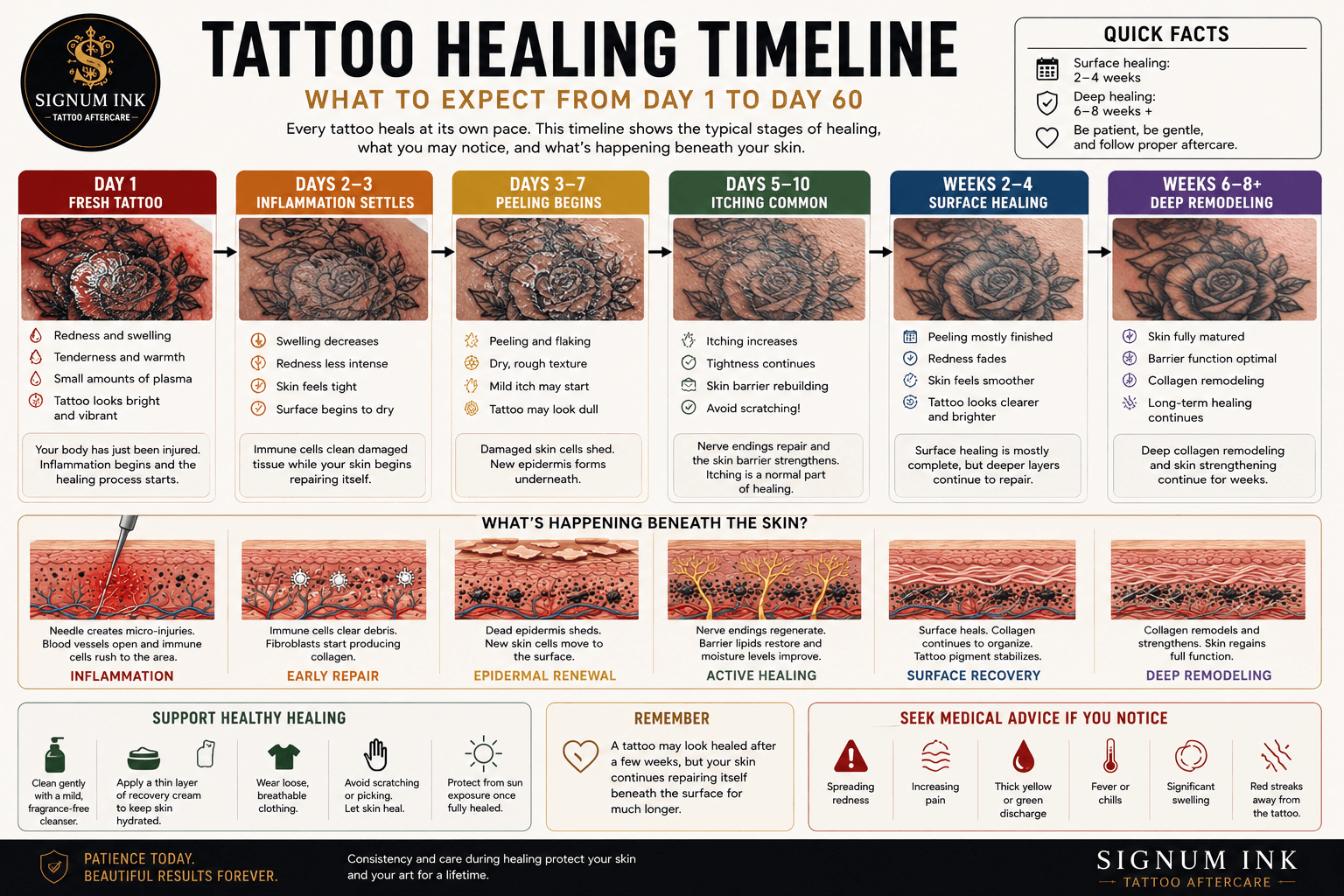
Day 1
Redness and swelling begin.
Days 2–3
Inflammation starts settling.
Days 3–7
Peeling usually begins.
Days 5–10
Itching often becomes noticeable.
Week 2
Surface healing progresses rapidly.
Weeks 3–4
Most tattoos appear healed.
Weeks 6–8
Deep skin remodeling continues.
The Four Stages of Tattoo Healing
Although healing is continuous, it is helpful to think of it as four overlapping stages.
Stage 1 – Inflammation (Days 1–3)
Immediately after tattooing, your body begins repairing thousands of microscopic needle punctures.
During this phase you may notice:
- Redness.
- Warmth.
- Mild swelling.
- Tenderness.
- Small amounts of clear plasma.
These responses are completely normal.
Inflammation is not something your body is trying to avoid—it is one of the first and most important stages of wound healing.
Blood vessels widen, immune cells move into the skin, and growth factors begin coordinating tissue repair.
What’s Happening Beneath the Skin?
Even though the tattoo may simply look red on the surface, enormous biological activity is taking place underneath.
During the first 72 hours:
- White blood cells begin cleaning damaged tissue.
- Blood vessels deliver oxygen and nutrients.
- Fibroblasts prepare for collagen production.
- The skin barrier becomes temporarily disrupted.
- Tattoo pigment settles within the dermis.
This stage lays the foundation for every step that follows.
Stage 2 – Early Repair (Days 3–7)
As inflammation begins to decrease, the body shifts toward rebuilding damaged skin.
This is when many people first notice:
- Peeling.
- Dryness.
- Tight skin.
- Mild itching.
These changes often cause unnecessary concern.
Fortunately, they are usually signs that healing is progressing normally.
Epidermal Renewal Begins
The damaged outer skin is gradually replaced.
Fresh epidermal cells move toward the surface while older damaged cells separate naturally.
This creates the familiar peeling seen on most healing tattoos.
Skin Barrier Recovery Starts
The skin barrier is still incomplete.
During this stage the tattoo loses moisture more easily through transepidermal water loss (TEWL).
Maintaining appropriate hydration helps improve comfort while the barrier continues rebuilding.
Stage 3 – Surface Healing (Week 2)
By the second week, many tattoos begin looking dramatically better.
Visible changes often include:
- Peeling slowing down.
- Less redness.
- Reduced itching.
- Smoother skin.
- Sharper tattoo appearance.
Although the tattoo may appear healed, the deeper layers of skin are still actively repairing themselves.
This is why gentle skin care remains important even after the tattoo “looks finished.”
Collagen Continues Organizing
Fibroblasts continue producing and reorganizing collagen beneath the tattoo.
This process strengthens the skin while supporting long-term tissue recovery.
Pigment Stabilization
Specialized immune cells called macrophages continue interacting with tattoo pigment.
These cells help explain why tattoo ink remains remarkably stable within the dermis over time.
Stage 4 – Deep Remodeling (Weeks 3–8)
The final stage of healing is largely invisible.
Although the tattoo often looks completely healed, biological repair continues beneath the surface.
Processes still underway include:
- Collagen remodeling.
- Barrier maturation.
- Immune regulation.
- Skin strengthening.
- Long-term moisture balance.
This gradual maturation explains why tattoos sometimes continue looking slightly brighter or clearer several weeks after peeling has ended.
Why Healing Looks Different for Everyone
No two tattoos heal exactly the same way.
Several factors influence healing speed.
Tattoo Size
Larger tattoos naturally require more tissue repair.
Tattoo Placement
Hands, feet, elbows, knees, and ribs often heal more slowly because of movement and friction.
Tattoo Style
Heavy colour packing generally creates more temporary skin trauma than fine-line tattoos.
Individual Biology
Age, genetics, skin type, circulation, hydration, and overall health all influence healing.
Supporting Healthy Healing
The goal of aftercare is not to speed up biology.
Instead, it is to create the best possible environment for your skin while it heals naturally.
A balanced routine includes:
- Gentle cleansing.
- Maintaining comfortable hydration.
- Avoiding scratching.
- Wearing breathable clothing.
- Protecting the tattoo from unnecessary irritation.
Supporting the skin barrier helps reduce discomfort while allowing the body’s remarkable healing processes to continue uninterrupted.
Day-by-Day Tattoo Healing Timeline
Every tattoo heals at its own pace, but most people experience a similar sequence of biological changes.
Understanding what typically happens each day can help you distinguish normal healing from changes that deserve closer attention.
Day 1: Fresh Tattoo
Immediately after your tattoo session, your skin begins repairing thousands of microscopic needle punctures.
You will often notice:
- Redness.
- Mild swelling.
- Warmth.
- Tenderness.
- Small amounts of clear plasma.
- Bright, vibrant tattoo colours.
These are all expected signs of the inflammatory phase of wound healing.
At this stage, your body’s priority is protecting the injured skin while beginning tissue repair.
Days 2–3: Inflammation Begins to Settle
During the next couple of days:
- Swelling gradually decreases.
- Redness often becomes less intense.
- The tattoo may feel tight.
- The surface begins drying.
- Plasma leakage usually stops.
Although the tattoo may still feel sore, many people notice that discomfort gradually improves.
Beneath the surface, immune cells continue clearing damaged tissue while fibroblasts begin producing collagen.
Days 3–5: Peeling Often Begins
This is one of the most recognizable stages of tattoo healing.
The tattoo may become:
- Dry.
- Flaky.
- Slightly dull.
- Mildly itchy.
Many first-time tattoo owners worry that the tattoo is fading.
Fortunately, the peeling skin consists only of damaged epidermal cells.
The tattoo pigment remains safely stored within the dermis.
Days 5–10: Itching Becomes More Noticeable
For many people, this is the most frustrating stage.
Peeling and itching often occur together.
Several biological processes contribute:
- New skin formation.
- Recovery of nerve endings.
- Skin barrier repair.
- Temporary moisture loss.
The urge to scratch may be strong, but allowing the skin to heal undisturbed gives the best long-term result.
Week-by-Week Healing
Although the daily changes become less dramatic after the first week, healing continues for several more weeks.
Week 2
During the second week:
- Most peeling finishes.
- Redness continues fading.
- Itching decreases.
- The tattoo appears sharper.
- The skin feels smoother.
Although the tattoo often looks healed, deeper repair continues.
Weeks 3–4
At this stage:
- Surface healing is usually complete.
- The tattoo feels comfortable.
- Skin texture becomes more normal.
- Barrier function continues improving.
Many people mistakenly believe healing is finished.
In reality, collagen remodeling is still ongoing beneath the surface.
Weeks 4–8
Most biological healing now occurs beneath the epidermis.
Processes still underway include:
- Collagen maturation.
- Skin strengthening.
- Barrier optimization.
- Pigment stabilization.
- Long-term tissue remodeling.
These changes are largely invisible but remain essential for complete recovery.
Why Tattoos Peel
Peeling often causes unnecessary concern.
However, it is simply the skin replacing damaged surface cells.
During this stage:
- Dead epidermal cells separate.
- New skin moves upward.
- The barrier continues rebuilding.
This is why peeling is generally considered one of the healthiest signs of normal tattoo healing.
Why Tattoos Itch
As the skin repairs itself, itching becomes increasingly common.
Several factors contribute:
- Healing nerve endings.
- Temporary dryness.
- Skin barrier repair.
- Regeneration of the epidermis.
Mild itching usually improves naturally as healing progresses.
What Happens to Tattoo Ink?
Many people worry that peeling or scabbing removes tattoo ink.
Fortunately, this is not how tattoo healing works.
Tattoo pigment is placed within the dermis, which lies beneath the peeling outer skin.
While tiny amounts of excess pigment may be lost from the surface during the first few days, the permanent tattoo remains below the epidermis throughout healing.
This is why peeling skin does not normally remove the tattoo itself.
What Does the Research Say?
Modern wound-healing research describes tattoo healing as a sequence of overlapping biological phases.
These include:
Inflammation
Immune cells begin cleaning damaged tissue.
Proliferation
New skin cells develop while collagen production increases.
Remodeling
The skin gradually regains strength, flexibility, and barrier function over several weeks.
Rather than occurring as separate events, these stages overlap throughout healing.
Common Healing Mistakes
Many tattoo problems arise because normal healing is interrupted.
Common mistakes include:
Picking Peeling Skin
Removing flakes too early may irritate healing tissue.
Scratching
Scratching can damage newly formed skin and increase irritation.
Using Too Much Ointment
Very thick layers may leave the skin feeling overly occluded.
A thin, even application is generally sufficient.
Overwashing
Excessive washing may disrupt the recovering skin barrier.
Tight Clothing
Repeated friction may prolong irritation, especially over joints or areas of frequent movement.
Excessive Sun Exposure
Healing skin is particularly sensitive to ultraviolet radiation.
Once fully healed, regular sunscreen use helps protect both the skin and tattoo pigments.
Research Snapshot
| Research Area | Evidence |
|---|---|
| Wound Healing Biology | ★★★★★ |
| Epidermal Regeneration | ★★★★★ |
| Skin Barrier Recovery | ★★★★★ |
| Collagen Remodeling | ★★★★★ |
| Tattoo Aftercare | ★★★★☆ |
| Tattoo Healing Research | ★★★★☆ |
Frequently Asked Questions About the Tattoo Healing Timeline
How long does it take for a tattoo to heal?
Most tattoos appear healed on the surface within 2–4 weeks.
However, deeper healing continues for approximately 6–8 weeks, and larger or more complex tattoos may take even longer to fully mature beneath the skin.
When is a tattoo no longer considered an open wound?
For most people, the skin closes during the first week of healing.
Even after the surface has closed, the deeper layers continue repairing themselves for several weeks.
This is why gentle aftercare remains important after peeling has finished.
Why does my tattoo look dull after a week?
This is completely normal.
During healing, dry skin and newly forming epidermal cells temporarily reduce the tattoo’s brightness.
Once peeling has finished and the skin barrier recovers, colours usually appear clearer and more vibrant.
Why does my tattoo still feel dry after peeling?
Although the visible peeling may be over, the skin barrier is still rebuilding.
Moisture retention gradually improves over several weeks as the epidermis continues to mature.
Keeping the skin comfortably hydrated can help improve overall skin comfort.
Can my tattoo still change after one month?
Yes.
While the artwork itself should already be visible, the surrounding skin continues to mature.
Over the following weeks you may notice:
- Smoother skin texture.
- Reduced dryness.
- Improved softness.
- Slightly clearer tattoo appearance.
These subtle changes reflect ongoing skin remodeling rather than changes to the tattoo pigment itself.
Why do some tattoos heal faster than others?
Healing speed depends on several factors, including:
- Tattoo size.
- Tattoo placement.
- Tattoo technique.
- Individual skin type.
- Age.
- Overall health.
- Daily aftercare.
Even two tattoos on the same person may heal at different speeds.
Does peeling mean my tattoo is healing correctly?
In most cases, yes.
Peeling is a natural part of epidermal renewal.
It usually indicates that damaged surface cells are being replaced by healthy new skin.
Can I exercise during tattoo healing?
Light activity is often possible, but intense exercise may increase sweating, friction, and stretching of the healing skin.
The best approach depends on the tattoo’s size, location, and how your skin is healing.
If exercise causes repeated rubbing or discomfort, allowing additional recovery time may help.
When can I swim?
Fresh tattoos should not be submerged in pools, hot tubs, lakes, rivers, or the ocean until the skin has fully healed.
Submerging a healing tattoo for prolonged periods may increase irritation and delay recovery.
If you’re unsure whether your tattoo is ready, ask your tattoo artist or healthcare professional for guidance.
When should I seek medical advice?
Seek prompt medical assessment if you experience:
- Rapidly spreading redness.
- Increasing pain.
- Thick yellow or green discharge.
- Fever or chills.
- Significant swelling.
- Red streaks extending away from the tattoo.
- Symptoms that continue worsening instead of gradually improving.
These findings are not typical of uncomplicated tattoo healing and deserve professional evaluation.
Complete Tattoo Healing Timeline
| Stage | Typical Time | What You May Notice |
|---|---|---|
| Inflammation | Days 1–3 | Redness, swelling, tenderness |
| Early Repair | Days 3–7 | Dryness, peeling, tight skin |
| Active Healing | Days 5–14 | Itching, reduced redness, smoother skin |
| Surface Recovery | Weeks 2–4 | Peeling finished, tattoo looks clearer |
| Deep Remodeling | Weeks 4–8 | Barrier maturation, collagen remodeling, long-term recovery |
Signs Your Tattoo Is Healing Normally
✅ Mild redness during the first few days.
✅ Peeling between Days 3 and 7.
✅ Mild itching during the first two weeks.
✅ Gradual improvement over time.
✅ Skin becoming smoother.
✅ Tattoo appearing clearer after peeling ends.
The most important sign of healthy healing is steady improvement rather than immediate perfection.
Signs That Need Medical Assessment
⚠️ Redness that spreads beyond the tattoo.
⚠️ Pain that becomes more severe rather than improving.
⚠️ Thick yellow or green discharge.
⚠️ Fever or chills.
⚠️ Significant swelling.
⚠️ Red streaks extending away from the tattoo.
⚠️ Symptoms that worsen instead of improving.
These symptoms do not automatically indicate an infection, but they are not typical of uncomplicated healing and should be evaluated promptly by a healthcare professional.
Common Myths About Tattoo Healing
Myth 1: My tattoo is fully healed after two weeks.
Reality:
While the surface may look healed, deeper tissues continue remodeling for several more weeks.
Myth 2: Peeling means the tattoo is fading.
Reality:
Peeling involves only the outer layer of skin.
The tattoo pigment remains within the dermis.
Myth 3: If the tattoo no longer hurts, healing is complete.
Reality:
Pain often disappears before deeper healing has finished.
The skin barrier and connective tissue continue recovering beneath the surface.
Myth 4: More aftercare cream speeds up healing.
Reality:
Healthy healing depends on balance.
Applying excessive amounts of product does not accelerate the body’s natural repair process and may leave the skin feeling overly occluded.
Research Snapshot
| Research Area | Evidence |
|---|---|
| Wound Healing Biology | ★★★★★ |
| Skin Barrier Repair | ★★★★★ |
| Epidermal Regeneration | ★★★★★ |
| Collagen Remodeling | ★★★★★ |
| Tattoo Aftercare | ★★★★☆ |
| Tattoo Healing Research | ★★★★☆ |
Expert Tip
Don’t judge your tattoo by how it looks today—judge it by how it changes over time.
Healthy tattoos generally become less red, less swollen, less itchy, and more comfortable with each passing day. Looking for gradual improvement is far more useful than focusing on temporary changes during individual stages of healing.
Why Skin Barrier Recovery Matters
Throughout every stage of healing, one process remains constant: rebuilding the skin’s protective barrier.
Modern tattoo aftercare focuses on supporting this recovery with ingredients that help maintain hydration and reinforce the skin’s natural defenses.
| Function | Example Ingredient |
|---|---|
| Attracts moisture | Glycerin |
| Supports hydration | Betaine |
| Reinforces the barrier | Ceramides |
| Supports barrier function | Niacinamide |
| Skin conditioning | Panthenol |
| Lightweight emollient | Squalane |
| Smooth application | Caprylic/Capric Triglyceride |
| Skin comfort | Allantoin |
| Botanical support | Madecassoside |
| Antioxidant protection | Vitamin E |
Together, these ingredients help create an environment that supports comfortable healing while allowing the skin’s natural repair processes to continue.
Final Thoughts
Tattoo healing is a journey rather than a single event.
From the first hours after tattooing to the final stages of collagen remodeling, your skin performs an extraordinary series of biological processes to repair itself while preserving the artwork beneath the surface.
Understanding the tattoo healing timeline helps explain why redness, peeling, itching, and mild dryness are often expected stages rather than signs that something has gone wrong. It also makes it easier to recognize when symptoms fall outside the pattern of uncomplicated healing and should be assessed by a healthcare professional.
With patience, gentle cleansing, balanced hydration, and consistent aftercare, your skin can recover naturally while protecting the detail and vibrancy of your tattoo for years to come.
Related Articles
To help readers explore each stage of healing in more detail, include internal links to:
- The Complete Science of Tattoo Healing: What Happens from Day 1 to Day 60
- Why Is My Tattoo Red?
- Tattoo Peeling Explained
- Is Tattoo Scabbing Normal?
- Why Is My Tattoo Itchy?
- Tattoo Pimples After Healing
- Over-Moisturized Tattoo: Can You Use Too Much Tattoo Cream?
- How Long Does a Tattoo Take to Heal?
- Can You Exercise After Getting a Tattoo?
- When Can You Swim After Getting a Tattoo?
 English
  German
  Dutch
Dutch  Danish
  Swedish
  French
  Italian