Introduction
Walk through any skincare store or browse online, and you’ll quickly notice one recurring theme:
“Made with natural ingredients.”
For many people, “natural” automatically sounds healthier, safer and more effective.
But when it comes to tattoo aftercare, is that actually true?
Not necessarily.
Modern tattoo aftercare products often combine carefully selected natural ingredients with well-researched synthetic ingredients to create balanced formulations that support healing skin.
In this guide, we’ll explain the differences between natural and synthetic ingredients, clear up common misconceptions and show why the overall formulation matters far more than the label.
What Does “Natural” Actually Mean?
One of the biggest misconceptions in skincare is that the word natural has a strict scientific definition.
In reality, it doesn’t.
A natural ingredient usually originates from:
- Plants.
- Seeds.
- Flowers.
- Fruits.
- Minerals.
- Naturally occurring oils or butters.
However, many natural ingredients still undergo processing before they become suitable for use in cosmetic products.
That means “natural” doesn’t necessarily mean untouched or unprocessed.
What Are Synthetic Ingredients?
Synthetic ingredients are created or refined using controlled manufacturing processes.
Some are entirely laboratory-made, while others are based on naturally occurring substances that have been purified or modified to improve stability, consistency or performance.
Many of the most trusted skincare ingredients are synthetic or semi-synthetic.
Examples include:
- Panthenol (Provitamin B5).
- Allantoin.
- Glycerin (can be plant-derived or synthetic).
- Preservative systems that help keep products safe.
Synthetic doesn’t automatically mean harsh.
In many cases, it simply means the ingredient is produced with greater consistency and purity.
Why Modern Tattoo Products Use Both
The highest-quality tattoo aftercare products rarely rely exclusively on natural or synthetic ingredients.
Instead, they combine the strengths of both.
For example:
Natural ingredients may help provide:
- Skin-conditioning lipids.
- Botanical oils.
- Plant butters.
- Antioxidants.
Synthetic ingredients may help provide:
- Consistent quality.
- Stable formulations.
- Reliable preservation.
- Proven moisturizing performance.
The goal is not to choose one category over the other—but to create a balanced product.
Natural Doesn’t Always Mean Better
This surprises many people.
Natural ingredients can be excellent.
But they can also contain:
- Allergens.
- Naturally occurring fragrance compounds.
- Variations between harvests.
- Differences in purity.
Likewise, synthetic ingredients are often designed to minimize variation and improve stability.
Neither category is automatically superior.
Synthetic Doesn’t Mean Unsafe
The word synthetic sometimes creates unnecessary concern.
In reality, many synthetic skincare ingredients have decades of research behind them and are used because they perform consistently and have well-established safety profiles.
Consumers often use synthetic ingredients every day without realizing it—in moisturizers, shampoos, cleansers and even baby skincare.
The origin of an ingredient is less important than its safety, quality and suitability for the intended use.
Formulation Is More Important Than Origin
Imagine two tattoo creams.
One contains only natural ingredients but has an unstable formulation.
The other combines natural plant oils with scientifically tested moisturizing ingredients in a well-balanced formula.
Which product is likely to perform better?
In most cases, the overall formulation—not the ingredient origin—is what determines how the product feels, performs and supports healing skin.
Nature and Science Work Best Together
Rather than viewing natural and synthetic ingredients as competitors, modern cosmetic science increasingly combines them.
For example:
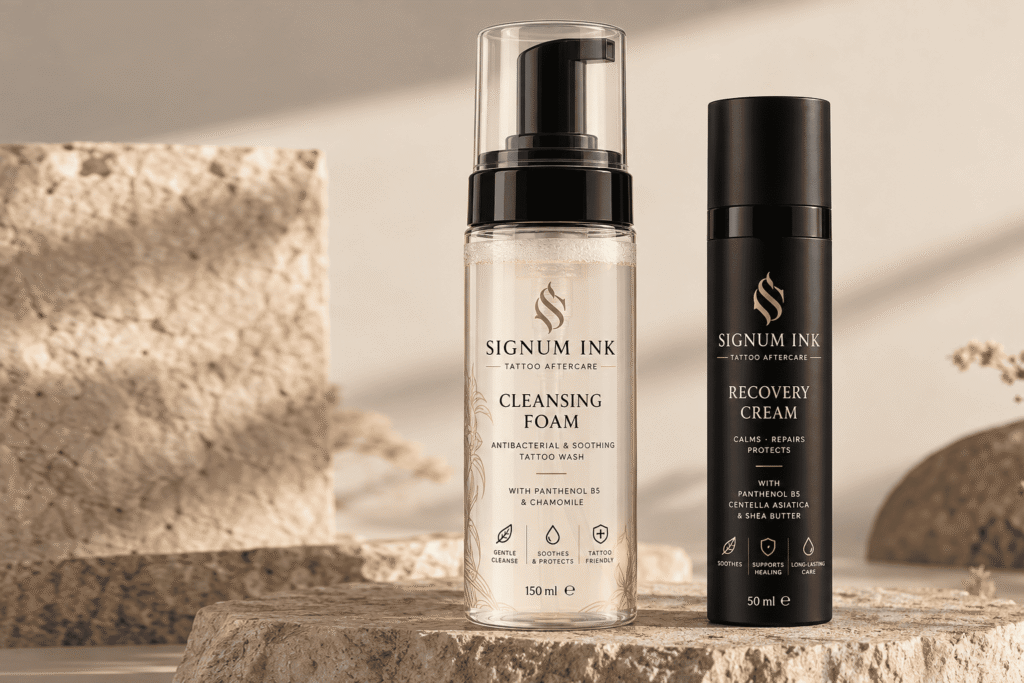
- Shea Butter provides rich emollient properties.
- Jojoba Oil helps soften the skin.
- Panthenol supports hydration.
- Glycerin attracts moisture.
- Beta-Glucan supports the skin barrier.
Together, these ingredients often perform better than any single ingredient alone.

How to Read Beyond the Marketing
The front of a cosmetic product often highlights words such as:
- Natural.
- Botanical.
- Clean.
- Pure.
- Plant-based.
While these descriptions may be accurate, they don’t tell you everything about how a product performs.
To make a more informed choice, consider looking beyond the packaging and asking questions such as:
- Is the product formulated for sensitive skin?
- Does it contain ingredients that support the skin barrier?
- Is the formula well-balanced?
- Does it fit your skin type?
- Will you enjoy using it consistently?
These factors usually have a greater impact on your experience than whether the product is marketed as natural or synthetic.
What About Preservatives?
Preservatives often receive negative attention, but they play an essential role in cosmetic safety.
Products that contain water—such as tattoo creams and cleansing foams—require an effective preservative system to help prevent the growth of bacteria, yeast and mold during normal use.
Without preservatives, a product may become unsafe long before you finish using it.
The goal isn’t to avoid preservatives altogether.
It’s to use products with preservative systems that are approved for cosmetic use and appropriate for the formulation.
Understanding Greenwashing
The popularity of natural skincare has led to an increase in greenwashing—marketing that makes products appear more natural or environmentally friendly than they really are.
Examples include:
- Emphasizing a single botanical ingredient while overlooking the rest of the formulation.
- Using green packaging to imply natural origins.
- Making vague claims such as “chemical-free.”
- Highlighting buzzwords without explaining their relevance.
Remember that everything is made of chemicals, including water and plant extracts.
Instead of focusing on slogans, look at the complete formulation and whether the product is suitable for healing skin.
Should You Choose Natural or Synthetic?
For most people, this isn’t the right question.
A better question is:
“Does this product support my skin during tattoo healing?”
The answer depends on:
- The overall formulation.
- Ingredient compatibility.
- Skin tolerance.
- Product quality.
- Consistent use.
A well-formulated product that combines carefully selected natural and synthetic ingredients is often an excellent choice.

Common Myths
Myth 1: Natural Ingredients Never Cause Allergies
False.
Some of the most common cosmetic allergens are naturally occurring compounds found in essential oils and botanical extracts.
Myth 2: Synthetic Ingredients Are Harmful
False.
Many synthetic cosmetic ingredients have excellent safety records and are widely used in products for sensitive skin.
Myth 3: Natural Products Don’t Need Preservatives
False.
If a cosmetic product contains water, it generally requires a preservative system to remain safe throughout its shelf life.
Myth 4: More Botanical Extracts Mean Better Healing
False.
Adding numerous plant extracts doesn’t automatically improve a product.
A balanced formulation is usually far more important than the number of botanical ingredients.
Frequently Asked Questions
Are natural tattoo aftercare products better?
Not necessarily.
Many excellent products combine natural and synthetic ingredients to achieve the best balance between performance, stability and skin compatibility.
Should I avoid synthetic ingredients?
No.
Judge ingredients based on their function, safety profile and suitability for healing skin rather than their origin.
Are preservatives bad for tattoos?
No.
Approved cosmetic preservatives help keep products safe during normal use and are an important part of many water-based formulations.
Can natural oils replace tattoo aftercare products?
Some plant oils may help soften the skin, but they don’t necessarily provide the balanced hydration, stability or complete formulation offered by products specifically developed for tattoo aftercare.
Is “chemical-free” skincare possible?
No.
Everything—including water, plant extracts and natural oils—is made of chemicals.
The important question is whether the ingredients are safe, well-formulated and appropriate for cosmetic use.
Conclusion
The debate between natural and synthetic ingredients often creates more confusion than clarity.
The reality is that both have valuable roles in modern tattoo aftercare.
Natural ingredients can provide nourishing lipids, antioxidants and plant-derived compounds.
Synthetic ingredients can contribute consistency, stability and well-documented performance.
The best tattoo aftercare products don’t choose one side—they combine the strengths of both in thoughtfully designed formulations that support your skin while it heals naturally.
 English
 German
 Dutch
 Danish
 Swedish
 French
 Italian