Introduction
Getting a new tattoo is exciting—but it can also be worrying.
One day your tattoo feels warm and slightly swollen. A few days later it starts peeling. Then it becomes itchy, dry and sometimes even a little shiny.
If you’ve never experienced the healing process before, it’s completely natural to wonder:
“Is my tattoo healing normally?”
The good news is that most tattoos follow a predictable healing pattern. While everyone’s skin heals at a slightly different pace, there are clear milestones you can expect during the first few weeks.
Understanding these stages helps you avoid unnecessary worry and makes it easier to recognise when something is truly unusual.
In this guide, we’ll walk through the tattoo healing process day by day, explain what’s considered normal, and highlight signs that may require extra attention.
For a deeper understanding of what happens beneath the skin, we also recommend reading:
→ The Complete Science of Tattoo Healing: What Happens to Your Skin from Day 1 to Day 60
Why Every Tattoo Heals Differently
No two tattoos heal in exactly the same way.
Several factors influence how quickly your skin recovers, including:
- Tattoo size
- Placement on the body
- Skin type
- Age
- General health
- Daily aftercare routine
- Climate and humidity
For example, a small tattoo on the forearm may feel almost comfortable after a week, while a large tattoo on the calf or ribs may remain tender for much longer.
The important thing is not to compare your healing journey with someone else’s.
Instead, focus on whether your tattoo follows a gradual pattern of improvement.
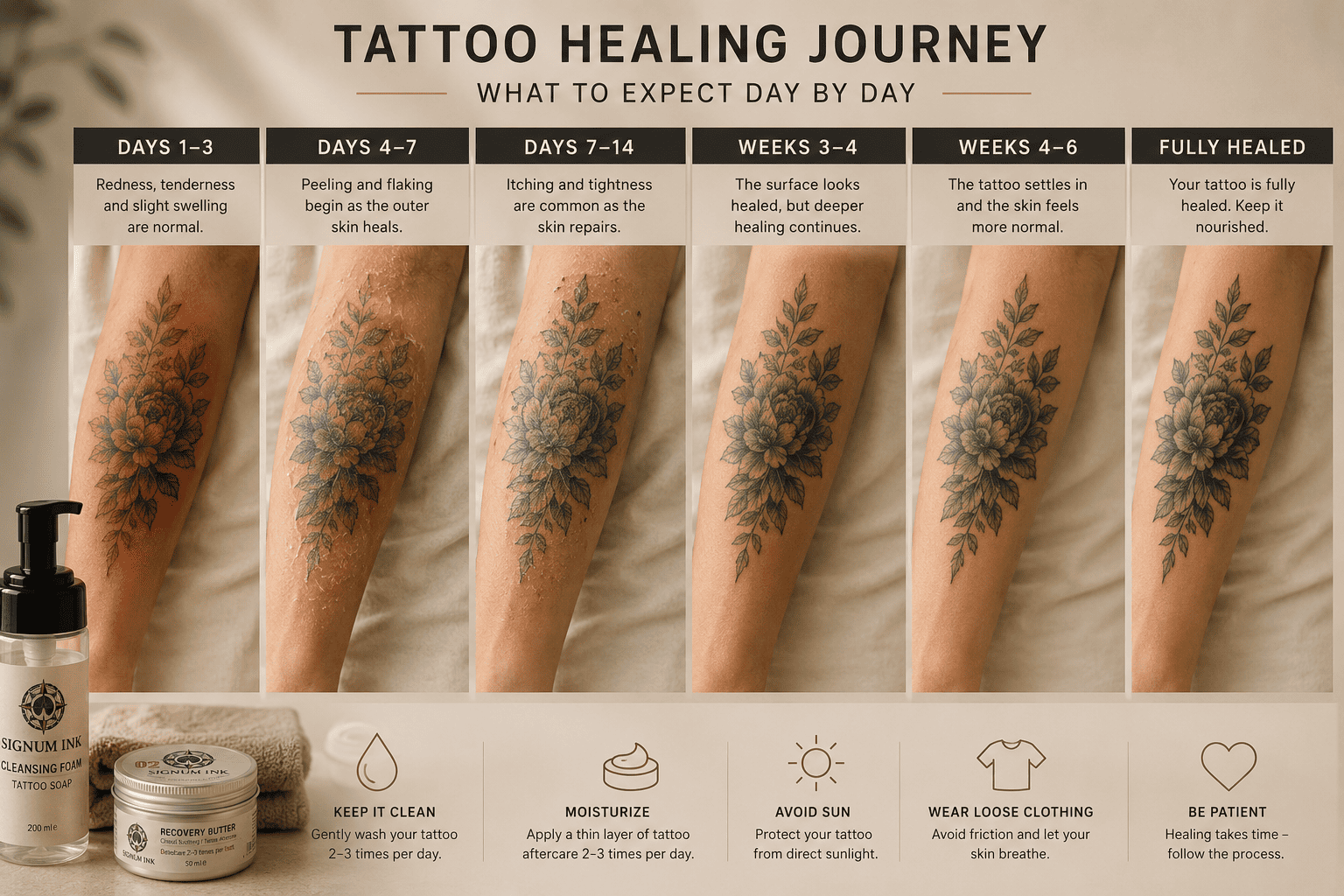
Days 1–3: The Fresh Tattoo Stage
The first few days are when your body begins repairing the tiny wounds created during tattooing.
During this stage it’s normal to experience:
- Mild redness
- Slight swelling
- Warmth around the tattoo
- Small amounts of plasma
- Tiny traces of excess ink
- Mild tenderness
These reactions are part of your body’s natural inflammatory response.
This doesn’t mean your tattoo is infected.
Your immune system is simply beginning the healing process.
During these first days your priority should be keeping the tattoo clean, avoiding unnecessary friction and following your aftercare routine consistently.
Days 4–7: Peeling Begins
Around the fourth or fifth day, many tattoos begin to peel.
This often surprises people.
The tattoo may suddenly appear:
- Dry
- Flaky
- Dull
- Slightly cloudy
This is completely normal.
The outermost layer of damaged skin is beginning to shed as new skin develops underneath.
Many people are tempted to remove the peeling skin.
Don’t.
Allow the flakes to fall away naturally.
Pulling them off too early may damage healing skin and increase irritation.
Days 7–14: Itching and Tightness
As the outer skin barrier continues rebuilding, itching becomes one of the most common symptoms.
Your tattoo may feel:
- Tight
- Dry
- Slightly itchy
- Less flexible
This doesn’t mean something is wrong.
In fact, itching is often a positive sign that healing is progressing.
Continue washing gently and applying a thin layer of moisturizer whenever the skin begins to feel uncomfortably dry.
Avoid scratching the tattoo, even if the urge is strong.
Scratching can damage delicate healing skin and delay recovery.
A Simple Rule to Remember
Healing should generally become better—not worse.
While it’s normal to have good and bad days, the overall trend should be gradual improvement.
Ask yourself:
- Is the redness decreasing?
- Is the swelling improving?
- Does the tattoo feel more comfortable than yesterday?
- Is the peeling becoming less noticeable?
If the answer is yes, your tattoo is most likely healing exactly as expected.
Weeks 3–4: The Invisible Healing Stage
By the third week, most tattoos look almost completely healed.
The redness has usually disappeared, peeling has stopped, and the skin feels much more comfortable.
However, appearances can be misleading.
Although the surface of your skin may look normal, the deeper layers are still rebuilding. Your body continues repairing tissue beneath the tattoo long after the visible signs of healing have faded.
During this stage, your tattoo may appear:
- Slightly shiny
- A little dry from time to time
- More settled in colour
- Comfortable to touch
This stage often leads people to believe their tattoo is fully healed when, in reality, the healing process is still continuing below the surface.
Continue following your aftercare routine until your skin feels completely normal again.
When Is a Tattoo Fully Healed?
There is no single answer that applies to everyone.
For most people:
- The outer layer of skin heals within 2–4 weeks.
- The deeper layers continue recovering for several more weeks.
Large tattoos, heavily shaded work and tattoos on areas that experience frequent movement may take longer than smaller, simpler designs.
Rather than focusing on a specific number of days, pay attention to your skin.
A fully healed tattoo should no longer feel:
- Tight
- Itchy
- Tender
- Dry because of healing
Instead, it should feel like the surrounding skin.
Normal vs. Abnormal Healing
Many first-time tattoo clients become concerned because healing doesn’t always look attractive.
Fortunately, many of the changes people worry about are completely normal.
Normal Signs
- Mild redness during the first few days
- Light swelling
- Peeling
- Flaking
- Itching
- Temporary dull appearance
- Slight shininess during later healing
These are expected parts of the recovery process.
Signs That May Need Attention
While complications are uncommon with proper aftercare, you should pay closer attention if you experience:
- Redness that continues spreading after the first few days
- Increasing swelling instead of gradual improvement
- Thick yellow or green discharge
- A strong unpleasant smell
- Fever or feeling generally unwell
- Severe or worsening pain
These symptoms are not typical of normal healing and should be assessed by a healthcare professional.
Common Healing Myths
The internet is full of advice about tattoo healing—but not all of it is accurate.
Myth 1: A Tattoo Should Never Peel
False.
Peeling is one of the most common and completely normal stages of healing.
Myth 2: More Moisturizer Means Faster Healing
False.
Applying excessive amounts of product does not speed up recovery.
Healthy healing depends on balance, not quantity.
Myth 3: Itching Means Something Is Wrong
False.
Mild itching is often a normal part of skin repair.
Only excessive itching combined with other concerning symptoms may require further attention.
Myth 4: A Tattoo Is Fully Healed After Two Weeks
Not always.
While the surface may look healed, the deeper skin layers often continue recovering for several more weeks.
Frequently Asked Questions
Is it normal for my tattoo to look dull?
Yes.
During peeling, the tattoo often appears cloudy or less vibrant.
Once the outer layer of skin has recovered, the colours and details usually become clearer again.
Why does my tattoo feel tight?
Tightness is common because the skin is temporarily losing moisture while rebuilding its protective barrier.
Gentle moisturizing usually improves comfort.
Is peeling always a good sign?
Peeling itself is a normal sign of healing.
The important thing is to allow the skin to shed naturally without picking or scratching.
Why does my tattoo look shiny?
A temporary shiny appearance often occurs as new skin develops.
This usually fades over time as the skin continues to mature.
Should every tattoo heal at the same speed?
No.
Healing time varies depending on the tattoo, your skin and how well you follow your aftercare routine.
Conclusion
Every tattoo heals a little differently, but the overall process is remarkably predictable.
Redness, peeling, itching and temporary dullness are all normal stages of your body’s natural repair process.
The most important thing is to look for gradual improvement rather than expecting your tattoo to look perfect every day.
By understanding what happens during each stage of healing, you can care for your tattoo with confidence and recognise when something genuinely deserves extra attention.
Patience is one of the most valuable parts of tattoo aftercare.
Give your skin the time it needs, and your tattoo will reward you with the best possible result.
 English
  German
  Dutch
Dutch  Danish
  Swedish
  French
  Italian