Introduction
Every new tattoo owner asks the same question:
“How can I make my tattoo heal faster?”
It’s understandable. You want the peeling, itching and tenderness to pass as quickly as possible so you can enjoy your finished tattoo.
The truth is that you can’t force your skin to heal overnight.
Your body follows its own natural healing process, and that process takes time.
What you can do is create the best possible conditions for your skin to recover efficiently.
By supporting your body’s natural healing mechanisms—and avoiding the most common aftercare mistakes—you can help your tattoo heal as comfortably as possible.
In this guide, we’ll explore ten practical, science-backed ways to support healthy tattoo healing.
Can You Really Heal a Tattoo Faster?
To some extent—yes.
You can’t dramatically shorten your body’s biological healing timeline.
However, you can avoid factors that slow healing down.
Think of it like recovering from a small cut.
You can’t make new skin appear overnight, but you can support the process by keeping the wound clean, protected and properly cared for.
Tattoo healing works the same way.
The goal isn’t to rush healing.
The goal is to avoid delaying it.
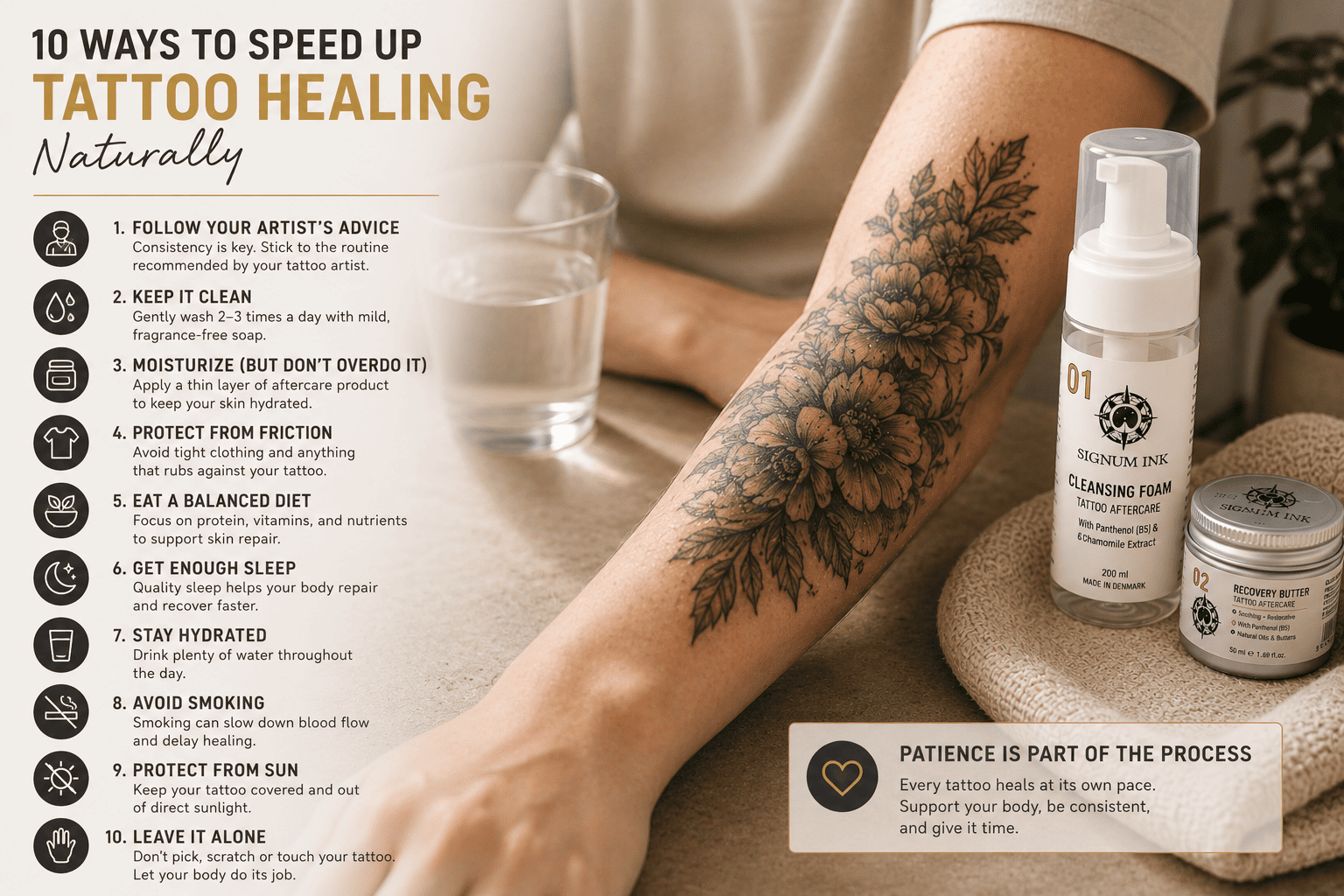
1. Follow Your Tattoo Artist’s Aftercare Advice
Your tattoo artist understands how your tattoo was created and will usually provide aftercare instructions based on their experience.
Although advice may vary slightly between artists, consistency is important.
Once you’ve been given an appropriate aftercare routine:
- Stick with it.
- Avoid changing products repeatedly.
- Give your skin time to respond.
Consistency often produces better results than constantly trying new methods.
2. Keep Your Tattoo Clean
Clean skin supports healthy healing.
Wash your tattoo gently using lukewarm water and a mild cleanser designed for sensitive skin.
Avoid:
- Scrubbing.
- Hot water.
- Harsh soaps.
- Excessive washing.
Cleaning your tattoo two or three times a day is generally sufficient unless your tattoo artist recommends otherwise.
3. Moisturize—But Don’t Overdo It
Hydrated skin usually feels more comfortable.
Applying a thin layer of moisturizer helps reduce dryness, tightness and itching.
However, more isn’t always better.
Your tattoo shouldn’t feel greasy or heavily coated.
Instead:
- Apply a thin layer.
- Allow it to absorb.
- Reapply only when needed.
Balanced hydration supports healthy healing.
4. Protect Your Tattoo from Friction
Constant rubbing can irritate healing skin.
Try to avoid:
- Tight clothing.
- Backpack straps.
- Sports equipment rubbing the tattoo.
- Repeated contact with rough fabrics.
Less irritation allows your skin to focus on healing.
5. Eat a Balanced Diet
Your body needs nutrients to repair damaged skin.
Focus on meals that include:
- Protein.
- Fruit.
- Vegetables.
- Whole grains.
- Healthy fats.
Combined with adequate hydration, good nutrition provides the building blocks your skin needs during recovery.
Your Skin Does the Healing
It’s easy to think that creams or special products “heal” tattoos.
In reality, your skin performs the healing.
Aftercare products simply help create an environment where your skin can recover with less irritation and greater comfort.
Supporting your body’s natural healing process is more effective than trying to force it.
Patience Is Still the Most Powerful Tool
The internet is full of shortcuts and miracle tips.
Most don’t live up to their promises.
Healthy tattoo healing is usually the result of:
- Good hygiene.
- Consistent aftercare.
- Healthy lifestyle habits.
- Time.
Sometimes the fastest way to heal is simply not interfering with your body’s natural repair process.
6. Get Enough Sleep
Your body carries out many of its repair processes while you sleep.
Although there’s no specific number of hours that guarantees faster tattoo healing, consistently getting enough quality sleep supports your immune system and normal tissue repair.
Aim to:
- Keep a regular sleep schedule.
- Get enough rest each night.
- Avoid staying up late repeatedly during the first week after getting your tattoo.
Well-rested bodies generally recover more efficiently than sleep-deprived ones.
7. Stay Hydrated
Water plays an important role in overall health, including normal skin function.
Drinking enough fluids won’t magically speed up healing, but dehydration can leave your skin feeling drier and less comfortable.
Simple habits include:
- Drinking water regularly throughout the day.
- Increasing fluid intake during hot weather.
- Replacing fluids lost through exercise.
Hydrated skin often feels more comfortable throughout the healing process.
8. Avoid Smoking If Possible
Smoking affects blood circulation and reduces the amount of oxygen delivered to tissues.
Because oxygen is essential for wound repair, smoking may slow the body’s natural healing processes.
If you smoke, reducing or avoiding smoking while your tattoo heals may help support recovery and benefit your overall health.
9. Protect Your Tattoo from Sun Exposure
Fresh tattoos are particularly sensitive to ultraviolet (UV) radiation.
During the healing period:
- Keep your tattoo covered with loose clothing when possible.
- Avoid prolonged direct sunlight.
- Wait until the tattoo is fully healed before relying on sunscreen.
Protecting healing skin from UV exposure helps reduce unnecessary irritation.
10. Leave It Alone
This may be the most overlooked tip of all.
Many people unintentionally slow healing by constantly checking, touching or experimenting with new products.
Avoid:
- Scratching.
- Picking peeling skin.
- Touching the tattoo unnecessarily.
- Changing your aftercare routine every few days.
Sometimes the best thing you can do is simply allow your body to do its job.
Common Myths About Healing Tattoos Faster
Myth 1: More Cream Means Faster Healing
False.
Applying thick layers of moisturizer won’t make your tattoo heal more quickly.
A light, even layer is usually enough.
Myth 2: Expensive Products Heal Tattoos Better
Not necessarily.
Consistent, appropriate aftercare matters far more than choosing the most expensive product on the shelf.
Myth 3: Peeling Means Your Tattoo Is Healing Slowly
Not at all.
Peeling is a normal stage of recovery and often indicates that your skin is replacing damaged outer layers.
Myth 4: There’s a Miracle Trick to Heal Tattoos Overnight
Unfortunately, no.
Tattoo healing is a biological process that takes time.
Healthy habits support the process—but they can’t eliminate it.
Frequently Asked Questions
How can I make my tattoo heal faster?
Focus on the basics: keep your tattoo clean, moisturize appropriately, eat a balanced diet, stay hydrated, get enough sleep and avoid unnecessary irritation.
Does moisturizer speed up tattoo healing?
Moisturizer doesn’t directly speed up healing, but it helps create a comfortable environment that supports the skin’s natural recovery.
Can drinking more water heal a tattoo faster?
Staying hydrated supports normal skin function, but water alone won’t shorten the healing timeline.
What’s the fastest a tattoo can heal?
Most tattoos appear largely healed after two to four weeks, although deeper layers of skin continue recovering for several more weeks.
The exact timeline varies from person to person.
Can I speed up peeling?
No.
Peeling is a natural part of tattoo healing.
Trying to remove peeling skin prematurely can interfere with the healing process.
Conclusion
There’s no shortcut to healthy tattoo healing.
Your body needs time to repair the skin, restore the protective barrier and settle the tattoo beneath the surface.
The best approach isn’t to search for miracle solutions—it’s to consistently support your body’s natural healing process.
Keep your tattoo clean, moisturize it when needed, eat well, sleep enough and avoid unnecessary irritation.
These simple habits won’t perform miracles, but they can help your tattoo heal as comfortably and efficiently as possible.
Continue Learning
Want to understand exactly what happens beneath your skin during every stage of tattoo healing?
→ Read: The Complete Science of Tattoo Healinhttps://signumink.com/the-complete-science-of-tattoo-healing/g: What Happens to Your Skin from Day 1 to Day 60
 English
  German
  Dutch
Dutch  Danish
  Swedish
  French
  Italian