Introduction
An itchy tattoo can test anyone’s patience.
Just as your tattoo starts looking better, the itching begins. It might be mild and occasional or persistent enough to make you want to scratch without even thinking about it.
If you’ve reached this stage, you’re probably asking yourself:
“Is it normal for my tattoo to itch?”
In most cases, the answer is yes.
Itching is one of the most common—and often one of the most reassuring—signs that your skin is repairing itself.
Understanding why it happens can make it much easier to resist scratching and allow your tattoo to heal properly.
In this guide, you’ll learn why tattoos itch, when itching usually starts, how long it lasts and what you can do to relieve it without interrupting the healing process.
If you’d like to understand the complete biology behind tattoo healing, we also recommend reading:
→ The Complete Science of Tattoo Healing: What Happens to Your Skin from Day 1 to Day 60
Why Does a Healing Tattoo Itch?
Your skin is constantly communicating with your nervous system.
As damaged skin repairs itself, millions of tiny nerve endings become active while new tissue develops.
At the same time, your skin barrier is rebuilding and moisture levels are changing.
These processes stimulate nerve endings, creating the familiar sensation we recognise as itching.
In other words:
The itch isn’t caused by the tattoo ink.
It’s caused by your skin healing.
For most people, itching simply means that your body’s natural repair mechanisms are working exactly as they should.
When Does Tattoo Itching Usually Start?
Although everyone heals differently, itching commonly begins:
Around Days 5–10
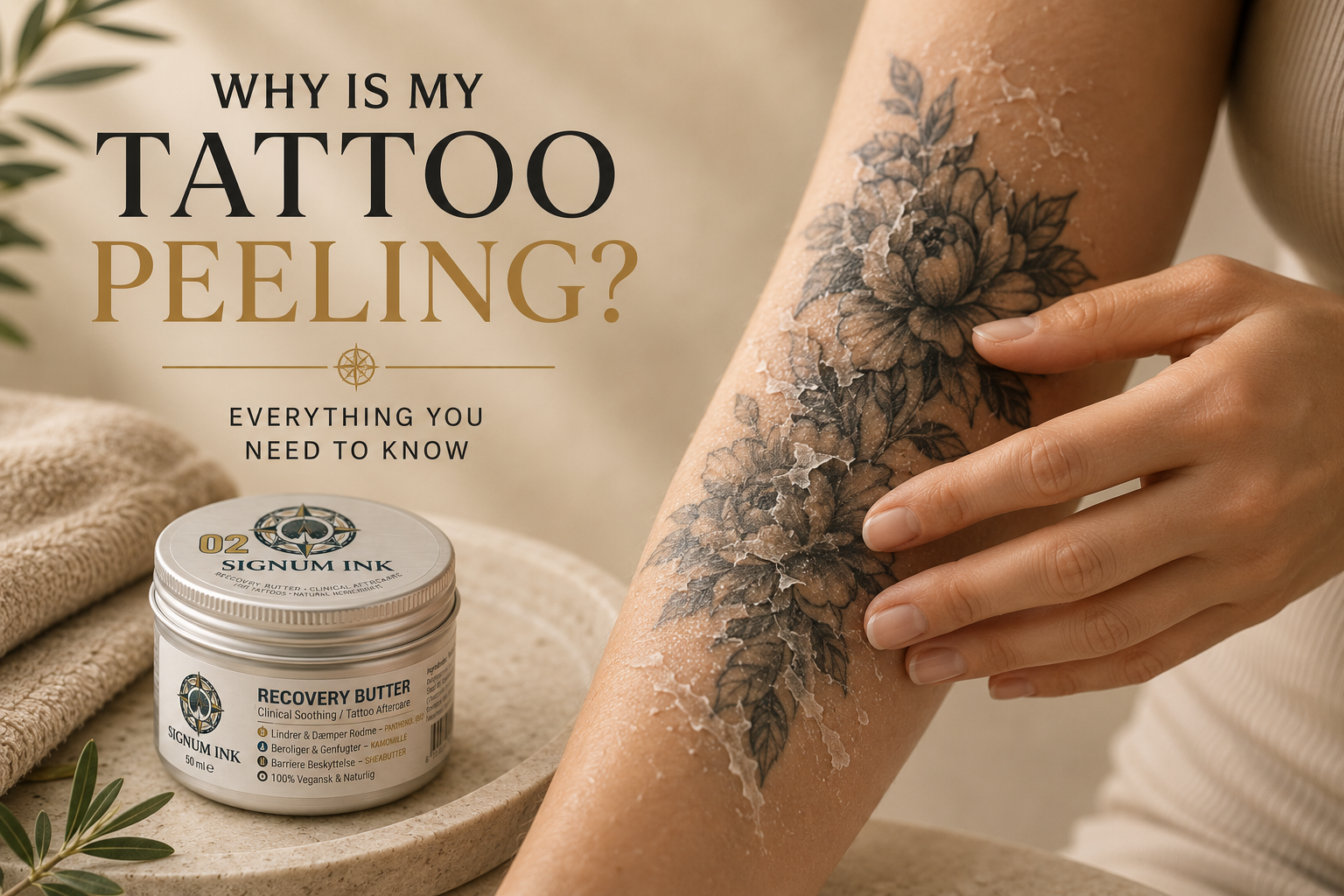
This usually coincides with the peeling stage.
As old skin begins shedding and new skin develops underneath, many people notice increasing tightness and itching.
Some tattoos itch only for a day or two.
Others remain itchy for more than a week.
The exact timing depends on factors such as:
- Tattoo size
- Placement
- Skin type
- Moisture balance
- Daily aftercare
- Climate
There is no “perfect” timeline.
Gradual improvement is much more important than exact dates.
What Does Normal Tattoo Itching Feel Like?
Normal tattoo itching is usually:
- Mild to moderate
- Temporary
- Worse when the skin feels dry
- More noticeable during peeling
- Relieved after gentle moisturizing
Many people describe it as a deep itch that can’t quite be scratched.
Although uncomfortable, this sensation is usually a normal part of healing.
As long as the itching gradually improves over time, there is rarely any cause for concern.
Why Does Dry Skin Make It Worse?
As your tattoo heals, the outer skin barrier temporarily becomes less effective at retaining moisture.
This causes water to evaporate more quickly from the skin.
The result is:
- Dryness
- Tightness
- Increased sensitivity
- More itching
Keeping your skin comfortably moisturized helps restore balance and often reduces itching significantly.
The goal isn’t to eliminate itching completely.
It’s to keep your skin comfortable while it heals naturally.
Can Moisturizer Stop Tattoo Itching?
A quality moisturizer can’t stop the biological healing process.
Nor should it.
Instead, it supports the skin by improving hydration and strengthening the skin barrier.
Many people notice that itching becomes much more manageable after applying a thin layer of aftercare product.
However, more product isn’t necessarily better.
Applying excessive amounts may leave the skin greasy without providing additional relief.
Thin, consistent applications usually provide the best balance between comfort and healthy healing.
Why You Should Never Scratch Your Tattoo
Scratching might provide temporary relief.
Unfortunately, it can also interfere with healing.
Even if your tattoo appears almost healed, the skin underneath may still be fragile.
Scratching may:
- Reopen delicate skin.
- Increase irritation.
- Introduce bacteria.
- Delay healing.
- Damage peeling skin before it’s ready to detach.
If the urge becomes overwhelming, gently tapping the skin nearby or applying a cool compress is usually a much safer alternative.
Safe Ways to Relieve Tattoo Itching
The good news is that you don’t have to simply “put up with” an itchy tattoo.
There are several safe ways to make the healing process much more comfortable without interfering with your skin’s natural recovery.
Keep the Tattoo Moisturized
Dry skin is one of the biggest triggers for itching.
After washing and drying your tattoo, apply a thin layer of aftercare product whenever your skin begins to feel tight or uncomfortable.
The goal isn’t to cover the tattoo in cream.
The goal is to support the skin barrier.
Avoid Hot Showers
Hot water may temporarily feel soothing, but it can also strip natural oils from the skin.
This often makes itching worse later.
Choose short, lukewarm showers instead.
Wear Loose Clothing
Tight clothing constantly rubbing against healing skin may increase irritation.
Whenever possible, choose soft, breathable fabrics that allow your tattoo to remain comfortable throughout the day.
Use a Cool Compress
If the itching becomes particularly uncomfortable, gently placing a clean, cool compress near the tattoo for a few minutes may provide temporary relief.
Avoid ice directly on the tattoo.
Extreme temperatures can further irritate healing skin.
Distract Yourself
Sometimes the hardest part is resisting the urge to scratch.
Keeping your hands occupied often works surprisingly well.
Remember:
Every time you choose not to scratch, you’re helping your tattoo heal.
When Itching May Need Extra Attention
Most itching is completely normal.
However, itching alone doesn’t tell the whole story.
If itching is accompanied by any of the following symptoms, it’s worth paying closer attention:
- Increasing redness after the first few days
- Significant swelling
- Thick yellow or green discharge
- Severe pain
- Fever
- A rapidly spreading rash
These symptoms are not considered part of normal tattoo healing and should be evaluated by a healthcare professional.
Fortunately, most tattoos never reach this stage.
Common Mistakes That Make Itching Worse
Scratching
The most obvious mistake—and the hardest one to avoid.
Scratching may temporarily satisfy the itch, but it often increases irritation afterwards.
Using Too Much Moisturizer
Many people think that if a little moisturizer helps, a lot must be even better.
Unfortunately, that’s rarely true.
Healthy skin needs balance.
Not excess.
Letting the Tattoo Become Extremely Dry
Ignoring dryness often increases itching unnecessarily.
Keeping the skin comfortably hydrated usually provides significant relief.
Using Fragranced Products
Strong fragrances, alcohol and unnecessary additives may irritate already sensitive skin.
Choose products designed for healing or sensitive skin whenever possible.
Frequently Asked Questions
Is itching a good sign?
In most cases, yes.
Mild itching often indicates that your skin is actively repairing itself.
When does tattoo itching stop?
Most itching gradually improves as the outer skin barrier finishes healing.
For many people, this happens within the first two to three weeks.
Can scratching ruin my tattoo?
Repeated scratching may damage delicate healing skin and increase irritation.
Although occasional accidental contact is unlikely to ruin a tattoo, it’s always best to avoid scratching whenever possible.
Is itching worse at night?
Many people notice itching more during the evening.
This is partly because you’re more relaxed and have fewer distractions.
Keeping your tattoo comfortably moisturized before bed often helps.
Should I apply more moisturizer every time it itches?
Not necessarily.
If your skin already feels soft and comfortable, applying more product may not provide additional relief.
Instead, check whether the itching improves naturally after a few minutes.
Conclusion
An itchy tattoo is rarely something to fear.
In fact, for most people it’s one of the clearest signs that the skin is progressing through its natural healing process.
The key is learning how to manage the itch without interfering with recovery.
Gentle cleansing, consistent moisturizing and plenty of patience will usually do far more for your tattoo than scratching ever could.
Healing isn’t always comfortable—but it is temporary.
Your patience today helps protect the artwork you’ll enjoy for years to come.
Continue Learning
Want to understand every stage of tattoo healing?
→ Read: The Complete Science of Tattoo Healing: What Happens to Your Skin from Day 1 to Day 60
 English
  German
  Dutch
Dutch  Danish
  Swedish
  French
  Italian