Jede gesunde Hautbarriere ist auf eine bemerkenswerte Gruppe von Lipiden angewiesen:
Ceramide.
Im Gegensatz zu pflanzlichen Ölen oder feuchtigkeitsspendenden Inhaltsstoffen, die der Haut zugesetzt werden, Ceramide kommen natürlicherweise in der äußersten Hautschicht gesunder Haut vor, wo sie eine kritische strukturelle Rolle spielen.
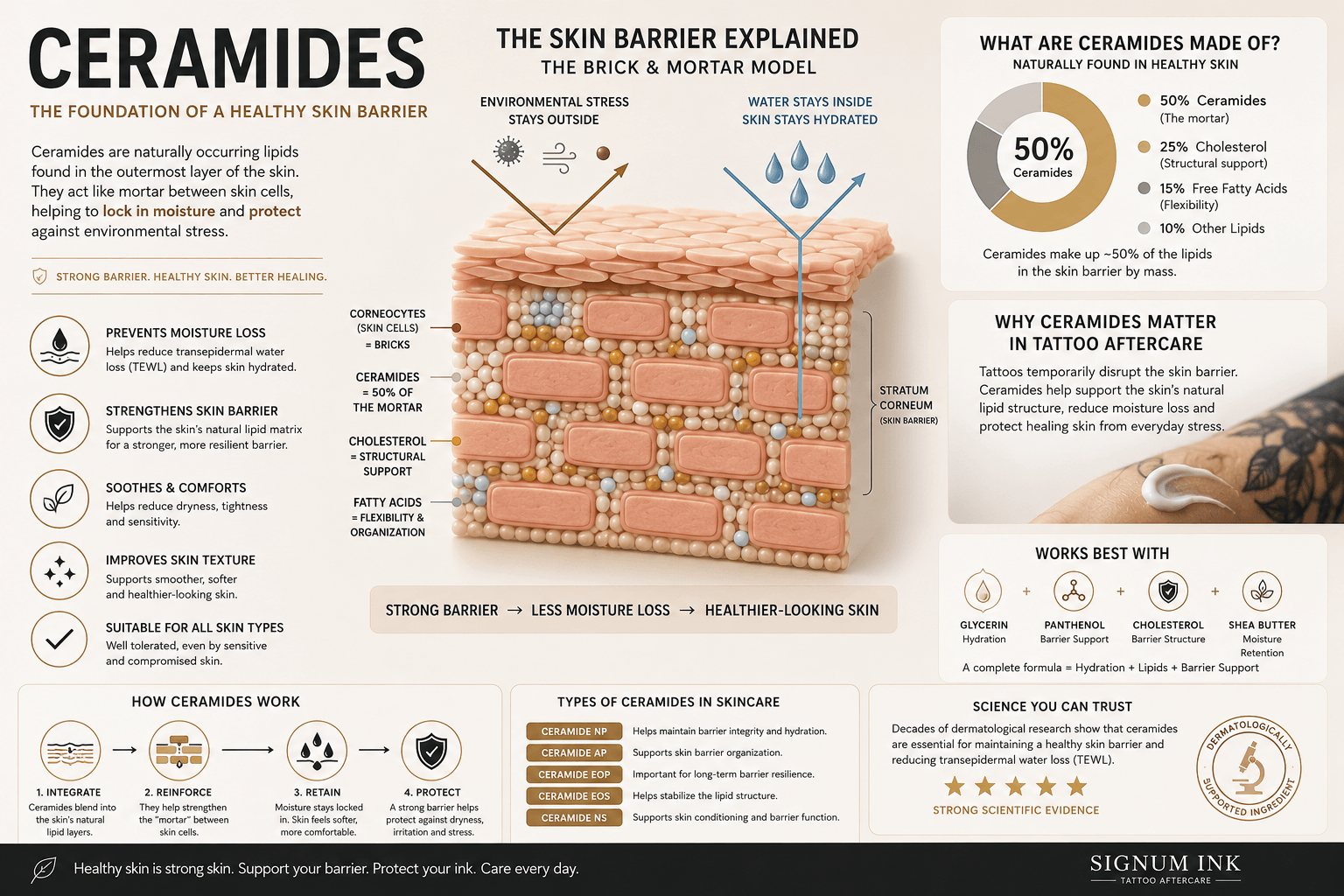
Tatsächlich machen Ceramide aus etwa 50% der Lipide in der Hautbarriere nach Masse.
Dies allein erklärt, warum Dermatologen und Hautpflegeexperten sie als einige der wichtigsten Inhaltsstoffe in der modernen Hautpflege ansehen.
Wenn die Hautbarriere richtig funktioniert, hilft sie, Feuchtigkeit zu speichern und die Haut vor alltäglichen Umweltbelastungen zu schützen.
Wenn diese Barriere vorübergehend beeinträchtigt wird – wie es nach einer Tätowierung der Fall ist –, verliert die Haut leichter Wasser und wird anfälliger für Trockenheit und Unbehagen.
Hier ist genau wo Ceramide wichtig werden.
Ceramide unterstützen die natürliche Schutzstruktur der Haut, anstatt sie nur mit Feuchtigkeit zu versorgen.
Für die Tattoo-Nachsorge, dies macht sie grundlegend anders als Inhaltsstoffe wie Glycerin, Sheabutter, oder Jojobaöl.
Jede dieser Zutaten trägt etwas Wertvolles bei.
Aber Ceramide unterstützen die Struktur, die alles zusammenhält.
Kurz & Bündig
Zutatenart
Hautidentisches Lipid
Primäre Vorteile
Barriereunterstützung • Feuchtigkeitsspeicherung • Hautpflege
Am besten für
Frische Tattoos • Trockene Haut • Empfindliche Haut • Barriere-reparierende Hautpflege
Gefunden in
Regenerierende Cremes • Barrierecremes • Gesichtsfeuchtigkeitscremes • Fortschrittliche Hautpflege • Tattoo-Nachsorge
Geeignet für
Alle Hauttypen
Typische kosmetische Konzentration
0.1–3%
Passt gut zu
Panthenol • Glycerin • Cholesterin • Fettsäuren • Sheabutter • Jojobaöl • Beta-Glucan
Wissenschaftliche Unterstützung
★★★★★ Herausragend
Wussten Sie schon?
Gesunde menschliche Haut enthält natürlich mehr als ein Dutzend verschiedener Ceramid-Typen. Gemeinsam bilden sie einen Teil des Lipid-“Mörtels”, der die Hautzellen zusammenhält und so zu einer starken und widerstandsfähigen Hautbarriere beiträgt.
Was sind Ceramide?
Ceramide natürlich vorkommende Lipide, die sich in den Hornschicht, die äußerste Hautschicht.
Es sind keine Vitamine.
Es sind keine botanischen Extrakte.
Sie sind strukturelle Bestandteile gesunder Haut.
Eine nützliche Methode, um die Hautbarriere zu verstehen, ist, sich eine Ziegelmauer vorzustellen.
Die Hautzellen (Korneozyten) sind die Ziegelsteine.
Die Lipide – einschließlich Ceramide, Cholesterin und freie Fettsäuren – bilden die Mörtel das die Ziegel zusammenhält.
Ohne diese Lipidmatrix wird die Barriere schwächer.
Feuchtigkeit entweicht leichter.
Die Haut wird trockener.
Externe Reizstoffe können leichter mit den äußeren Hautschichten interagieren.
Dieses einfache Modell erklärt, warum Ceramide zum Kern moderner, auf die Hautbarriere fokussierter Hautpflege geworden sind.
Wie funktionieren Ceramide?
Anstatt auf der Oberfläche zu sitzen wie viele Öle, Ceramide integrieren sich in die natürliche Lipidmatrix der Haut.
Ihre Hauptaufgabe ist die Unterstützung der Organisation der Hautbarriere.
Eine gesunde Hautbarriere erfüllt zwei wichtige Aufgaben:
- Es hilft, übermäßigen Wasserverlust zu verhindern.
- Es hilft, die Haut vor äußeren Umwelteinflüssen zu schützen.
Wenn die Barriere vorübergehend gestört wird, wird die Aufrechterhaltung dieser Funktionen schwieriger.
Topisch angewendete Ceramide werden in der Hautpflege verwendet, um die natürliche Hautbarriere zu unterstützen und gleichzeitig Inhaltsstoffe zu ergänzen, die für Feuchtigkeit und Pflege verantwortlich sind.
Deshalb gelten Ceramide heute als einer der wichtigsten Inhaltsstoffe in der Hautpflege zur Stärkung der Hautbarriere.
Warum frische Tattoos von Ceramiden profitieren
Das Tätowieren beeinträchtigt vorübergehend die äußeren Hautschichten.
Obwohl dies ein natürlicher Teil des Tätowierprozesses ist, bedeutet dies auch, dass die Hautbarriere Zeit zur Erholung benötigt.
Während dieser Zeit reicht es nicht aus, nur auf die Flüssigkeitszufuhr zu achten.
Die Barriere selbst erfordert ebenfalls Unterstützung.
Hier ist wo Ceramide Etwas Einzigartiges anbieten.
Anstatt lediglich Feuchtigkeit anzuziehen oder die Haut aufzuweichen, tragen sie zu Formulierungen bei, die die natürliche Lipidstruktur der Haut unterstützen.
Professionelle Tattoo-Aftercare-Cremes kombinieren Ceramide oft mit:
- Glycerin zieht Feuchtigkeit an.
- Panthenol – unterstützt die Hydratation und die Barrierefunktion.
- Sheabutter – hilft, den Feuchtigkeitsverlust zu reduzieren.
- Jojobaöl – unterstützt die Lipidbarriere der Haut.
- Beta-Glucan – ergänzt die Flüssigkeitsversorgung und stärkt die Barrierefunktion.
- Cholesterin – wirkt natürlich zusammen mit Ceramiden in der Hautbarriere.
Zusammen ergeben diese Inhaltsstoffe einen der wissenschaftlich am besten unterstützten Ansätze zur Erhaltung einer gesunden Haut während der Tattoo-Regeneration.
Warum Ceramide zum Goldstandard für Barrierepflege in der Hautpflege geworden sind
In den letzten zwei Jahrzehnten hat die auf die Hautbarriere fokussierte Hautpflege die Dermatologie revolutioniert.
Anstatt lediglich Feuchtigkeit zuzuführen, konzentrieren sich Formulierer zunehmend darauf, die eigene Schutzbarriere der Haut zu erhalten.
Dieser Wandel erklärt, warum Ceramide zu den angesehensten Inhaltsstoffen in der Hautpflege geworden sind.
Hautidentische Lipide
Im Gegensatz zu vielen kosmetischen Inhaltsstoffen sind Ceramide bereits Bestandteil gesunder menschlicher Haut.
Das macht sie außergewöhnlich kompatibel mit barriererelevanten Formulierungen.
Unverzichtbar für die Feuchtigkeitsspeicherung
Gesunde Ceramidspiegel helfen, zu reduzieren transepidermaler Wasserverlust (TEWL) durch Unterstützung der hauteigenen Lipidmatrix.
Hervorragende Kompatibilität
Ceramide funktionieren außergewöhnlich gut zusammen mit:
- Panthenol
- Glycerin
- Cholesterin
- Freie Fettsäuren
- Beta-Glucan
- Sheabutter
- Jojobaöl
- Tigerkraut
Zusammen erzeugen diese Inhaltsstoffe fortschrittliche Formulierungen, die für trockene, empfindliche und heilende Haut entwickelt wurden.
Starke wissenschaftliche Unterstützung
Nur wenige kosmetische Inhaltsstoffe wurden so intensiv erforscht wie Ceramide.
Ihre Rolle in der barrierefokussierten Hautpflege wird durch jahrzehntelange dermatologische und kosmetische Forschung gestützt.
Warum professionelle Formulierer weiterhin auf Ceramide setzen
Moderne Hautpflege konzentriert sich zunehmend darauf, die natürliche Biologie der Haut zu unterstützen, anstatt Symptome zu maskieren.
Ceramide verkörpern diese Philosophie perfekt.
Da sie natürlicherweise in gesunder Haut vorkommen, integrieren sie sich nahtlos in Formulierungen, die für die Unterstützung der Hautbarriere entwickelt wurden.
Für die Tätowierpflege bieten Ceramide etwas, das nur sehr wenige Inhaltsstoffe bieten können:
Sie unterstützen die Struktur der Haut selbst.
Anstatt als Wundermittel zu wirken, werden Ceramide zu einem wesentlichen Bestandteil einer sorgfältig ausgewogenen Formulierung, bei der Feuchtigkeit, Barriereunterstützung, Feuchtigkeitsspeicherung und Hautpflege zusammenwirken, um während des gesamten Heilungsprozesses gesunde Haut zu fördern.
Ceramide in der Regenerationscreme: Unterstützung für den Wiederaufbau der Hautbarriere
Eine Regenerationscreme sollte mehr tun, als der Haut nur Feuchtigkeit zu spenden.
Während der Tattooheilung ist die natürliche Hautbarriere vorübergehend gestört. Wasser verdunstet leichter, die Haut kann sich straff anfühlen und die äußeren Schichten werden anfälliger für alltägliche Umwelteinflüsse.
Während Feuchthaltemittel Feuchtigkeit in die Haut ziehen, Ceramide unterstützen die Struktur, die die Feuchtigkeit dort hält, wo sie hingehört.
Dies ist einer der Gründe, warum Ceramide zu einer der angesehensten Inhaltsstoffe in von der Dermatologie inspirierter Hautpflege geworden sind.
Anstatt nur an der Oberfläche zu wirken, integrieren sich Ceramide in die Lipidmatrix der Haut und arbeiten Hand in Hand mit natürlich vorkommendem Cholesterin und freien Fettsäuren.
Zusammen bilden diese Lipide das strukturelle Netzwerk, das hilft, eine widerstandsfähige Hautbarriere aufrechtzuerhalten.
Professionelle Tattoo-Pflegecremes kombinieren Ceramide häufig mit:
- Glycerin um Feuchtigkeit anzuziehen.
- Panthenol zur Unterstützung der Hydratation und der Barrierefunktion.
- Beta-Glucan um die Hydration und den Hautkomfort zu ergänzen.
- Sheabutter um den Feuchtigkeitsverlust zu reduzieren.
- Jojobaöl zur Unterstützung der hauteigenen Oberflächenlipide.
- Cholesterin und Fettsäuren um die natürliche Lipoidzusammensetzung der Haut nachzuahmen.
Diese vielschichtige Formulierungstrategie spiegelt modernes dermatologisches Denken wider: Gesunde Haut hängt vom Zusammenspiel von Wasser und Lipiden ab.
Ceramide in Tattoo Schaumseife
Schaumreiniger spielen eine ganz andere Rolle als auf der Haut verbleibende Aufbaucremes.
Ihr Hauptzweck ist es, den tätowierten Bereich sanft zu reinigen und dabei so viel wie möglich von der natürlichen Barriere der Haut zu erhalten.
Da Reinigungsprodukte innerhalb von Sekunden abgewaschen werden, Ceramide sind in Schaumseifen weniger verbreitet als in Produkten zum Aufsprühen.
Einige fortschrittliche Reinigungsmittel enthalten jedoch jetzt Ceramide, um die austrocknende Wirkung des Waschens zu reduzieren.
Obwohl die Kontaktzeit kurz ist, zielen diese Formulierungen darauf ab, ein angenehmes Hautgefühl nach der Reinigung zu hinterlassen.
Bei der Tattoo-Nachsorge unterstützt die Reinigung den gesamten Ablauf, anstatt die Barriere zu beeinträchtigen, bevor eine Erholungscreme aufgetragen wird.
Was sagt die Forschung?
Unter allen kosmetischen Hautpflegeinhaltsstoffen, Ceramide haben eine der stärksten wissenschaftlichen Grundlagen überhaupt.
In den letzten drei Jahrzehnten hat die dermatologische Forschung durchgängig gezeigt, dass Ceramide für die Aufrechterhaltung einer gesunden Hautbarriere unerlässlich sind.
Gesunde Haut enthält natürlicherweise eine komplexe Mischung aus Ceramiden, Cholesterin und freien Fettsäuren, die in hochorganisierten Lipidschichten angeordnet sind.
Wenn diese Organisation gestört ist, erfährt die Haut typischerweise:
- Erhöhter transepidermaler Wasserverlust (TEWL).
- Reduzierte Barriereeffizienz.
- Größere Anfälligkeit für Trockenheit.
- Erhöhte Hautempfindlichkeit.
- Vermindertes allgemeines Hautgefühl.
Topische Ceramide sind daher ein zentraler Bestandteil vieler auf die Hautbarriere ausgerichteter Hautpflegeformulierungen geworden.
Aktuelle kosmetische Forschung legt nahe, dass Formulierungen mit Ceramiden:
- Unterstützt die natürliche Hautbarriere.
- Transepidermalen Wasserverlust reduzieren.
- Verbessert die Hautfeuchtigkeit mit der Zeit.
- Hilft, glattere und weichere Haut zu erhalten.
- Verbessern Sie den allgemeinen Hautkomfort bei trockener und geschädigter Haut.
Da Ceramide den Lipiden, die natürlicherweise in gesunder Haut vorkommen, sehr ähnlich sind, sind sie zu einem Eckpfeiler der modernen Hautpflege zur Reparatur der Hautbarriere geworden.
Warum Ceramide am besten zusammen mit Cholesterin und Fettsäuren wirken
Eine der wichtigsten Entdeckungen in der modernen Dermatologie ist, dass Ceramide arbeiten selten allein.
Gesunde Haut enthält natürlich drei Hauptlipidgruppen:
- Ceramide
- Cholesterin
- Freie Fettsäuren
Diese Lipide arbeiten in sorgfältig ausbalancierten Verhältnissen zusammen, um die Hautbarriere aufrechtzuerhalten.
Aus diesem Grund enthalten viele fortgeschrittene Hautpflegeformulierungen alle drei.
Dieser biomimetische Ansatz versucht, die natürliche Zusammensetzung gesunder Haut nachzuahmen, anstatt sich auf eine einzige Zutat zu verlassen.
Es stellt einen der bedeutendsten Fortschritte in der barrierefokussierten Hautpflege dar.
Forschungsbericht
| Forschungsbereich | Beweis |
|---|---|
| Hautbarriere-Unterstützung | ★★★★★ |
| Feuchtigkeitsspeicherung | ★★★★★ |
| Verringerung der TEWL | ★★★★★ |
| Empfindliche Haut | ★★★★★ |
| Klinische Dermatologie | ★★★★★ |
| Tattoo-Nachsorge | ★★★☆☆ |
Direkte klinische Studien, die spezifisch Ceramide in der Tätowierungsnachsorge untersuchen, bleiben begrenzt. Die umfangreichen Belege, die ihre Rolle bei der Hautbarrierefunktion unterstützen, machen sie jedoch für Formulierungen zur Heilung geschädigter Haut hochrelevant.
Ceramide im Vergleich mit anderen feuchtigkeitsspendenden Inhaltsstoffen
Das Verständnis von Ceramiden wird einfacher, wenn sie mit anderen gängigen Hautpflegeinhaltsstoffen verglichen werden.
Jede Zutat trägt etwas anderes bei.
Ceramide vs. Glycerin
Dies ist vielleicht der wichtigste Vergleich in der Hautpflege.
Glycerin zieht Wasser in die Haut.
Ceramide hilft bei der Aufrechterhaltung der Lipidstruktur, die verhindert, dass Wasser entweicht.
Man verbessert die Flüssigkeitszufuhr.
Das andere erhält es.
Professionelle Formulierungen verwenden fast immer beides.
Ceramide vs. Sheabutter
Beide Inhaltsstoffe tragen zur Feuchtigkeitsspeicherung bei.
Sie funktionieren jedoch anders.
Sheabutter bildet eine schützende, geschmeidig machende Schicht auf der Haut.
Ceramide in die hauseigene Lipidmatrix integrieren.
Gemeinsam bieten sie sowohl Oberflächenschutz als auch Barriereunterstützung.
Ceramide gegen Cholesterin
Diese Zutaten sind Partner und keine Konkurrenten.
Gesunde Haut enthält natürlich beides.
Moderne Formulierungen kombinieren häufig Ceramide und Cholesterin, da sie innerhalb der Hautbarriere zusammenwirken.
Ceramide vs. Squalan
Squalane Bietet leichte pflegende Feuchtigkeit.
Ceramide strukturelle Barriereunterstützung leisten.
Kombiniert ergeben sie elegante Formulierungen, die sowohl Komfort als auch langfristige Barrierepflege bieten.
Warum Ceramide zum Goldstandard für die Reparatur der Hautbarriere geworden sind
Wenige kosmetische Inhaltsstoffe haben die moderne Hautpflege so tiefgreifend beeinflusst wie Ceramide.
Ihre Popularität wird nicht durch Marketingtrends angetrieben.
Es wird von der Biologie angetrieben.
Professionelle Formulierer wählen Ceramide, weil sie:
- Kommen in gesunder Haut natürlich vor.
- Unterstützen Sie die Hautbarriere.
- Transepidermalen Wasserverlust reduzieren.
- Arbeitet außergewöhnlich gut mit anderen barriereunterstützenden Inhaltsstoffen zusammen.
- Haben eine der stärksten wissenschaftlichen Beweise in der kosmetischen Hautpflege.
Diese Eigenschaften erklären, warum Ceramide zu einer entscheidenden Komponente in luxuriösen Feuchtigkeitscremes, von der Dermatologie inspirierten Hautpflegeprodukten und fortschrittlichen Tattoo-Pflegeprodukten geworden sind.
Wichtige Ceramid-Typen in gesunder Haut
| Ceramid Typ | Hauptrolle |
|---|---|
| Ceramid NP | Barriereintegrität und Feuchtigkeitsspeicherung |
| Ceramid AP | Hautbarriereorganisation |
| Ceramid EOP | Langfristige Barriere-Resilienz |
| Ceramid EOS | Lipidschichtstabilität |
| Ceramid NS | Hautpflege und Barriereunterstützung |
Warum das wichtig ist:
Moderne Hautpflegeprodukte enthalten oft ein oder mehrere dieser hautidentischen Ceramide. Anstatt die natürlichen Lipide der Haut zu ersetzen, werden sie ausgewählt, um die bestehende Struktur der Barriere zu ergänzen und die allgemeine Hautgesundheit zu unterstützen.
Häufig gestellte Fragen zu Ceramiden
Was sind Ceramide?
Ceramide natürlich vorkommende Lipide, die in der äußersten Schicht gesunder Haut vorkommen, bekannt als die Hornschicht.
Anstatt als Feuchtigkeitsspender zu wirken, sind Ceramide Teil der natürlichen Hautbarriere, helfen, Hautzellen zusammenzuhalten und reduzieren den Feuchtigkeitsverlust.
Sie sind einer der wichtigsten Bausteine gesunder Haut.
Warum sind Ceramide wichtig für die Tätowierpflege?
Ein frisches Tattoo stört vorübergehend die Hautbarriere.
Infolgedessen verliert die Haut leichter Feuchtigkeit und wird anfälliger für Umweltstress.
Ceramide tragen dazu bei, die natürliche Lipidstruktur der Haut zu unterstützen, was sie zu einem der wertvollsten Inhaltsstoffe in barriereorientierten Formulierungen zur Tattoo-Nachsorge macht.
Kommen Ceramide von Natur aus in der Haut vor?
Ja.
Gesunde menschliche Haut enthält von Natur aus eine komplexe Mischung aus Ceramiden.
Tatsächlich machen Ceramide etwa 50% der Lipide der Hautbarriere, bezogen auf die Masse, womit sie eine der häufigsten und wichtigsten Lipidgruppen in der äußeren Hautbarriere bilden.
Spendet Ceramide Feuchtigkeit für die Haut?
Nicht direkt.
Im Gegensatz zu Glycerin, das Feuchtigkeit in die Haut zieht, helfen Ceramide, den Verlust dieser Feuchtigkeit zu verhindern.
Sie unterstützen die Feuchtigkeitsversorgung, indem sie die Hautbarriere stärken, anstatt Wasser in die Haut zu ziehen.
Können Ceramide die Hautbarriere reparieren?
In der kosmetischen Hautpflege sind ceramidhaltige Formulierungen darauf ausgelegt, die natürliche Hautbarriere unterstützen und helfen, den transepidermalen Wasserverlust (TEWL) zu reduzieren.
Genauer gesagt unterstützen und stärken sie die Barriere, als zu behaupten, sie würden sie direkt “reparieren”.
Sind Ceramide für empfindliche Haut geeignet?
Absolut.
Da Ceramide von Natur aus in gesunder Haut vorkommen, werden sie im Allgemeinen von praktisch allen Hauttypen, einschließlich trockener, reifer und empfindlicher Haut, gut vertragen.
Warum werden Ceramide oft mit Cholesterin kombiniert?
Gesunde Haut enthält natürlich drei Hauptlipidgruppen:
- Ceramide
- Cholesterin
- Freie Fettsäuren
Diese Lipide wirken zusammen, um die Struktur der Hautbarriere aufrechtzuerhalten.
Moderne Hautschutzcremes enthalten häufig mehr als eine dieser Lipidgruppen, um die natürliche Zusammensetzung der Haut besser nachzubilden.

Sind alle Ceramide gleich?
Nein.
Wissenschaftler haben zahlreiche Ceramid-Unterklassen in gesunder Haut identifiziert.
Kosmetische Formulierungen enthalten häufig Inhaltsstoffe wie:
- Ceramid NP
- Ceramid AP
- Ceramid EOP
- Ceramid NS
Jeder trägt zur Gesamtorganisation und Funktion der Hautbarriere bei.
Warum sind Ceramide in der Hautpflege so beliebt geworden?
Auf die Hautbarriere ausgerichtete Hautpflege hat sich zu einem der größten Trends in der modernen Dermatologie entwickelt.
Da Ceramide von Natur aus am Erhalt der Hautbarriere beteiligt sind, haben sie sich zu einem der prägenden Inhaltsstoffe in hochwertigen Feuchtigkeitscremes und Barrierecremes entwickelt.
Können Ceramide jeden Tag verwendet werden?
Ja.
Die tägliche Anwendung ist einer der Hauptvorteile von ceramidhaltiger Hautpflege.
Sie sind häufig in Produkten zu finden, die für langfristige Barriereunterstützung und die Erhaltung gesunder Haut entwickelt wurden.
Häufige Mythen über Ceramide
Mythos 1: Ceramide sind einfach eine weitere Feuchtigkeitscreme.
Realität
Ceramide sind Struktur-Lipide.
Ihre Hauptaufgabe besteht darin, die Hautbarriere zu unterstützen, anstatt Feuchtigkeit in die Haut zu ziehen.
Mythos 2: Ceramide wirken am besten allein.
Realität
Professionelle Rezepturen kombinieren Ceramide fast immer mit Cholesterin, Fettsäuren, Feuchthaltemitteln und Emollients, um die Hautbarriere besser zu unterstützen.
Mythos 3: Mehr Ceramide bedeuten immer bessere Ergebnisse.
Realität
Wirksame Hautpflege hängt von der Ausgewogenheit der Formulierung ab.
Das Zusammenspiel von Ceramiden, Cholesterin, Fettsäuren, Feuchthaltemitteln und Emollients ist oft wichtiger als die Konzentration eines einzelnen Inhaltsstoffs.
Mythos 4: Ceramide sind nur für trockene Haut.
Realität
Jeder Hauttyp ist auf eine gesunde Hautbarriere angewiesen.
Ceramide sind vorteilhaft für trockene, normale, Misch-, fettige, reife und empfindliche Haut, da die Hautbarriere für jeden unerlässlich ist.
Forschungsbericht
| Forschungsbereich | Beweis |
|---|---|
| Hautbarriere-Unterstützung | ★★★★★ |
| Feuchtigkeitsspeicherung | ★★★★★ |
| Verringerung der TEWL | ★★★★★ |
| Klinische Dermatologie | ★★★★★ |
| Empfindliche Haut | ★★★★★ |
| Tattoo-Nachsorge | ★★★☆☆ |
Die meisten veröffentlichten wissenschaftlichen Arbeiten konzentrieren sich auf Hautbarrierefunktion, Feuchtigkeit und Dermatologie. Spezifische klinische Studien zur Tätowiernachsorge sind nach wie vor begrenzt, aber die zugrundeliegende Wissenschaft ist für die Hautheilung hochrelevant.
Evidenzniveau
| Beweisquelle | Stärke |
|---|---|
| Hautbiologie | ★★★★★ |
| Klinische Dermatologie | ★★★★★ |
| Kosmetische Wissenschaft | ★★★★★ |
| Traditionelle Verwendung | ★☆☆☆☆ (Ceramide sind ein wissenschaftlich basierter Inhaltsstoff und kein traditioneller pflanzlicher Wirkstoff.) |
| Tattoo-spezifische Studien | ★★☆☆☆ |
Warum das wichtig ist:
Ceramide gehören zu den am besten dokumentierten Hautpflegeinhaltsstoffen, die es gibt. Ihre Rolle bei der Erhaltung der Hautbarriere wird durch jahrzehntelange Hautbiologie, dermatologische Forschung und Kosmetikwissenschaft gestützt, was sie zu einem Grundpfeiler moderner Formulierungen mit Fokus auf die Hautbarriere macht.
Zutatenklassifizierung
| Eigentum | Klassifizierung |
|---|---|
| Ursprung | hautidentisches Lipid (in der Kosmetik oft bio-identisch oder pflanzlichen Ursprungs) |
| Chemische Familie | Sphingolipide |
| Hauptfunktion | Barriereunterstützendes Lipid |
| Wasserlöslich | ❌ Nein |
| Öllöslich | ✅ Ja |
| Hautbarriere-Funktion | Struktureller Bestandteil der Lipidmatrix |
| Wissenschaftliche Unterstützung | ★★★★★ Herausragend |
Wie es in einer Formel funktioniert
| Rolle | Funktion |
|---|---|
| Feuchthaltemittel | ❌ |
| Emollient | ⚪ Teilweise |
| Okklusiv | ❌ |
| Barriereunterstützung | ✅ Primär |
| Hautpflege | ✅ Stark |
| Strukturlipid | ✅ Primär |
Formulierungseinblick
Ceramide sind nicht enthalten, damit sich eine Creme reichhaltiger oder luxuriöser anfühlt. Sie werden ausgewählt, weil sie dazu beitragen, die natürliche Lipidstruktur der Haut zu unterstützen. In einer geeigneten Formulierung tragen sie in Kombination mit Cholesterin und freien Fettsäuren zu einer widerstandsfähigeren Hautbarriere und einer verbesserten Feuchtigkeitsspeicherung bei.
Leistungsübersicht der Inhaltsstoffe
| Kategorie | Bewertung |
|---|---|
| Barriereunterstützung | ⭐⭐⭐⭐⭐ |
| Feuchtigkeitsspeicherung | ⭐⭐⭐⭐⭐ |
| Empfindliche Haut | ⭐⭐⭐⭐⭐ |
| Täglicher Gebrauch | ⭐⭐⭐⭐⭐ |
| Dermatologischer Wert | ⭐⭐⭐⭐⭐ |
| Wissenschaftliche Beweise | ⭐⭐⭐⭐⭐ |
Warum Formulierer Ceramide wählen
| Formulierungsnutzen | Warum es wichtig ist |
|---|---|
| hautidentische Lipide | Natürlich hautverträglich. |
| Hervorragende Forschung | Unterstützt durch jahrzehntelange dermatologische Wissenschaft. |
| Barrierenunterstützung | Hilft, die schützende Lipidmatrix der Haut zu erhalten. |
| Hervorragende Kompatibilität | Funktioniert hervorragend mit Feuchthaltemitteln und Weichmachern. |
| Premium-Positionierung | Einer der angesehensten Wirkstoffe in der modernen Hautpflege. |
Perspektive des Formulierers
Ceramide stellen einen der größten Fortschritte in der modernen Hautpflege dar.
Anstatt die Haut einfach nur mit Feuchtigkeit zu versorgen, unterstützen sie die biologische Struktur, die gesunde Haut ermöglicht. Ihre Fähigkeit, zusammen mit Glycerin, Panthenol, Cholesterin, Fettsäuren, Sheabutter, und Jojobaöl ermöglicht es Formulierern, Produkte zu entwickeln, die die Feuchtigkeitsversorgung unterstützen und gleichzeitig die natürliche Hautbarriere stärken.
Dieser wissenschaftsbasierte Ansatz hat Ceramide zu einem der prägenden Inhaltsstoffe in der Premium-Hautpflege mit Fokus auf die Hautbarriere und zu einer ausgezeichneten Wahl für fortschrittliche Tattoo-Nachpflegeformulierungen gemacht.
Experten-Tipp
Stellen Sie sich Ihre Hautbarriere wie eine Ziegelmauer vor.
Hautzellen sind die Ziegelsteine. Ceramide, Cholesterin und Fettsäuren sind der Mörtel, der alles zusammenhält. Feuchthaltemittel wie Glycerin die Wand mit Feuchtigkeit füllen, während Emollients wie Sheabutter und Jojobaöl Helfen Sie mit, die Oberfläche zu schützen.
Eine gesunde Tattoo-Nachsorge-Routine funktioniert am besten, wenn all diese Elemente zusammenwirken.
Zutaten-Synergie
| Passt besonders gut zu | Warum |
|---|---|
| Cholesterin | Zusammen bilden sie einen Teil der natürlichen Lipidmatrix der Haut. |
| Freie Fettsäuren | Vervollständigen Sie das barrierestützende Lipidsystem. |
| Glycerin | Zieht Wasser an, während Ceramide helfen, es in der Haut zu halten. |
| Panthenol | Unterstützt die Hydratisierung und ergänzt Formulierungen, die auf die Hautbarriere ausgerichtet sind. |
| Beta-Glucan | Verleiht Feuchtigkeit, während Ceramide die Hautbarriere stärken. |
| Sheabutter | Hilft, den Feuchtigkeitsverlust von der Hautoberfläche zu reduzieren. |
| Jojobaöl | Unterstützt die Hautlipide und verbessert das Hautgefühl. |
Zutatenurteil
| Kategorie | Bewertung |
|---|---|
| Gesamtbewertung | ⭐⭐⭐⭐⭐ |
| Am besten für | Barrieren-fokussierte Hautpflege, frische Tattoos, empfindliche Haut |
| Wissenschaftliche Zuversicht | Hervorragend |
| Formulator-Empfehlung | Wesentlicher die Hautbarriere unterstützender Inhaltsstoff |
| Funktioniert am besten mit | Cholesterin, freie Fettsäuren, Glycerin, Panthenol, Beta-Glucan |
Abschließende Gedanken
Ceramide sind nicht einfach nur ein weiterer Hautpflegeinhaltsstoff – sie sind einer der grundlegenden Bausteine gesunder Haut.
Ihre einzigartige Rolle bei der Unterstützung der natürlichen Hautbarriere hebt sie von Feuchthaltemitteln, Emollients und pflanzlichen Extrakten ab. Während Inhaltsstoffe wie Glycerin Feuchtigkeit anziehen und Sheabutter hilft, den Wasserverlust zu reduzieren, tragen Ceramide zu genau der Struktur bei, die es der Haut ermöglicht, Feuchtigkeit zu speichern und widerstandsfähig zu bleiben.
Für die Tattoo-Nachsorge macht dies Ceramide äußerst wertvoll. Frist tätowierte Haut profitiert von Formulierungen, die nicht nur Feuchtigkeit spenden, sondern auch die Hautbarriere bei der Regeneration unterstützen. In Kombination mit Inhaltsstoffen wie Panthenol, Glycerin, Cholesterin, Beta-Glucan und Sheabutter tragen Ceramide zu einem umfassenden, wissenschaftlich fundierten Ansatz bei, um das gesund aussehende Erscheinungsbild der Haut während des gesamten Heilungsprozesses zu erhalten.
Ihr herausragendes wissenschaftliches Fundament und ihre hautidentische Beschaffenheit erklären, warum Ceramide zum Goldstandard für die moderne, auf die Hautbarriere ausgerichtete Hautpflege geworden sind.
 English
  German
  Dutch
Dutch  Danish
  Swedish
  French
  Italian