Ein paar Tage nach dem Stechen eines Tattoos bemerken viele Menschen etwas Unerwartetes.
Das einst lebendige Tattoo beginnt trocken auszusehen.
Kleine Hautschuppen beginnen sich abzulösen.
Die Farben können stumpf, trüb oder verblasst erscheinen.
Für jemanden, der sich sein erstes Tattoo stechen lässt, kann diese Phase beunruhigend sein.
“Verliert mein Tattoo an Tinte?”
“Habe ich etwas falsch gemacht?”
“Soll ich die abpellende Haut abziehen?”
Die beruhigende Antwort ist, dass Das Ablösen der Tätowierung ist eine der normalsten Phasen des Heilungsprozesses.
Tatsächlich ist das Schälen ein Zeichen dafür, dass Ihre Haut die beschädigte äußere Schicht ersetzt, die beim Tätowieren entstanden ist.
Während die Tätowierung selbst permanent ist, erneuert sich die äußerste Hautschicht ständig.
Nach dem Tätowieren wird dieser natürliche Erneuerungsprozess vorübergehend beschleunigt, da Ihr Körper Tausende von mikroskopisch kleinen Nadelstichen repariert.
Zu verstehen, warum die Haut abblättert – und zu wissen, was normal ist – kann Ihnen helfen, unnötige Sorgen zu vermeiden und eine gesunde Tätowierungsheilung zu unterstützen.
Kurze Antwort
Ist es normal, dass sich eine Tätowierung schält?
Ja.
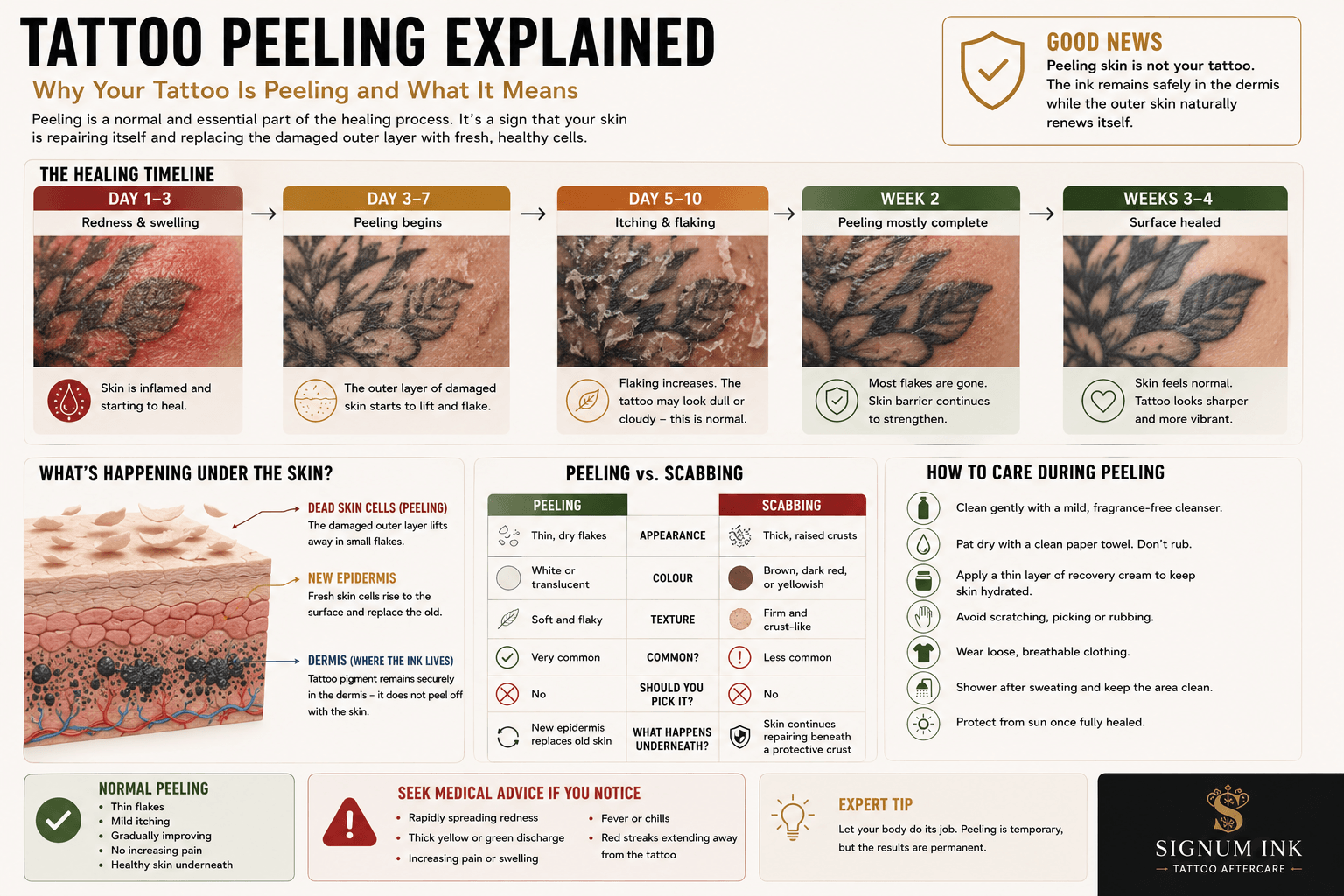
Für die meisten Leute beginnt das Schälen zwischen Tag 3 und Tag 7 nachdem man sich tätowieren ließ.
Es dauert normalerweise mehrere Tage bis etwa eine Woche, abhängig von der Größe des Tattoos, seiner Platzierung und der individuellen Heilung.
Peeling ist ein normaler Teil der Hauterneuerung und es tut nicht Das bedeutet, dein Tattoo löst sich ab.
Kurz & Bündig
Beginnt normalerweise
Tag 3–7
Dauert typischerweise
4–10 Tage
Häufigstes Erscheinungsbild
- Dünne Hautschuppen
- Leichter Juckreiz
- Vorübergehende Dumpfheit
- Leichte Hautstraffung
Normalerweise nicht normal
- Dicker gelber oder grüner Ausfluss
- Schnell zunehmende Rötung
- Starke Schmerzen
- Fieber
- Stinkende Kanalisation
Warum schält sich ein Tattoo?
Um Peeling zu verstehen, hilft es zu verstehen, was Tätowierungen tatsächlich mit der Haut machen.
Eine Tätowiernadel durchdringt die Epidermis und bringt Pigment in die Dermis.
Während das Pigment in der Dermis verbleibt, erfährt die Epidermis tausende mikroskopischer Verletzungen.
Während die Heilung beginnt, werden die beschädigten Oberflächenzellen nach und nach durch neue, gesunde Haut ersetzt.
Die alten Zellen müssen sich schließlich von der Oberfläche trennen.
Das ist die Schale, die Sie sehen.
Die Haut erneuert sich ständig
Auch ohne Tätowierung erneuert sich Ihre Haut ständig, indem sie alte Zellen ersetzt.
Die äußerste Hautschicht – die Hornschicht—natürlich mit der Zeit abfällt.
Tätowieren beschleunigt diesen Prozess vorübergehend.
Anstatt mehrere Wochen auf den normalen Zellumsatz zu warten, werden beschädigte Oberflächenzellen viel schneller entfernt, sodass gesunde Haut sie ersetzen kann.
Peeling ist also ein Zeichen dafür, dass Ihre Haut genau das tut, wofür sie geschaffen wurde.
Was passiert unter der Haut während eines Peelings?
Obwohl an der Oberfläche Abblätterungen sichtbar sind, geschieht darunter viel mehr.
Mehrere biologische Prozesse laufen gleichzeitig ab.
Neue epidermale Zellen steigen an die Oberfläche
Frische Hautzellen, die sich in den unteren Schichten der Epidermis bilden, wandern allmählich nach oben.
Während sie beschädigte Zellen ersetzen, beginnt sich die alte Oberflächenschicht abzulösen.
Die Hautbarriere baut sich weiter auf
Während der Schälphase ist die Hautbarriere noch unvollständig.
Das ist der Grund, warum sich die Tätowierung anfühlen kann:
- Eng
- Trocken
- Leicht empfindlich
- Leicht juckend
Die Unterstützung der Flüssigkeitszufuhr in dieser Phase hilft, den Hautkomfort zu erhalten, während sich die Barriere weiter erholt.
Feuchtigkeitshaushaltänderungen
Frische Tattoos verlieren schneller Wasser, da die Hautbarriere gestört ist.
Während sich die Barriere repariert, verbessert sich die Feuchtigkeitsspeicherung allmählich.
Dies ist ein Grund, warum leichte Feuchtigkeitspflege auch nach Beginn des Schälens hilfreich bleibt.
Warum sieht das Tattoo stumpf aus?
Viele Leute glauben, dass die Tätowierung verblasst, wenn das Schälen beginnt.
Glücklicherweise ist das fast nie der Fall.
Das Tattoo sieht stumpf aus, weil:
- Trockene Haut streut Licht.
- Neue Epidermiszellen entwickeln sich noch.
- Winzige Flocken bedecken das Tattoo vorübergehend.
Sobald die Schuppung abgeschlossen ist und die Hautfeuchtigkeit wieder normal ist, erscheint das Tattoo normalerweise wieder schärfer und lebendiger.
Warum du die Haut niemals selbst abziehen solltest
Einer der größten Fehler während der Tätowierheilung ist das Abreißen loser Hautschuppen, bevor sie sich von selbst lösen.
Obwohl es verlockend sein kann, kann das manuelle Entfernen von sich schälender Haut:
- Reizendes heilendes Gewebe.
- Entzündung steigern.
- Verzögere normale Heilung.
- Das Risiko, Bakterien einzuschleppen, erhöhen.
- Führen zu unnötigen Hautschäden.
Lassen Sie die Haut auf natürliche Weise abfallen.
Dein Körper weiß bereits genau, wann diese Oberflächenzellen bereit sind, abzufallen.
Ist jede Tätowierung gleich?
Gern geschehen.
Mehrere Faktoren beeinflussen, wie stark die Ablösung auftritt.
Tattoo-Größe
Große Tätowierungen schälen sich normalerweise stärker als kleine Tätowierungen, da eine größere Hautfläche betroffen ist.
Tattoo-Platzierung
Bereiche, die sich häufig bewegen – wie Ellbogen, Knie, Hände, Füße oder Rippen – können sich aufgrund von Reibung und Dehnung unterschiedlich abpellen.
Tattoo-Stil
Schwere Farbpakete und massive schwarze Arbeiten erfordern oft mehr Nadelstiche als Feintattooings, was zu einer stärkeren Schuppenbildung führen kann.
Individueller Hauttyp
Trockene Haut neigt von Natur aus zu stärkerer sichtbarer Schuppenbildung als gut mit Feuchtigkeit versorgte Haut.
Jede Person heilt in einem etwas anderen Tempo.
Unterstützung Ihrer Haut während der Schälphase
Das Ziel beim Peeling ist nicht, den Prozess zu stoppen – es ist, gesunde Haut dabei zu unterstützen.
Eine ausgewogene Nachsorge-Routine beinhaltet im Allgemeinen:
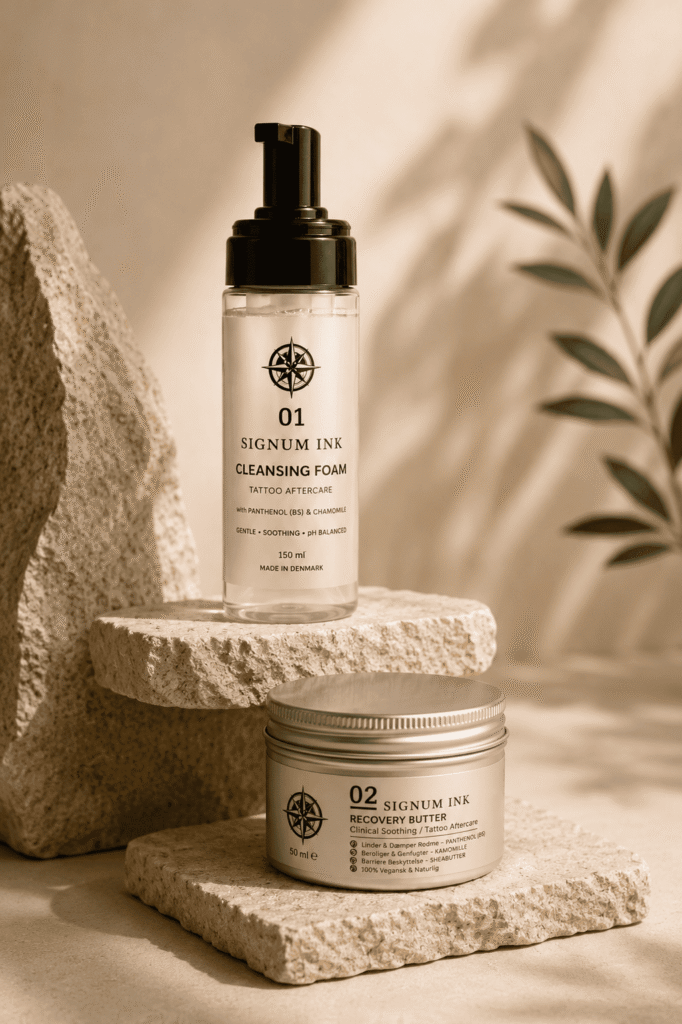
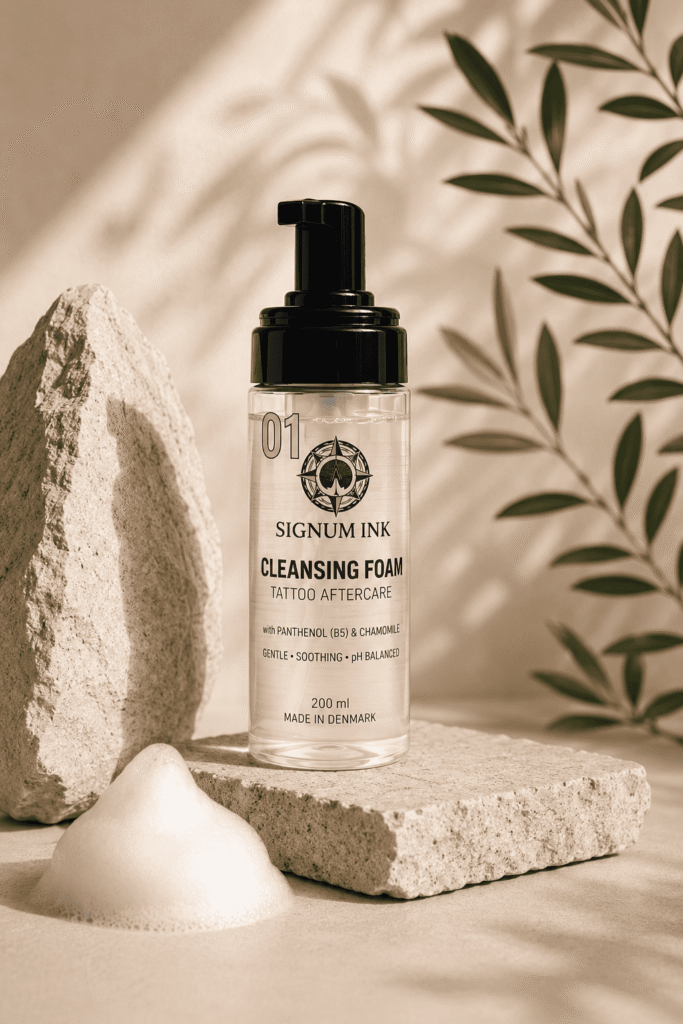
- Sanfte Reinigung mit einem milden Schaumreiniger.
- Patting the tattoo dry instead of rubbing.
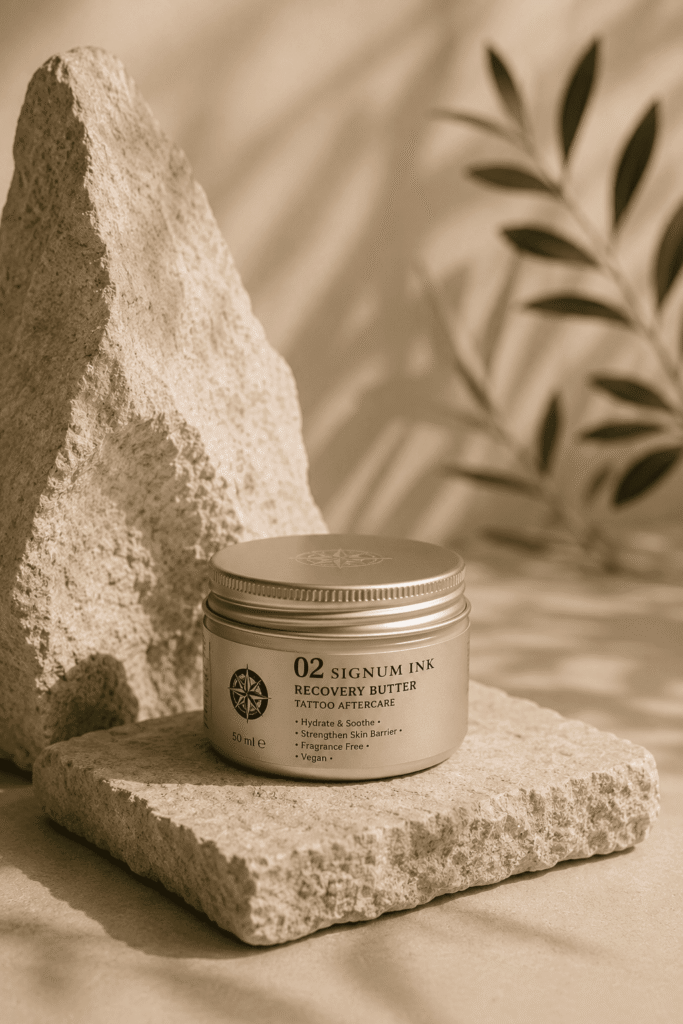
- Applying a thin layer of recovery cream to maintain hydration.
- Avoiding scratching or picking at loose skin.
- Wearing loose, breathable clothing when possible.
Healthy hydration helps improve skin comfort while allowing the skin barrier to recover naturally.
Tattoo Peeling vs. Scabbing
Many people use the terms Peeling und Verkrustung interchangeably.
However, they are not the same process.
Understanding the difference helps explain what your tattoo is doing during healing.
Normal Tattoo Peeling
Peeling is part of the skin’s natural renewal process.
It usually appears as:
- Dünne, trockene Flocken.
- Small pieces of peeling skin.
- Milder Juckreiz.
- Temporary dullness.
The flakes separate naturally as new epidermal cells replace the damaged surface.
Verkrustung
Scabs are different.
A scab forms when blood or plasma dries on the surface of a wound.
Small, thin scabs may occasionally develop on certain tattoos, particularly after heavy colour packing or longer tattoo sessions.
Large, thick, raised scabs are less typical and may indicate that the skin experienced greater trauma during tattooing or that healing has been disrupted.
Allow any scabs to detach naturally rather than picking at them.
Tattoo Peeling vs. Infection
Peeling alone is nicht ein Zeichen einer Infektion.
In fact, peeling is expected during normal healing.
Instead, pay attention to the overall pattern.
Normales Peeling
Beinhaltet normalerweise:
- Thin flakes.
- Milder Juckreiz.
- Allmählich abklingende Rötung.
- No increasing pain.
- Healthy-looking skin beneath the flakes.
Symptome, die ärztlich abgeklärt werden müssen
Prompt medical evaluation is appropriate if peeling is accompanied by:
- Schnell ausbreitende Rötung.
- Dicker gelber oder grüner Ausfluss.
- Increasing swelling.
- Severe pain.
- Fieber oder Schüttelfrost.
- Rote Streifen, die sich vom Tattoo weg erstrecken.
Diese Symptome Infektion nicht automatisch bestätigen, but they should be assessed by a healthcare professional.
Why Does Peeling Make Tattoos Itch?
Itching is one of the most common parts of the peeling phase.
Several biological processes contribute to this sensation.
New Skin Is Forming
As fresh epidermal cells develop, the skin surface becomes temporarily tighter.
This tightening can stimulate nerve endings, leading to mild itching.
The Skin Barrier Is Still Recovering
The protective barrier has not yet fully recovered.
As moisture escapes more easily, the skin becomes drier.
Dry skin naturally feels itchier.
Nerve Endings Continue Healing
Tiny nerve endings affected during tattooing continue repairing themselves throughout the first weeks.
This regeneration may contribute to occasional itching.
How Long Does Tattoo Peeling Last?
The peeling stage varies between individuals, but most tattoos follow a similar pattern.
| Zeit nach der Tätowierung | What Usually Happens |
|---|---|
| Tage 1–3 | Redness and swelling |
| Tage 3–7 | Peeling beginnt |
| Tage 5–10 | Most visible peeling |
| Woche 2 | Peeling largely finished |
| Wochen 3–4 | Surface appears healed |
Larger tattoos and areas exposed to more movement may continue peeling slightly longer.
Was sagt die Forschung?
The outermost layer of the skin, known as the Hornschicht, is continuously renewed throughout life.
Following tattooing, this renewal process temporarily accelerates as damaged surface cells are replaced.
Scientific research on wound healing shows that this controlled shedding of damaged cells is a normal part of epidermal regeneration.
At the same time, deeper repair continues within the dermis, where collagen fibers reorganize and immune cells continue interacting with tattoo pigment.
This is why a tattoo may look healed long before biological healing is complete.
Why Moisture Matters During Peeling
One of the biggest misconceptions is that peeling skin should simply be allowed to become completely dry.
In reality, healthy healing depends on maintaining an appropriate moisture balance.
The goal is nicht to keep the tattoo constantly wet or heavily coated with ointment.
Instead, modern tattoo aftercare aims to support the skin barrier by maintaining comfortable hydration while allowing natural skin renewal to continue.
Balanced formulations often include:
- Feuchthaltemittel such as Glycerin.
- Barrier-supporting ingredients such as Ceramides.
- Lightweight emollients such as Squalane.
- Skin-conditioning ingredients such as Panthenol.
Together these ingredients help maintain skin comfort during the peeling phase.
Common Mistakes During Peeling
Many people accidentally interfere with healing because peeling can look alarming.
Häufige Fehler sind:
Picking Loose Skin
Removing flakes before they detach naturally may irritate the skin and delay healing.
Kratzen
Although itching is normal, scratching may damage newly formed skin.
Using Harsh Cleansers
Strong soaps may further dry the skin while the barrier is still rebuilding.
Applying Excessive Product
A thick layer of ointment is not necessarily better.
A thin, even application is generally sufficient to support hydration.
Ignoring Sun Protection
Healing skin is particularly vulnerable to UV exposure.
Once fully healed, regular sunscreen use helps preserve tattoo colour over the long term.
Forschungsbericht
| Forschungsbereich | Beweis |
|---|---|
| Epidermale Regeneration | ★★★★★ |
| Skin Barrier Repair | ★★★★★ |
| Feuchtigkeitshaushalt | ★★★★★ |
| Wundheilungsbiologie | ★★★★★ |
| Tattoo-Nachsorge | ★★★★☆ |
| Tattoo Peeling Studies | ★★★★☆ |
Frequently Asked Questions About Tattoo Peeling
Ist es normal, dass sich eine Tätowierung schält?
Ja.
Peeling is one of the most common stages of tattoo healing.
As the outer layer of damaged skin is replaced with healthy new skin, small flakes naturally separate from the surface.
For most people, peeling begins between Day 3 and Day 7 and lasts for several days.
Is my tattoo losing ink when it peels?
Nein.
This is one of the biggest misconceptions about tattoo healing.
The peeling skin consists of dead epidermal cells.
The tattoo pigment is stored much deeper within the Dermis, where it remains during the healing process.
Although tiny amounts of excess surface pigment may be present in the peeling skin, your tattoo itself is not peeling away.
Why does my tattoo look faded while peeling?
Dry, peeling skin changes the way light reflects from the tattoo.
In addition, newly formed epidermal cells temporarily cover the tattoo, making colours appear softer or cloudy.
As healing continues and the skin barrier recovers, the tattoo usually regains its normal clarity.
Can I remove the peeling skin?
Nein.
Allow the skin to separate naturally.
Pulling away loose flakes may irritate the skin, delay healing, and increase the risk of introducing bacteria.
Patience is one of the most important parts of successful tattoo aftercare.
Why is my tattoo itchy while peeling?
Mild itching is a normal part of healing.
Several factors contribute, including:
- Neue Hautbildung.
- Vorübergehende Trockenheit.
- Barrier repair.
- Heilung von Nervenenden.
Avoid scratching the tattoo, as this may damage newly formed skin.
Can I moisturize while my tattoo is peeling?
Ja.
Maintaining appropriate hydration helps support the skin barrier while reducing tightness and discomfort.
Apply a thin layer of a suitable recovery cream rather than a thick coating.
The goal is to support the skin—not to saturate it.
Does every tattoo peel?
Almost every tattoo experiences some degree of peeling.
However, the amount varies depending on:
- Tattoo-Größe.
- Tattoo location.
- Individueller Hauttyp.
- Tattooing technique.
- Personal healing response.
Some tattoos produce only very fine flakes that are barely noticeable.
Why is one part of my tattoo peeling more than another?
Different sections of a tattoo may receive different numbers of needle passes.
Areas with heavier shading or solid colour often peel more noticeably than fine-line sections.
Diese Abweichung ist normalerweise normal.
Can peeling last longer than one week?
Manchmal.
Large tattoos, tattoos on high-movement areas, or naturally dry skin may continue peeling for a little longer.
The important point is that the skin should gradually improve over time.
Wann sollte ich ärztlichen Rat einholen?
Seek prompt medical assessment if peeling is accompanied by:
- Schnell ausbreitende Rötung.
- Zunehmende Schmerzen.
- Dicker gelber oder grüner Ausfluss.
- Fieber oder Schüttelfrost.
- Significant swelling that worsens.
- Rote Streifen, die sich vom Tattoo weg erstrecken.
These symptoms are not typical of uncomplicated peeling und eine professionelle Bewertung verdienen.
Common Myths About Tattoo Peeling
Myth 1: Peeling means the tattoo is healing badly.
Realität
Peeling is a normal part of skin regeneration and usually indicates that the outer layer of damaged skin is being replaced.
Myth 2: The tattoo ink is coming off with the peeling skin.
Realität
The pigment remains in the dermis.
Only dead surface skin cells are being shed.
Myth 3: The more you moisturize, the better.
Realität
Healthy healing depends on balance.
Applying an excessively thick layer of product is not more effective than applying a thin, even layer.
Myth 4: Peeling should stop after a few days.
Realität
Healing varies from person to person.
Some tattoos continue producing small flakes for more than a week, particularly if they are large or located on areas that move frequently.
Healing Timeline
| Zeit nach der Tätowierung | Typical Changes |
|---|---|
| Tag 1 | Redness and mild swelling |
| Tage 2–3 | Skin begins drying |
| Tage 3–7 | Peeling usually starts |
| Tage 5–10 | Most visible flaking |
| Woche 2 | Peeling largely complete |
| Wochen 3–4 | Surface healing complete |
| Wochen 6–8 | Deeper remodeling continues |
Forschungsbericht
| Forschungsbereich | Beweis |
|---|---|
| Epidermal Cell Renewal | ★★★★★ |
| Skin Barrier Repair | ★★★★★ |
| Wundheilungsbiologie | ★★★★★ |
| Feuchtigkeitshaushalt | ★★★★★ |
| Tattoo-Nachsorge | ★★★★☆ |
| Tattoo Peeling Research | ★★★★☆ |
Experten-Tipp
Don’t judge your tattoo while it is peeling.
During this stage, the skin is dry, the barrier is still rebuilding, and a thin layer of new epidermis temporarily covers the tattoo. Once peeling is complete and hydration returns to normal, the tattoo typically appears sharper, brighter, and more defined.
Signs Your Tattoo Is Peeling Normally
✅ Thin, dry flakes.
✅ Mild itching.
✅ Temporary dull appearance.
✅ Gradually improving redness.
✅ No increasing pain.
✅ Healthy skin visible beneath the flakes.
Anzeichen, die eine ärztliche Untersuchung erfordern
⚠️ Dickflüssiger gelber oder grüner Ausfluss.
⚠️ Rapidly spreading redness.
⚠️ Increasing swelling.
Fieber oder Schüttelfrost.
⚠️ Severe or worsening pain.
⚠️ Red streaks extending beyond the tattoo.
If these symptoms occur, seek prompt medical advice rather than assuming they are part of normal peeling.
Why Modern Tattoo Aftercare Supports the Skin Barrier
Peeling is a reminder that the skin barrier is still recovering.
Rather than trying to stop the peeling process, modern aftercare focuses on supporting the skin while it heals.
A balanced recovery cream often combines ingredients that work together:
| Funktion | Example Ingredient |
|---|---|
| Attracts moisture | Glycerin |
| Supports cellular hydration | Betain |
| Reinforces the skin barrier | Ceramide |
| Supports barrier function | Niacinamid |
| Hautpflege | Panthenol |
| Lightweight emollient | Squalane |
| Improves spreadability | Capryl-Capric-Triglyceride |
| Botanical support | Madecassosid |
| Antioxidant protection | Vitamin E |
| Skin comfort | Allantoin |
Each ingredient plays a different role, helping the skin maintain hydration and rebuild its natural protective barrier during the healing process.
Abschließende Gedanken
Tattoo peeling is one of the clearest signs that your skin is progressing through its natural healing cycle.
Although the dry flakes and temporary dullness may look concerning, they are usually evidence that damaged surface cells are being replaced by healthy new skin. Throughout this process, the tattoo pigment remains safely within the dermis while the epidermis renews itself above it.
The best approach is to let your body do what it is designed to do. Cleanse the tattoo gently, keep the skin comfortably hydrated, avoid picking at loose flakes, and give the healing process time to unfold.
Understanding the science behind tattoo peeling can turn a worrying stage into a reassuring one. When you know that peeling is part of healthy skin renewal—not a sign that your tattoo is disappearing—you can focus on supporting your skin rather than fighting the process.
 English
  German