Introduction
A tattoo can look healed long before it has actually finished healing.
This is one of the biggest misconceptions about tattoo aftercare.
Once the peeling stops and the skin feels smooth again, many people assume the healing process is complete.
In reality, your skin continues repairing itself beneath the surface for several more weeks.
Understanding the difference between surface healing and complete healing helps you know when it’s safe to return to your normal routine—and why aftercare still matters even after your tattoo looks finished.
In this guide, we’ll explain what happens beneath the skin, how long healing usually takes, and the signs that your tattoo has fully recovered.
Surface Healing vs. Complete Healing
Healing happens in stages.
The first stage is what you can see.
During the first couple of weeks, you may notice:
- Redness
- Mild swelling
- Peeling
- Itching
- Dryness
These visible changes gradually disappear as the outer layer of skin repairs itself.
However, beneath the surface, deeper layers of the skin continue rebuilding.
Pigment settles into place while the skin barrier becomes stronger.
This internal healing process simply takes longer.
How Long Does Tattoo Healing Usually Take?
Every tattoo is different.
Several factors influence healing, including:
- Tattoo size
- Placement
- Your general health
- Your skincare routine
- Your immune system
For many people:
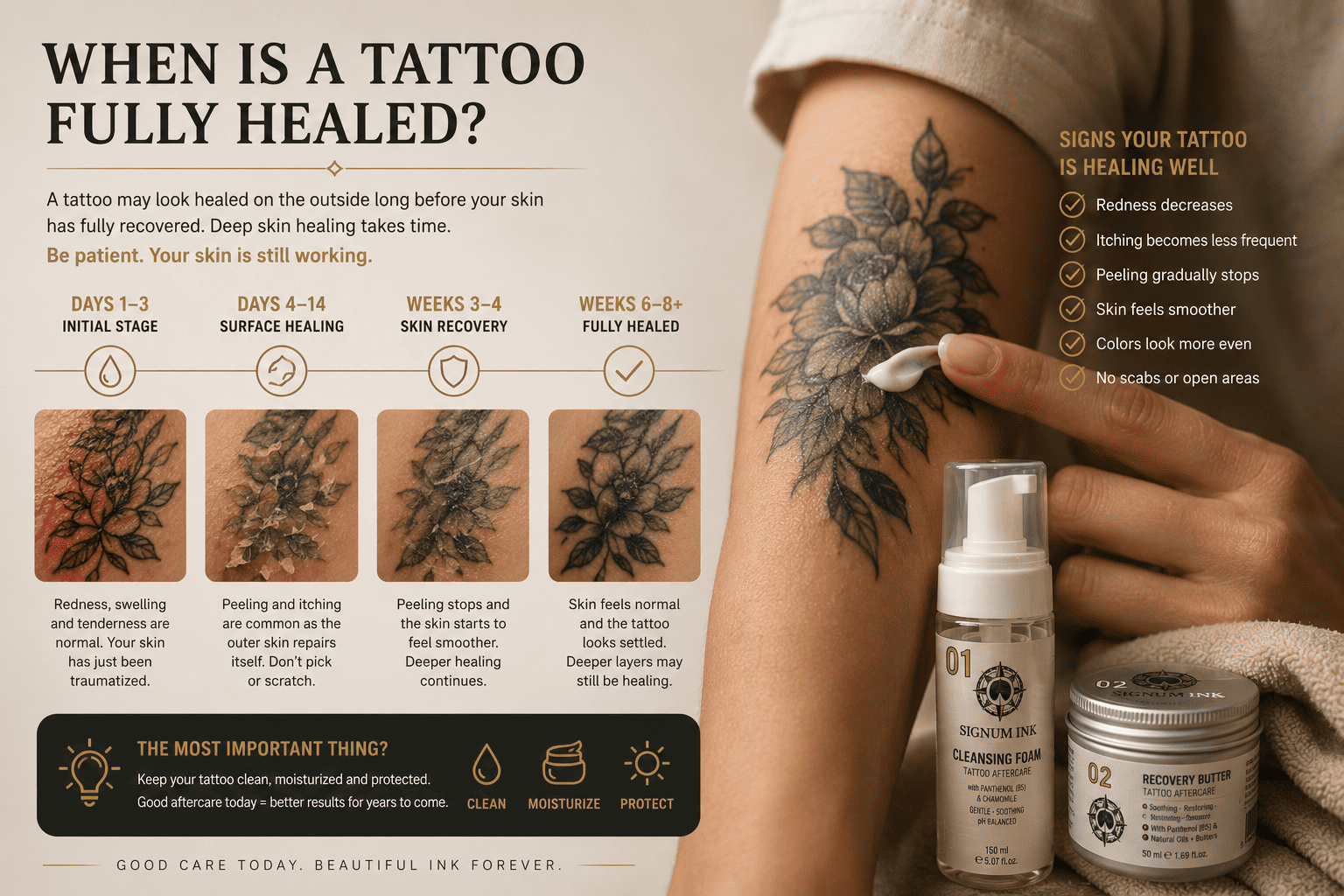
- The outer skin appears healed after 2–4 weeks.
- Deeper healing often continues for 6–8 weeks, and sometimes longer.
This is why many tattoo artists recommend continuing gentle aftercare even after the tattoo looks normal.
Signs Your Tattoo Is Healing Well
A healthy tattoo usually becomes more comfortable with each passing week.
Positive signs include:
- Less redness
- Reduced sensitivity
- Peeling gradually stopping
- Skin feeling smoother
- Itching becoming less frequent
- Colours appearing more even
Healing is rarely perfectly linear.
Some days your tattoo may feel slightly drier or itchier than others.
This is usually part of the normal healing process.
What Happens Beneath the Skin?
Although you can’t see it happening, your immune system continues working long after the tattoo appears healed.
Specialised immune cells help stabilise the pigment while the surrounding tissue repairs itself.
At the same time:
- Collagen is remodelled.
- The skin barrier strengthens.
- Moisture balance gradually returns to normal.
These internal processes explain why a tattoo may continue changing subtly even after peeling has finished.
Can a Tattoo Look Dull Before It Brightens?
Yes.
Many people notice a temporary cloudy or slightly dull appearance during healing.
This is sometimes called the “silver skin” stage.
A thin layer of newly formed skin temporarily sits above the tattoo while deeper healing continues.
As the skin matures, the tattoo gradually becomes clearer again.
This stage is completely normal.
When Can You Stop Your Aftercare Routine?
Many people stop caring for their tattoo as soon as it stops peeling.
That’s often earlier than necessary.
Even after the surface looks healed, continuing with:
- Gentle washing
- Regular moisturizing
- Sun protection
helps support the skin while deeper healing continues.
Good skincare doesn’t end when the peeling stops—it simply becomes part of maintaining healthy skin.
Healing Isn’t a Race
Every person’s skin heals differently.
Comparing your tattoo with someone else’s rarely provides useful answers.
Some tattoos appear fully settled within six weeks.
Others continue improving for several months.
The most important thing is gradual progress rather than trying to meet a specific deadline.
What Can Affect Healing Time?
No two tattoos heal in exactly the same way.
Several factors influence how quickly your skin recovers, including:
- The size of the tattoo
- Its location on your body
- Your age
- Your overall health
- Your immune system
- Your daily aftercare routine
For example, tattoos placed over joints or areas that move frequently may take a little longer to settle because the skin experiences more stretching during everyday activities.
Likewise, larger tattoos often require more time simply because more skin needs to repair itself.
Can You Speed Up Tattoo Healing?
Your body heals at its own pace.
There isn’t a product or technique that can dramatically speed up the natural healing process.
What you can do is create the best possible conditions for your skin to recover.
Helpful habits include:
- Washing your tattoo gently.
- Keeping the skin comfortably moisturized.
- Avoiding unnecessary scratching.
- Protecting the tattoo from excessive sun exposure.
- Staying hydrated.
- Eating a balanced diet.
- Getting enough sleep.
Healthy skin heals more efficiently when your body is well supported.
When Should You Be Concerned?
Most tattoos heal without complications.
However, you should seek advice from a healthcare professional if your tattoo develops symptoms such as:
- Increasing redness after several days.
- Worsening swelling.
- Thick yellow or green discharge.
- Fever or chills.
- Increasing pain instead of gradual improvement.
These symptoms are not typical of normal healing and may require medical assessment.
Common Myths About Tattoo Healing
Myth 1: My Tattoo Looks Healed, So It Is Healed
Not necessarily.
The surface often heals weeks before the deeper layers of the skin finish repairing.
Myth 2: More Moisturizer Means Faster Healing
No.
Keeping your skin comfortably moisturized supports healing, but applying excessive amounts won’t speed up the process.
A thin layer is usually all that’s needed.
Myth 3: Every Tattoo Heals in Exactly Two Weeks
False.
Healing time varies from person to person and from tattoo to tattoo.
Patience is more important than following an exact timeline.
Myth 4: Once It’s Healed, It Doesn’t Need Care Anymore
Your tattoo may no longer require special aftercare, but it still benefits from good skincare.
Regular moisturizing and sun protection help preserve your tattoo’s appearance over time.
Frequently Asked Questions
How do I know when my tattoo is fully healed?
A fully healed tattoo generally feels like the surrounding skin.
There should be no peeling, scabbing, tenderness or noticeable dryness, and the skin should look smooth and even.
Why does my tattoo still look shiny?
A slightly shiny appearance often means the outer skin has healed, while deeper layers are still recovering.
This is a normal part of the healing process for many people.
Can my tattoo still change after one month?
Yes.
Subtle improvements in the skin’s appearance can continue for several weeks after the visible healing has finished.
Should I keep moisturizing after my tattoo has healed?
Yes.
Healthy skin helps your tattoo continue looking vibrant.
Moisturizing is part of good long-term skincare rather than just tattoo aftercare.
Does every tattoo heal at the same speed?
No.
Healing depends on many individual factors, including tattoo size, placement and your body’s natural healing response.
Conclusion
Tattoo healing doesn’t end when the peeling stops.
Although the surface may appear healed after a few weeks, deeper layers of your skin continue repairing themselves for several more weeks.
Understanding this difference helps you avoid returning to your normal routine too quickly and reminds you that aftercare is still important even when your tattoo looks finished.
Be patient.
Keep your skin clean.
Moisturize when needed.
Protect your tattoo from excessive sunlight.
With consistent care and a little time, your tattoo can heal comfortably and maintain its appearance for years to come.
Continue Learning
Want to understand exactly what your skin is doing throughout every stage of tattoo healing?
→ Read: The Complete Science of Tattoo Healing: What Happens to Your Skin from Day 1 to Day 60
 English
  German
  Dutch
Dutch  Danish
  Swedish
  French
  Italian