Introduction
Have you ever run your fingers across your tattoo and noticed that it feels raised?
Perhaps it healed perfectly months ago, yet parts of the design suddenly feel slightly elevated or uneven.
Or maybe your brand-new tattoo feels raised and you’re wondering whether something has gone wrong.
The good news is that raised tattoos are surprisingly common.
In many cases, they’re simply part of the normal healing process.
In other situations, a raised tattoo may be related to scar tissue, skin irritation or a reaction that deserves closer attention.
This guide explains why tattoos become raised, when it’s considered normal and when it’s worth seeking professional advice.
What Does a Raised Tattoo Mean?
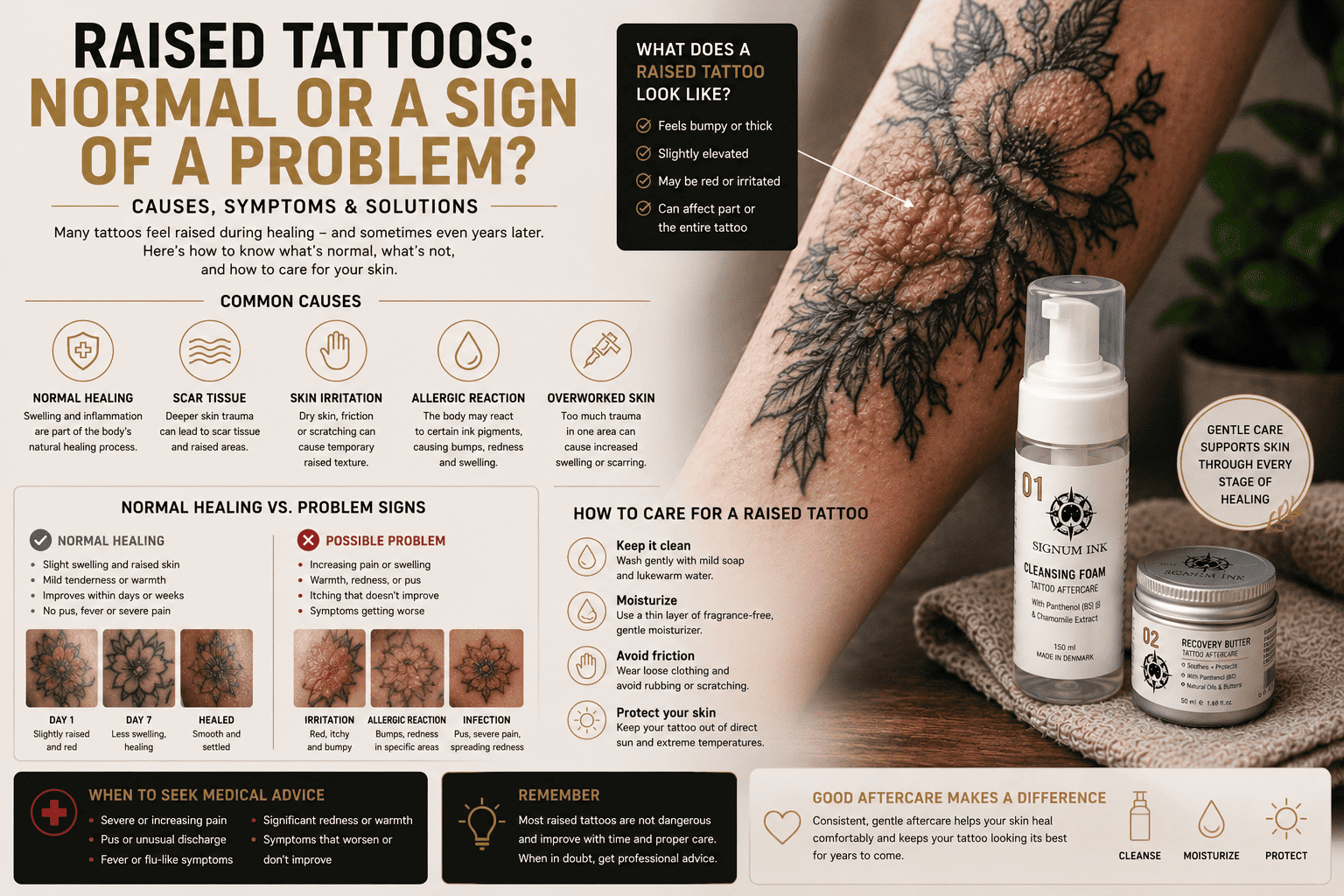
A raised tattoo simply means that part or all of the tattoo sits slightly above the surrounding skin.
It may feel:
- Slightly bumpy.
- Firm.
- Thickened.
- Uneven to the touch.
Sometimes only certain lines are raised.
Other times, the entire tattoo feels elevated.
The appearance depends on the underlying cause.
Raised Tattoos During Healing
During the first few weeks after getting tattooed, mild swelling is completely normal.
Your immune system is repairing thousands of tiny needle punctures while rebuilding the skin.
As a result, your tattoo may temporarily feel:
- Warm.
- Slightly swollen.
- Firm.
- Raised.
These changes usually improve as healing progresses.
Raised Tattoos Months or Years Later
Many people are surprised when an old tattoo suddenly feels raised.
This can happen even if the tattoo healed perfectly years ago.
Possible explanations include:
- Changes in temperature.
- Humidity.
- Dry skin.
- Mild immune responses.
- Individual skin sensitivity.
These temporary changes often settle without treatment.
What Causes Raised Tattoos?
Several factors may contribute.
The most common include:
Normal Healing
Inflammation during healing naturally causes the skin to swell.
This is expected during the early stages.
Scar Tissue
If the skin was damaged more deeply than intended during tattooing, small amounts of scar tissue may develop.
This can leave certain areas permanently raised.
Skin Irritation
Dry skin, friction or repeated scratching may temporarily make a tattoo feel thicker than usual.
Allergic Reactions
Occasionally, an allergic reaction to tattoo pigment can cause persistent raised areas.
This is more likely if the tattoo also becomes itchy, red or develops bumps long after healing.
Overworked Tattoos
If an area was tattooed repeatedly during the session, the skin may respond with increased inflammation or scar formation.
Is a Raised Tattoo Dangerous?
Usually not.
Most raised tattoos are harmless and improve naturally.
The important question is whether the tattoo is changing over time.
A tattoo that:
- Gradually improves.
- Doesn’t become increasingly painful.
- Doesn’t produce discharge.
- Isn’t associated with fever.
is generally less concerning than one whose symptoms continue to worsen.
Raised Doesn’t Always Mean Scarred
One of the biggest misconceptions is that every raised tattoo is permanently scarred.
Fortunately, that’s not true.
Temporary inflammation can make even a perfectly healthy tattoo feel raised for days or weeks.
Only after healing is complete can permanent skin texture changes be properly assessed.
Observe Before You Panic
It’s natural to worry when your tattoo suddenly feels different.
However, the skin constantly changes in response to:
- Weather.
- Hydration.
- Friction.
- General health.
A tattoo that feels slightly raised today may feel completely normal again tomorrow.
Giving your skin a little time before assuming the worst is often the best approach.
How Can You Reduce a Raised Tattoo?
The best approach depends on what’s causing the raised appearance.
If your tattoo is still healing, patience is often the most effective treatment.
Continue to:
- Wash the tattoo gently.
- Moisturize with a thin layer when needed.
- Avoid scratching or picking.
- Protect the area from unnecessary friction.
If the tattoo healed long ago and only becomes raised occasionally, keeping your skin well moisturized may help improve comfort.
When Should You See a Healthcare Professional?
Although most raised tattoos are harmless, some symptoms deserve medical attention.
Contact a healthcare professional if your tattoo becomes:
- Increasingly painful.
- Significantly swollen.
- Warm to the touch.
- Produces pus or unusual discharge.
- Associated with fever.
- Rapidly changing in appearance.
These symptoms may indicate an infection or another condition that requires assessment.
Can Raised Tattoos Become Flat Again?
Often, yes.
If the raised appearance is caused by temporary inflammation or mild skin irritation, the tattoo may gradually return to its normal texture.
If the elevation is caused by scar tissue, the texture may remain permanently different.
Even then, many scars soften over time.
Every person’s skin heals differently.
Can Weather Affect a Tattoo?
Surprisingly, yes.
Some people notice that older tattoos become slightly raised during:
- Hot weather.
- Cold weather.
- High humidity.
- Seasonal changes.
Although the exact reason isn’t fully understood, changes in skin hydration and blood flow are thought to contribute.
These episodes are usually temporary and settle on their own.
Does Moisturizer Help?
If your tattoo feels dry or tight, moisturizer can improve comfort.
Apply a thin layer and allow it to absorb naturally.
Moisturizer won’t remove scar tissue, but it may reduce dryness that makes raised areas more noticeable.
Common Myths About Raised Tattoos
Myth 1: Every Raised Tattoo Is Infected
False.
Temporary swelling is common during healing, and many older tattoos occasionally become raised without any sign of infection.
Myth 2: Raised Tattoos Always Mean Bad Tattooing
Not necessarily.
While overworked skin can contribute to raised areas, individual healing responses and skin type also play an important role.
Myth 3: If a Tattoo Is Raised, It Will Stay That Way Forever
False.
Many tattoos flatten naturally as inflammation settles.
Only permanent scar tissue tends to remain raised long term.
Myth 4: Scratching a Raised Tattoo Helps
No.
Scratching may increase irritation and damage healing skin.
If your tattoo feels itchy or uncomfortable, gentle moisturizing is a better option.
Frequently Asked Questions
Is it normal for a healing tattoo to feel raised?
Yes.
Mild swelling and raised skin are common during the first weeks of healing.
These changes usually improve over time.
Why does my old tattoo suddenly become raised?
Changes in temperature, humidity, dry skin or minor immune responses may temporarily make an older tattoo feel raised.
Can a raised tattoo be a sign of an allergy?
Sometimes.
If the tattoo becomes persistently raised, itchy or inflamed—particularly in specific colored areas—it may be worth discussing with a healthcare professional.
Will moisturizer flatten my tattoo?
Moisturizer won’t remove scar tissue, but it can improve skin hydration and make the tattoo feel more comfortable.
Should I massage a raised tattoo?
Avoid massaging a tattoo that is still healing.
If you have concerns about an older raised tattoo or scar tissue, speak with a healthcare professional before trying any treatment.
Conclusion
Raised tattoos are more common than many people realize.
In most cases, they reflect normal healing or temporary changes in the skin rather than a serious problem.
The key is to pay attention to the overall pattern.
A tattoo that gradually improves is usually following a healthy recovery process.
If symptoms worsen, persist or are accompanied by pain, discharge or fever, it’s important to seek professional advice.
Understanding why tattoos become raised can help you respond calmly and give your skin the care it needs.
Continue Learning
Not sure whether your raised tattoo is part of normal healing or something more serious?
→ Read: The Complete Guide to Common Tattoo Problems: Causes, Symptoms & Solutions
 English
  German
  Dutch
Dutch  Danish
  Swedish
  French
  Italian