Introduction
One of the oldest debates in tattoo aftercare is whether a tattoo should be allowed to dry out naturally—or whether it should be moisturized throughout the healing process.
Some people believe that applying aftercare products prevents the skin from “breathing.”
Others apply moisturizer every few hours because they’re afraid the tattoo will become too dry.
So who’s right?
The answer is more balanced than either extreme.
A healing tattoo doesn’t benefit from being completely dry, nor does it heal better when it’s constantly covered in thick layers of product.
Instead, healthy tattoo healing depends on maintaining the skin’s natural moisture balance while allowing your body to repair itself.
In this guide, we’ll explain what dry healing actually means, why moisture matters and how to support your tattoo without overdoing it.
For a complete understanding of tattoo healing, we also recommend reading:
→ The Complete Science of Tattoo Healing: What Happens to Your Skin from Day 1 to Day 60
What Is Dry Healing?
Dry healing is an aftercare method where little or no moisturizer is applied during the healing process.
Instead, the tattoo is simply:
- Washed regularly
- Kept clean
- Allowed to heal naturally
The idea behind dry healing is that the body already knows how to repair damaged skin without additional products.
While this sounds logical, it doesn’t necessarily mean it’s the most comfortable approach.
Many people who use dry healing report:
- Increased tightness
- More itching
- Greater discomfort during peeling
The tattoo may still heal successfully, but the experience can be less comfortable than necessary.
What Is Moist Healing?
Moist healing takes a different approach.
Instead of allowing the skin to become excessively dry, a thin layer of aftercare product is applied to help support the skin barrier.
The goal isn’t to keep the tattoo permanently wet.
It’s simply to reduce excessive moisture loss while allowing the skin to function normally.
A well-balanced moisturizing routine may help:
- Reduce tightness
- Improve comfort
- Support the skin barrier
- Make peeling less uncomfortable
- Reduce friction from clothing
Notice that none of these benefits involve “speeding up” healing.
Your body still performs the healing.
The aftercare routine simply creates better conditions for that process.
Does Skin Need to Breathe?
One of the biggest myths in tattoo aftercare is that moisturizer prevents the skin from breathing.
In reality, healthy skin doesn’t breathe in the way many people imagine.
Oxygen and nutrients are delivered to healing skin through the bloodstream—not through exposure to air.
Applying a thin layer of moisturizer doesn’t stop your skin from healing.
In fact, healthy skin depends on maintaining its protective barrier.
The real problem isn’t moisturizer.
It’s applying far too much of it.
What Happens If a Tattoo Becomes Too Dry?
As the skin loses moisture, it naturally becomes less flexible.
This often leads to:
- Tightness
- Increased itching
- More noticeable peeling
- Greater discomfort when moving
Dry skin may also tempt people to scratch or pick at peeling flakes, increasing the risk of irritation.
Keeping the skin comfortably hydrated often makes the entire healing process much easier to manage.
Can a Tattoo Be Too Moist?
Absolutely.
This is the opposite extreme.
Applying thick layers of aftercare several times a day doesn’t improve healing.
Instead, it may leave the skin:
- Greasy
- Sticky
- Uncomfortable
Healthy tattoo aftercare isn’t about maximum moisture.
It’s about balanced moisture.
A tattoo should feel comfortable—not wet.
The Goal Isn’t Wet Skin—It’s Healthy Skin
Many people think tattoo aftercare is a choice between:
Dry skin
or
Wet skin.
In reality, neither is ideal.
The goal is healthy skin.
Healthy healing skin feels:
- Comfortable
- Flexible
- Detergere
- Lightly moisturized
- Free from excessive dryness or excess product
When you achieve that balance, your body can focus on what it does best:
Healing.
Signs Your Tattoo Is Too Dry
A certain amount of dryness is completely normal during tattoo healing.
However, skin that becomes excessively dry may feel increasingly uncomfortable.
Common signs include:
- Tightness
- Persistent itching
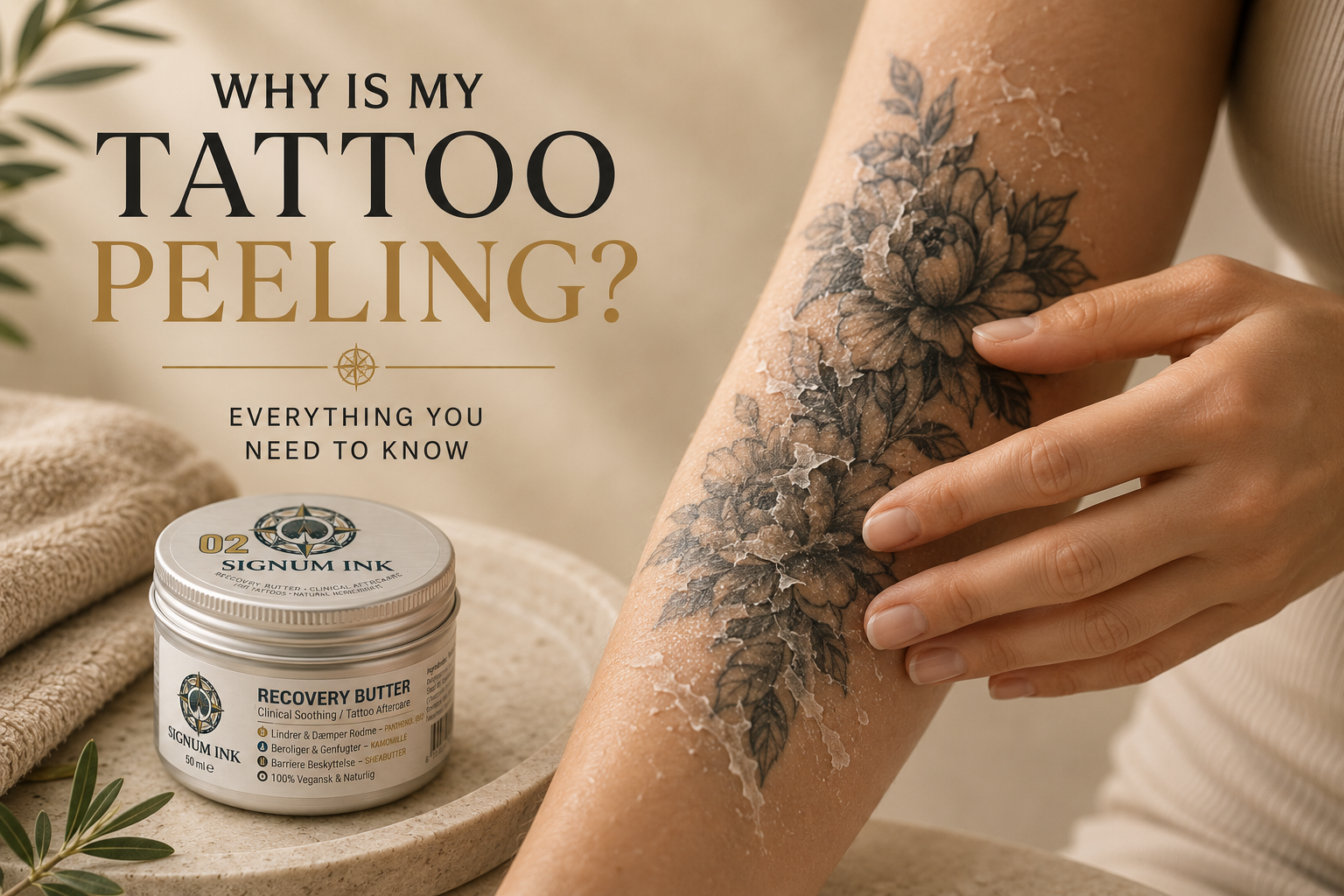
- Rough or flaky skin
- Discomfort when moving
- Peeling that feels painful rather than comfortable
These symptoms don’t necessarily mean something is wrong.
They simply indicate that your skin may benefit from a small amount of moisturizer to help restore its natural moisture balance.
Signs You’re Using Too Much Product
Many people assume that if moisturizer is good, then more must be better.
In reality, over-moisturizing is one of the most common tattoo aftercare mistakes.
Your tattoo may be receiving too much product if:
- The skin looks constantly shiny.
- Moisturizer remains visible after several minutes.
- The tattoo feels greasy.
- Clothing sticks to the tattoo.
- The skin never feels dry between applications.
Healthy skin should absorb moisturizer relatively quickly.
The goal is comfort—not a thick protective layer.
Dry Healing vs. Moist Healing
Both methods can lead to a successfully healed tattoo.
The difference is usually found in comfort rather than the final result.
| Dry Healing | Moist Healing |
|---|---|
| No moisturizer | Thin layer of aftercare |
| More tightness | Greater comfort |
| Often more itching | Usually less itching |
| More noticeable dryness | Better moisture balance |
| Minimal aftercare | Balanced daily routine |
Neither approach guarantees a better tattoo.
What matters most is keeping the tattoo clean, avoiding irritation and supporting your skin as it heals.
Finding the Right Balance
The healthiest approach usually lies somewhere between the two extremes.
Instead of asking:
“Should I let my tattoo dry out?”
A better question is:
“Does my skin feel comfortable?”
If your tattoo feels:
- Soft
- Flexible
- Comfortable
- Detergere
…then you’re probably maintaining the right balance.
If it feels painfully tight, extremely dry or constantly greasy, it’s worth adjusting your aftercare routine.
Your skin is often the best guide.
Common Mistakes
Believing More Product Means Faster Healing
Healing isn’t controlled by how much cream you apply.
Your body heals the tattoo.
Aftercare simply supports that process.
Letting the Tattoo Become Extremely Dry
Ignoring persistent dryness often makes healing unnecessarily uncomfortable.
Supporting the skin barrier is part of good aftercare.
Applying Moisturizer to Dirty Skin
Always wash the tattoo before applying aftercare whenever possible.
Clean skin provides the best environment for healing.
Constantly Touching the Tattoo
Many people repeatedly check whether the tattoo feels dry.
Frequent touching may irritate healing skin.
Sometimes the best thing you can do is simply leave it alone.
Frequently Asked Questions
Is dry healing bad?
Not necessarily.
Many tattoos heal successfully without moisturizer.
However, many people find the process significantly less comfortable.
Can moisturizer slow healing?
When applied in thin, appropriate amounts, moisturizer supports the skin barrier.
Problems usually arise only when excessive amounts are used.
Should my tattoo always feel moisturized?
No.
It should feel comfortable.
Healthy skin doesn’t need to feel wet or greasy.
Can I switch from dry healing to moisturizing?
Yes.
Many people begin using moisturizer once the tattoo starts feeling dry or tight.
Which method do tattoo artists recommend?
Recommendations vary between artists.
Regardless of the method, gentle washing, clean hands and patience remain the foundations of good tattoo aftercare.
Conclusion
The debate between dry healing and moist healing has existed for years.
Fortunately, the answer doesn’t have to be complicated.
Your tattoo doesn’t need to become extremely dry.
It also doesn’t need to be covered in thick layers of product all day.
The healthiest approach is usually the simplest:
Keep your tattoo clean.
Support your skin with light, consistent moisturization when needed.
Listen to how your skin feels.
Healing is about balance—not extremes.
Continue Learning
Want to understand the complete healing process from the day you leave the studio until your skin has fully recovered?
→ Read: The Complete Science of Tattoo Healing: What Happens to Your Skin from Day 1 to Day 60
 English
  German
  Dutch
Dutch  Danish
  Swedish
  French
  Italian