Introduction
You leave the tattoo studio excited about your new tattoo.
A few days or weeks later, you notice something unexpected.
The sharp lines don’t look quite as crisp anymore. Instead, the ink seems to have spread beneath the skin, creating a blurry or shadow-like appearance around parts of the design.
Many people immediately assume they’ve done something wrong during the healing process.
Fortunately, that’s usually not the case.
A tattoo blowout is most often related to how the ink was placed in the skin—not how you cared for your tattoo afterward.
In this guide, you’ll learn what a tattoo blowout is, why it happens, how to tell the difference between a blowout and normal healing, and what options are available if it occurs.
What Is a Tattoo Blowout?
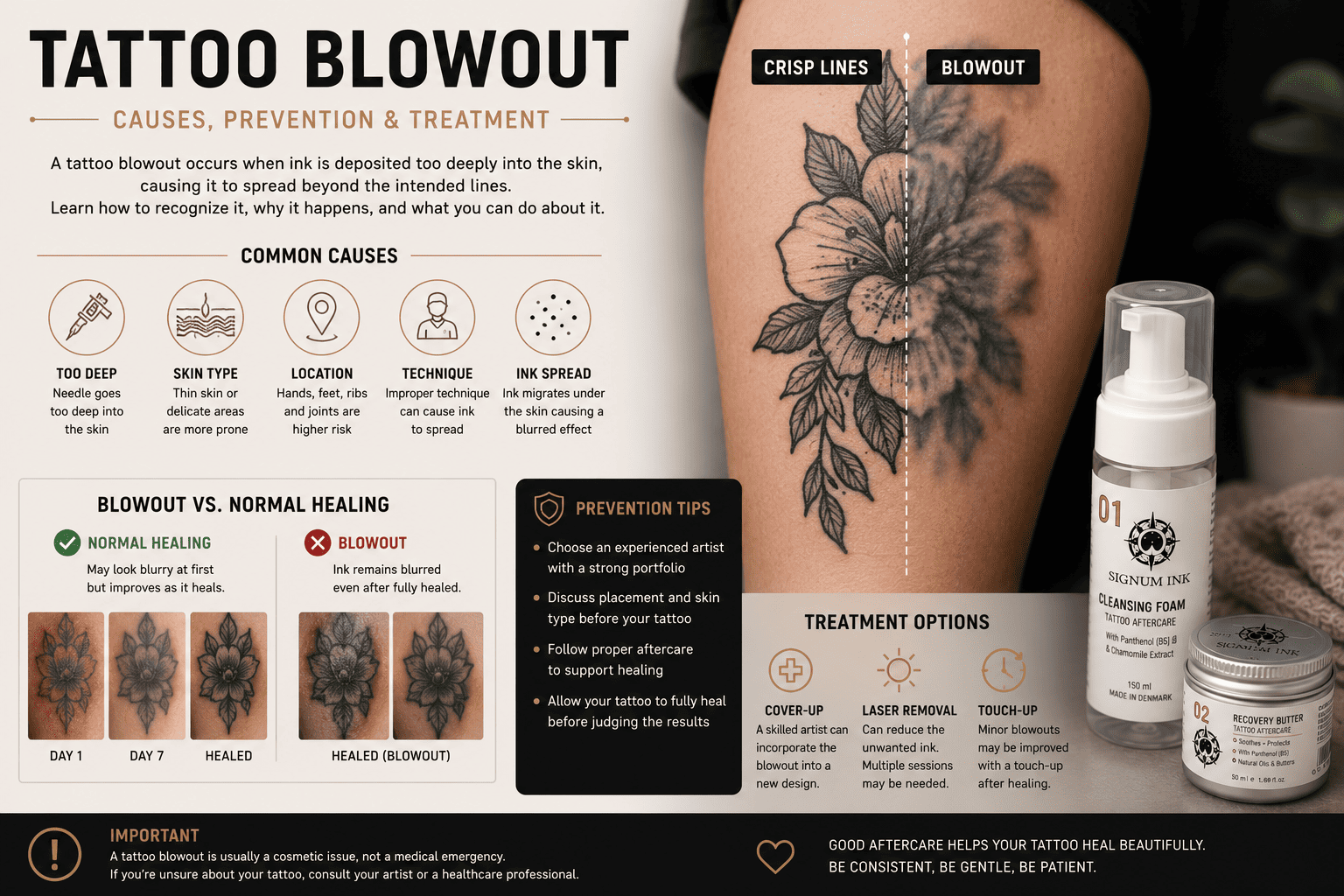
A tattoo blowout occurs when tattoo pigment spreads beyond the intended lines beneath the surface of the skin.
Instead of remaining precisely where it was placed, some of the ink migrates into the surrounding tissue.
This can create:
- Blurry edges.
- A shadow or halo around the tattoo.
- Lines that appear thicker than intended.
- Areas where the tattoo looks slightly smudged.
Unlike fading, a blowout doesn’t usually involve ink disappearing.
Instead, the ink has spread into nearby tissue.
Why Does a Tattoo Blowout Happen?
The most common cause is that the tattoo needle deposits ink deeper than intended.
Tattoo pigment should remain within the dermis—the middle layer of the skin.
If the ink is placed too deeply, it may spread through softer tissue beneath the dermis.
Several factors can contribute, including:
- Tattoo technique.
- Needle depth.
- Skin thickness.
- Tattoo location.
- Individual skin characteristics.
In most situations, the person receiving the tattoo has little or no control over whether a blowout occurs.
Common Areas Where Blowouts Occur
Some parts of the body are naturally more prone to blowouts because the skin is thinner or more flexible.
These include:
- Fingers.
- Wrists.
- Ankles.
- Tops of the feet.
- Inner arms.
- Ribs.
These areas require exceptional precision during tattooing.
Even experienced tattoo artists may occasionally encounter blowouts in these locations.
What Does a Tattoo Blowout Look Like?
Although every blowout is different, common signs include:
- A soft blue or gray shadow around the tattoo.
- Blurred outlines.
- Ink extending beyond the intended design.
- A “bleeding ink” appearance beneath the skin.
The effect is often easiest to notice on tattoos with fine lines or geometric details.
Blowout vs. Normal Healing
Many new tattoos look slightly blurry during the first days after tattooing.
This is usually caused by:
- Mild swelling.
- Surface healing.
- Ointment.
- Peeling skin.
As healing progresses, the tattoo generally becomes sharper again.
A true blowout typically remains visible after healing has finished.
Unlike temporary swelling, it doesn’t gradually disappear over time.
Can Aftercare Cause a Blowout?
This is one of the biggest myths surrounding tattoo blowouts.
The answer is almost always no.
Normal activities such as:
- Washing your tattoo.
- Applying moisturizer.
- Sleeping.
- Showering.
do not force tattoo ink deeper into the skin.
Likewise, scratching or peeling skin doesn’t create a true blowout, although it can damage the tattoo in other ways.
Proper aftercare helps your tattoo heal—but it cannot usually prevent or cause a blowout.
Not Every Blurry Tattoo Is a Blowout
Before assuming the worst, remember that several normal healing stages can temporarily affect your tattoo’s appearance.
Cloudiness, peeling and mild swelling can all make lines look softer than they really are.
For this reason, it’s generally best to wait until your tattoo has fully healed before deciding whether a blowout has actually occurred.
Can a Tattoo Blowout Be Fixed?
A tattoo blowout usually doesn’t disappear on its own.
Once the ink has spread beneath the skin, it typically remains in place.
However, several options may improve the tattoo’s appearance.
The right solution depends on:
- The size of the blowout.
- Its location.
- The tattoo design.
- Your personal preferences.
An experienced tattoo artist can help you decide which approach is most suitable.
Cover-Ups
One of the most common solutions is a cover-up.
A skilled tattoo artist may be able to:
- Widen existing lines.
- Add shading.
- Incorporate the blurred area into the design.
- Create a larger tattoo that disguises the blowout.
This approach is often effective when the blowout is relatively small.
Laser Tattoo Removal
Laser treatment may reduce or remove the unwanted spread of ink.
However, it’s important to understand that:
- Multiple sessions are usually required.
- Results vary from person to person.
- Complete removal cannot be guaranteed.
- Treatment should only be performed by qualified professionals.
Some people choose partial laser removal before getting a cover-up tattoo.
Can a Blowout Get Worse Over Time?
Most tattoo blowouts stabilize once healing is complete.
They don’t normally continue spreading year after year.
What can change over time is your perception of the tattoo.
As the tattoo naturally softens with age, a small blowout may become either more or less noticeable depending on the design, placement and surrounding skin.
How to Reduce the Risk of a Blowout
Although no tattoo can be guaranteed to heal perfectly, choosing the right tattoo artist is the single most important step.
Look for an artist who:
- Has experience with your preferred style.
- Produces consistently clean line work.
- Has healed photos in their portfolio.
- Maintains high hygiene standards.
It’s also worth discussing areas that are naturally more prone to blowouts before your appointment.
Does Aftercare Matter?
Good aftercare is essential for healthy healing.
However, it cannot usually prevent a tattoo blowout.
Proper aftercare helps reduce irritation and supports your skin while it heals, but it doesn’t change where the ink was originally deposited.
Continue to:
- Wash your tattoo gently.
- Moisturize when needed.
- Avoid picking or scratching.
- Protect the tattoo from unnecessary irritation.
These habits help your tattoo heal well, even if they can’t reverse a blowout.
Common Myths About Tattoo Blowouts
Myth 1: I Caused the Blowout by Washing My Tattoo
False.
Gentle washing doesn’t push ink deeper into the skin.
Cleaning your tattoo is an important part of proper aftercare.
Myth 2: Moisturizer Makes Ink Spread
No.
Moisturizer works on the surface of the skin.
It cannot move tattoo pigment deeper into the tissue.
Myth 3: Every Blurry Tattoo Is a Blowout
False.
Swelling, peeling and the temporary “milky” healing stage can all make a fresh tattoo appear blurry.
It’s best to wait until healing is complete before making any conclusions.
Myth 4: Blowouts Always Mean the Tattoo Artist Was Inexperienced
Not necessarily.
Even highly skilled artists can encounter blowouts in areas where the skin is especially thin or difficult to tattoo.
While technique is an important factor, individual anatomy also plays a role.
Frequently Asked Questions
Is a tattoo blowout dangerous?
No.
A blowout is considered a cosmetic issue rather than a medical emergency.
It affects the appearance of the tattoo but doesn’t usually pose a health risk.
Can a tattoo blowout heal on its own?
Generally, no.
Once the ink has spread beneath the skin, it usually remains there.
How long should I wait before deciding it’s a blowout?
It’s best to wait until your tattoo has fully healed.
Temporary swelling and peeling can make a fresh tattoo appear blurrier than it will look after healing.
Can laser treatment remove a blowout?
In some cases, yes.
Laser treatment can reduce unwanted pigment, although results vary and several sessions are often needed.
Can I tattoo over a blowout?
Often, yes.
Many small blowouts can be disguised with a carefully planned cover-up or by incorporating additional design elements.
Conclusion
A tattoo blowout can be disappointing, but it’s important to remember that it isn’t usually caused by poor aftercare.
In most cases, it’s the result of how the ink was placed in the skin or the characteristics of the skin itself.
The good news is that blowouts are cosmetic, not dangerous.
Whether you choose to leave it as it is, explore laser treatment or discuss a cover-up with an experienced tattoo artist, there are options available.
Understanding what happened allows you to make informed decisions and approach future tattoos with realistic expectations.
Continue Learning
Not sure whether you’re looking at a blowout or a normal stage of healing?
→ Read: The Complete Guide to Common Tattoo Problems: Causes, Symptoms & Solutions
 English
  German
  Dutch
Dutch  Danish
  Swedish
  French
  Italian