Introduction
Few tattoo problems create as much concern as discovering that crisp, sharp lines have started to look blurry.
Many people immediately fear that something went wrong during healing.
In reality, blurred tattoo lines can have several different causes.
One possibility is a tattoo blowout.
Unlike normal healing changes, a blowout happens when tattoo pigment spreads into surrounding tissue beneath the skin, creating a soft, blurry appearance around the design.
Although tattoo blowouts can affect the final appearance of a tattoo, understanding why they happen helps separate fact from fiction—and explains why aftercare is rarely the cause.
What Is a Tattoo Blowout?
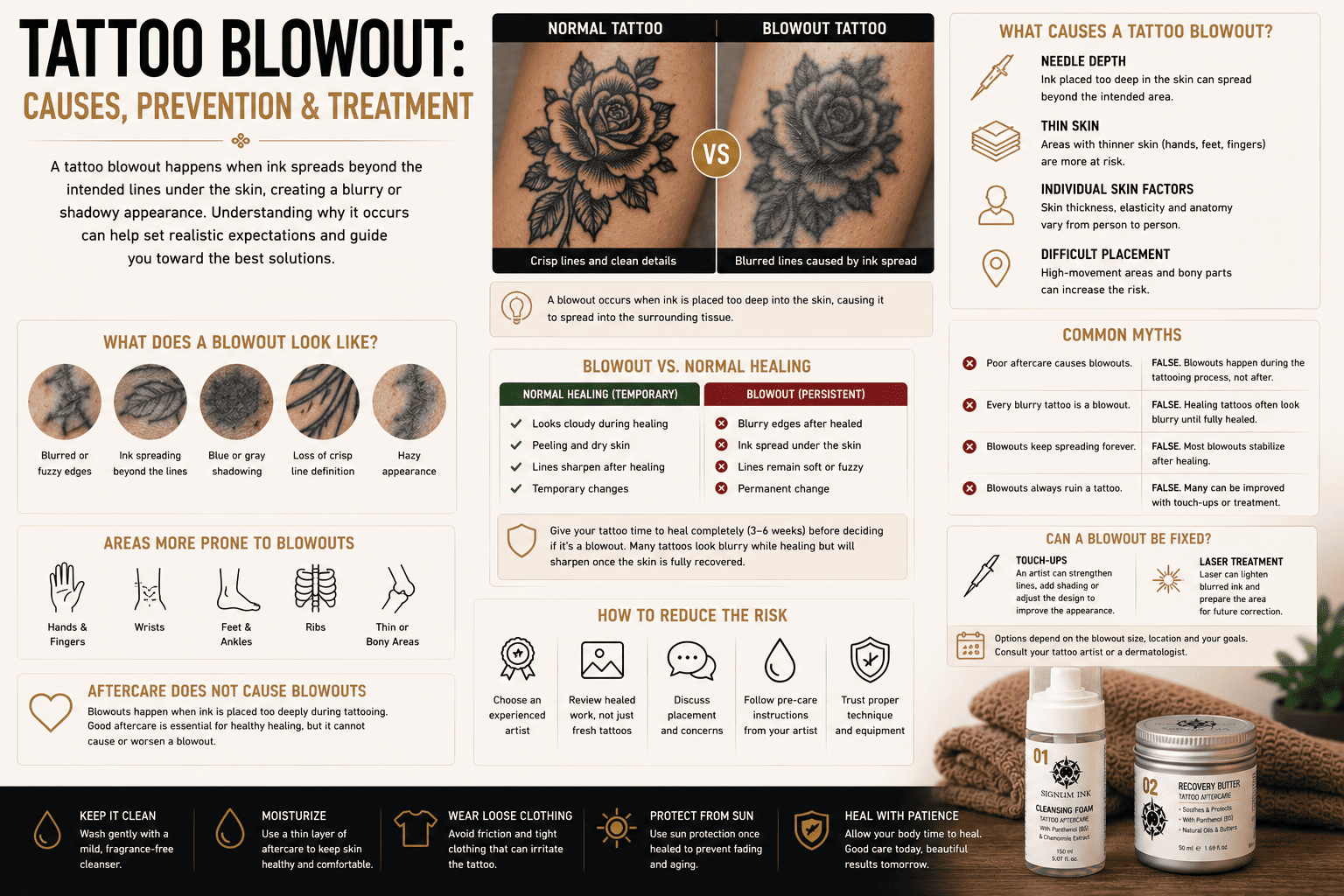
A tattoo blowout occurs when tattoo pigment spreads outside the intended tattoo lines beneath the skin.
Instead of remaining neatly within the dermis, some pigment moves into surrounding tissue.
This creates:
- Blurred edges.
- A shadow-like appearance.
- Fuzzy outlines.
- Ink that appears to spread beneath the skin.
Unlike fading, the tattoo doesn’t lose pigment.
Instead, the pigment is simply no longer confined to the original design.
What Causes a Tattoo Blowout?
Several factors may contribute.
The most common include:
Needle Depth
The most common cause is placing tattoo ink too deeply into the skin.
When pigment enters tissue beneath the ideal tattoo layer, it can spread more easily.
Thin Skin
Certain body areas naturally have thinner skin.
Examples include:
- Fingers.
- Hands.
- Wrists.
- Feet.
- Ankles.
These locations may carry a slightly higher risk because the skin layers are thinner.
Individual Skin Characteristics
Every person’s skin responds differently.
Skin thickness, elasticity and anatomy can all influence the likelihood of pigment spreading.
Difficult Tattoo Placements
Highly mobile areas or locations with limited soft tissue may present additional challenges during tattooing.
Experienced tattoo artists adjust their technique accordingly.
What Does a Tattoo Blowout Look Like?
Tattoo blowouts often have a recognizable appearance.
Typical features include:
- Soft blurry edges.
- A blue or gray haze.
- Ink extending beyond the design.
- Loss of crisp line definition.
Unlike temporary swelling, these changes generally remain visible after healing.
Tattoo Blowout vs. Normal Healing
This distinction is important because many healing tattoos temporarily look blurred.
During normal healing, tattoos may appear:
- Cloudy.
- Dry.
- Slightly dull.
- Covered by peeling skin.
Once healing finishes, the lines usually become sharper again.
A blowout, however, typically remains visible after complete healing.
Can a Blowout Get Worse Over Time?
Most tattoo blowouts become noticeable shortly after tattooing.
They generally don’t continue spreading indefinitely.
However, natural skin aging over many years may make existing blurry edges appear slightly more noticeable.
The blowout itself usually stabilizes once healing is complete.
Is a Blowout Dangerous?
Fortunately, no.
A tattoo blowout is a cosmetic issue rather than a medical emergency.
It doesn’t usually indicate infection or illness.
The primary concern is how it affects the appearance of the tattoo.
Aftercare Doesn’t Usually Cause Blowouts
One of the biggest misconceptions is that poor aftercare causes tattoo blowouts.
In reality, blowouts almost always occur during the tattooing process rather than during healing.
Good aftercare remains important for healthy skin, but it cannot push tattoo pigment deeper into the skin.
Can a Tattoo Blowout Be Fixed?
Although a tattoo blowout cannot simply disappear on its own, there are several ways to improve its appearance.
The best option depends on:
- The size of the blowout.
- Its location.
- The tattoo design.
- Your personal preferences.
An experienced tattoo artist or dermatologist can help you understand which approach is most appropriate.
Tattoo Touch-Ups
In some cases, a carefully planned touch-up can make a blowout less noticeable.
For example, your tattoo artist may:
- Strengthen surrounding lines.
- Add shading.
- Slightly adjust the design.
- Improve overall balance.
A touch-up doesn’t remove the spread pigment, but it may help disguise it.
Laser Treatment
Laser tattoo removal may sometimes be considered for more noticeable blowouts.
Depending on the situation, laser treatment may:
- Lighten the blurred pigment.
- Reduce the appearance of the haze.
- Prepare the area for a later touch-up.
Because every tattoo is different, laser treatment should always be discussed with a qualified professional.
Can You Prevent a Tattoo Blowout?
While no tattoo is completely risk-free, choosing an experienced tattoo artist is the most effective way to reduce the likelihood of a blowout.
Helpful considerations include:
- Reviewing healed tattoo examples—not just fresh tattoos.
- Choosing an artist experienced with the style you want.
- Discussing placement for areas with thinner skin.
- Following your artist’s preparation advice before the appointment.
Once tattooing has begun, the technique used by the artist is the primary factor influencing blowout risk.
When Should You Seek Professional Advice?
A tattoo blowout isn’t a medical emergency.
However, it’s worth speaking with your tattoo artist if:
- You’re unsure whether you’re seeing a blowout or normal healing.
- The tattoo still looks blurry after it has fully healed.
- You’re considering a touch-up.
- You’re interested in laser treatment.
If the tattoo is accompanied by increasing pain, swelling, discharge or fever, seek medical advice, as these symptoms are more consistent with infection than a blowout.
Common Myths About Tattoo Blowouts
Myth 1: Poor Aftercare Causes Blowouts
False.
Tattoo blowouts almost always occur during the tattooing process rather than afterward.
Good aftercare cannot force pigment deeper into the skin.
Myth 2: Every Blurry Tattoo Is a Blowout
False.
Healing tattoos often appear cloudy or slightly blurred because of peeling skin and temporary inflammation.
Many sharpen considerably once healing is complete.
Myth 3: Blowouts Continue Spreading Forever
False.
Most blowouts stabilize after healing.
Although the tattoo naturally ages over time, the pigment doesn’t continue spreading indefinitely.
Myth 4: Blowouts Always Ruin a Tattoo
Not necessarily.
Many blowouts are subtle and barely noticeable.
Others can often be improved through thoughtful touch-ups or other professional treatments.
Frequently Asked Questions
Can a tattoo blowout heal on its own?
No.
A true blowout usually remains because the pigment has already spread beneath the skin.
However, it often becomes less noticeable as you adjust to the tattoo, and treatment options may improve its appearance.
Does moisturizer prevent blowouts?
No.
Moisturizer supports healthy skin but cannot influence how deeply tattoo pigment was originally placed.
Can laser remove a tattoo blowout?
In some cases, yes.
Laser treatment may reduce the appearance of the blurred pigment, although results vary between individuals.
How do I know if it’s a blowout or normal healing?
If your tattoo still has soft, blurry edges after it has completely healed, a blowout may be present.
If the tattoo simply appears cloudy during healing, it’s usually best to wait until healing is complete before drawing conclusions.
Should I get a touch-up immediately?
No.
Always allow the tattoo to heal fully before considering additional tattooing.
Your tattoo artist can then evaluate whether a touch-up is appropriate.
Conclusion
A tattoo blowout can be disappointing, but it’s important to remember that it’s a cosmetic issue rather than a health problem.
Most blowouts occur during the tattooing process—not because of anything you did afterward.
Understanding how blowouts happen helps you make informed decisions when choosing a tattoo artist and prevents unnecessary worry during healing.
If a blowout does occur, options such as touch-ups or laser treatment may help improve the final appearance.
 English
  German
  Dutch
Dutch  Danish
  Swedish
  French
  Italian