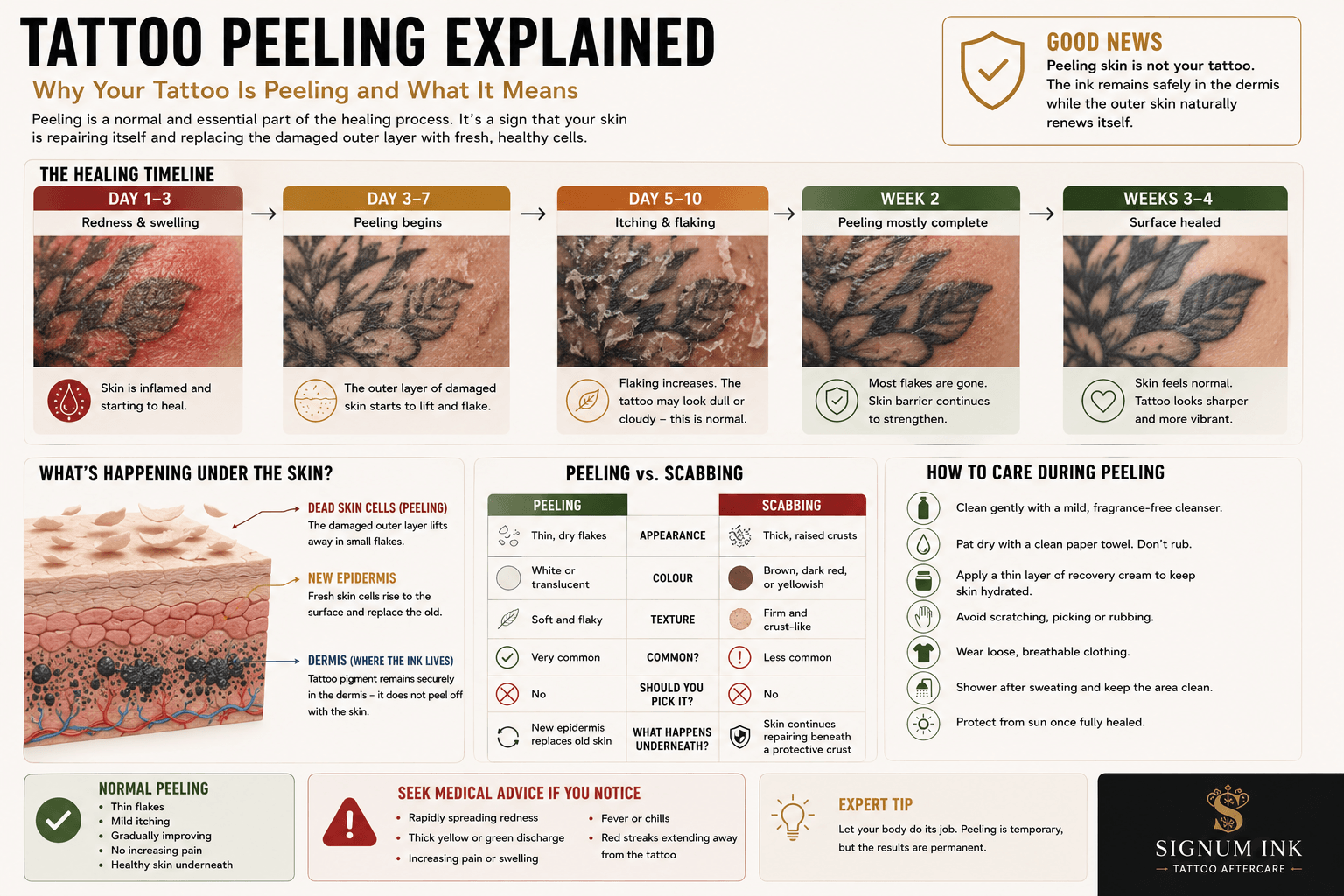
A few days after getting a tattoo, many people notice something unexpected.
The once vibrant tattoo begins to look dry.
Tiny flakes of skin start lifting away.
The colours may appear dull, cloudy, or faded.
For someone getting their first tattoo, this stage can be alarming.
“Is my tattoo losing ink?”
“Did I do something wrong?”
“Should I pull the peeling skin off?”
The reassuring answer is that tattoo peeling is one of the most normal stages of the healing process.
In fact, peeling is a sign that your skin is replacing the damaged outer layer created during tattooing.
While the tattoo itself is permanent, the outermost layer of skin is constantly renewing.
After tattooing, this natural renewal process becomes temporarily accelerated as your body repairs thousands of microscopic needle punctures.
Understanding why peeling happens—and knowing what is normal—can help you avoid unnecessary worry and support healthy tattoo healing.
Quick Answer
Is tattoo peeling normal?
Yes.
For most people, peeling begins between Day 3 and Day 7 after getting a tattoo.
It usually lasts several days to about one week, depending on the size of the tattoo, its location, and individual healing.
Peeling is a normal part of skin regeneration and does not mean your tattoo is falling out.
Quick Facts
Usually Begins
Day 3–7
Typically Lasts
4–10 days
Most Common Appearance
- Thin flakes of dry skin
- Mild itching
- Temporary dullness
- Slight skin tightness
Usually Not Normal
- Thick yellow or green discharge
- Rapidly worsening redness
- Severe pain
- Fever
- Foul-smelling drainage
Why Does a Tattoo Peel?
To understand peeling, it helps to understand what tattooing actually does to the skin.
A tattoo needle passes through the epidermis and deposits pigment into the dermis.
While the pigment remains in the dermis, the epidermis experiences thousands of microscopic injuries.
As healing begins, the damaged surface cells are gradually replaced with new healthy skin.
The old cells must eventually separate from the surface.
This is the peeling you see.
The Skin Is Constantly Renewing Itself
Even without a tattoo, your skin is constantly replacing old cells.
The outermost layer of skin—the stratum corneum—naturally sheds over time.
Tattooing temporarily speeds up this process.
Instead of waiting several weeks for normal cell turnover, damaged surface cells are removed much sooner so healthy skin can replace them.
Peeling is therefore a sign that your skin is doing exactly what it is designed to do.
What Happens Beneath the Skin During Peeling?
Although peeling is visible on the surface, much more is happening underneath.
Several biological processes occur simultaneously.
New Epidermal Cells Rise to the Surface
Fresh skin cells formed in the lower layers of the epidermis gradually move upward.
As they replace damaged cells, the old surface layer begins separating.
The Skin Barrier Continues Rebuilding
During the peeling phase, the skin barrier is still incomplete.
This is why the tattoo may feel:
- Tight
- Dry
- Slightly sensitive
- Mildly itchy
Supporting hydration during this stage helps maintain skin comfort while the barrier continues to recover.
Moisture Balance Changes
Fresh tattoos lose water more rapidly because the skin barrier has been disrupted.
As the barrier repairs itself, moisture retention gradually improves.
This is one reason why lightweight hydration remains helpful even after peeling begins.
Why Does the Tattoo Look Dull?
Many people believe the tattoo is fading when peeling starts.
Fortunately, this is almost never the case.
The tattoo looks dull because:
- Dry skin scatters light.
- New epidermal cells are still developing.
- Tiny flakes temporarily cover the tattoo.
Once peeling is complete and hydration returns to normal, the tattoo usually appears sharper and more vibrant again.
Why You Should Never Peel the Skin Yourself
One of the biggest mistakes during tattoo healing is pulling away loose flakes before they are ready to detach naturally.
Although it can be tempting, manually removing peeling skin may:
- Irritate healing tissue.
- Increase inflammation.
- Delay normal healing.
- Increase the risk of introducing bacteria.
- Lead to unnecessary skin damage.
Allow the skin to shed naturally.
Your body already knows exactly when those surface cells are ready to come away.
Is Every Tattoo the Same?
Not at all.
Several factors influence how much peeling occurs.
Tattoo Size
Large tattoos usually peel more than small tattoos because a greater area of skin has been affected.
Tattoo Placement
Areas that move frequently—such as elbows, knees, hands, feet, or ribs—may peel differently because of friction and stretching.
Tattoo Style
Heavy colour packing and solid black work often involve more needle passes than fine-line tattoos, which can lead to more noticeable peeling.
Individual Skin Type
Dry skin naturally tends to produce more visible flaking than well-hydrated skin.
Every person heals at a slightly different pace.
Supporting Your Skin During the Peeling Phase
The goal during peeling is not to stop the process—it is to support healthy skin while it happens.
A balanced aftercare routine generally includes:
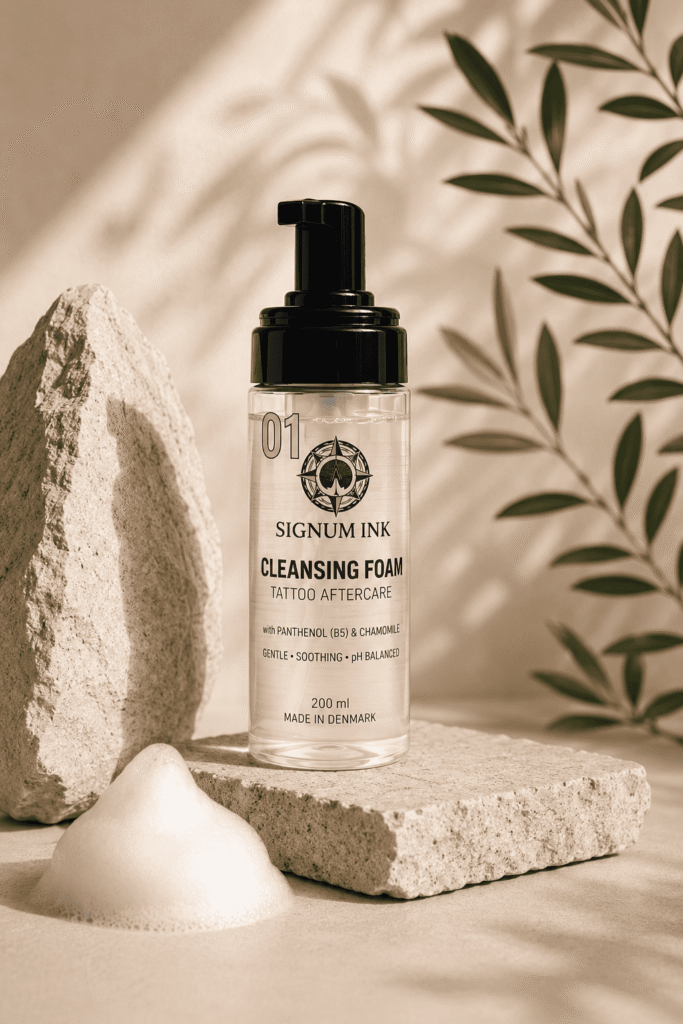
- Gentle cleansing with a mild foam cleanser.
- Patting the tattoo dry instead of rubbing.
- Applying a thin layer of recovery cream to maintain hydration.
- Avoiding scratching or picking at loose skin.
- Wearing loose, breathable clothing when possible.
Healthy hydration helps improve skin comfort while allowing the skin barrier to recover naturally.
Tattoo Peeling vs. Scabbing
Many people use the terms peeling and scabbing interchangeably.
However, they are not the same process.
Understanding the difference helps explain what your tattoo is doing during healing.
Normal Tattoo Peeling
Peeling is part of the skin’s natural renewal process.
It usually appears as:
- Thin, dry flakes.
- Small pieces of peeling skin.
- Mild itching.
- Temporary dullness.
The flakes separate naturally as new epidermal cells replace the damaged surface.
Scabbing
Scabs are different.
A scab forms when blood or plasma dries on the surface of a wound.
Small, thin scabs may occasionally develop on certain tattoos, particularly after heavy colour packing or longer tattoo sessions.
Large, thick, raised scabs are less typical and may indicate that the skin experienced greater trauma during tattooing or that healing has been disrupted.
Allow any scabs to detach naturally rather than picking at them.
Tattoo Peeling vs. Infection
Peeling alone is not a sign of infection.
In fact, peeling is expected during normal healing.
Instead, pay attention to the overall pattern.
Normal Peeling
Usually includes:
- Thin flakes.
- Mild itching.
- Gradually improving redness.
- No increasing pain.
- Healthy-looking skin beneath the flakes.
Symptoms That Need Medical Assessment
Prompt medical evaluation is appropriate if peeling is accompanied by:
- Rapidly spreading redness.
- Thick yellow or green discharge.
- Increasing swelling.
- Severe pain.
- Fever or chills.
- Red streaks extending away from the tattoo.
These symptoms do not automatically confirm an infection, but they should be assessed by a healthcare professional.
Why Does Peeling Make Tattoos Itch?
Itching is one of the most common parts of the peeling phase.
Several biological processes contribute to this sensation.
New Skin Is Forming
As fresh epidermal cells develop, the skin surface becomes temporarily tighter.
This tightening can stimulate nerve endings, leading to mild itching.
The Skin Barrier Is Still Recovering
The protective barrier has not yet fully recovered.
As moisture escapes more easily, the skin becomes drier.
Dry skin naturally feels itchier.
Nerve Endings Continue Healing
Tiny nerve endings affected during tattooing continue repairing themselves throughout the first weeks.
This regeneration may contribute to occasional itching.
How Long Does Tattoo Peeling Last?
The peeling stage varies between individuals, but most tattoos follow a similar pattern.
| Time After Tattoo | What Usually Happens |
|---|---|
| Days 1–3 | Redness and swelling |
| Days 3–7 | Peeling begins |
| Days 5–10 | Most visible peeling |
| Week 2 | Peeling largely finished |
| Weeks 3–4 | Surface appears healed |
Larger tattoos and areas exposed to more movement may continue peeling slightly longer.
What Does the Research Say?
The outermost layer of the skin, known as the stratum corneum, is continuously renewed throughout life.
Following tattooing, this renewal process temporarily accelerates as damaged surface cells are replaced.
Scientific research on wound healing shows that this controlled shedding of damaged cells is a normal part of epidermal regeneration.
At the same time, deeper repair continues within the dermis, where collagen fibers reorganize and immune cells continue interacting with tattoo pigment.
This is why a tattoo may look healed long before biological healing is complete.
Why Moisture Matters During Peeling
One of the biggest misconceptions is that peeling skin should simply be allowed to become completely dry.
In reality, healthy healing depends on maintaining an appropriate moisture balance.
The goal is not to keep the tattoo constantly wet or heavily coated with ointment.
Instead, modern tattoo aftercare aims to support the skin barrier by maintaining comfortable hydration while allowing natural skin renewal to continue.
Balanced formulations often include:
- Humectants such as Glycerin.
- Barrier-supporting ingredients such as Ceramides.
- Lightweight emollients such as Squalane.
- Skin-conditioning ingredients such as Panthenol.
Together these ingredients help maintain skin comfort during the peeling phase.
Common Mistakes During Peeling
Many people accidentally interfere with healing because peeling can look alarming.
Common mistakes include:
Picking Loose Skin
Removing flakes before they detach naturally may irritate the skin and delay healing.
Scratching
Although itching is normal, scratching may damage newly formed skin.
Using Harsh Cleansers
Strong soaps may further dry the skin while the barrier is still rebuilding.
Applying Excessive Product
A thick layer of ointment is not necessarily better.
A thin, even application is generally sufficient to support hydration.
Ignoring Sun Protection
Healing skin is particularly vulnerable to UV exposure.
Once fully healed, regular sunscreen use helps preserve tattoo colour over the long term.
Research Snapshot
| Research Area | Evidence |
|---|---|
| Epidermal Regeneration | ★★★★★ |
| Skin Barrier Repair | ★★★★★ |
| Moisture Balance | ★★★★★ |
| Wound Healing Biology | ★★★★★ |
| Tattoo Aftercare | ★★★★☆ |
| Tattoo Peeling Studies | ★★★★☆ |
Frequently Asked Questions About Tattoo Peeling
Is tattoo peeling normal?
Yes.
Peeling is one of the most common stages of tattoo healing.
As the outer layer of damaged skin is replaced with healthy new skin, small flakes naturally separate from the surface.
For most people, peeling begins between Day 3 and Day 7 and lasts for several days.
Is my tattoo losing ink when it peels?
No.
This is one of the biggest misconceptions about tattoo healing.
The peeling skin consists of dead epidermal cells.
The tattoo pigment is stored much deeper within the dermis, where it remains during the healing process.
Although tiny amounts of excess surface pigment may be present in the peeling skin, your tattoo itself is not peeling away.
Why does my tattoo look faded while peeling?
Dry, peeling skin changes the way light reflects from the tattoo.
In addition, newly formed epidermal cells temporarily cover the tattoo, making colours appear softer or cloudy.
As healing continues and the skin barrier recovers, the tattoo usually regains its normal clarity.
Can I remove the peeling skin?
No.
Allow the skin to separate naturally.
Pulling away loose flakes may irritate the skin, delay healing, and increase the risk of introducing bacteria.
Patience is one of the most important parts of successful tattoo aftercare.
Why is my tattoo itchy while peeling?
Mild itching is a normal part of healing.
Several factors contribute, including:
- New skin formation.
- Temporary dryness.
- Barrier repair.
- Healing nerve endings.
Avoid scratching the tattoo, as this may damage newly formed skin.
Can I moisturize while my tattoo is peeling?
Yes.
Maintaining appropriate hydration helps support the skin barrier while reducing tightness and discomfort.
Apply a thin layer of a suitable recovery cream rather than a thick coating.
The goal is to support the skin—not to saturate it.
Does every tattoo peel?
Almost every tattoo experiences some degree of peeling.
However, the amount varies depending on:
- Tattoo size.
- Tattoo location.
- Individual skin type.
- Tattooing technique.
- Personal healing response.
Some tattoos produce only very fine flakes that are barely noticeable.
Why is one part of my tattoo peeling more than another?
Different sections of a tattoo may receive different numbers of needle passes.
Areas with heavier shading or solid colour often peel more noticeably than fine-line sections.
This variation is usually normal.
Can peeling last longer than one week?
Sometimes.
Large tattoos, tattoos on high-movement areas, or naturally dry skin may continue peeling for a little longer.
The important point is that the skin should gradually improve over time.
When should I seek medical advice?
Seek prompt medical assessment if peeling is accompanied by:
- Rapidly spreading redness.
- Increasing pain.
- Thick yellow or green discharge.
- Fever or chills.
- Significant swelling that worsens.
- Red streaks extending away from the tattoo.
These symptoms are not typical of uncomplicated peeling and deserve professional evaluation.
Common Myths About Tattoo Peeling
Myth 1: Peeling means the tattoo is healing badly.
Reality:
Peeling is a normal part of skin regeneration and usually indicates that the outer layer of damaged skin is being replaced.
Myth 2: The tattoo ink is coming off with the peeling skin.
Reality:
The pigment remains in the dermis.
Only dead surface skin cells are being shed.
Myth 3: The more you moisturize, the better.
Reality:
Healthy healing depends on balance.
Applying an excessively thick layer of product is not more effective than applying a thin, even layer.
Myth 4: Peeling should stop after a few days.
Reality:
Healing varies from person to person.
Some tattoos continue producing small flakes for more than a week, particularly if they are large or located on areas that move frequently.
Healing Timeline
| Time After Tattoo | Typical Changes |
|---|---|
| Day 1 | Redness and mild swelling |
| Days 2–3 | Skin begins drying |
| Days 3–7 | Peeling usually starts |
| Days 5–10 | Most visible flaking |
| Week 2 | Peeling largely complete |
| Weeks 3–4 | Surface healing complete |
| Weeks 6–8 | Deeper remodeling continues |
Research Snapshot
| Research Area | Evidence |
|---|---|
| Epidermal Cell Renewal | ★★★★★ |
| Skin Barrier Repair | ★★★★★ |
| Wound Healing Biology | ★★★★★ |
| Moisture Balance | ★★★★★ |
| Tattoo Aftercare | ★★★★☆ |
| Tattoo Peeling Research | ★★★★☆ |
Expert Tip
Don’t judge your tattoo while it is peeling.
During this stage, the skin is dry, the barrier is still rebuilding, and a thin layer of new epidermis temporarily covers the tattoo. Once peeling is complete and hydration returns to normal, the tattoo typically appears sharper, brighter, and more defined.
Signs Your Tattoo Is Peeling Normally
✅ Thin, dry flakes.
✅ Mild itching.
✅ Temporary dull appearance.
✅ Gradually improving redness.
✅ No increasing pain.
✅ Healthy skin visible beneath the flakes.
Signs That Need Medical Assessment
⚠️ Thick yellow or green discharge.
⚠️ Rapidly spreading redness.
⚠️ Increasing swelling.
⚠️ Fever or chills.
⚠️ Severe or worsening pain.
⚠️ Red streaks extending beyond the tattoo.
If these symptoms occur, seek prompt medical advice rather than assuming they are part of normal peeling.
Why Modern Tattoo Aftercare Supports the Skin Barrier
Peeling is a reminder that the skin barrier is still recovering.
Rather than trying to stop the peeling process, modern aftercare focuses on supporting the skin while it heals.
A balanced recovery cream often combines ingredients that work together:
| Function | Example Ingredient |
|---|---|
| Attracts moisture | Glycerin |
| Supports cellular hydration | Betaine |
| Reinforces the skin barrier | Ceramides |
| Supports barrier function | Niacinamide |
| Skin conditioning | Panthenol |
| Lightweight emollient | Squalane |
| Improves spreadability | Caprylic/Capric Triglyceride |
| Botanical support | Madecassoside |
| Antioxidant protection | Vitamin E |
| Skin comfort | Allantoin |
Each ingredient plays a different role, helping the skin maintain hydration and rebuild its natural protective barrier during the healing process.
Final Thoughts
Tattoo peeling is one of the clearest signs that your skin is progressing through its natural healing cycle.
Although the dry flakes and temporary dullness may look concerning, they are usually evidence that damaged surface cells are being replaced by healthy new skin. Throughout this process, the tattoo pigment remains safely within the dermis while the epidermis renews itself above it.
The best approach is to let your body do what it is designed to do. Cleanse the tattoo gently, keep the skin comfortably hydrated, avoid picking at loose flakes, and give the healing process time to unfold.
Understanding the science behind tattoo peeling can turn a worrying stage into a reassuring one. When you know that peeling is part of healthy skin renewal—not a sign that your tattoo is disappearing—you can focus on supporting your skin rather than fighting the process.
 English
  German
  Dutch
Dutch  Danish
  Swedish
  French
  Italian