A new tattoo is more than fresh ink—it is skin that has entered a natural healing process. Over the following days and weeks, your body works continuously to repair the outer layers of the skin while restoring its protective barrier.
During this time, the right skincare routine can help keep the skin clean, hydrated, and comfortable.
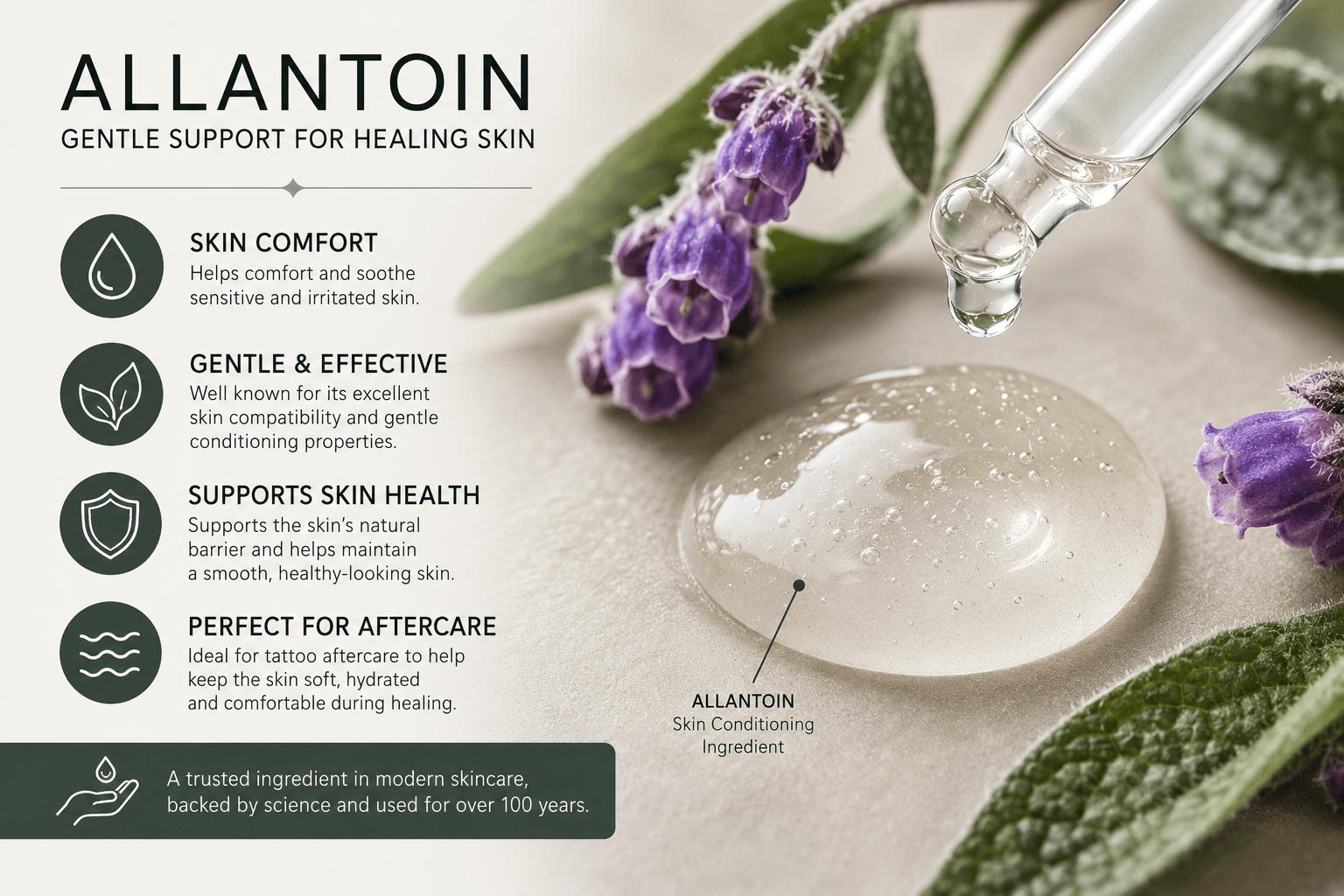
Among the many ingredients used in modern skincare, Allantoin has earned a reputation as one of the gentlest and most versatile skin-conditioning ingredients available.
Although it is rarely the ingredient featured in marketing campaigns, Allantoin has been trusted by dermatologists and skincare formulators for decades because of its excellent skin compatibility and its ability to support soft, healthy-looking skin.
Its gentle nature makes it particularly valuable for skincare products developed for sensitive, dry, and compromised skin—including products designed for tattoo aftercare.
Quick Facts
Ingredient Type
Skin Conditioning Agent
Primary Benefits
Skin Comfort • Hydration Support • Smooth Skin • Barrier Care
Best For
Fresh Tattoos • Sensitive Skin • Dry Skin • Irritated Skin
Found In
Recovery Creams • Moisturisers • Tattoo Aftercare • Sensitive Skin Products
Suitable For
All Skin Types
Typical Cosmetic Concentration
0.1–0.5%
Pairs Well With
Panthenol • Beta-Glucan • Glycerin • Ceramides • Aloe Vera
Scientific Support
★★★★★ Excellent
Did You Know?
Allantoin has been used in skincare for more than 100 years and remains one of the most widely trusted ingredients for sensitive skin because of its excellent skin compatibility and gentle conditioning properties.
What Is Allantoin?
Allantoin is a naturally occurring compound that can be found in several plants, including comfrey. Today, however, the Allantoin used in skincare is almost always produced synthetically.
This is actually considered an advantage.
Synthetic Allantoin offers extremely high purity, consistent quality, and excellent stability while avoiding some of the impurities that may occur in plant extracts.
In cosmetic science, Allantoin is classified as a skin-conditioning ingredient.
Rather than dramatically changing the skin, it supports the skin’s natural condition by helping it remain soft, smooth, and comfortable.
Its outstanding skin compatibility explains why Allantoin appears in products developed for:
- Sensitive skin
- Baby skincare
- Facial moisturisers
- Hand creams
- Barrier creams
- Post-procedure skincare
- Tattoo aftercare
Despite being one of the oldest skincare ingredients still in use, Allantoin continues to be included in modern formulations because its benefits remain highly relevant.
How Does Allantoin Work?
Freshly tattooed skin experiences temporary disruption of the outer skin barrier.
As the skin repairs itself, it often feels:
- Tight
- Dry
- Sensitive
- Rough
- Slightly uncomfortable
Allantoin helps support the skin during this period by acting as a skin-conditioning ingredient.
Rather than functioning as a traditional moisturiser, Allantoin helps improve the overall feel of the skin by supporting softness and smoothness.
Because it works gently, Allantoin is particularly suitable for products intended for repeated daily use.
It also works exceptionally well alongside humectants such as Glycerin and Panthenol, allowing formulators to create balanced products that address multiple aspects of skin health.
This complementary approach has made Allantoin a standard ingredient in many advanced skincare formulations.
Why Fresh Tattoos Benefit from Allantoin
Healing skin requires more than hydration alone.
While ingredients such as Glycerin attract moisture and Panthenol supports the skin barrier, Allantoin contributes by helping the skin feel smoother and more comfortable throughout the recovery process.
Its gentle nature makes it especially suitable for freshly tattooed skin, which often becomes more sensitive during healing.
When combined with other well-established skincare ingredients, Allantoin helps create formulations that focus on maintaining overall skin comfort rather than relying on a single active ingredient.
This balanced philosophy reflects the direction of modern tattoo aftercare, where multiple complementary ingredients work together to support healthy-looking skin.
Why Allantoin Has Been Trusted for Generations
Few skincare ingredients have remained as consistently popular as Allantoin.
Although new ingredients appear every year, Allantoin continues to earn its place in premium skincare because of its reliability, versatility, and excellent compatibility with virtually every skin type.
Professional formulators continue to choose Allantoin because it offers several important advantages.
Excellent Skin Compatibility
Allantoin is widely recognised as one of the gentlest skincare ingredients available, making it suitable for products developed for sensitive and compromised skin.
Supports Skin Comfort
One of the primary reasons Allantoin remains popular is its ability to help keep the skin feeling soft, smooth, and comfortable.
Works Well in Modern Formulations
Allantoin combines exceptionally well with ingredients such as:
- Panthenol
- Glycerin
- Beta-Glucan
- Ceramides
- Aloe Vera
- Shea Butter
Each ingredient supports different aspects of healthy skin while complementing one another in balanced skincare formulations.
Suitable for Daily Skincare
Because of its gentle profile, Allantoin is commonly included in products designed for regular daily use.
This makes it particularly relevant for tattoo aftercare routines, where cleansing and moisturising are repeated several times during the healing process.
Why Professional Skincare Still Relies on Allantoin
Skincare trends may change, but certain ingredients continue to stand the test of time.
Allantoin is one of those ingredients.
Its long history of safe use, excellent skin compatibility, and ability to complement other scientifically established ingredients have made it a permanent part of modern skincare.
Rather than attracting attention through marketing claims, Allantoin has built its reputation through consistent performance and decades of practical use.
For sensitive and healing skin, that reliability is one of its greatest strengths.
Allantoin in Recovery Cream: Gentle Care for Healing Skin
The days following a new tattoo are a critical period for the skin.
During this time, the skin works continuously to rebuild its protective barrier while replacing damaged cells and restoring its natural moisture balance. Supporting these natural processes requires ingredients that are both effective and gentle.
This is one of the reasons why Allantoin has remained a trusted ingredient in skincare for generations.
Unlike ingredients that primarily focus on hydration, Allantoin is valued for its skin-conditioning properties. It helps maintain soft, smooth, and comfortable skin while complementing other ingredients that contribute hydration and barrier support.
When incorporated into a well-balanced recovery cream, Allantoin helps create an environment where the skin feels cared for throughout the healing journey.
Rather than relying on a single “hero ingredient,” modern recovery creams combine ingredients that work together. In this type of formulation, Allantoin acts as an important supporting ingredient alongside humectants, emollients, and barrier-supporting compounds.
Its versatility is one of the reasons it continues to appear in premium skincare products designed for sensitive and recovering skin.
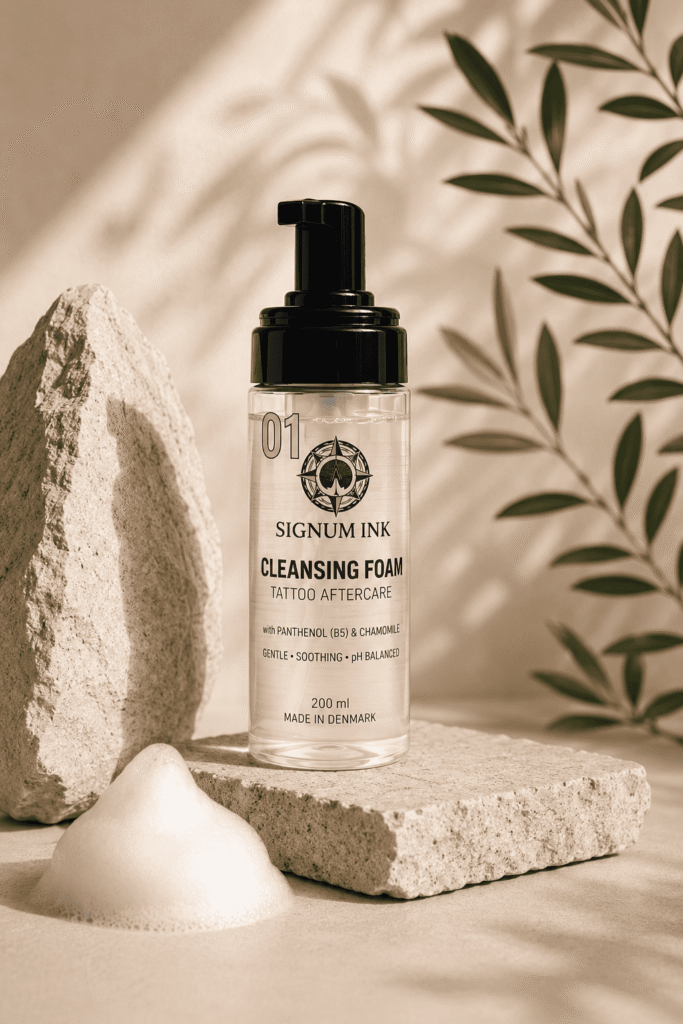
Allantoin in Tattoo Foam Soap
Gentle cleansing is one of the foundations of effective tattoo aftercare.
Fresh tattoos should be cleaned regularly to remove excess ink, plasma, sweat, and everyday impurities. However, cleansing should never leave the skin feeling overly dry or uncomfortable.
While Allantoin is more commonly associated with creams than cleansers, it also plays an important role in modern tattoo foam soaps.
Although a cleanser remains on the skin for only a short period, ingredients such as Allantoin contribute to creating a gentler cleansing experience.
Combined with mild surfactants and moisturizing ingredients, Allantoin helps support skin comfort during repeated daily washing.
For freshly tattooed skin, this can make cleansing feel noticeably less harsh while preparing the skin for the next step of the aftercare routine.
What Does the Research Say?
Although Allantoin has been used in skincare for well over a century, scientific interest in the ingredient remains strong.
Research has consistently shown that Allantoin is an excellent skin-conditioning ingredient with outstanding compatibility for sensitive skin.
Studies suggest that topical Allantoin can contribute to:
- Improving skin smoothness.
- Supporting the skin’s natural barrier.
- Increasing skin hydration when used in balanced formulations.
- Improving overall skin comfort.
- Supporting the appearance of healthy-looking skin.
Because Allantoin is exceptionally well tolerated, it has become a standard ingredient in products developed for sensitive skin, baby care, and post-procedure skincare.
For tattoo aftercare, these characteristics make Allantoin an excellent supporting ingredient when combined with moisturizers and barrier-focused actives.
While research specifically investigating Allantoin in tattoo healing remains limited, its documented benefits for sensitive and compromised skin make it highly relevant in modern tattoo aftercare formulations.
Research Snapshot
| Research Area | Evidence |
|---|---|
| Skin Comfort | ★★★★★ |
| Sensitive Skin | ★★★★★ |
| Skin Conditioning | ★★★★★ |
| Barrier Support | ★★★★☆ |
| Hydration Support | ★★★★☆ |
| Tattoo Aftercare | ★★★☆☆* |
*Note: While direct clinical studies on Allantoin in tattoo aftercare are limited, there is substantial evidence supporting its use in products developed for sensitive, compromised, and recovering skin. These documented properties make it highly relevant for modern tattoo aftercare formulations.
Allantoin Compared with Other Popular Skincare Ingredients
Every skincare ingredient serves a different purpose.
Rather than competing with one another, professional formulations combine ingredients that complement each other’s strengths.
Allantoin vs. Panthenol
Both ingredients are excellent choices for sensitive skin.
Panthenol primarily supports hydration and the skin barrier.
Allantoin focuses more on improving skin comfort and maintaining a soft, smooth skin feel.
Together they create an outstanding combination for products intended for healing skin.
Allantoin vs. Beta-Glucan
Beta-Glucan is recognised for its hydration and barrier-supporting properties.
Allantoin complements these benefits by contributing excellent skin-conditioning properties.
Together they help create balanced formulations designed for compromised skin.
Allantoin vs. Aloe Vera
Aloe Vera is well known for its refreshing feel and botanical origin.
Allantoin offers a different advantage by providing highly consistent skin-conditioning performance with excellent formulation stability.
Many premium skincare products include both ingredients because they complement each other naturally.
Allantoin vs. Ceramides
Ceramides are naturally occurring lipids that strengthen the skin barrier.
Allantoin does not replace Ceramides. Instead, it supports overall skin comfort and helps maintain a healthy skin condition while Ceramides reinforce the barrier itself.
Together they create a more comprehensive approach to skincare.
Why Dermatologists Continue to Recommend Allantoin
Despite the rapid evolution of skincare science, Allantoin remains one of the most consistently recommended ingredients for sensitive skin.
Its reputation has been built on decades of clinical use, excellent skin compatibility, and reliable performance across countless skincare formulations.
Dermatologists and formulators continue to value Allantoin because it is:
- Gentle on sensitive skin.
- Suitable for daily use.
- Highly compatible with other active ingredients.
- Effective in supporting overall skin comfort.
- Well established in dermatological skincare.
Rather than following trends, Allantoin has maintained its place in modern skincare because it consistently performs exactly as expected.
Its reliability is one of the reasons why it continues to be included in products designed for sensitive and healing skin around the world.
Frequently Asked Questions About Allantoin
What is Allantoin?
Allantoin is a skin-conditioning ingredient widely used in modern skincare. It is valued for its excellent compatibility with sensitive skin and its ability to help maintain soft, smooth, and comfortable skin. Although it occurs naturally in some plants, the Allantoin used in cosmetic products is almost always produced synthetically to ensure exceptional purity and consistency.
Why is Allantoin used in tattoo aftercare?
Fresh tattoos temporarily compromise the skin barrier, making the skin more vulnerable to dryness and discomfort.
Allantoin is commonly included in tattoo aftercare products because it helps support skin comfort while complementing moisturizing and barrier-supporting ingredients. Its gentle nature makes it particularly suitable for products intended for healing skin.
Is Allantoin suitable for sensitive skin?
Yes.
One of the reasons Allantoin has remained a trusted skincare ingredient for decades is its outstanding skin compatibility.
It is frequently included in products developed for sensitive skin, baby care, post-procedure skincare, and products designed for compromised skin barriers.
Does Allantoin moisturize the skin?
Not directly.
Unlike humectants such as Glycerin, Allantoin is primarily classified as a skin-conditioning ingredient.
Its role is to help improve the overall condition and feel of the skin while working alongside ingredients that provide hydration.
Can Allantoin be used every day?
Absolutely.
Because Allantoin is gentle and well tolerated, it is commonly used in products designed for daily application.
This makes it particularly suitable for tattoo aftercare routines, where cleansing and moisturizing are repeated over several weeks.
Does Allantoin work well with other skincare ingredients?
Yes.
Professional skincare formulations frequently combine Allantoin with:
- Panthenol
- Glycerin
- Beta-Glucan
- Ceramides
- Aloe Vera
- Calendula Extract
- Vitamin E
Each ingredient contributes different benefits while creating a balanced skincare formulation.
Is Allantoin only beneficial during tattoo healing?
No.
Although Allantoin is highly relevant for tattoo aftercare, it is equally valuable in everyday skincare.
It is commonly found in facial moisturizers, body lotions, hand creams, baby products, after-sun products, and barrier creams.
Is synthetic Allantoin safe?
Yes.
The vast majority of cosmetic Allantoin is synthetically produced because it offers higher purity, better consistency, and excellent stability.
From a skincare perspective, synthetic Allantoin performs the same function while providing manufacturers with reliable quality.
Why do dermatologists recommend Allantoin?
Dermatologists appreciate Allantoin because it combines excellent skin compatibility with proven skin-conditioning properties.
Its long history of safe use and versatility make it one of the most dependable ingredients used in products for sensitive skin.
Can Allantoin replace Panthenol or Glycerin?
No.
Each ingredient performs a different function.
Glycerin focuses on attracting moisture.
Panthenol supports hydration and the skin barrier.
Allantoin helps maintain skin comfort and softness.
Together they create a far more effective skincare formulation than any single ingredient alone.
Common Myths About Allantoin
Myth 1: Allantoin is only used in medical creams.
Reality:
Although Allantoin has long been used in dermatological products, it is now found in a wide range of modern skincare products, including moisturizers, cleansers, serums, baby care, and tattoo aftercare.
Myth 2: Allantoin is a moisturizer.
Reality:
Allantoin is primarily a skin-conditioning ingredient.
It works alongside moisturizing ingredients rather than replacing them.
Myth 3: Allantoin is an outdated ingredient.
Reality:
Quite the opposite.
Its continued popularity reflects decades of consistent scientific support and excellent performance rather than marketing trends.
Many newly developed ingredients are still compared with the reliability of Allantoin.
Myth 4: More Allantoin always gives better results.
Reality:
Professional skincare formulations are carefully balanced.
The effectiveness of Allantoin depends on the complete formulation rather than simply increasing its concentration.
Ingredient Performance Snapshot
| Category | Rating |
|---|---|
| Hydration Support | ⭐⭐⭐☆☆ |
| Skin Comfort | ⭐⭐⭐⭐⭐ |
| Sensitive Skin | ⭐⭐⭐⭐⭐ |
| Barrier Support | ⭐⭐⭐⭐☆ |
| Tattoo Healing Support | ⭐⭐⭐⭐☆ |
| Daily Use | ⭐⭐⭐⭐⭐ |
| Scientific Evidence | ⭐⭐⭐⭐⭐ |
Expert Tip
Healthy tattoo healing is rarely the result of a single ingredient.
Ingredients such as Allantoin, Panthenol, Glycerin, and Beta-Glucan each support different aspects of skin health. When thoughtfully combined in a balanced formulation, they create a comprehensive approach to tattoo aftercare that focuses on hydration, barrier support, and long-term skin comfort.
Final Thoughts
Although Allantoin rarely receives the same attention as trend-driven skincare ingredients, it remains one of the most dependable components of modern skincare.
Its exceptional skin compatibility, long history of safe use, and ability to complement other active ingredients have secured its place in formulations developed for sensitive and healing skin.
For tattoo aftercare, Allantoin contributes an important piece of the overall recovery process. Rather than acting as a stand-alone solution, it works alongside humectants, barrier-supporting ingredients, and emollients to help create products that support healthy-looking skin throughout every stage of healing.
As skincare science continues to evolve, Allantoin remains a reminder that some of the most effective ingredients are also the most established.
Its reliability, versatility, and scientific foundation make it a valuable ingredient for anyone seeking a gentle, well-balanced approach to tattoo aftercare.
Continue Your Learning
Explore more ingredient guides in the Signum Ink Journal:
- Glycerin – Nature’s Moisture Magnet
- Panthenol (Vitamin B5) – Supporting the Skin Barrier
- Beta-Glucan – Advanced Barrier Support
- Ceramides – Building a Stronger Skin Barrier
- Centella Asiatica – Botanical Skin Recovery
- Aloe Vera – Hydration and Skin Comfort
- How to Build the Perfect Tattoo Aftercare Routine
- Why the Skin Barrier Matters During Tattoo Healing
 English
  German
  Dutch
Dutch  Danish
  Swedish
  French
  Italian