When people think about premium skincare ingredients, they often focus on well-known names such as Ceramides, Niacinamide, or Panthenol.
However, some of the most important ingredients in a high-quality formulation are the ones most consumers have never heard of.
One of these is Caprylic/Capric Triglyceride, often abbreviated as CCT.
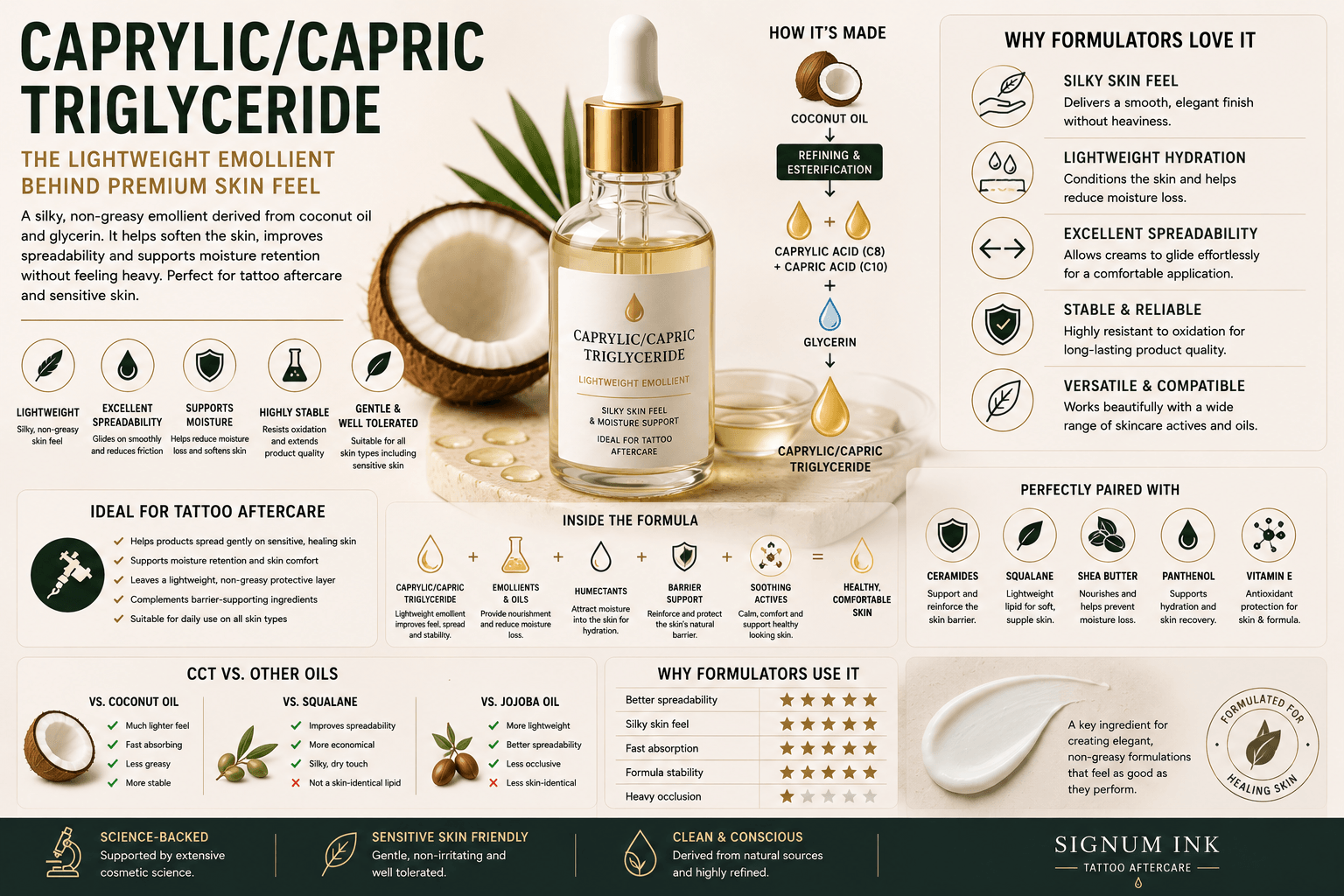
Although its name sounds highly technical, Caprylic/Capric Triglyceride is a gentle, lightweight emollient commonly derived from coconut oil and glycerin.
It is valued not because it delivers dramatic biological effects, but because it improves the way a skincare product feels, spreads, and performs.
For tattoo aftercare, this matters more than many people realize.
Freshly tattooed skin benefits from products that apply smoothly without excessive rubbing, absorb comfortably, and leave a protective yet lightweight finish.
Caprylic/Capric Triglyceride helps achieve exactly that.
Rather than acting as the primary active ingredient, it supports the overall formulation by improving spreadability, enhancing skin comfort, and complementing barrier-supporting ingredients such as Ceramides, Squalane, and Shea Butter.
Quick Facts
Ingredient Type
Lightweight Emollient
Primary Benefits
Skin Conditioning • Improved Spreadability • Lightweight Moisture Retention
Best For
Fresh Tattoos • Sensitive Skin • Dry Skin • Daily Moisturising
Found In
Recovery Creams • Facial Moisturisers • Barrier Creams • Body Lotions • Tattoo Aftercare
Suitable For
All Skin Types
Typical Cosmetic Concentration
3–20%
Pairs Well With
Ceramides • Squalane • Shea Butter • Jojoba Oil • Panthenol • Vitamin E
Scientific Support
★★★★★ Excellent
Did You Know?
Caprylic/Capric Triglyceride is produced by combining glycerin with medium-chain fatty acids obtained from coconut oil. The result is a remarkably stable ingredient with a silky, non-greasy texture that has become a favourite among cosmetic formulators worldwide.
What Is Caprylic/Capric Triglyceride?
Caprylic/Capric Triglyceride is a purified ester composed of glycerin and medium-chain fatty acids known as caprylic acid (C8) and capric acid (C10).
These fatty acids are commonly obtained from coconut oil, although other vegetable sources may also be used.
Unlike raw coconut oil, Caprylic/Capric Triglyceride has been refined to remove many of the heavier components that create an oily or greasy feel.
The result is a lightweight ingredient that spreads effortlessly across the skin while leaving a soft, elegant finish.
Because of its stability and excellent skin compatibility, it is widely used in premium skincare products around the world.
How Does Caprylic/Capric Triglyceride Work?
Caprylic/Capric Triglyceride functions primarily as an emollient.
Rather than attracting water like Glycerin or supporting barrier biology like Niacinamide, it conditions the skin by creating a smooth, lightweight layer that helps reduce moisture loss.
Its excellent spreadability allows creams to glide easily over the skin.
This offers several practical advantages:
- Reduces friction during application.
- Leaves the skin feeling soft and silky.
- Helps distribute active ingredients evenly.
- Improves the sensory experience of the product.
- Supports moisture retention without heaviness.
Because it absorbs quickly, Caprylic/Capric Triglyceride has become a defining ingredient in many luxury skincare formulations.
Why Fresh Tattoos Benefit from Caprylic/Capric Triglyceride
Freshly tattooed skin should be treated gently.
Products that require excessive rubbing or leave a heavy, greasy residue may reduce overall comfort during the healing process.
Caprylic/Capric Triglyceride contributes by improving how a recovery cream spreads across the skin.
Its lightweight emollient properties help create a smooth application while complementing ingredients responsible for hydration and barrier support.
Professional tattoo aftercare formulations frequently combine it with:
- Ceramides — to reinforce the skin barrier.
- Squalane — for lightweight lipid support.
- Shea Butter — to reduce moisture loss.
- Panthenol — to support hydration and skin conditioning.
- Vitamin E — to help protect the formulation from oxidation.
- Jojoba Oil — to support the skin’s surface lipids.
Together these ingredients create products that feel luxurious while supporting healthy-looking skin.
Why Caprylic/Capric Triglyceride Has Become a Favourite Among Formulators
Few ingredients improve the sensory experience of skincare as effectively as Caprylic/Capric Triglyceride.
Silky Skin Feel
It creates a smooth, elegant finish without excessive shine or greasiness.
Excellent Spreadability
It allows creams and lotions to glide effortlessly across the skin, reducing the need for rubbing.
Outstanding Stability
Unlike many natural oils, Caprylic/Capric Triglyceride is highly resistant to oxidation, helping maintain product quality over time.
Versatile Compatibility
Professional formulators regularly combine it with:
- Ceramides
- Squalane
- Jojoba Oil
- Argan Oil
- Shea Butter
- Panthenol
- Vitamin E
Rather than competing with these ingredients, it enhances the overall texture, stability, and user experience of the formulation.
Why Professional Formulators Continue Choosing Caprylic/Capric Triglyceride
Modern skincare is about more than active ingredients.
Consumers also expect products to feel elegant, absorb quickly, and leave the skin comfortable.
Caprylic/Capric Triglyceride helps achieve all of these goals.
For tattoo aftercare, it contributes to formulations that spread easily, support moisture retention, and provide a lightweight finish without compromising skin comfort.
This combination of performance, stability, and sensory elegance explains why it has become one of the most widely used emollients in premium skincare.
Caprylic/Capric Triglyceride in Recovery Cream: Lightweight Comfort Without the Greasy Feel
A premium recovery cream should deliver hydration while remaining comfortable to wear throughout the day.
Freshly tattooed skin is often sensitive to friction, making the texture of a recovery cream almost as important as its active ingredients.
This is one of the reasons Caprylic/Capric Triglyceride (CCT) has become a staple in premium skincare.
Unlike heavier oils, CCT spreads effortlessly across the skin, allowing a cream to be applied with minimal rubbing.
This is particularly beneficial during tattoo aftercare, where gentle application helps avoid unnecessary irritation.
Because of its lightweight texture, Caprylic/Capric Triglyceride also improves the absorption and overall elegance of a formulation.
Professional tattoo aftercare creams frequently combine it with:
- Ceramides to support the skin barrier.
- Squalane for lightweight lipid conditioning.
- Shea Butter to reduce moisture loss.
- Panthenol to support hydration and skin comfort.
- Niacinamide to support the skin’s natural barrier processes.
- Vitamin E to help protect both the skin and the formulation.
Rather than replacing these ingredients, Caprylic/Capric Triglyceride improves how they are delivered to the skin while creating a silky, luxurious finish.
Caprylic/Capric Triglyceride in Tattoo Foam Soap
Although leave-on products benefit most from Caprylic/Capric Triglyceride, it also has applications in gentle cleansers.
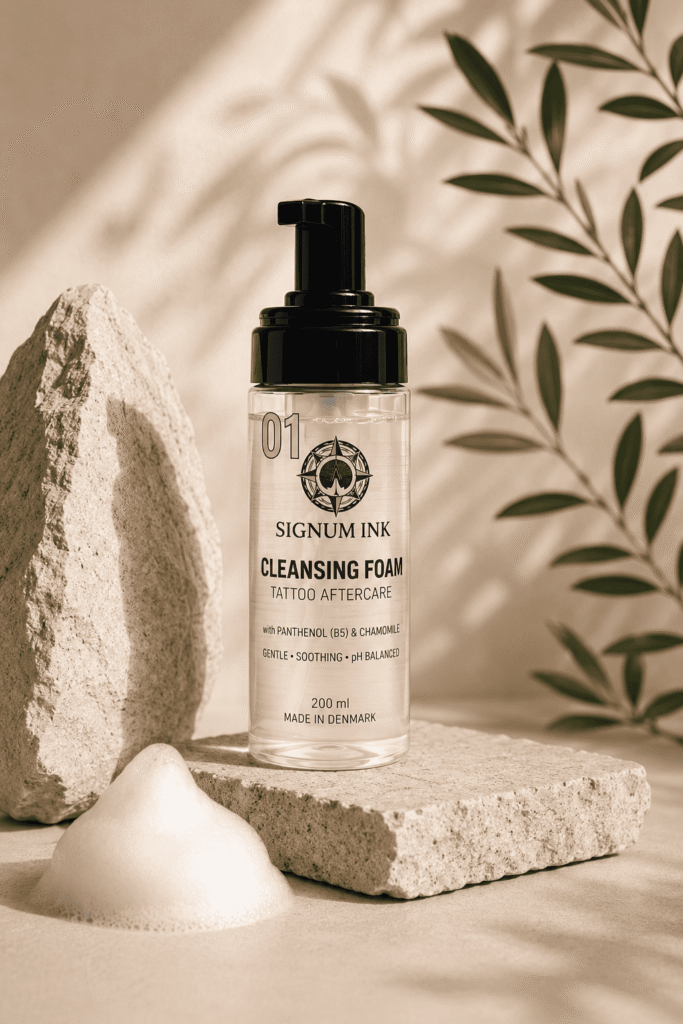
Premium tattoo foam soaps sometimes include CCT in small amounts to improve skin feel during cleansing.
Its lightweight emollient properties help reduce the feeling of tightness that may occur after washing.
Combined with mild surfactants, humectants, and soothing ingredients, it contributes to a cleansing experience that leaves the skin feeling clean yet comfortable.
What Does the Research Say?
Caprylic/Capric Triglyceride has been used in cosmetic science for decades.
Although it is not considered a biologically active ingredient like Niacinamide or Panthenol, research and formulation experience consistently demonstrate several important advantages.
Studies and cosmetic literature show that CCT:
- Provides excellent emollient properties.
- Improves skin softness.
- Reduces moisture loss by supporting the skin’s surface lipid layer.
- Improves the spreadability of creams and lotions.
- Enhances the sensory profile of skincare products.
- Offers excellent oxidative stability.
One reason formulators value CCT so highly is its remarkable stability.
Unlike many natural plant oils, Caprylic/Capric Triglyceride resists oxidation exceptionally well.
This helps maintain consistent product quality throughout the product’s shelf life.
Why Texture Matters in Tattoo Aftercare
Consumers often judge a recovery cream within seconds of applying it.
If it feels greasy, sticky, or difficult to spread, many assume the formulation is inferior—even if the active ingredients are excellent.
Professional formulators therefore pay close attention to texture.
Caprylic/Capric Triglyceride contributes by:
- Improving glide.
- Reducing drag during application.
- Creating a silky after-feel.
- Helping creams absorb more evenly.
- Supporting an elegant, non-greasy finish.
This combination explains why it appears in many premium moisturizers, luxury facial creams, and advanced tattoo aftercare products.
Research Snapshot
| Research Area | Evidence |
|---|---|
| Skin Conditioning | ★★★★★ |
| Spreadability | ★★★★★ |
| Cosmetic Stability | ★★★★★ |
| Moisture Retention | ★★★★☆ |
| Sensitive Skin | ★★★★★ |
| Tattoo Aftercare | ★★★☆☆* |
*Most published evidence relates to cosmetic formulation, sensory performance, and emollient properties rather than tattoo-specific clinical studies.
Caprylic/Capric Triglyceride Compared with Other Emollients
Understanding how CCT differs from other lipids helps explain why formulators rarely rely on a single oil.
Caprylic/Capric Triglyceride vs. Coconut Oil
Although both originate from coconut-derived fatty acids, they behave very differently.
Coconut Oil
- Rich.
- Heavier texture.
- Naturally contains long-chain fatty acids.
- More occlusive.
Caprylic/Capric Triglyceride
- Lightweight.
- Fast absorbing.
- Highly refined.
- Elegant skin feel.
- Excellent formulation stability.
Many premium formulations choose CCT specifically because it retains the pleasant characteristics of coconut-derived lipids without the heavy feel of raw coconut oil.

Caprylic/Capric Triglyceride vs. Squalane
Both ingredients provide lightweight conditioning.
Squalane resembles one of the skin’s naturally occurring lipids.
Caprylic/Capric Triglyceride primarily improves spreadability and texture.
Together they create exceptionally elegant formulations.
Caprylic/Capric Triglyceride vs. Jojoba Oil
Jojoba Oil is technically a liquid wax ester that supports the skin’s surface lipids.
Caprylic/Capric Triglyceride functions primarily as a lightweight emollient.
Professional formulations frequently include both because they contribute different sensory properties.
Caprylic/Capric Triglyceride vs. Shea Butter
Shea Butter provides rich nourishment and helps reduce moisture loss.
Caprylic/Capric Triglyceride balances that richness by improving spreadability and reducing the heavy skin feel.
This combination allows formulators to create creams that feel protective without becoming overly greasy.
Why Caprylic/Capric Triglyceride Has Become a Premium Formulation Ingredient
Professional formulators increasingly focus on creating products that are both effective and enjoyable to use.
Caprylic/Capric Triglyceride contributes to this goal by offering:
- Outstanding spreadability.
- Excellent oxidative stability.
- Lightweight skin conditioning.
- High compatibility with active ingredients.
- Improved consumer experience.
These qualities explain why it has become one of the most widely used emollients in premium skincare, dermatology-inspired products, and advanced tattoo aftercare formulations.
Ingredient Classification
| Property | Classification |
|---|---|
| Origin | Coconut-derived fatty acids + glycerin |
| Chemical Family | Medium-chain triglyceride ester |
| Primary Function | Emollient |
| Water Soluble | ❌ No |
| Oil Soluble | ✅ Yes |
| Skin Barrier Role | Supports the skin’s surface lipid layer |
| Scientific Support | ★★★★★ Excellent |
Frequently Asked Questions About Caprylic/Capric Triglyceride
What is Caprylic/Capric Triglyceride?
Caprylic/Capric Triglyceride (CCT) is a lightweight emollient made by combining glycerin with medium-chain fatty acids derived primarily from coconut oil.
Although it originates from coconut, it behaves very differently from raw coconut oil.
It provides a silky, lightweight skin feel while helping reduce moisture loss without leaving a greasy residue.
Why is Caprylic/Capric Triglyceride used in tattoo aftercare?
Fresh tattoos require products that spread easily across sensitive skin.
Caprylic/Capric Triglyceride improves the texture and glide of recovery creams, allowing them to be applied gently while helping maintain skin comfort.
It also supports moisture retention by forming a lightweight emollient layer on the skin.
Is Caprylic/Capric Triglyceride the same as Coconut Oil?
No.
Although both originate from coconut-derived fatty acids, they are very different ingredients.
Coconut Oil is a natural oil containing a broad mixture of fatty acids.
Caprylic/Capric Triglyceride is a purified ester that is lighter, more stable, faster absorbing, and less greasy.
Is Caprylic/Capric Triglyceride natural?
It is generally considered naturally derived.
The ingredient is produced using plant-derived glycerin and medium-chain fatty acids obtained primarily from coconut oil or palm kernel oil.
The manufacturing process refines these raw materials into a highly stable cosmetic ingredient.
Does Caprylic/Capric Triglyceride hydrate the skin?
Not directly.
Unlike Glycerin, which attracts water, CCT functions primarily as an emollient.
It helps soften the skin and reduce moisture loss while improving the feel and spreadability of a formulation.
Is Caprylic/Capric Triglyceride suitable for sensitive skin?
Yes.
Because of its gentle nature and excellent skin compatibility, it is widely used in products formulated for sensitive, dry, and compromised skin.
It is considered one of the most well-tolerated emollients in cosmetic science.
Can Caprylic/Capric Triglyceride clog pores?
Caprylic/Capric Triglyceride is generally regarded as having a low comedogenic potential.
Its lightweight texture makes it suitable for many skin types, including combination and oily skin.
Individual responses can vary, but it is widely used in non-greasy skincare formulations.
Why do formulators use Caprylic/Capric Triglyceride instead of heavier oils?
Professional formulators choose CCT because it offers:
- Excellent spreadability.
- Fast absorption.
- Lightweight skin feel.
- Outstanding oxidative stability.
- Broad compatibility with active ingredients.
These qualities help create elegant formulations that are pleasant to use.
Does Caprylic/Capric Triglyceride improve product stability?
Yes.
Compared with many natural oils, CCT is highly resistant to oxidation.
Its excellent stability helps maintain the consistency, texture, and overall quality of skincare products throughout their shelf life.
Which ingredients work best with Caprylic/Capric Triglyceride?
CCT combines exceptionally well with:
- Ceramides
- Squalane
- Jojoba Oil
- Shea Butter
- Vitamin E
- Panthenol
- Niacinamide
Together these ingredients create balanced formulations that combine hydration, barrier support, and an elegant skin feel.
Common Myths About Caprylic/Capric Triglyceride
Myth 1: It’s just another cheap filler.
Reality:
Caprylic/Capric Triglyceride is a carefully selected formulation ingredient that improves texture, spreadability, stability, and user experience. Premium skincare brands use it because of its performance—not because it is inexpensive.
Myth 2: It behaves exactly like Coconut Oil.
Reality:
Although it is coconut-derived, CCT is a refined ingredient with a completely different texture and cosmetic profile.
It absorbs much faster and feels significantly lighter than raw coconut oil.
Myth 3: It has no skincare benefits.
Reality:
While it is not an active ingredient like Niacinamide or Panthenol, CCT helps soften the skin, reduce moisture loss, improve product application, and enhance the overall sensory experience.
Myth 4: Premium creams don’t need ingredients like Caprylic/Capric Triglyceride.
Reality:
Many luxury skincare products rely on ingredients such as CCT because the user experience is just as important as the active ingredients themselves.
Research Snapshot
| Research Area | Evidence |
|---|---|
| Skin Conditioning | ★★★★★ |
| Cosmetic Stability | ★★★★★ |
| Spreadability | ★★★★★ |
| Sensitive Skin | ★★★★★ |
| Moisture Retention | ★★★★☆ |
| Tattoo Aftercare | ★★★☆☆* |
*Most published evidence relates to cosmetic formulation science, sensory performance, and emollient function. Dedicated tattoo-specific clinical studies remain limited, but the ingredient’s excellent skin compatibility makes it highly suitable for products intended for healing skin.
Level of Evidence
| Evidence Source | Strength |
|---|---|
| Cosmetic Science | ★★★★★ |
| Formulation Science | ★★★★★ |
| Skin Biology | ★★★★☆ |
| Clinical Dermatology | ★★★★☆ |
| Tattoo-Specific Studies | ★★☆☆☆ |
Why this matters:
Caprylic/Capric Triglyceride is one of the most trusted emollients in cosmetic formulation. Its widespread use is supported by decades of experience demonstrating excellent skin compatibility, stability, and sensory performance.
Ingredient Classification
| Property | Classification |
|---|---|
| Origin | Plant-derived (typically coconut oil + glycerin) |
| Chemical Family | Medium-Chain Triglyceride Ester |
| Primary Function | Emollient |
| Water Soluble | ❌ No |
| Oil Soluble | ✅ Yes |
| Skin Barrier Role | Supports the skin’s surface lipid layer |
| Scientific Support | ★★★★★ Excellent |
How It Works in a Formula
| Role | Function |
|---|---|
| Humectant | ❌ |
| Emollient | ✅ Primary |
| Occlusive | ⚪ Light |
| Barrier Support | ✅ Complementary |
| Improves Spreadability | ✅ Primary |
| Formula Stabilizer | ✅ Strong |
Formulation Insight:
Caprylic/Capric Triglyceride is often described as a “performance ingredient.” Rather than delivering a dramatic biological effect, it enhances how a product spreads, absorbs, and feels on the skin. This allows formulators to create recovery creams that are comfortable to apply while complementing active ingredients such as Ceramides, Panthenol, and Niacinamide.
Ingredient Performance Snapshot
| Category | Rating |
|---|---|
| Skin Feel | ⭐⭐⭐⭐⭐ |
| Spreadability | ⭐⭐⭐⭐⭐ |
| Formula Stability | ⭐⭐⭐⭐⭐ |
| Sensitive Skin | ⭐⭐⭐⭐⭐ |
| Moisture Retention | ⭐⭐⭐⭐☆ |
| Scientific Evidence | ⭐⭐⭐⭐☆ |
Why Formulators Choose Caprylic/Capric Triglyceride
| Formulation Benefit | Why It Matters |
|---|---|
| Silky skin feel | Creates a luxurious, lightweight finish. |
| Excellent spreadability | Reduces friction during application. |
| High oxidative stability | Helps maintain product quality over time. |
| Broad compatibility | Works seamlessly with oils, butters, and active ingredients. |
| Lightweight conditioning | Softens the skin without leaving a greasy residue. |
Formulator’s Perspective
Caprylic/Capric Triglyceride demonstrates that great skincare is not only about active ingredients—it is also about formulation design.
A recovery cream may contain exceptional ingredients such as Ceramides, Niacinamide, Panthenol, and Vitamin E, but if the texture is heavy or difficult to apply, the overall experience suffers.
Caprylic/Capric Triglyceride helps bridge this gap by improving glide, spreadability, and skin feel while supporting moisture retention and formulation stability. It is one of the quiet ingredients that often makes a premium product feel truly premium.
Expert Tip
One of the hallmarks of a premium recovery cream is effortless application.
Ingredients such as Caprylic/Capric Triglyceride, Squalane, and Jojoba Oil allow a formulation to spread smoothly across freshly tattooed skin with minimal friction. This creates a more comfortable application while supporting hydration and the skin’s natural protective barrier.
Ingredient Synergy
| Combines Especially Well With | Why |
|---|---|
| Squalane | Together they create a silky, lightweight skin feel with excellent spreadability. |
| Ceramides | Ceramides reinforce the barrier while CCT improves delivery and application. |
| Shea Butter | Balances rich nourishment with a lighter, more elegant texture. |
| Vitamin E | Vitamin E protects the formulation while CCT provides excellent stability and skin feel. |
| Panthenol | Panthenol supports hydration while CCT improves product application. |
| Jojoba Oil | Together they provide lightweight conditioning and enhanced skin comfort. |
Ingredient Verdict
| Category | Rating |
|---|---|
| Overall Rating | ⭐⭐⭐⭐⭐ |
| Best For | Premium recovery creams, sensitive skin, lightweight moisturizers |
| Scientific Confidence | Very High |
| Formulator Recommendation | Essential modern emollient |
| Works Best With | Squalane, Ceramides, Shea Butter, Vitamin E, Panthenol |
Final Thoughts
Caprylic/Capric Triglyceride may not be the most recognizable ingredient on a skincare label, but it is one of the most influential from a formulation perspective.
Its lightweight texture, exceptional stability, and excellent spreadability make it a cornerstone of modern premium skincare. Rather than acting as a headline active ingredient, it enhances the performance of an entire formulation by improving application, supporting skin comfort, and helping reduce moisture loss without leaving a greasy finish.
For tattoo aftercare, this means a recovery cream that glides effortlessly across sensitive skin while working in harmony with barrier-supporting ingredients such as Ceramides, Niacinamide, Panthenol, and Squalane. It is a perfect example of how thoughtful formulation design can elevate both the effectiveness and the experience of a skincare product.
 English
  German
  Dutch
Dutch  Danish
  Swedish
  French
  Italian