Ein Tattoo zu bekommen ist weit mehr als das Erschaffen eines permanenten Kunstwerks.
Aus biologischer Sicht beginnt jede Tätowierung als eine sorgfältig kontrollierte Hautverletzung.
Tausende mikroskopisch kleine Nadelstiche durchdringen die oberste Hautschicht und bringen Pigmente in die Dermis ein, wo spezialisierte Immunzellen dabei helfen, die Tinte jahrelang – oder sogar Jahrzehnte – zu speichern.
Obwohl das fertige Tattoo unmittelbar nach dem Verlassen des Studios vollständig erscheinen mag, beginnt die eigentliche Arbeit erst.
In den folgenden Tagen und Wochen beginnt Ihr Körper einen der bemerkenswertesten Reparaturprozesse in der menschlichen Biologie.
Blutgefäße reagieren fast augenblicklich.
Immunzellen wandern in das behandelte Gebiet.
Neue Hautzellen beginnen, geschädigtes Gewebe zu ersetzen.
Die Hautbarriere baut sich allmählich wieder auf.
Der Feuchtigkeitshaushalt ändert sich von Tag zu Tag.
Auch nachdem die Oberfläche verheilt aussieht, setzen sich wichtige biologische Reparaturen unter der Haut fort.
Das Verständnis dieser Phasen macht die Tattoo-Nachsorge weitaus weniger verwirrend.
Viele Reaktionen, die alarmierend erscheinen – wie Rötungen, Abschuppungen, Juckreiz oder Schuppenbildung – sind oft ein völlig normaler Teil des Heilungsprozesses.
Zur gleichen Zeit, was zu erkennen ist nicht normal kann Ihnen helfen, angemessen zu reagieren, wenn Komplikationen auftreten.
Dieser Leitfaden erklärt die Wissenschaft hinter der Tätowierungsheilung von Tag 1 bis Tag 60, die genau zeigen, was während jeder Phase der Genesung in Ihrer Haut passiert.
Kurzübersicht
Heilungszeit
Oberflächenheilung 2–4 Wochen
Barriere-Wiederherstellung: 3–6 Wochen
Vollständige Hauterneuerung: 6–8 Wochen (manchmal länger)
Primäre biologische Prozesse
- Entzündung
- Blutgerinnung
- Epidermale Regeneration
- Hautbarriere-Reparatur
- Feuchtigkeitsregulierung
- Dermale Remodellierung
- Langzeit-Pigmentstabilisierung
Wichtigste Ziele während der Heilung
✅ Halte das Tattoo sauber
✅ Auf ausreichende Flüssigkeitszufuhr achten
✅ Stärkt die Hautbarriere
✅ Vermeiden Sie unnötige Irritationen
✅ Schutz vor übermäßiger UV-Strahlung
Wussten Sie schon?
Ein Tattoo wird nicht dauerhaft, weil die Tinte “trocknet”. Stattdessen werden Pigmentpartikel in die Dermis eingebracht, wo Immunzellen, sogenannte Makrophagen, sie über viele Jahre in der Haut zurückhalten.
Verstehen Sie Ihre Haut vor dem Tätowieren
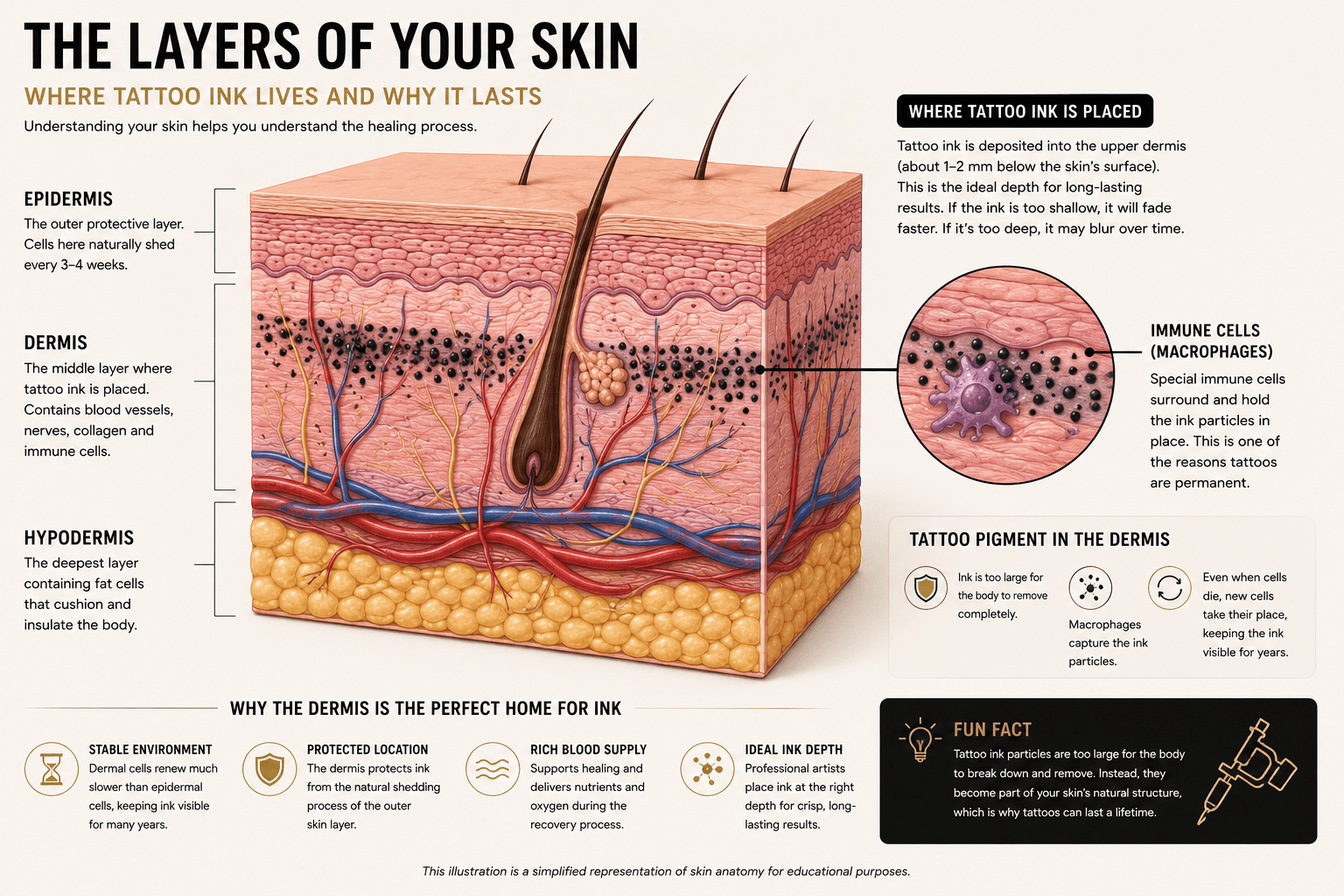
Bevor man die Heilung von Tätowierungen versteht, ist es hilfreich zu verstehen, wohin die Tätowierfarbe tatsächlich gelangt.
Die menschliche Haut besteht aus mehreren verschiedenen Schichten, die jeweils ihre eigene Funktion haben.
Die Epidermis
Der Epidermis ist die dünne äußere Hautschicht.
Sie fungiert als primäre Schutzbarriere des Körpers gegen:
- Wasserverlust
- Bakterien
- Schmutz
- Chemikalien
- UV-Strahlung
Obwohl sie überraschend widerstandsfähig ist, erneuert sich die Epidermis ständig.
Die meisten Oberhautzellen werden auf natürliche Weise ungefähr alle vier Wochen ersetzt.
Wenn Tattoo-Tinte nur in der Epidermis verbleiben würde, würde dein Tattoo allmählich verschwinden, wenn diese Zellen abgebaut werden.
Glücklicherweise ist es nicht dort, wo Tätowierer die Pigmente platzieren.
Die Dermis
Tätowierfarbe wird absichtlich in die Dermis, die dickere Schicht unterhalb der Epidermis.
Die Dermis enthält:
- Blutgefäße
- Nervenenden
- Kollagenfasern
- Elastin
- Haarfollikel
- Schweißdrüsen
- Immunzellen
Da die Dermis viel langsamer erneuert wird als die Epidermis, können Pigmente jahrzehntelang sichtbar bleiben.
Dies ist das wahre Zuhause deines Tattoos.
Die Hautbarriere
Eines der wichtigsten Konzepte in der modernen Tattoo-Nachsorge ist das Hautbarriere.
Der äußerste Teil der Epidermis – die Hornschicht—wirkt als natürliche Barriere des Körpers.
Es erfüllt zwei wesentliche Aufgaben:
- Hält schädliche Substanzen fern.
- Hält Wasser im Körper zurück.
Während des Tätowierens wird diese Barriere vorübergehend unterbrochen.
Als Ergebnis:
- Feuchtigkeit entweicht leichter.
- Die Haut wird empfindlicher.
- Reinigung wird wichtiger.
- Hautpflege, die die Hautbarriere unterstützt, spielt eine größere Rolle.
Dies ist ein Grund, warum sich die moderne Tattoo-Nachsorge stark auf Hydration und Reparatur der Hautbarriere konzentriert, anstatt einfach dicke Salben aufzutragen.
Was passiert eigentlich, wenn die Nadel in die Haut eindringt?
Eine Tätowiermaschine bewegt ihre Nadeln typischerweise 50 bis 150 Mal pro Sekunde, je nach Maschine, Einstellungen und Tätowiertechnik.
Jede Bewegung erzeugt einen mikroskopisch kleinen Stich durch die Epidermis und bringt Pigment in die obere Dermis ein.
Obwohl diese Einstiche winzig sind, kann ein großes Tattoo beinhalten Millionen von einzelnen Nadelstichen im Verlauf einer Sitzung.
Dein Körper erkennt dies sofort als Gewebeschaden.
Innerhalb von Sekunden beginnt eine außergewöhnliche biologische Reaktion.
Die ersten Sekunden nach dem Tätowieren
In dem Moment, in dem das Tattoo fertiggestellt ist, werden mehrere Reparaturmechanismen gleichzeitig aktiviert.
Blutgerinnung beginnt
Kleine Blutgefäße ziehen sich zusammen, um Blutungen zu reduzieren.
Blutplättchen sammeln sich im geschädigten Gewebe an und beginnen, mikroskopisch kleine Gerinnsel zu bilden.
Die Entzündungsreaktion beginnt
Chemische Signalmoleküle werden freigesetzt.
Diese Signale rekrutieren Immunzellen in den tätowierten Bereich.
Obwohl Entzündungen oft negativ klingen, sind sie tatsächlich eine der wichtigsten Phasen der normalen Heilung.
Ohne sie könnte keine ordnungsgemäße Gewebereparatur stattfinden.
Plasma erreicht die Oberfläche
Klares Plasma beginnt aus den winzigen Wunden zu sickern.
Diese Flüssigkeit enthält Proteine, Gerinnungsfaktoren und Immunmoleküle, die die frühe Heilung unterstützen.
Viele Leute verwechseln diese klare Flüssigkeit mit einem Tintenleck.
In Wirklichkeit besteht der größte Teil dessen, was Sie am ersten Tag sehen, aus Plasma, das mit einer geringen Menge überschüssigem Oberflächenpigment vermischt ist.
Die Hautbarriere ist vorübergehend beeinträchtigt
Eine der frühesten Veränderungen ist eine erhöhte Transepidermaler Wasserverlust (TEWL).
Da die Schutzbarriere gestört ist, entweicht Feuchtigkeit viel schneller als normal aus der Haut.
Das erklärt, warum sich ein frisches Tattoo oft schon am ersten Tag straff anfühlt.
Die Aufrechterhaltung einer angemessenen Flüssigkeitszufuhr während dieser Phase unterstützt den allgemeinen Hautkomfort, während sich die Barriere allmählich erholt.
Warum sich moderne Tattoo-Nachsorge auf Feuchtigkeit konzentriert
Ältere Ratschläge zur Tattoo-Nachsorge betonten oft das Auftragen dicker Schichten von Salben auf Petrolatumbasis.
Die moderne Hautpflegewissenschaft hat sich hin zu einem ausgewogeneren Ansatz entwickelt.
Forscher verstehen heute, dass die Aufrechterhaltung des natürlichen Feuchtigkeitshaushalts der Haut die Barriere unterstützt und gleichzeitig eine übermäßige Okklusion vermeidet.
Anstatt sich auf eine einzige Zutat zu verlassen, kombinieren hochwertige Regenerationscremes mehrere komplementäre Mechanismen:
- Feuchthaltemittel wie zum Beispiel Glycerin helfen, Wasser in die äußeren Hautschichten zu ziehen.
- Osmolyte wie zum Beispiel Betain hilft Hautzellen, ihr inneres Wassergleichgewicht aufrechtzuerhalten.
- Barriere-Lipide wie zum Beispiel Ceramide hilft, die Schutzstruktur der Haut zu stärken.
- Emollientien wie zum Beispiel Squalane und Capryl-Capric-Triglyceride die Haut weich machen und den Feuchtigkeitsverlust reduzieren.
- Botanische Wirkstoffe wie zum Beispiel Madecassosid und Beta-Glucan komplementär auf Barrieren fokussierte Formulierungen.
Anstatt sich auf eine einzige “Wunderzutat” zu verlassen, basiert die moderne Tattoo-Nachsorge auf der Kombination mehrerer Inhaltsstoffe, die verschiedene Aspekte der natürlichen Hautregeneration unterstützen.
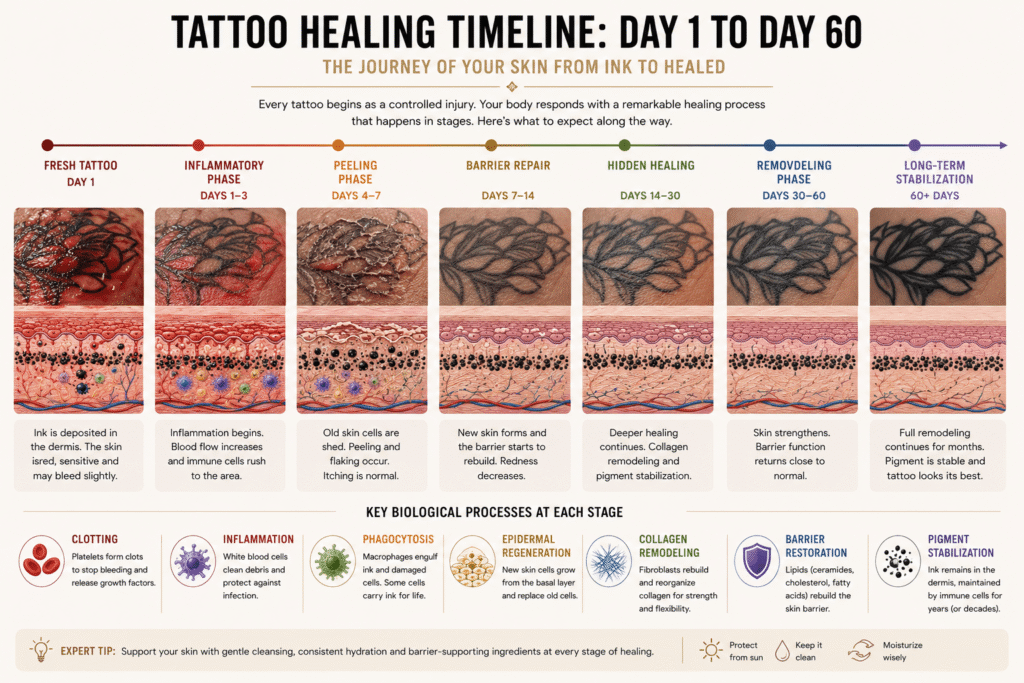
Tag 1–3: Die Entzündungsphase
Die ersten drei Tage nach dem Stechen eines Tattoos sind der aktivste Teil des Heilungsprozesses.
Obwohl Ihre Tätowierung an der Oberfläche vielleicht nur rot oder geschwollen aussieht, finden unter der Haut Millionen von biologischen Ereignissen statt.
Diese Phase ist bekannt als die Entzündungsphase.
Entgegen ihrem Namen ist eine Entzündung nichts, wovor man Angst haben muss. Sie ist ein normaler und wesentlicher Bestandteil der Wundheilung.
Ohne sie würde die Haut niemals beginnen, sich selbst zu reparieren.
Was passiert unter der Haut?
Innerhalb von Minuten nach dem Tätowieren:
- Kleine Blutgefäße ziehen sich zusammen, um Blutungen zu reduzieren.
- Blutplättchen bilden mikroskopisch kleine Blutgerinnsel.
- Weiße Blutkörperchen wandern zum Tattoo.
- Makrophagen beginnen, beschädigte Zellen zu beseitigen.
- Wachstumsfaktoren werden freigesetzt, um die Gewebereparatur einzuleiten.
Gleichzeitig stoßen einige Makrophagen auf Tätowierpigmente.
Anstatt jeden Pigmentpartikel zu entfernen, behalten viele die Tinte in der Dermis.
Dieser Prozess ist einer der Gründe, warum Tätowierungen dauerhaft werden.
Was Sie bemerken werden
In den ersten Tagen ist es völlig normal, Folgendes zu erleben:
- Leichte Rötung
- Leichte Schwellung
- Warm skin
- Zärtlichkeit
- Small amounts of clear plasma
- Excess surface ink
These reactions are expected and usually decrease over several days.
Why Hydration Matters Immediately
One of the biggest changes after tattooing is increased Transepidermal Water Loss (TEWL).
The damaged skin barrier allows moisture to escape much faster than normal.
As hydration decreases, the tattoo may begin feeling:
- Eng
- Trocken
- Leicht unbehaglich
Modern tattoo aftercare focuses on supporting this moisture balance while allowing the skin to recover naturally.
Day 4–7: The Peeling Phase
Around the fourth day, many people become concerned.
Their tattoo suddenly begins to:
- Peel
- Flake
- Feel itchy
- Look dull
Fortunately, these changes are usually signs that healing is progressing normally.
Warum schält sich ein Tattoo?
Tattooing temporarily damages part of the epidermis.
As new skin cells develop beneath the surface, older damaged cells gradually detach.
This creates the familiar peeling stage.
Unlike a sunburn, tattoo peeling usually occurs in thin, dry flakes rather than large sheets of skin.
Never Pick the Peeling Skin
Removing peeling skin prematurely can interfere with normal healing.
Allow loose flakes to fall away naturally.
Picking may increase irritation and could potentially affect how evenly the tattoo heals.

Why the Tattoo Looks Dull
Many people worry that their tattoo has already faded.
It hasn’t.
During this stage, a thin layer of newly forming skin partially covers the tattoo.
This temporarily reduces the appearance of contrast and colour saturation.
As healing continues, clarity gradually returns.
Why Does a Healing Tattoo Itch?
Itching is one of the most common questions tattoo artists receive.
Fortunately, mild itching is usually a sign that the skin is progressing through normal healing.
Several biological processes contribute to itching:
Nerve endings are recovering.
Tiny nerve fibres disturbed during tattooing begin repairing themselves.
New skin is forming.
As fresh epidermal cells replace damaged tissue, the surface becomes tighter.
Die Haut wird trockener.
Temporary barrier disruption increases moisture loss.
Dry skin naturally becomes itchier.
Inflammatory chemicals gradually decrease.
As inflammation resolves, chemical signals involved in healing can temporarily stimulate itch receptors.
Should You Scratch It?
Nein.
Scratching may damage newly forming skin.
Instead, maintaining proper hydration and using an appropriate recovery cream helps improve skin comfort during this stage.
Day 7–14: The Barrier Repair Phase
Around the second week, healing begins entering a new stage.
The tattoo often looks dramatically better.
Redness decreases.
Peeling slows.
The surface feels smoother.
However, beneath the surface, important repair processes continue.
Rebuilding the Skin Barrier
The outer skin barrier gradually rebuilds its highly organized lipid structure.
This structure consists primarily of:
- Ceramide
- Cholesterin
- Freie Fettsäuren
Together these lipids reduce water loss while strengthening the skin’s natural defense against the environment.
Modern recovery creams often include ingredients that complement this natural repair process.
Why Moisturizing Still Matters
Many people stop moisturizing once peeling ends.
In reality, the barrier is still recovering.
Continuing to support hydration during this stage helps maintain skin comfort while normal barrier function gradually returns.
Day 14–30: The Hidden Healing Phase
By the third week, many tattoos appear completely healed.
In reality, only the surface has largely recovered.
Beneath the epidermis, the dermis continues repairing itself.
This stage often goes unnoticed because the visible signs of healing have mostly disappeared.
What Happens Under the Surface?
Several important processes continue:
- Kollagenumbau.
- Stabilization of connective tissue.
- Ongoing immune cell activity.
- Gradual organization of tattoo pigment.
- Continued restoration of normal skin function.
Although you may no longer think about your tattoo every day, your skin is still actively repairing itself.
Why Colours Continue Changing
Many people notice subtle colour changes during the first month.
Das ist völlig normal.
Mehrere Faktoren tragen dazu bei:
- Remaining inflammation gradually subsides.
- The epidermis becomes clearer.
- Skin hydration stabilizes.
- Pigment becomes easier to see through fully healed skin.
As these changes occur, blacks often appear deeper and colours regain their full vibrancy.
Häufige Heilungsfehler
Most tattoo problems are not caused by poor tattooing.
Instead, they often result from simple aftercare mistakes.
Common examples include:
❌ Over-washing the tattoo.
❌ Applying excessively thick layers of ointment.
❌ Allowing the tattoo to become excessively dry.
❌ Picking peeling skin.
❌ Excessive sun exposure.
❌ Swimming before the skin has healed.
❌ Wearing tight clothing that causes repeated friction.
Avoiding these habits gives the skin the best opportunity to recover naturally.
Signs That Healing Is Progressing Normally
Every person heals at a slightly different pace, but these are generally reassuring signs:
✅ Redness gradually decreases.
✅ Swelling subsides.
✅ Peeling becomes lighter each day.
✅ Itching remains mild and temporary.
✅ The tattoo becomes smoother.
✅ Colours begin to appear clearer again.
Patience is an important part of tattoo aftercare. Even when the surface looks healed, deeper repair is still taking place.
Day 30–60: The Remodeling Phase
By the end of the first month, most tattoos look completely healed.
However, appearances can be deceiving.
Although the epidermis has largely recovered, important biological processes continue beneath the surface for several more weeks.
This final stage is known as the remodeling phase.
During remodeling, the skin gradually strengthens its structure while the tattoo becomes increasingly stable.
Collagen Continues to Organize
Tattooing temporarily disrupts collagen fibers within the dermis.
Over the following weeks, specialized cells called fibroblasts continue producing and organizing new collagen.
Unlike the rapid repair that occurs during the first weeks, collagen remodeling is slow and carefully controlled.
This process helps restore the skin’s strength and flexibility.
The Skin Barrier Returns to Normal
By this stage, the outer skin barrier has regained much of its normal function.
Water loss decreases.
The skin becomes more resistant to irritation.
Natural lipid production gradually returns to its usual balance.
For most people, moisturising remains beneficial, although the tattoo no longer requires intensive aftercare.
Pigment Becomes More Stable
One common misconception is that tattoo ink simply “stays where it was injected.”
The reality is far more fascinating.
Throughout the healing process, immune cells called Makrophagen interact continuously with tattoo pigment.
These cells help contain pigment particles within the dermis.
Even when individual macrophages eventually die, new macrophages often absorb the released pigment, helping maintain the tattoo’s appearance over many years.
This ongoing biological cycle explains why tattoos remain visible for decades.
Why Tattoos Fade Over Time
Although tattoo pigment is remarkably stable, no tattoo remains exactly the same forever.
Several factors gradually influence its appearance.
Dazu gehören:
- Natural skin aging.
- Sun exposure.
- Repeated UV damage.
- Individual skin biology.
- Immune activity.
- Tattoo-Platzierung.
- Ink quality.
- Depth of pigment placement.
Protecting tattoos from excessive sunlight remains one of the most effective ways to preserve colour and detail over the long term.
When Is a Tattoo Actually Healed?
This is one of the most common questions people ask.
The answer depends on which layer of the skin you are talking about.
| Healing Stage | Typische Zeit |
|---|---|
| Bleeding stops | Within hours |
| Redness begins improving | 2–4 days |
| Peeling phase | Days 4–10 |
| Surface healing | 2–4 Wochen |
| Barrier recovery | 3–6 Wochen |
| Dermale Remodellierung | 6–8 weeks or longer |
Anders ausgedrückt:
Your tattoo may look healed after three weeks, while deeper biological healing is still taking place.
Common Tattoo Healing Myths
Myth 1: The more cream you apply, the faster your tattoo heals.
Realität
Healthy healing depends on balance.
Applying excessive amounts of product may leave the skin overly occluded without improving the natural healing process.
Eine dünne, gleichmäßige Schicht ist im Allgemeinen ausreichend.
Myth 2: Peeling means something went wrong.
Realität
Peeling is one of the most normal stages of tattoo healing.
It reflects the natural replacement of damaged epidermal cells.
Myth 3: Once the tattoo stops peeling, healing is finished.
Realität
Surface healing usually finishes long before deeper tissue remodeling.
The dermis continues repairing itself for several more weeks.
Myth 4: Tattoos fade because the ink disappears.
Realität
Most long-term fading is caused by changes in the skin itself, cumulative UV exposure, and gradual biological remodeling—not because the pigment suddenly vanishes.
Häufig gestellte Fragen
Why does my tattoo look cloudy?
A thin layer of newly formed skin temporarily covers the tattoo during healing.
This “cloudy” appearance is usually temporary and gradually disappears as the epidermis matures.
Why does my tattoo feel raised?
Mild swelling during the first days is normal.
Some tattoos may also feel slightly textured while collagen remodeling continues.
If swelling increases significantly, becomes very painful, or is accompanied by fever or spreading redness, seek medical advice promptly.
Why is my tattoo shiny?
Newly regenerated epidermis often reflects light differently than mature skin.
The shiny appearance gradually fades as the skin continues to mature.
Why does my tattoo look lighter after peeling?
Immediately after peeling, the new epidermis is still developing.
As hydration normalizes and the skin becomes more transparent, colours generally regain their depth.
Is itching still normal after three weeks?
Mild occasional itching can still occur while deeper healing continues.
Persistent or worsening symptoms, especially if accompanied by redness, swelling, warmth, pus, or severe pain, should be evaluated by a healthcare professional.
The Science of Modern Tattoo Aftercare
Modern tattoo aftercare no longer focuses on a single “miracle ingredient.”
Instead, it combines multiple approaches that support different aspects of skin biology.
A balanced formulation may include:
| Funktion | Example Ingredient |
|---|---|
| Attracts moisture | Glycerin |
| Supports cellular hydration | Betain |
| Reinforces the barrier | Ceramide |
| Supports barrier function | Niacinamid |
| Softens and conditions | Squalane |
| Improves spreadability | Capryl-Capric-Triglyceride |
| Conditions the skin | Sheabutter |
| Botanical barrier support | Madecassosid |
| Antioxidant protection | Vitamin E |
| Skin-conditioning support | Allantoin |
Each ingredient contributes differently, creating a formulation that works with the skin’s natural healing processes rather than relying on a single active ingredient.
Key Takeaways
✔ Tattoo healing is a biological process that continues well beyond the first few weeks.
✔ The epidermis heals first, while deeper repair within the dermis takes considerably longer.
✔ Redness, peeling, mild itching, and temporary dullness are usually normal stages of healing.
✔ The skin barrier plays a central role in maintaining hydration and protecting healing skin.
✔ Modern tattoo aftercare combines humectants, emollients, barrier lipids, antioxidants, and botanical actives to support healthy-looking skin.
✔ Long-term tattoo appearance depends not only on the tattoo artist but also on consistent aftercare and protection from excessive UV exposure.
Abschließende Gedanken
Every tattoo tells two stories.
The first is the artwork created by the tattoo artist.
The second is the remarkable biological journey your skin undertakes to preserve that artwork for years to come.
From the moment the needle enters the skin, thousands of microscopic repair processes begin working together. Blood vessels seal tiny wounds, immune cells respond to tissue damage, new skin cells replace the old, collagen is reorganized, and the skin barrier gradually restores itself. Throughout this process, tattoo pigment becomes integrated within the dermis, where it is maintained by the skin’s own immune system.
Understanding this science changes the way we think about tattoo aftercare.
Rather than trying to “speed up” healing, the goal is to support the skin’s natural recovery by keeping the tattoo clean, maintaining hydration, protecting the barrier, and giving the body time to complete the work it has already begun.
A well-healed tattoo is not simply the result of good ink or skilled artistry—it is also the result of respecting the biology of the skin.
 English
  German