Ein Tattoo zu bekommen ist weit mehr als das Erschaffen eines permanenten Kunstwerks.
Aus biologischer Sicht beginnt jede Tätowierung als eine sorgfältig kontrollierte Hautverletzung.
Tausende mikroskopisch kleine Nadelstiche durchdringen die oberste Hautschicht und bringen Pigmente in die Dermis ein, wo spezialisierte Immunzellen dabei helfen, die Tinte jahrelang – oder sogar Jahrzehnte – zu speichern.
Obwohl das fertige Tattoo unmittelbar nach dem Verlassen des Studios vollständig erscheinen mag, beginnt die eigentliche Arbeit erst.
In den folgenden Tagen und Wochen beginnt Ihr Körper einen der bemerkenswertesten Reparaturprozesse in der menschlichen Biologie.
Blutgefäße reagieren fast augenblicklich.
Immunzellen wandern in das behandelte Gebiet.
Neue Hautzellen beginnen, geschädigtes Gewebe zu ersetzen.
Die Hautbarriere baut sich allmählich wieder auf.
Der Feuchtigkeitshaushalt ändert sich von Tag zu Tag.
Auch nachdem die Oberfläche verheilt aussieht, setzen sich wichtige biologische Reparaturen unter der Haut fort.
Das Verständnis dieser Phasen macht die Tattoo-Nachsorge weitaus weniger verwirrend.
Viele Reaktionen, die alarmierend erscheinen – wie Rötungen, Abschuppungen, Juckreiz oder Schuppenbildung – sind oft ein völlig normaler Teil des Heilungsprozesses.
Zur gleichen Zeit, was zu erkennen ist nicht normal kann Ihnen helfen, angemessen zu reagieren, wenn Komplikationen auftreten.
Dieser Leitfaden erklärt die Wissenschaft hinter der Tätowierungsheilung von Tag 1 bis Tag 60, die genau zeigen, was während jeder Phase der Genesung in Ihrer Haut passiert.
Kurzübersicht
Heilungszeit
Oberflächenheilung 2–4 Wochen
Barriere-Wiederherstellung: 3–6 Wochen
Vollständige Hauterneuerung: 6–8 Wochen (manchmal länger)
Primäre biologische Prozesse
- Entzündung
- Blutgerinnung
- Epidermale Regeneration
- Hautbarriere-Reparatur
- Feuchtigkeitsregulierung
- Dermale Remodellierung
- Langzeit-Pigmentstabilisierung
Wichtigste Ziele während der Heilung
✅ Halte das Tattoo sauber
✅ Auf ausreichende Flüssigkeitszufuhr achten
✅ Stärkt die Hautbarriere
✅ Vermeiden Sie unnötige Irritationen
✅ Schutz vor übermäßiger UV-Strahlung
Wussten Sie schon?
Ein Tattoo wird nicht dauerhaft, weil die Tinte “trocknet”. Stattdessen werden Pigmentpartikel in die Dermis eingebracht, wo Immunzellen, sogenannte Makrophagen, sie über viele Jahre in der Haut zurückhalten.
Verstehen Sie Ihre Haut vor dem Tätowieren
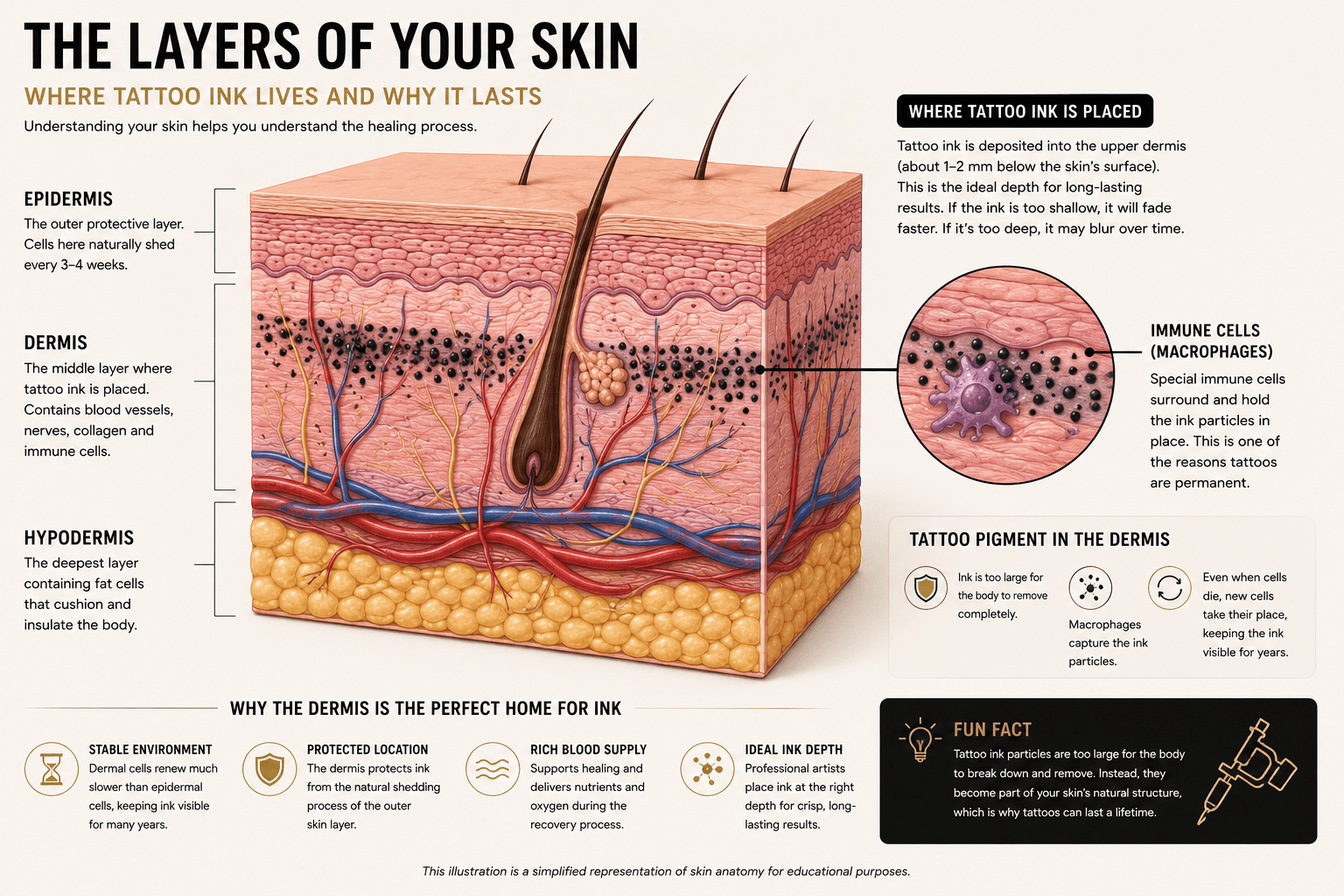
Bevor man die Heilung von Tätowierungen versteht, ist es hilfreich zu verstehen, wohin die Tätowierfarbe tatsächlich gelangt.
Die menschliche Haut besteht aus mehreren verschiedenen Schichten, die jeweils ihre eigene Funktion haben.
Die Epidermis
Der Epidermis ist die dünne äußere Hautschicht.
Sie fungiert als primäre Schutzbarriere des Körpers gegen:
- Wasserverlust
- Bakterien
- Schmutz
- Chemikalien
- UV-Strahlung
Obwohl sie überraschend widerstandsfähig ist, erneuert sich die Epidermis ständig.
Die meisten Oberhautzellen werden auf natürliche Weise ungefähr alle vier Wochen ersetzt.
Wenn Tattoo-Tinte nur in der Epidermis verbleiben würde, würde dein Tattoo allmählich verschwinden, wenn diese Zellen abgebaut werden.
Glücklicherweise ist es nicht dort, wo Tätowierer die Pigmente platzieren.
Die Dermis
Tätowierfarbe wird absichtlich in die Dermis, die dickere Schicht unterhalb der Epidermis.
Die Dermis enthält:
- Blutgefäße
- Nervenenden
- Kollagenfasern
- Elastin
- Haarfollikel
- Schweißdrüsen
- Immunzellen
Da die Dermis viel langsamer erneuert wird als die Epidermis, können Pigmente jahrzehntelang sichtbar bleiben.
Dies ist das wahre Zuhause deines Tattoos.
Die Hautbarriere
Eines der wichtigsten Konzepte in der modernen Tattoo-Nachsorge ist das Hautbarriere.
Der äußerste Teil der Epidermis – die Hornschicht—wirkt als natürliche Barriere des Körpers.
Es erfüllt zwei wesentliche Aufgaben:
- Hält schädliche Substanzen fern.
- Hält Wasser im Körper zurück.
Während des Tätowierens wird diese Barriere vorübergehend unterbrochen.
Als Ergebnis:
- Feuchtigkeit entweicht leichter.
- Die Haut wird empfindlicher.
- Reinigung wird wichtiger.
- Hautpflege, die die Hautbarriere unterstützt, spielt eine größere Rolle.
Dies ist ein Grund, warum sich die moderne Tattoo-Nachsorge stark auf Hydration und Reparatur der Hautbarriere konzentriert, anstatt einfach dicke Salben aufzutragen.
Was passiert eigentlich, wenn die Nadel in die Haut eindringt?
Eine Tätowiermaschine bewegt ihre Nadeln typischerweise 50 bis 150 Mal pro Sekunde, je nach Maschine, Einstellungen und Tätowiertechnik.
Jede Bewegung erzeugt einen mikroskopisch kleinen Stich durch die Epidermis und bringt Pigment in die obere Dermis ein.
Obwohl diese Einstiche winzig sind, kann ein großes Tattoo beinhalten Millionen von einzelnen Nadelstichen im Verlauf einer Sitzung.
Dein Körper erkennt dies sofort als Gewebeschaden.
Innerhalb von Sekunden beginnt eine außergewöhnliche biologische Reaktion.
Die ersten Sekunden nach dem Tätowieren
In dem Moment, in dem das Tattoo fertiggestellt ist, werden mehrere Reparaturmechanismen gleichzeitig aktiviert.
Blutgerinnung beginnt
Kleine Blutgefäße ziehen sich zusammen, um Blutungen zu reduzieren.
Blutplättchen sammeln sich im geschädigten Gewebe an und beginnen, mikroskopisch kleine Gerinnsel zu bilden.
Die Entzündungsreaktion beginnt
Chemische Signalmoleküle werden freigesetzt.
Diese Signale rekrutieren Immunzellen in den tätowierten Bereich.
Obwohl Entzündungen oft negativ klingen, sind sie tatsächlich eine der wichtigsten Phasen der normalen Heilung.
Ohne sie könnte keine ordnungsgemäße Gewebereparatur stattfinden.
Plasma erreicht die Oberfläche
Klares Plasma beginnt aus den winzigen Wunden zu sickern.
Diese Flüssigkeit enthält Proteine, Gerinnungsfaktoren und Immunmoleküle, die die frühe Heilung unterstützen.
Viele Leute verwechseln diese klare Flüssigkeit mit einem Tintenleck.
In Wirklichkeit besteht der größte Teil dessen, was Sie am ersten Tag sehen, aus Plasma, das mit einer geringen Menge überschüssigem Oberflächenpigment vermischt ist.
Die Hautbarriere ist vorübergehend beeinträchtigt
Eine der frühesten Veränderungen ist eine erhöhte Transepidermaler Wasserverlust (TEWL).
Da die Schutzbarriere gestört ist, entweicht Feuchtigkeit viel schneller als normal aus der Haut.
Das erklärt, warum sich ein frisches Tattoo oft schon am ersten Tag straff anfühlt.
Die Aufrechterhaltung einer angemessenen Flüssigkeitszufuhr während dieser Phase unterstützt den allgemeinen Hautkomfort, während sich die Barriere allmählich erholt.
Warum sich moderne Tattoo-Nachsorge auf Feuchtigkeit konzentriert
Ältere Ratschläge zur Tattoo-Nachsorge betonten oft das Auftragen dicker Schichten von Salben auf Petrolatumbasis.
Die moderne Hautpflegewissenschaft hat sich hin zu einem ausgewogeneren Ansatz entwickelt.
Forscher verstehen heute, dass die Aufrechterhaltung des natürlichen Feuchtigkeitshaushalts der Haut die Barriere unterstützt und gleichzeitig eine übermäßige Okklusion vermeidet.
Anstatt sich auf eine einzige Zutat zu verlassen, kombinieren hochwertige Regenerationscremes mehrere komplementäre Mechanismen:
- Feuchthaltemittel wie zum Beispiel Glycerin helfen, Wasser in die äußeren Hautschichten zu ziehen.
- Osmolyte wie zum Beispiel Betain hilft Hautzellen, ihr inneres Wassergleichgewicht aufrechtzuerhalten.
- Barriere-Lipide wie zum Beispiel Ceramide hilft, die Schutzstruktur der Haut zu stärken.
- Emollientien wie zum Beispiel Squalane und Capryl-Capric-Triglyceride die Haut weich machen und den Feuchtigkeitsverlust reduzieren.
- Botanische Wirkstoffe wie zum Beispiel Madecassosid und Beta-Glucan komplementär auf Barrieren fokussierte Formulierungen.
Anstatt sich auf eine einzige “Wunderzutat” zu verlassen, basiert die moderne Tattoo-Nachsorge auf der Kombination mehrerer Inhaltsstoffe, die verschiedene Aspekte der natürlichen Hautregeneration unterstützen.
Tag 1–3: Die Entzündungsphase
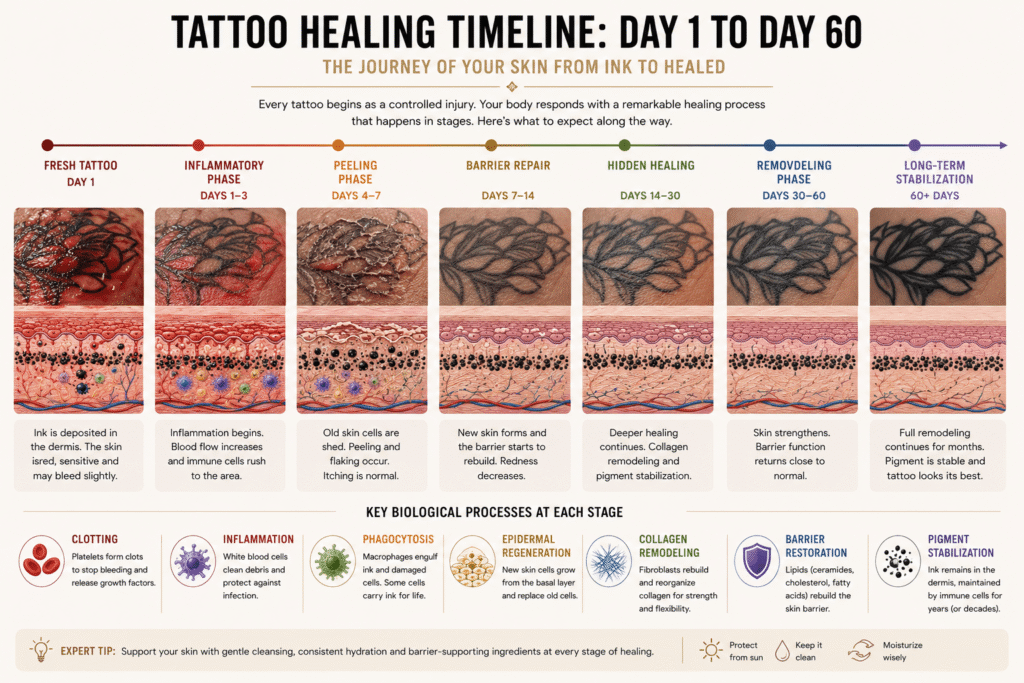
Die ersten drei Tage nach dem Stechen eines Tattoos sind der aktivste Teil des Heilungsprozesses.
Obwohl Ihre Tätowierung an der Oberfläche vielleicht nur rot oder geschwollen aussieht, finden unter der Haut Millionen von biologischen Ereignissen statt.
Diese Phase ist bekannt als die Entzündungsphase.
Entgegen ihrem Namen ist eine Entzündung nichts, wovor man Angst haben muss. Sie ist ein normaler und wesentlicher Bestandteil der Wundheilung.
Ohne sie würde die Haut niemals beginnen, sich selbst zu reparieren.
Was passiert unter der Haut?
Innerhalb von Minuten nach dem Tätowieren:
- Kleine Blutgefäße ziehen sich zusammen, um Blutungen zu reduzieren.
- Blutplättchen bilden mikroskopisch kleine Blutgerinnsel.
- Weiße Blutkörperchen wandern zum Tattoo.
- Makrophagen beginnen, beschädigte Zellen zu beseitigen.
- Wachstumsfaktoren werden freigesetzt, um die Gewebereparatur einzuleiten.
Gleichzeitig stoßen einige Makrophagen auf Tätowierpigmente.
Anstatt jeden Pigmentpartikel zu entfernen, behalten viele die Tinte in der Dermis.
Dieser Prozess ist einer der Gründe, warum Tätowierungen dauerhaft werden.
Was Sie bemerken werden
In den ersten Tagen ist es völlig normal, Folgendes zu erleben:
- Leichte Rötung
- Leichte Schwellung
- Warme Haut
- Zärtlichkeit
- Geringe Mengen klaren Plasmas
- Überschüssige Oberflächenfarbe
Diese Reaktionen sind zu erwarten und lassen in der Regel nach mehreren Tagen nach.
Warum sofortige Flüssigkeitszufuhr wichtig ist
Eine der größten Veränderungen nach dem Tätowieren ist erhöhtes Transepidermaler Wasserverlust (TEWL).
Die geschädigte Hautbarriere lässt Feuchtigkeit viel schneller entweichen als normal.
Wenn die Feuchtigkeitsversorgung abnimmt, kann sich das Tattoo wie folgt anfühlen:
- Eng
- Trocken
- Leicht unbehaglich
Die moderne Tattoo-Nachsorge konzentriert sich darauf, dieses Feuchtigkeitsgleichgewicht zu unterstützen und der Haut gleichzeitig zu ermöglichen, sich auf natürliche Weise zu erholen.
Tag 4–7: Die Schälphase
Um den vierten Tag herum machen sich viele Menschen Sorgen.
Ihr Tattoo beginnt plötzlich:
- Schälen
- Flocke
- Es juckt
- Wirken langweilig
Glücklicherweise sind diese Veränderungen meist Zeichen dafür, dass die Heilung normal verläuft.
Warum schält sich ein Tattoo?
Das Tätowieren schädigt vorübergehend einen Teil der Epidermis.
Da sich unter der Oberfläche neue Hautzellen entwickeln, lösen sich ältere, geschädigte Zellen allmählich ab.
Dies erzeugt die bekannte Pelingphase.
Anders als ein Sonnenbrand schält sich ein Tattoo normalerweise in dünnen, trockenen Schuppen statt in großen Hautfetzen.
Niemals an abzulöster Haut ziehen
Das vorzeitige Entfernen von sich schälender Haut kann den normalen Heilungsprozess beeinträchtigen.
Lassen Sie lose Schuppen auf natürliche Weise abfallen.
Das Kratzen kann die Reizung verstärken und möglicherweise die gleichmäßige Abheilung des Tattoos beeinträchtigen.

Warum das Tattoo matt aussieht
Viele Menschen machen sich Sorgen, dass ihr Tattoo bereits verblasst ist.
Das hat es nicht.
Während dieser Phase bedeckt eine dünne Schicht sich neu bildender Haut das Tattoo teilweise.
Dies reduziert vorübergehend die Sichtbarkeit von Kontrast und Farbsättigung.
Während die Heilung voranschreitet, kehrt allmählich die Klarheit zurück.
Warum juckt ein heilendes Tattoo?
Juckreiz gehört zu den häufigsten Fragen, die Tätowierer erhalten.
Glücklicherweise ist leichter Juckreiz meist ein Zeichen dafür, dass die Haut einen normalen Heilungsprozess durchläuft.
Mehrere biologische Prozesse tragen zum Juckreiz bei:
Die Nervenendigungen erholen sich.
Kleine Nervenfasern, die beim Tätowieren gestört wurden, beginnen sich selbst zu reparieren.
Neue Haut bildet sich.
Da frische Epidermiszellen das beschädigte Gewebe ersetzen, wird die Oberfläche straffer.
Die Haut wird trockener.
Eine temporäre Störung der Hautbarriere erhöht den Feuchtigkeitsverlust.
Trockene Haut neigt von Natur aus stärker zu Juckreiz.
Entzündungsfördernde Chemikalien nehmen allmählich ab.
Wenn die Entzündung abklingt, können chemische Signale, die an der Heilung beteiligt sind, Juckreizrezeptoren vorübergehend stimulieren.
Sollten Sie daran kratzen?
Nein.
Kratzen kann die sich neu bildende Haut beschädigen.
Stattdessen trägt eine ausreichende Flüssigkeitszufuhr und die Verwendung einer geeigneten Erholungscreme dazu bei, den Hautkomfort in dieser Phase zu verbessern.
Tag 7–14: Die Phase der Hautbarriere-Reparatur
Um die zweite Woche herum beginnt die Heilung in eine neue Phase einzutreten.
Das Tattoo sieht oft dramatisch besser aus.
Die Rötung nimmt ab.
Das Schälen verlangsamt sich.
Die Oberfläche fühlt sich glatter an.
Doch unter der Oberfläche laufen wichtige Reparaturprozesse weiter.
Wiederaufbau der Hautbarriere
Die äußere Hautbarriere baut ihre hochorganisierte Lipidstruktur allmählich wieder auf.
Diese Struktur besteht hauptsächlich aus:
- Ceramide
- Cholesterin
- Freie Fettsäuren
Zusammen reduzieren diese Lipide den Feuchtigkeitsverlust und stärken gleichzeitig die natürliche Schutzbarriere der Haut gegen Umwelteinflüsse.
Moderne Regenerationscremes enthalten oft Inhaltsstoffe, die diesen natürlichen Reparaturprozess unterstützen.
Warum Feuchtigkeitspflege nach wie vor wichtig ist
Viele Menschen hören auf, Feuchtigkeitscreme zu verwenden, sobald das Schuppen aufhört.
In Wirklichkeit erholt sich die Barriere immer noch.
Die fortgesetzte Unterstützung der Feuchtigkeitsversorgung in dieser Phase hilft dabei, das Wohlbefinden der Haut zu erhalten, während sich die normale Barrierefunktion allmählich erholt.
Tag 14–30: Die verborgene Heilungsphase
Bis zur dritten Woche scheinen viele Tattoos vollständig verheilt zu sein.
In Wirklichkeit hat sich nur die Oberfläche weitgehend erholt.
Unter der Epidermis repariert sich die Dermis weiterhin selbst.
Dieses Stadium bleibt oft unbemerkt, da die sichtbaren Anzeichen der Heilung größtenteils verschwunden sind.
Was passiert unter der Oberfläche?
Mehrere wichtige Prozesse laufen weiter:
- Kollagenumbau.
- Stabilisierung des Bindegewebes.
- Anhaltende Aktivität der Immunzellen.
- Allmähliche Anordnung der Tätowierpigmente.
- Weiterhin Wiederherstellung der normalen Hautfunktion.
Obwohl Sie vielleicht nicht mehr jeden Tag an Ihr Tattoo denken, repariert sich Ihre Haut immer noch aktiv selbst.
Warum sich Farben weiter verändern
Viele Menschen bemerken im ersten Monat subtile Farbveränderungen.
Das ist völlig normal.
Mehrere Faktoren tragen dazu bei:
- Verbleibende Entzündungen klingen allmählich ab.
- Die Epidermis wird klarer.
- Der Feuchtigkeitshaushalt der Haut stabilisiert sich.
- Pigment wird durch vollständig verheilte Haut besser sichtbar.
Im Zuge dieser Veränderungen wirken Schwarztöne oft tiefer und die Farben gewinnen ihre volle Leuchtkraft zurück.
Häufige Heilungsfehler
Die meisten Tattoo-Probleme werden nicht durch schlechtes Tätowieren verursacht.
Stattdessen sind sie oft auf einfache Fehler bei der Nachsorge zurückzuführen.
Gängige Beispiele sind:
❌ Zu häufiges Waschen des Tattoos.
❌ Das Auftragen übermäßig dicker Salbenschichten.
❌ Das Tattoo übermäßig austrocknen lassen.
❌ Abziehen von sich schälen der Haut.
❌ Übermäßige Sonnenbestrahlung.
❌ Schwimmen, bevor die Haut verheilt ist.
❌ Das Tragen enger Kleidung, die wiederholte Reibung verursacht.
Das Vermeiden dieser Gewohnheiten gibt der Haut die beste Möglichkeit, sich auf natürliche Weise zu erholen.
Anzeichen dafür, dass die Heilung normal verläuft
Jeder Mensch heilt in einem etwas anderen Tempo, doch dies sind im Allgemeinen ermutigende Anzeichen:
✅ Die Rötung lässt allmählich nach.
✅ Die Schwellung lässt nach.
✅ Das Peeling wird jeden Tag heller.
✅ Der Juckreiz bleibt mild und vorübergehend.
✅ Das Tattoo wird glatter.
✅ Die Farben erscheinen wieder klarer.
Geduld ist ein wichtiger Teil der Tattoo-Nachsorge. Selbst wenn die Oberfläche verheilt aussieht, findet in der Tiefe immer noch eine Regeneration statt.
Tag 30–60: Die Umbauphase
Bis zum Ende des ersten Monats sehen die meisten Tattoos vollständig verheilt aus.
Doch der Schein trügt.
Obwohl sich die Epidermis weitgehend erholt hat, laufen unter der Oberfläche noch mehrere Wochen lang wichtige biologische Prozesse ab.
Diese letzte Phase wird als bezeichnet Umbauphase.
Während des Umbaus stärkt die Haut schmiedend ihre Struktur, während das Tattoo zunehmend stabiler wird.
Kollagen organisiert sich weiter
Das Tätowieren stört vorübergehend die Kollagenfasern in der Dermis.
Über die folgenden Wochen hinweg spezialisierte Zellen namens Fibroblasten weiterhin neues Kollagen produzieren und organisieren.
Im Gegensatz zu der raschen Reparatur, die während der ersten Wochen stattfindet, verläuft der Kollagenumbau langsam und streng kontrolliert.
Dieser Prozess hilft dabei, die Festigkeit und Elastizität der Haut wiederherzustellen.
Die Hautbarriere regeneriert sich
Zu diesem Zeitpunkt hat die äußere Hautbarriere einen Großteil ihrer normalen Funktion wiedererlangt.
Wasserverlust nimmt ab.
Die Haut wird widerstandsfähiger gegen Reizungen.
Die natürliche Lipidproduktion kehrt allmählich zu ihrem gewohnten Gleichgewicht zurück.
Für die meisten Menschen bleibt das Eincremen von Vorteil, obwohl das Tattoo keine intensive Nachpflege mehr erfordert.
Pigment wird stabiler
Ein weit verbreiteter Irrglaube ist, dass Tätowierfarbe einfach “dort bleibt, wo sie injiziert wurde.”
Die Realität ist noch viel faszinierender.
Während des Heilungsprozesses heißen Immunzellen Makrophagen kontinuierlich mit Tätowierungspigment interagieren.
Diese Zellen tragen dazu bei, Pigmentpartikel in der Dermis einzuschließen.
Selbst wenn einzelne Makrophagen schließlich absterben, nehmen neue Makrophagen oft das freigesetzte Pigment auf und tragen so dazu bei, dass das Aussehen des Tattoos über viele Jahre hinweg erhalten bleibt.
Dieser anhaltende biologische Zyklus erklärt, warum Tattoos jahrzehntelang sichtbar bleiben.
Warum Tattoos mit der Zeit verblassen
Obwohl Tätowierpigment remarkably stabil ist, bleibt kein Tattoo für immer exakt gleich.
Mehrere Faktoren beeinflussen nach und nach sein Aussehen.
Dazu gehören:
- Natürliche Hautalterung.
- Sonnenbestrahlung.
- Wiederholte UV-Schäden.
- Individuelle Hautbiologie.
- Immunaktivität.
- Tattoo-Platzierung.
- Tintenqualität.
- Tiefe der Pigmentierung.
Der Schutz von Tätowierungen vor übermäßiger Sonneneinstrahlung bleibt eine der wirksamsten Methoden, um Farbe und Details langfristig zu erhalten.
Wann ist ein Tattoo tatsächlich verheilt?
Dies ist eine der am häufigsten gestellten Fragen.
Die Antwort hängt ab von Über welche Hautschicht sprechen Sie?.
| Heilungsphase | Typische Zeit |
|---|---|
| Blutungen hören auf | Innerhalb von Stunden |
| Die Rötung lässt allmählich nach | 2–4 Tage |
| Peeling-Phase | Tage 4–10 |
| Oberflächenheilung | 2–4 Wochen |
| Barrierenregeneration | 3–6 Wochen |
| Dermale Remodellierung | 6–8 Wochen oder länger |
Anders ausgedrückt:
Dein Tattoo kann nach drei Wochen sah es verheilt aus, während die tiefere biologische Heilung noch stattfindet.
Häufige Mythen zur Tattoo-Heilung
Mythos 1: Je mehr Creme Sie auftragen, desto schneller heilt Ihr Tattoo.
Realität
Gesundes Heilen hängt vom Gleichgewicht ab.
Das Auftragen übermäßiger Produktmengen kann dazu führen, dass die Haut zu stark okkludiert wird, ohne den natürlichen Heilungsprozess zu verbessern.
Eine dünne, gleichmäßige Schicht ist im Allgemeinen ausreichend.
Mythos 2: Schälen bedeutet, dass etwas schiefgelaufen ist.
Realität
Das Pellen ist einer der normalsten Phasen der Tattoo-Heilung.
Es spiegelt den natürlichen Ersatz geschädigter Epidermiszellen wider.
Mythos 3: Sobald sich das Tattoo nicht mehr schält, ist die Abheilung abgeschlossen.
Realität
Die Oberflächenheilung ist in der Regel lange vor der tieferen Gewebewiederherstellung abgeschlossen.
Die Dermis repariert sich noch mehrere Wochen lang weiter.
Mythos 4: Tattoos verblassen, weil die Tinte verschwindet.
Realität
Das meiste langfristige Verblassen wird durch Veränderungen in der Haut selbst, kumulative UV-Strahlung und einen schrittweisen biologischen Umbau verursacht – nicht dadurch, dass das Pigment plötzlich verschwindet.
Häufig gestellte Fragen
Warum sieht mein Tattoo trüb aus?
Eine dünne Schicht neu gebildeter Haut bedeckt das Tattoo während des Heilungsprozesses vorübergehend.
Dieses “trübe” Erscheinungsbild ist in der Regel vorübergehend und verschwindet allmählich, wenn die Epidermis reift.
Warum fühlt sich mein Tattoo erhaben an?
Leichte Schwellungen in den ersten Tagen sind normal.
Manche Tattoos können sich zudem leicht strukturiert anfühlen, solange der Kollagenaufbau noch andauert.
Sollte die Schwellung deutlich zunehmen, sehr schmerzhaft werden oder mit Fieber oder einer sich ausbreitenden Rötung einhergehen, suchen Sie umgehend einen Arzt auf.
Warum glänzt mein Tattoo?
Neu gebildete Epidermis reflektiert Licht oft anders als reife Haut.
Das glänzende Aussehen verblasst allmählich, während die Haut weiter reift.
Warum sieht mein Tattoo nach dem Pellen hellicher aus?
Unmittelbar nach dem Peeling befindet sich die neue Epidermis noch in der Entwicklung.
Wenn sich der Feuchtigkeitshaushalt normalisiert und die Haut transparenter wird, gewinnen die Farben in der Regel wieder an Tiefe.
Ist Juckreiz nach drei Wochen noch normal?
Während der Heilungsprozess in tieferen Hautschichten weitergeht, kann es gelegentlich noch zu leichtem Juckreiz kommen.
Anhaltende oder sich verschlimmernde Symptome, insbesondere wenn sie mit Rötungen, Schwellungen, Überwärmung, Eiterbildung oder starken Schmerzen einhergehen, sollten von einer medizinischen Fachkraft untersucht werden.
Die Wissenschaft hinter der modernen Tattoo-Nachsorge
Bei der modernen Tattoo-Nachsorge steht nicht mehr ein einziger “Wirkstoff” im Mittelpunkt.”
Stattdessen vereint es verschiedene Ansätze, die unterschiedliche Aspekte der Hautbiologie unterstützen.
Eine ausgewogene Zusammensetzung kann Folgendes enthalten:
| Funktion | Beispiel für eine Zutat |
|---|---|
| Zieht Feuchtigkeit an | Glycerin |
| Unterstützt die zelluläre Hydration | Betain |
| Verstärkt die Barriere | Ceramide |
| Unterstützt die Barrierefunktion | Niacinamid |
| Macht das Haar geschmeidig und pflegt es | Squalane |
| Verbessert die Streichfähigkeit | Capryl-Capric-Triglyceride |
| Pflegt die Haut | Sheabutter |
| Unterstützung durch pflanzliche Barrieren | Madecassosid |
| Antioxidativer Schutz | Vitamin E |
| Unterstützung bei Hautproblemen | Allantoin |
Jeder Inhaltsstoff leistet einen eigenen Beitrag, wodurch eine Rezeptur entsteht, die die natürlichen Heilungsprozesse der Haut unterstützt, anstatt sich auf einen einzigen Wirkstoff zu verlassen.
Die wichtigsten Erkenntnisse
✔ Die Heilung eines Tattoos ist ein biologischer Prozess, der weit über die ersten Wochen hinaus andauert.
✔ Die Epidermis heilt zuerst, während die Regeneration in den tieferen Schichten der Dermis deutlich länger dauert.
✔ Rötungen, Hautschuppen, leichter Juckreiz und vorübergehende Mattheit sind in der Regel normale Phasen des Heilungsprozesses.
✔ Die Hautbarriere spielt eine zentrale Rolle bei der Aufrechterhaltung des Feuchtigkeitshaushalts und beim Schutz der sich regenerierenden Haut.
✔ Die moderne Nachsorge bei Tattoos kombiniert Feuchthaltemittel, Hautpflegemittel, Barriere-Lipide, Antioxidantien und pflanzliche Wirkstoffe, um ein gesundes Hautbild zu fördern.
✔ Wie lange ein Tattoo schön bleibt, hängt nicht nur vom Tätowierer ab, sondern auch von einer konsequenten Nachsorge und dem Schutz vor übermäßiger UV-Strahlung.
Abschließende Gedanken
Jedes Tattoo erzählt zwei Geschichten.
Das erste ist das vom Tätowierer entworfene Motiv.
Das zweite ist die bemerkenswerte biologische Reise, die Ihre Haut unternimmt, um dieses Kunstwerk für die kommenden Jahre zu erhalten.
Sobald die Nadel in die Haut eindringt, setzen Tausende mikroskopisch kleiner Reparaturprozesse ein, die zusammenwirken. Blutgefäße verschließen winzige Wunden, Immunzellen reagieren auf Gewebeschäden, neue Hautzellen ersetzen die alten, Kollagen wird neu organisiert, und die Hautbarriere regeneriert sich allmählich. Während dieses gesamten Prozesses wird das Tätowierungspigment in die Dermis eingebaut, wo es vom körpereigenen Immunsystem aufrechterhalten wird.
Das Verständnis dieser wissenschaftlichen Erkenntnisse verändert unsere Sichtweise auf die Nachsorge bei Tätowierungen.
Rather than trying to “speed up” healing, the goal is to support the skin’s natural recovery by keeping the tattoo clean, maintaining hydration, protecting the barrier, and giving the body time to complete the work it has already begun.
A well-healed tattoo is not simply the result of good ink or skilled artistry—it is also the result of respecting the biology of the skin.
 English
  German
  Dutch
Dutch  Danish
  Swedish
  French
  Italian