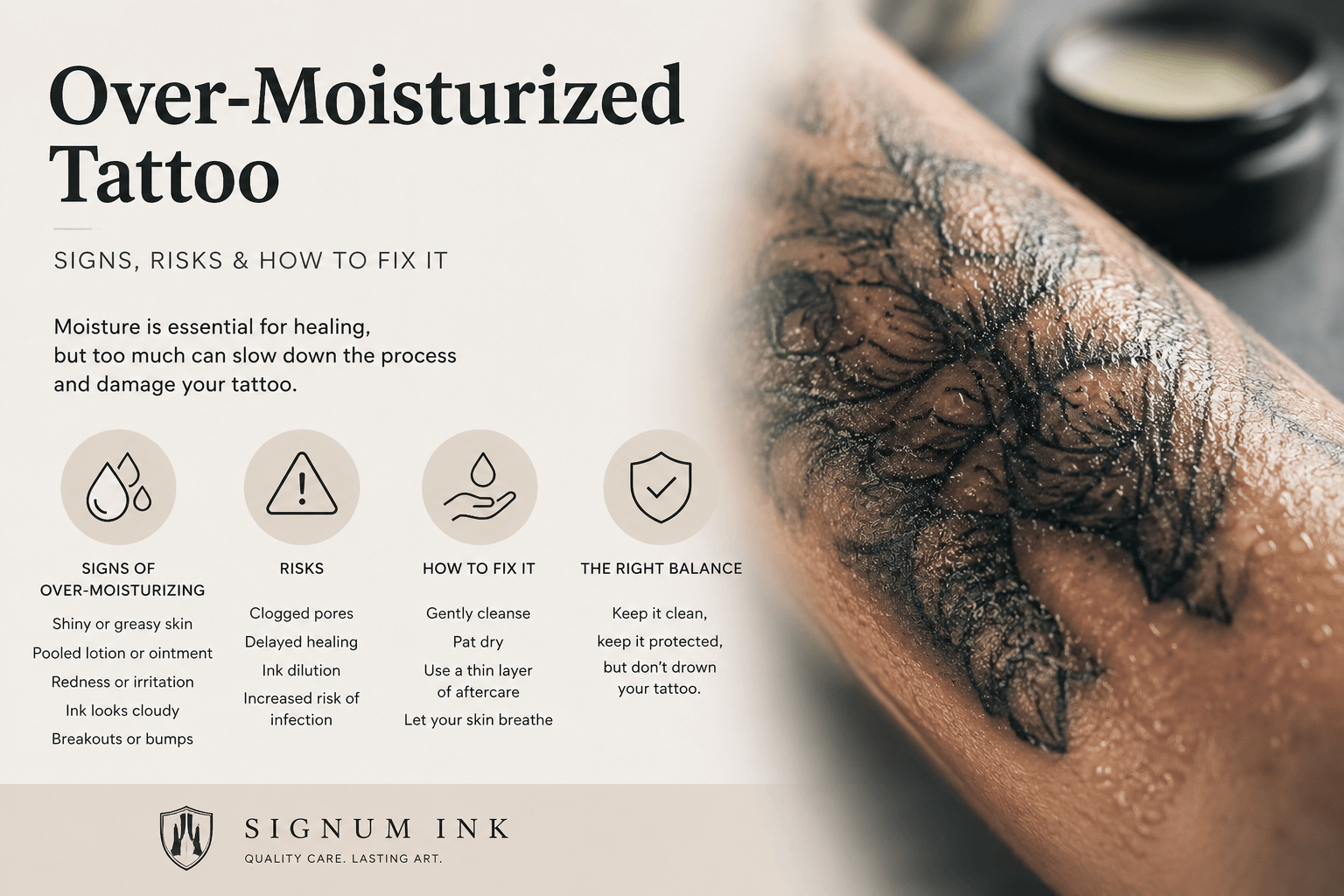
Most people know that a healing tattoo needs moisture.
However, fewer people realize that too much moisture can also become a problem.
After getting a new tattoo, it’s natural to want to protect it by applying plenty of tattoo cream or ointment.
Unfortunately, applying excessive amounts of product may leave the skin constantly wet, soft, and unable to breathe comfortably.
This condition is commonly described as an over-moisturized tattoo.
While it usually doesn’t damage the tattoo pigment itself, excessive moisture can make healing skin appear shiny, sticky, swollen, or unusually soft.
Den Unterschied zwischen healthy hydration und over-moisturizing helps create the best possible environment for your skin to recover naturally.
Kurze Antwort
Can you over-moisturize a tattoo?
Ja.
Applying excessive amounts of cream or ointment may trap moisture against the healing skin, leaving it overly soft and reducing the natural evaporation that supports normal barrier recovery.
The goal is balanced hydration rather than constantly coated skin.
Kurz & Bündig
Häufigste Zeit
Tage 2–10
Häufigste Ursache
Applying excessive amounts of aftercare product.
Common Signs
- Shiny appearance.
- Sticky skin.
- Soft peeling skin.
- Leichte Schwellung.
- Tattoo bubbling.
Verbessert normalerweise
When product application is reduced and the skin is allowed to return to a balanced moisture level.
What Is an Over-Moisturized Tattoo?
An over-moisturized tattoo is a healing tattoo whose outer layer has remained too wet for too long.
Instead of allowing the epidermis to regulate moisture naturally, thick layers of ointment or frequent reapplication may leave the skin continuously saturated.
This often affects only the outer healing layer.
Das Tattoo-Pigment verbleibt sicher in der Dermis gespeichert.
Why Does Over-Moisturizing Happen?
Tattoo aftercare advice often emphasizes keeping the tattoo moisturized.
Sometimes this advice is misunderstood.
Rather than applying thin layers when needed, some people repeatedly apply cream throughout the day before the previous layer has absorbed.
This can create a continuously moist environment that may interfere with normal surface healing.
Common Causes of an Over-Moisturized Tattoo
Mehrere Faktoren können dazu beitragen.
Applying Too Much Tattoo Cream
The most common cause is simply using more product than the skin can comfortably absorb.
The tattoo may remain shiny for hours after application.
Reapplying Too Frequently
Adding new layers before the previous application has been absorbed may gradually trap more moisture against the skin.
Heavy Ointments
Very thick occlusive ointments reduce water evaporation more than lightweight creams.
While they may be appropriate in certain situations, applying large quantities can leave the skin overly saturated.
Covering the Tattoo for Too Long
Keeping protective films or dressings in place longer than recommended may increase moisture accumulation beneath the dressing.
Always follow the instructions provided by your tattoo artist or the dressing manufacturer.
Hot Weather and Sweating
Heat and perspiration may combine with heavy moisturizer to create an overly moist environment on the skin.
What Does an Over-Moisturized Tattoo Look Like?
Gängige Funktionen umfassen:
- Glänzende Haut.
- Sticky surface.
- Soft peeling skin.
- Puffy appearance.
- Leichte Schwellung.
- Skin that feels constantly damp.
- Tattoo bubbling.
Unlike a healthy tattoo, the skin rarely has time to dry naturally between applications.
Can Too Much Cream Damage a Tattoo?
Normalerweise, nein.
The tattoo pigment itself is generally unaffected.
However, excessive moisture may:
- Delay comfortable surface healing.
- Increase bubbling.
- Make peeling less natural.
- Leave the skin feeling overly soft.
- Increase friction against clothing.
Maintaining balanced hydration helps support healthier barrier recovery.
Unterstützung der gesunden Heilung
Healthy aftercare is about balance, not maximum moisture.
Hilfreiche Gewohnheiten sind:
- Applying only a thin layer of product.
- Waiting until the skin feels dry before reapplying.
- Atmungsaktive Kleidung tragen.
- Washing gently with a mild cleanser.
- Allowing the skin to regulate moisture naturally.
Supporting the skin barrier gives your tattoo the best environment to heal comfortably.
Over-Moisturized Tattoo vs. Dry Tattoo
Although both conditions involve the healing skin, they are almost opposite problems.
Dry Tattoo
A dry tattoo usually appears:
- Matte.
- Eng.
- Flaky.
- Slightly rough.
- Leicht juckend.
The skin has temporarily lost moisture while the barrier is rebuilding.
Over-Moisturized Tattoo
An over-moisturized tattoo often appears:
- Shiny.
- Sticky.
- Weich.
- Aufgeblasen.
- Constantly damp.
Instead of lacking moisture, the outer skin is holding too much.
Healthy healing happens somewhere between these two extremes.
Over-Moisturized Tattoo vs. Tattoo Bubbling
These two terms are closely connected but not identical.
Over-Moisturized Tattoo
This describes the cause.
Too much product or trapped moisture keeps the skin excessively hydrated.
Tattoo Bubbling
This describes one possible result.
The softened outer layer may become:
- Aufgewachsen.
- Zerknittert.
- Glänzend.
- Waterlogged.
Not every over-moisturized tattoo develops bubbling, but bubbling is frequently associated with excessive moisture.
Over-Moisturized Tattoo vs. Infection
Many people worry that shiny or swollen skin means the tattoo is infected.
Glücklicherweise, over-moisturizing by itself is not an infection.
Healthy over-moisturized skin usually:
- Looks shiny.
- Feels soft.
- Has little or no increasing pain.
- Gradually improves when excess moisture is reduced.
Symptoms that deserve prompt medical assessment include:
- Schnell ausbreitende Rötung.
- Dicker gelber oder grüner Ausfluss.
- Zunehmende Schmerzen.
- Fieber oder Schüttelfrost.
- Erhebliche Schwellung.
- Rote Streifen, die sich vom Tattoo weg erstrecken.
These symptoms are nicht typisch für eine unkomplizierte Tattooheilung.
How to Fix an Over-Moisturized Tattoo
Fortunately, the solution is usually straightforward.
The goal is to restore the skin’s natural moisture balance.
Apply Less Product
Instead of thick layers, apply only a dünne, gleichmäßige Schicht when the tattoo actually feels dry.
The skin should absorb the product rather than leaving it sitting on the surface.
Allow the Skin to Breathe
Whenever possible:
- Wear loose clothing.
- Reduce unnecessary friction.
- Avoid trapping heat against the tattoo.
Good airflow supports normal barrier recovery.
Wait Before Reapplying
Avoid adding more cream simply because a schedule says it’s time.
Instead, observe the tattoo.
If it still looks shiny or feels moisturized, wait before applying more.
Clean the Tattoo Normally
Continue washing gently with lukewarm water and a mild cleanser.
Pat the tattoo dry with a clean towel.
Avoid scrubbing.
Avoid Picking Soft Skin
Soft peeling skin may seem ready to remove.
Allow it to separate naturally.
Picking may interrupt healthy healing.
Was passiert unter der Haut?
Although the surface appears overly moist, healing continues underneath.
Several biological processes remain active.
Epidermal Renewal
Fresh skin cells continue replacing damaged surface tissue.
Barrier Recovery
The skin gradually regains control of its moisture balance.
Kollagenumbau
Fibroblasts continue strengthening the dermis by reorganizing collagen fibers.
Pigmentstabilisierung
Tattoo pigment remains protected within the dermis while only the outer epidermis is affected by excess moisture.
Was sagt die Forschung?
Modern wound-healing research shows that healing skin performs best within a balanced moisture environment.
Skin that becomes:
- Too dry may feel tight and uncomfortable.
- Too wet may become softened through maceration, a process in which prolonged moisture weakens the outer layer of the skin.
Balanced hydration supports healthy barrier recovery without excessive softening.
Common Mistakes That Cause Over-Moisturizing
Several habits commonly contribute.
Thick Layers of Ointment
More product does not mean faster healing.
Reapplying Too Often
Adding cream before the previous layer has absorbed may trap moisture against the skin.
Covering the Tattoo Too Long
Protective dressings should only remain in place for the recommended period.
Heavy Sweating
Sweat combined with thick moisturizer may increase surface moisture.
Enge Kleidung
Limited airflow may trap heat and moisture against the skin.
Ignoring the Skin’s Appearance
Instead of following a rigid schedule, let your tattoo guide you.
If it still looks shiny and hydrated, additional product is usually unnecessary.
Forschungsbericht
| Forschungsbereich | Beweis |
|---|---|
| Moist Wound Healing | ★★★★★ |
| Hautbarriere-Regeneration | ★★★★★ |
| Epidermale Regeneration | ★★★★★ |
| Wound Maceration | ★★★★☆ |
| Tattoo-Nachsorge | ★★★★☆ |
| Tattoo Over-Moisturizing Research | ★★★☆☆ |
Frequently Asked Questions About an Over-Moisturized Tattoo
Can you put too much cream on a healing tattoo?
Ja.
Applying excessive amounts of tattoo cream or ointment can leave the skin constantly coated with moisture. This may make the outer layer appear shiny, soft, sticky, or overly hydrated.
A healing tattoo generally benefits more from a thin layer applied when needed than from thick, frequent applications.
Can too much moisturizer ruin a tattoo?
Usually, no.
An over-moisturized tattoo does not normally damage the tattoo pigment because the ink remains protected within the dermis.
However, excessive moisture may:
- Increase skin irritation.
- Contribute to tattoo bubbling.
- Slow comfortable surface healing.
- Make the skin more vulnerable to friction.
Reducing excess product usually allows the skin to recover normally.
How do I know if I’m using too much tattoo cream?
Häufige Anzeichen sind:
- The tattoo stays shiny for hours.
- The skin feels sticky.
- Cream remains sitting on the surface instead of absorbing.
- Peeling skin becomes soft and soggy.
- The tattoo develops bubbling.
If your tattoo still looks heavily moisturized before your next application, you probably don’t need more product yet.
Should my tattoo always look shiny?
Nein.
Immediately after applying a moisturizer, a slight sheen is normal.
However, your tattoo should not remain constantly glossy throughout the day.
Healthy healing skin should spend most of its time feeling comfortable rather than continuously coated with product.
How often should I apply tattoo cream?
There is no universal schedule.
Instead of applying cream at fixed intervals, observe your skin.
Wenn sich das Tattoo anfühlt:
- Eng.
- Trocken.
- Slightly itchy.
…it may benefit from a light application.
If it still feels soft and hydrated, additional product is usually unnecessary.
Can over-moisturizing cause tattoo bubbling?
Ja.
Tattoo bubbling is frequently associated with excess moisture trapped in the outer healing skin.
Reducing heavy applications of cream often allows the softened skin to gradually return to normal.
Can sweating make over-moisturizing worse?
Absolut.
Heavy sweating combined with thick layers of moisturizer may trap additional moisture against the tattoo.
During healing, breathable clothing and gentle cleansing after excessive sweating can help maintain a healthier environment for the skin.
Should I stop moisturizing completely?
Usually not.
The solution is rarely to stop using moisturizer altogether.
Stattdessen
- Apply smaller amounts.
- Wait longer between applications.
- Allow the previous layer to absorb fully.
Balanced hydration is generally the healthiest approach.
Wann sollte ich ärztlichen Rat einholen?
Arrange prompt medical assessment if your tattoo develops:
- Schnell ausbreitende Rötung.
- Dicker gelber oder grüner Ausfluss.
- Zunehmende Schmerzen.
- Fieber oder Schüttelfrost.
- Erhebliche Schwellung.
- Rote Streifen, die sich vom Tattoo weg erstrecken.
- A foul odor.
These symptoms are nicht typisch für eine unkomplizierte Tattooheilung and should be evaluated by a healthcare professional.
Common Myths About Over-Moisturized Tattoos
Myth 1: More tattoo cream means faster healing.
Realität
Healing depends on your body’s natural repair processes. Excess product does not speed them up and may create an overly moist environment.
Myth 2: A tattoo should stay shiny all day.
Realität
A slight shine immediately after application is normal.
Constant shininess often indicates that too much product remains on the skin.
Myth 3: If my tattoo feels dry once, I should immediately apply more cream.
Realität
Temporary tightness is a normal part of healing.
Allow your skin to guide you rather than applying product on a strict schedule.
Myth 4: Over-moisturizing removes tattoo ink.
Realität
Tattoo pigment remains safely stored within the dermis.
Over-moisturizing primarily affects the outer healing epidermis.
Healing Timeline
| Zeit nach der Tätowierung | Was Sie bemerken könnten |
|---|---|
| Tage 1–3 | Rötung, Schwellung, Zärtlichkeit |
| Days 2–10 | Risk of over-moisturizing if excessive product is applied |
| Days 3–10 | Peeling, itching, possible bubbling |
| Woche 2 | Skin barrier continues recovering |
| Wochen 3–4 | Oberflächenheilung weitgehend abgeschlossen |
| Wochen 6–8 | Tiefgreifende Hauterneuerung setzt sich fort |
Forschungsbericht
| Forschungsbereich | Beweis |
|---|---|
| Moist Wound Healing | ★★★★★ |
| Hautbarriere-Regeneration | ★★★★★ |
| Epidermale Regeneration | ★★★★★ |
| Wound Maceration | ★★★★☆ |
| Tattoo-Nachsorge | ★★★★☆ |
| Over-Moisturized Tattoo Research | ★★★☆☆ |
Experten-Tipp
Your tattoo doesn’t need to stay wet—it needs the right balance of moisture.
Think of moisturizer as support rather than a protective coating. A thin layer that absorbs into the skin is usually far more beneficial than repeatedly applying thick layers throughout the day. Healthy tattoo healing happens when the skin can breathe, regulate moisture, and rebuild its protective barrier naturally.
Signs Your Tattoo Has a Healthy Moisture Balance
✅ Comfortable skin.
✅ Light hydration.
✅ No sticky residue.
✅ Natural peeling.
✅ Skin gradually becoming smoother.
✅ Less redness each day.
✅ Overall improvement.
These are reassuring signs that your skin barrier is recovering normally.
Anzeichen, die eine ärztliche Untersuchung erfordern
⚠️ Rapidly spreading redness.
⚠️ Dickflüssiger gelber oder grüner Ausfluss.
⚠️ Increasing pain.
Fieber oder Schüttelfrost.
⚠️ Deutliche Schwellung.
⚠️ A foul odor.
⚠️ Red streaks extending away from the tattoo.
These findings do not automatically indicate an infection, but they are not part of uncomplicated tattoo healing and should be assessed promptly.
Why Moisture Balance Matters
Healthy tattoo healing is closely linked to the skin barrier’s ability to regulate water.
Modern aftercare products often contain ingredients chosen to support this process without leaving the skin excessively greasy or occluded.
| Funktion | Example Ingredient |
|---|---|
| Attracts moisture | Glycerin |
| Supports hydration | Betain |
| Strengthens the barrier | Ceramide |
| Supports barrier repair | Niacinamid |
| Hautpflege | Panthenol |
| Lightweight emollient | Squalane |
| Improves spreadability | Capryl-Capric-Triglyceride |
| Soothes the skin | Allantoin |
| Botanical support | Madecassosid |
| Antioxidant protection | Vitamin E |
Used correctly, these ingredients help maintain a comfortable level of hydration while allowing the skin’s natural repair mechanisms to continue.
Abschließende Gedanken
Moisturizing is an important part of tattoo aftercare—but more is not always better. While healing skin benefits from hydration, constantly coating the tattoo with thick layers of cream can leave the surface overly soft and interfere with its natural moisture balance.
The best approach is simple: keep the tattoo clean, apply a thin layer of aftercare product only when the skin needs it, and allow time between applications so the skin can breathe. By supporting—not overwhelming—the healing process, you create the ideal conditions for your tattoo to recover comfortably and maintain its sharp appearance.
When in doubt, remember one simple rule: your tattoo should feel comfortably hydrated, not constantly wet.
Related Articles
Continue exploring healthy tattoo healing with these guides:
- Dry Tattoo: Why Your Healing Tattoo Feels Dry
- Tattoo Bubbling Explained
- Tattoo Cracking Explained
- Tattoo Peeling Explained
- Tattoo Flaking vs. Infection
- Signs Your Tattoo Is Healing Properly
- Wie lange dauert es, bis eine Tätowierung verheilt ist?
- Tattoo-Heilungs-Zeitplan: Was Sie von Tag 1 bis Tag 60 erwarten können
- Can I Scratch My Healing Tattoo?
- The Complete Science of Tattoo Healing
 English
  German