Getting a tattoo is only the beginning of the journey.
Over the following days and weeks, your skin works continuously to repair itself while protecting the artwork beneath the surface.
During this time, many people find themselves asking the same question:
“Is my tattoo healing normally?”
The answer is often reassuring.
Most tattoos follow a predictable healing pattern that includes temporary redness, peeling, mild itching, and gradual improvement.
Understanding the signs of healthy healing helps you distinguish between expected changes and symptoms that may deserve closer attention.
Rather than focusing on every small change from one day to the next, it is far more helpful to look for steady progress over time.
A tattoo that becomes slightly less red, slightly less itchy, and slightly more comfortable each day is usually following the normal course of healing.
Kurze Antwort
What are the signs a tattoo is healing properly?
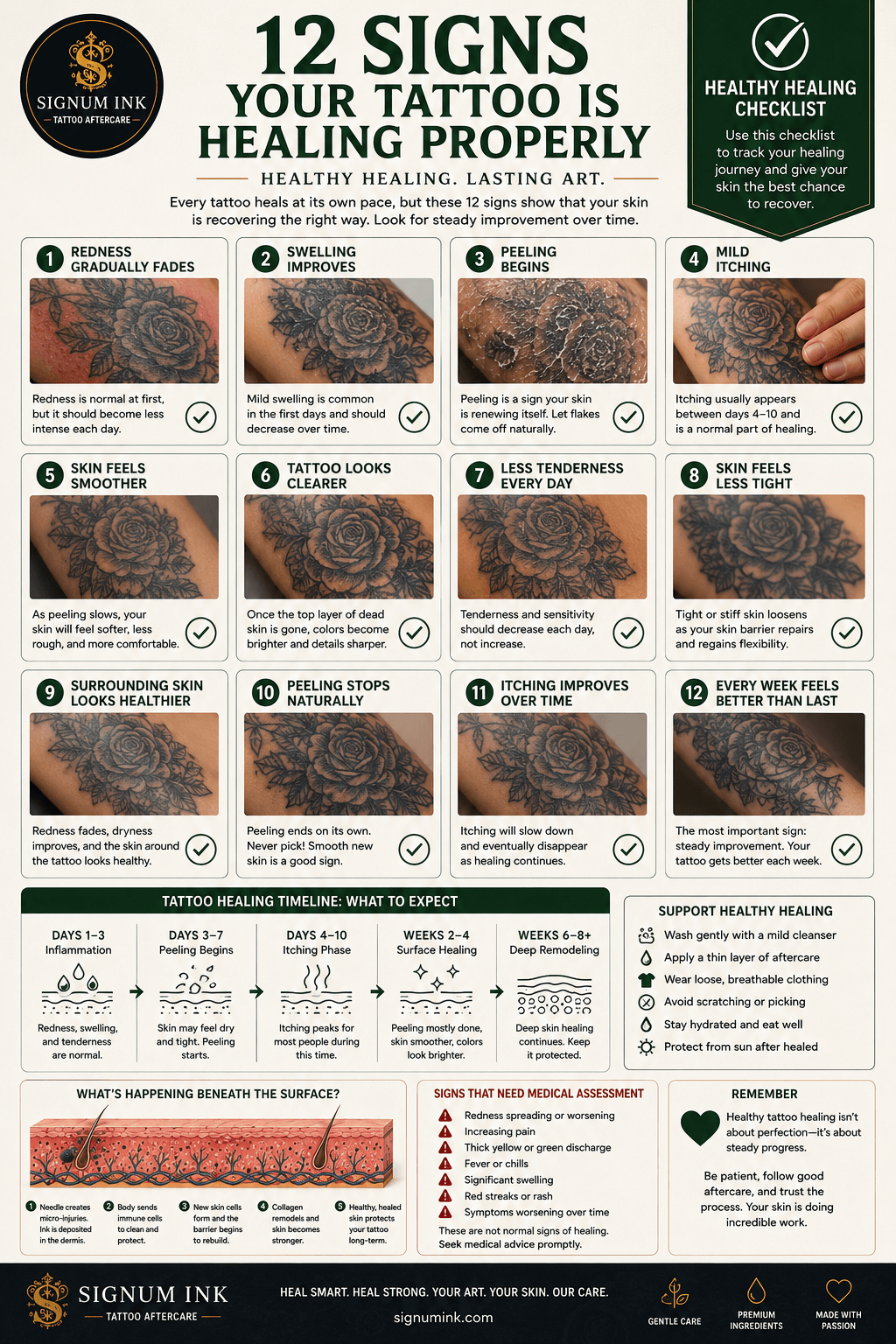
Healthy tattoos generally show:
- Gradually fading redness.
- Mild peeling.
- Temporary itching.
- Less swelling over time.
- Smooth new skin forming.
- Comfortable healing.
- No worsening symptoms.
The most important sign is consistent improvement.
Kurz & Bündig
Tage 1–3
Normal redness and mild swelling.
Tage 3–7
Peeling often begins.
Days 4–10
Itching commonly develops.
Wochen 2–4
Surface healing largely complete.
Wochen 6–8
Die tiefe Hauterneuerung geht weiter.
Sign 1 – Redness Gradually Fades
Immediately after tattooing, redness is expected.
Healthy healing means the redness becomes:
- Less intense.
- Less widespread.
- Less noticeable each day.
A tattoo that slowly becomes calmer is generally healing well.
Sign 2 – Swelling Improves
Mild swelling is common during the first couple of days.
Healthy healing usually means:
- Swelling decreases naturally.
- Skin feels less tight.
- Movement becomes more comfortable.
Most swelling begins improving within the first several days.
Sign 3 – Peeling Begins
One of the clearest signs of normal healing is peeling.
As damaged epidermal cells are replaced, thin flakes naturally separate from the surface.
This process usually begins between Days 3 and 7.
Peeling is not a sign that your tattoo is fading.
It is a sign that your skin is renewing itself.
Sign 4 – Mild Itching Appears
Many people worry when their tattoo starts itching.
Fortunately, mild itching is one of the most common stages of tattoo healing.
It often reflects:
- Neue Hautbildung.
- Barrier repair.
- Heilung von Nervenenden.
- Vorübergehende Trockenheit.
Most itching gradually improves over one to two weeks.
Sign 5 – The Skin Feels Smoother
As peeling slows, the tattoo begins feeling different.
Instead of rough, flaky skin, you may notice:
- Smoother texture.
- Less tightness.
- Improved flexibility.
- Greater comfort.
These changes indicate that the epidermis is rebuilding successfully.
Sign 6 – The Tattoo Looks Clearer
During peeling, tattoos often appear cloudy or dull.
Once fresh skin reaches the surface:
- Colours become brighter.
- Lines appear sharper.
- Fine details become easier to see.
This is one of the most satisfying stages of healing.
Sign 7 – Less Tenderness Every Day
Discomfort is expected immediately after tattooing.
Healthy healing usually follows this pattern:
- Day 1: Most tender.
- Days 2–3: Noticeable improvement.
- Week 2: Only minimal tenderness remains.
Gradually decreasing sensitivity is one of the strongest indicators of normal recovery.
Unterstützung der gesunden Heilung
The body does most of the healing naturally.
You can support the process by:
- Washing gently.
- Applying a thin layer of recovery cream when needed.
- Vermeiden von Kratzern.
- Lockere Kleidung tragen.
- Allowing peeling skin to separate naturally.
These simple habits help create the best possible environment for healthy skin repair.
Sign 8 – The Tattoo Feels Less Tight
During the first few days, many tattoos feel tight or stiff.
This happens because the skin barrier has been temporarily disrupted and the epidermis is beginning to repair itself.
As healing progresses, you will usually notice:
- Greater flexibility.
- Less tightness.
- Improved comfort when moving.
- Skin that feels more natural.
These changes suggest that the skin barrier is gradually recovering.
Sign 9 – The Skin Looks Healthier
Healthy healing isn’t only about the tattoo itself.
The surrounding skin should also begin looking healthier over time.
Sie werden vielleicht bemerken:
- Weniger Rötungen.
- Reduzierte Trockenheit.
- A more even skin tone.
- Healthy new skin replacing peeling areas.
The tattoo gradually begins blending into the surrounding skin rather than looking like an active wound.
Sign 10 – Peeling Stops Naturally
One of the clearest milestones during healing is when peeling gradually comes to an end.
Healthy peeling:
- Happens naturally.
- Ends without picking.
- Leaves smooth new skin underneath.
The tattoo often appears noticeably brighter after this stage.
Sign 11 – Itching Gradually Improves
Itching is common during the first couple of weeks.
Healthy healing usually follows this pattern:
- Itching develops.
- Peaks during peeling.
- Slowly becomes less noticeable.
- Eventually disappears.
A tattoo that becomes less itchy over time is generally following a normal healing pattern.
Sign 12 – Every Week Feels Better Than the Last
Perhaps the single best sign of healthy healing is simple:
Overall improvement.
No tattoo heals perfectly every single day.
Some mornings the skin may feel slightly drier.
Some evenings it may itch more than expected.
These temporary fluctuations are common.
The important question is:
“Is my tattoo gradually getting better?”
If the answer is yes, your tattoo is likely healing normally.
What If Healing Takes Longer?
Not every tattoo follows exactly the same schedule.
Several factors can influence healing time.
Dazu gehören:
Tattoo-Größe
Large tattoos naturally require more tissue repair.
Tattoo-Platzierung
Areas that bend or experience frequent friction often heal more slowly.
Beispiele sind:
- Hands.
- Finger.
- Feet.
- Ellbogen.
- Knie.
- Knöchel.
Tattoo-Stil
Heavy colour packing and solid black work often involve more needle passes than fine-line tattoos.
This may slightly extend healing time.
Individual Skin Differences
Jeder heilt anders.
Age, skin type, circulation, hydration, nutrition, sleep quality, and general health all influence recovery.
Healthy Healing vs. Warning Signs
One of the easiest ways to evaluate healing is to compare the overall pattern.
| Healthy Healing | Symptome, die ärztlich abgeklärt werden müssen |
|---|---|
| Redness fades | Redness spreads |
| Swelling decreases | Swelling worsens |
| Peeling gradually finishes | Dicker gelber oder grüner Ausfluss |
| Mild itching improves | Zunehmende Schmerzen |
| Skin becomes smoother | Fieber oder Schüttelfrost |
| Comfortable recovery | Red streaks extending away from the tattoo |
The key difference is progression.
Healthy tattoos improve.
More concerning conditions often become worse.
Was sagt die Forschung?
Scientific studies describe tattoo healing as a normal wound-healing response involving several overlapping biological phases.
During healing:
Immune Cells Protect the Skin
White blood cells remove damaged tissue and help coordinate repair.
New Epidermis Forms
Fresh skin cells gradually replace damaged surface cells.
Collagen Is Reorganized
Fibroblasts continue producing collagen to strengthen healing tissue.
The Skin Barrier Recovers
As barrier function improves:
- Moisture retention increases.
- Dryness decreases.
- Irritation becomes less noticeable.
- Skin becomes stronger.
These processes continue long after the tattoo appears healed.
Common Mistakes That Interrupt Healthy Healing
Even well-healing tattoos can become irritated if the skin is repeatedly disturbed.
Häufige Fehler sind:
Kratzen
Scratching may damage fragile new skin.
Abpuhlen von Haut
Allow flakes to separate naturally.
Übermäßiges Waschen
Too much washing may dry the recovering skin barrier.
Applying Excessive Product
Very thick layers of ointment may leave the skin feeling overly occluded.
A thin layer is usually sufficient.
Enge Kleidung
Repeated friction may prolong irritation.
Ignoring Sun Protection
Once the tattoo has fully healed, protecting it from ultraviolet radiation helps preserve both skin health and tattoo appearance.
Forschungsbericht
| Forschungsbereich | Beweis |
|---|---|
| Wundheilungsbiologie | ★★★★★ |
| Epidermale Regeneration | ★★★★★ |
| Hautbarriere-Regeneration | ★★★★★ |
| Kollagenumbau | ★★★★★ |
| Tattoo-Nachsorge | ★★★★☆ |
| Tattooheilungsforschung | ★★★★☆ |
Frequently Asked Questions About Healthy Tattoo Healing
How do I know if my tattoo is healing properly?
A healthy tattoo usually follows a predictable pattern.
Sie werden vielleicht bemerken:
- Redness gradually fades.
- Swelling decreases.
- Peeling begins and ends naturally.
- Mild itching improves.
- The skin becomes smoother.
- The tattoo looks clearer after peeling.
The most important sign is that your tattoo gradually improves over time.
Is peeling a good sign?
Ja.
Peeling is one of the most common stages of tattoo healing.
It reflects the natural replacement of damaged surface skin with healthy new epidermal cells.
Although peeling can look alarming, it is usually a normal part of recovery.
Should my tattoo still be red after one week?
A small amount of redness may still be present after several days.
Healthy redness should:
- Stay close to the tattoo.
- Become less noticeable over time.
- Be accompanied by improving comfort.
Redness that spreads or becomes more intense should be assessed by a healthcare professional.
Is itching a sign of healthy healing?
Usually, yes.
Mild itching commonly develops between Days 4 and 10.
It often reflects:
- Neue Hautbildung.
- Regeneration von Nervenenden.
- Hautbarriere-Reparatur.
- Vorübergehende Trockenheit.
Most itching gradually settles as healing continues.
Why does my tattoo look dull?
Das ist völlig normal.
During peeling, the tattoo is covered by dry surface skin and newly forming epidermal cells.
Once peeling has finished, colours often appear brighter and more defined.
When should my tattoo feel normal again?
Most tattoos feel much more comfortable after 2–4 Wochen.
Tiefergehende Heilung dauert jedoch etwa 6–8 Wochen, even though the tattoo may already look fully healed.
Can a healthy tattoo heal at different speeds?
Absolut.
Healing varies depending on:
- Tattoo-Größe.
- Placement.
- Tattoo style.
- Hauttyp.
- Gesundheit insgesamt.
- Tägliche Nachsorge.
No two tattoos heal exactly alike.
Should my tattoo still feel slightly dry?
Ja.
Even after peeling ends, the skin barrier may still be recovering.
Mild dryness often improves gradually over the following weeks.
Wann sollte ich ärztlichen Rat einholen?
Seek prompt medical assessment if you notice:
- Schnell ausbreitende Rötung.
- Zunehmende Schmerzen.
- Dicker gelber oder grüner Ausfluss.
- Fieber oder Schüttelfrost.
- Erhebliche Schwellung.
- Rote Streifen, die sich vom Tattoo weg erstrecken.
- Symptoms that worsen instead of improving.
Diese Ergebnisse sind nicht typisch für eine unkomplizierte Tattooheilung and should be evaluated by a healthcare professional.
Common Myths About Healthy Tattoo Healing
Myth 1: A healing tattoo should look perfect every day.
Realität
Healing naturally has ups and downs.
Some days your tattoo may feel drier or itchier than others.
What matters most is the overall trend toward improvement.
Myth 2: If my tattoo peels, something is wrong.
Realität
Peeling is one of the most common signs that the epidermis is renewing itself.
Myth 3: Once the peeling stops, healing is finished.
Realität
Surface healing may be complete, but deeper tissue remodeling continues for several more weeks.
Myth 4: Every tattoo heals the same way.
Realität
Healing varies from person to person and even between different tattoos on the same person.
Healthy Healing Timeline
| Zeit nach der Tätowierung | Healthy Signs |
|---|---|
| Tage 1–3 | Mild redness, swelling, tenderness |
| Tage 3–7 | Peeling begins, skin feels dry |
| Days 4–10 | Mild itching develops |
| Woche 2 | Less peeling, smoother skin |
| Wochen 3–4 | Oberflächenheilung weitgehend abgeschlossen |
| Wochen 6–8 | Tiefgreifende Hauterneuerung setzt sich fort |
Forschungsbericht
| Forschungsbereich | Beweis |
|---|---|
| Wundheilungsbiologie | ★★★★★ |
| Epidermale Regeneration | ★★★★★ |
| Hautbarriere-Regeneration | ★★★★★ |
| Kollagenumbau | ★★★★★ |
| Tattoo-Nachsorge | ★★★★☆ |
| Tattooheilungsforschung | ★★★★☆ |
Experten-Tipp
Healthy tattoo healing is measured by progress—not perfection.
Every tattoo heals a little differently. Instead of comparing your tattoo to someone else’s, focus on whether your own skin becomes less red, less swollen, less itchy, and more comfortable over time. Gradual improvement is one of the strongest indicators that healing is progressing normally.
Signs Your Tattoo Is Healing Well
✅ Redness gradually fades.
✅ Swelling improves.
✅ Peeling occurs naturally.
✅ Mild itching settles over time.
✅ Skin feels smoother.
✅ Tattoo colours become clearer.
✅ Less tenderness each day.
✅ Healthy surrounding skin.
✅ Comfortable movement.
✅ Overall improvement from week to week.
Anzeichen, die eine ärztliche Untersuchung erfordern
⚠️ Redness spreading beyond the tattoo.
⚠️ Increasing pain instead of improving.
⚠️ Dickflüssiger gelber oder grüner Ausfluss.
Fieber oder Schüttelfrost.
⚠️ Deutliche Schwellung.
⚠️ Red streaks extending away from the tattoo.
⚠️ Symptoms that continue worsening.
Diese Symptome do not automatically indicate an infection, but they are not typical of uncomplicated tattoo healing and should be evaluated promptly.
Why Supporting the Skin Barrier Is Essential
Throughout the healing process, one of your skin’s biggest tasks is rebuilding its protective barrier.
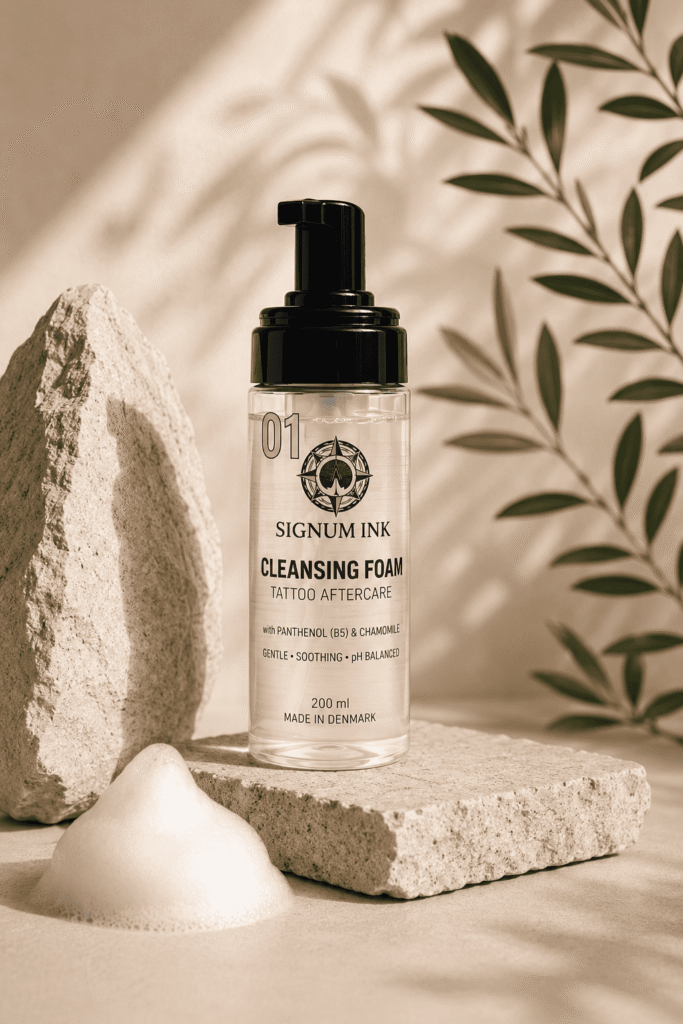
Modern tattoo aftercare products are designed to support this natural recovery by helping maintain hydration and reinforcing the skin’s defenses.
| Funktion | Example Ingredient |
|---|---|
| Attracts moisture | Glycerin |
| Supports hydration | Betain |
| Reinforces barrier lipids | Ceramide |
| Supports barrier function | Niacinamid |
| Hautpflege | Panthenol |
| Lightweight emollient | Squalane |
| Smooth application | Capryl-Capric-Triglyceride |
| Skin comfort | Allantoin |
| Botanical support | Madecassosid |
| Antioxidant protection | Vitamin E |
Together, these ingredients help create an environment where the skin can recover comfortably while its natural repair processes continue.
Abschließende Gedanken
Every tattoo tells a story—but before it becomes a lasting piece of art, your skin must complete an equally remarkable healing process.
While it is easy to focus on temporary redness, peeling, or itching, these changes are often expected stages of recovery. The most reliable sign of healthy healing is not that your tattoo looks perfect every day, but that it gradually becomes less inflamed, more comfortable, and more stable with each passing week.
Patience, gentle care, and realistic expectations are the foundation of successful tattoo aftercare. By understanding what healthy healing looks like, you can enjoy the process with greater confidence and know when your skin is simply doing exactly what it was designed to do.
Related Articles
Readers who want to learn more about each stage of tattoo healing can continue with:
- Tattoo-Heilungs-Zeitplan: Was Sie von Tag 1 bis Tag 60 erwarten können
- Wie lange dauert es, bis eine Tätowierung verheilt ist?
- The Complete Science of Tattoo Healing
- Why Is My Tattoo Red?
- Why Is My Tattoo Itchy?
- Tattoo Peeling Explained
- Is Tattoo Scabbing Normal?
- Tattoo Flaking vs. Infection
- Can I Scratch My Healing Tattoo?
- Tattoo Pimples After Healing
 English
  German