Die meisten Leute erwarten, dass ein heilendes Tattoo leicht rot, trocken, schuppig oder juckend wird.
Aber manchmal entwickelt die Haut etwas Unerwartetes.
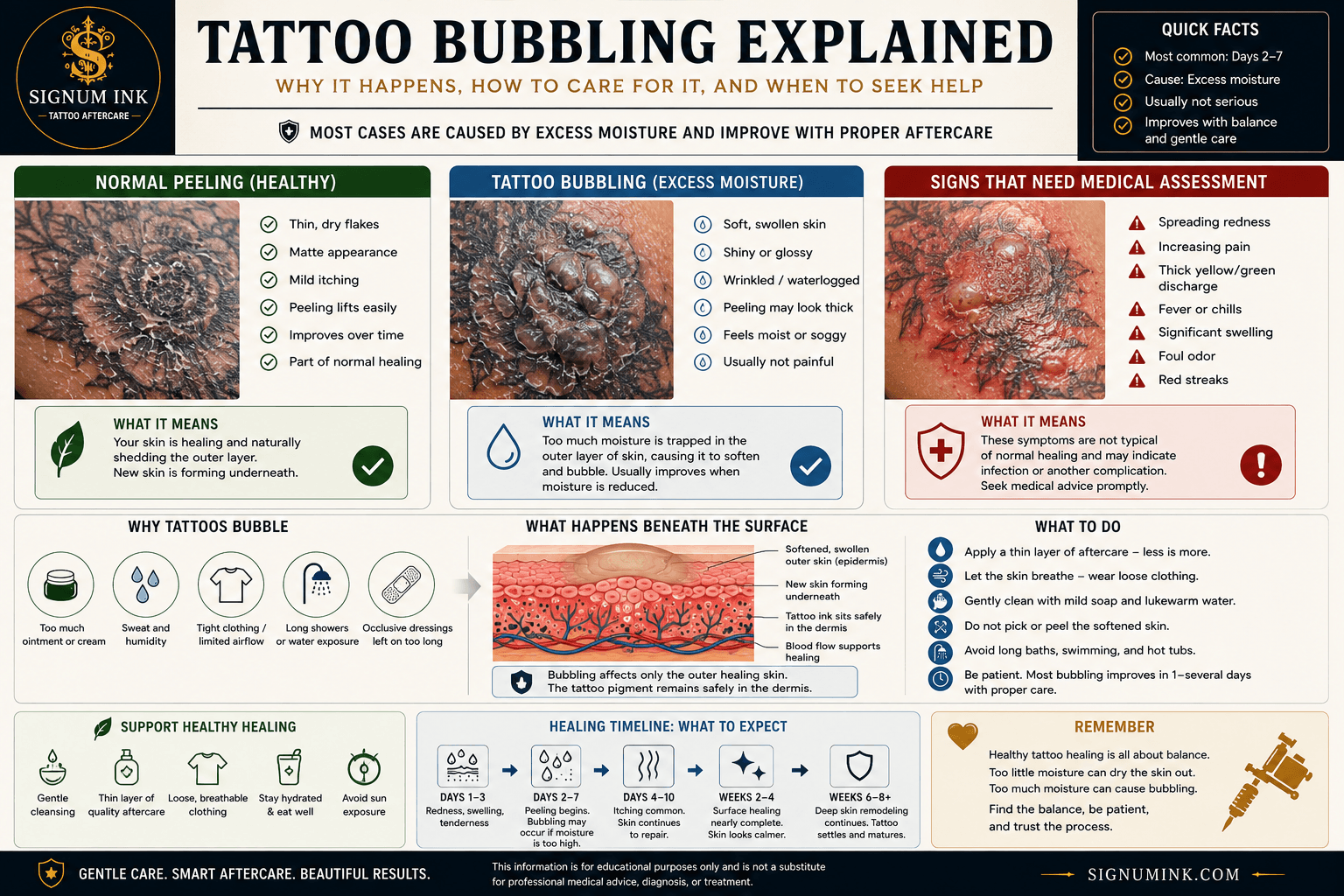
Anstatt normal abzuheilen, beginnt das Tattoo so auszusehen weich, erhaben, faltig oder aufgeweicht.
Die Oberfläche kann glänzend, geschwollen oder fast so aussehen, als würden sich winzige Bläschen in der sich schälenden Haut bilden.
Dieser Zustand ist allgemein bekannt als Tätowierung blubbert.
Obwohl Blasenbildung beunruhigend aussehen kann, steht sie oft im Zusammenhang mit Überschüssige Feuchtigkeit, die sich in der äußeren Schicht heilender Haut festsetzt eher ein Problem mit dem Tattoo selbst.
Zu verstehen, warum Blasenbildung bei Tattoos auftritt – und wie man angemessen darauf reagiert – kann Ihnen helfen, eine gesunde Heilung zu unterstützen und unnötige Reizungen zu vermeiden.
Kurze Antwort
Was ist Blasenbildung bei Tattoos?
Tattoo-Blasenbildung tritt auf, wenn heilende Haut übermäßig feucht wird, was dazu führt, dass sich schälende Haut aufweicht, anschwillt und von der Oberfläche abhebt.
In vielen Fällen verbessert sich das Bläschenstadium, sobald die Haut auf natürliche Weise trocknen kann und sich die darunterliegende Hautbarriere weiter erholt.
Wenn das Blubbern jedoch mit zunehmenden Schmerzen, sich ausbreitender Rötung, Fieber, dickem Ausfluss oder einem unangenehmen Geruch einhergeht, wird eine umgehende ärztliche Untersuchung empfohlen.
Kurz & Bündig
Häufigste Ursache
Überschüssige Feuchtigkeit, die in heilender Haut eingeschlossen ist.
Erscheint normalerweise
Tage 2–7.
Oft verbunden mit
- Dicke Salbenschichten.
- Übermäßiges Schwitzen.
- Okklusivverbände zu lange draufgelassen.
- Hohe Luftfeuchtigkeit.
- Wasserexposition.
Verbessert normalerweise
Wenn überschüssige Feuchtigkeit reduziert wird und die Heilung normal fortschreitet.
Was ist Tätowierungsblasenbildung?
Blasenbildung bei Tattoos ist keine eigenständige Heilungsphase.
Stattdessen handelt es sich um eine Veränderung des Aussehens von schälender Haut, die durch übermäßige Feuchtigkeit verursacht wird.
Anstatt trocken genug zu bleiben, um sich natürlich zu trennen, wird die äußere Schicht übermäßig hydriert.
Als Ergebnis kann sich die sich schälende Haut zeigen:
- Weich.
- Aufgeblasen.
- Zerknittert.
- Glänzend.
- Aufgewachsen.
- Leicht durchscheinend.
Obwohl das Erscheinungsbild überraschend sein kann, bleibt das zugrundeliegende Tattoo-Pigment normalerweise sicher in der Dermis eingeschlossen.
Warum platzen Tattoos auf?
Der häufigste Grund ist, dass heilende Haut bleibt zu feucht für zu lange.
Frische Tattoos verlieren auf natürliche Weise Wasser, während sich die Hautbarriere wieder aufbaut.
Wenn zusätzliche Feuchtigkeit an der Oberfläche zurückgehalten wird, kann die äußere Epidermis mehr Wasser aufnehmen, als sie bequem verarbeiten kann.
Anstatt normal auszutrocknen und abzufallen, wird die Haut weich und schwillt an.
Häufige Ursachen für Blasenbildung bei Tattoos
Mehrere Faktoren können dazu beitragen.
Zu viel Salbe auftragen
Eine der häufigsten Ursachen ist die Verwendung von sehr dicken Schichten Salbe oder Tattoo-Creme.
Schwere Applikationen können Feuchtigkeit auf der Haut einschließen und die Verdunstung verringern.
Moderne Nachsorge funktioniert im Allgemeinen am besten mit einem dünne, gleichmäßige Schicht eher als eine dicke Schicht.
Schwitzen
Starkes Schwitzen kann dazu führen, dass Feuchtigkeit über längere Zeit auf dem Tattoo verbleibt.
Darum wird manchmal anschließend Blasenbildung beobachtet:
- Intensives Training.
- Heißes Wetter.
- Lange Phasen körperlicher Aktivität.
Enge Kleidung tragen
Kleidung, die Wärme und Feuchtigkeit am Tattoo staut, kann die Wahrscheinlichkeit von Blasenbildung erhöhen.
Lockere, atmungsaktive Stoffe sorgen in der Regel für eine bessere Heilungsumgebung.
Wassereinwirkung
Langes Duschen, Baden, Schwimmbäder, Whirlpools oder langes Einweichen können heilende Haut überhydrieren.
Obwohl normale Duschen im Allgemeinen in Ordnung sind, sollte längerer Wasserkontakt vermieden werden, während die Tätowierung noch heilt.
Zu lange auf Okklusivverbände
Schutzfolien für Tattoos können in der ersten Phase der Heilung äußerst hilfreich sein.
Wenn die Abdeckung jedoch länger als vom Hersteller oder Tätowierer empfohlen aufgetragen bleibt, kann sich darunter Feuchtigkeit ansammeln und zu Blasenbildung führen.
Befolgen Sie immer die Anweisungen zur Nachsorge für die spezifische Wundauflage, die Sie verwenden.
Wie sieht Blasenbildung bei Tattoos aus?
Menschen beschreiben Tätowierungsblasen auf unterschiedliche Weise.
Gängige Funktionen umfassen:
- Glänzende Haut.
- Sanftes Peeling.
- Erhabene Flecken.
- Faltenflocken.
- Wässriges Aussehen.
- Leichte Schwellung der losen Haut.
Das Bläschenbildung betrifft normalerweise nur die äußere Heilungsschicht – nicht die darunter liegende Tätowierungsfarbe.
Verursacht Blasenbildung bei Tattoos Schäden am Tattoo?
In vielen Fällen, nein.
Blasenbildung bei Tätowierungen beschädigt die Tinte normalerweise nicht.
Die größere Sorge ist, was passiert, wenn die aufgeweichte Haut eingerieben, zerkratzt oder vorzeitig abgezogen wird.
Wenn die Haut sich natürlich erholen kann, wird das heilende Tattoo geschützt.
Unterstützung der gesunden Heilung
Wenn Ihre Tätowierung zu blubbern beginnt, ist es nicht das Ziel, sie aggressiv auszutrocknen.
Konzentrieren Sie sich stattdessen darauf, eine ausgewogene Heilungsumgebung wiederherzustellen.
Hilfreiche Gewohnheiten sind:
- Tragen Sie nur eine dünne Schicht Nachpflegecreme auf.
- Lockere, atmungsaktive Kleidung tragen.
- Vermeiden Sie längere Wassereinwirkung.
- Das Tattoo sanft reinigen.
- Tupfen Sie den Bereich trocken, anstatt zu reiben.
Die Unterstützung der Hautbarriere ermöglicht es der Epidermis, ihren normalen Heilungsprozess wieder aufzunehmen.
Tattoo-Blasenbildung im Vergleich zum normalen Schälen
Auf den ersten Blick können Blasenbildung und Ablösen ähnlich aussehen.
Beide treten normalerweise in der ersten Heilungswoche auf und beide betreffen die äußere Hautschicht.
Der Hauptunterschied ist Wie sich schälende Haut anfühlt und aussieht.
Normales Peeling
Gesundes Schälen ist meistens:
- Dünn und trocken.
- Matt statt glänzend.
- Leicht blättrig.
- Comfortable or only mildly itchy.
- Gradually improving.
The skin naturally sheds damaged surface cells while new epidermis forms underneath.
Tattoo Bubbling
Tattoo bubbling often appears as:
- Soft, swollen peeling skin.
- A glossy or wet appearance.
- Wrinkled or waterlogged flakes.
- Skin that feels overly moist.
- Raised patches within the peeling layer.
Rather than being too dry, the skin has become overhydrated.
Tattoo Bubbling vs. Infection
One of the biggest concerns is whether bubbling means the tattoo has become infected.
Glücklicherweise, bubbling by itself does not usually indicate an infection.
Instead, it is commonly related to trapped moisture.
Healthy bubbling generally:
- Appears during the peeling phase.
- Is not associated with severe pain.
- Improves once excess moisture is reduced.
Symptoms that deserve prompt medical assessment include:
- Schnell ausbreitende Rötung.
- Dicker gelber oder grüner Ausfluss.
- Zunehmende Schmerzen.
- Fieber oder Schüttelfrost.
- Erhebliche Schwellung.
- A foul odor.
- Rote Streifen, die sich vom Tattoo weg erstrecken.
Diese Ergebnisse sind nicht typisch für eine unkomplizierte Tattooheilung and should be evaluated by a healthcare professional.
What Should You Do If Your Tattoo Is Bubbling?
The goal is to restore a balanced healing environment rather than trying to dry the tattoo aggressively.
Reduce Excess Moisture
If you have been applying thick layers of ointment, reduce the amount.
A thin, even layer is generally enough to support the healing skin.
Let the Skin Breathe
Whenever possible:
- Wear loose clothing.
- Reduce unnecessary friction.
- Allow normal airflow around the tattoo.
Breathable fabrics help excess moisture evaporate naturally.
Clean the Tattoo Gently
Wash the tattoo with a mild cleanser and lukewarm water.
Avoid scrubbing.
Pat the tattoo dry with a clean towel instead of rubbing.
Avoid Picking the Softened Skin
Bubbled skin can be tempting to peel away.
Resist the urge.
Allow softened skin to dry and separate naturally as healing continues.
Avoid Long Water Exposure
Until healing is complete, avoid:
- Baths.
- Schwimmbäder.
- Whirlpools.
- Seen.
- Oceans.
Normal showers are generally acceptable, but prolonged soaking can make bubbling worse.
Was passiert unter der Haut?
Although bubbling affects the surface, deeper healing continues normally.
Several important biological processes remain active.
Epidermal Renewal
Fresh skin cells continue replacing damaged epidermis.
Hautbarriere-Regeneration
The protective barrier gradually restores its ability to regulate moisture.
Kollagenumbau
Fibroblasts continue strengthening the dermis by producing collagen.
Pigmentstabilisierung
Tattoo pigment remains within the dermis while the outer peeling skin naturally sheds.
Can Tattoo Bubbling Affect the Final Tattoo?
In most cases, no.
Bubbling itself rarely damages tattoo pigment.
The greater risk comes from:
- Scratching.
- Picking.
- Rubbing softened skin.
- Repeated friction.
Allowing the tattoo to heal naturally gives the best opportunity for a clean final result.
Was sagt die Forschung?
Although tattoo bubbling has not been studied as extensively as general wound healing, the underlying biology is well understood.
Scientific research shows that healthy healing depends on maintaining a balanced moisture environment.
Skin that becomes too dry may feel tighter and itchier.
Skin that remains too wet may develop maceration, where the outer epidermis becomes excessively softened by prolonged moisture exposure.
Modern wound care aims to avoid both extremes.
Common Mistakes That Can Make Bubbling Worse
Several habits may prolong bubbling.
Applying Too Much Product
More ointment is not necessarily better.
A thin layer is usually sufficient.
Covering the Tattoo for Too Long
Occlusive dressings should only be worn according to the manufacturer’s instructions or the guidance of your tattoo artist.
Heavy Exercise
Intense sweating may increase moisture trapped against healing skin.
Enge Kleidung
Heat and friction may increase irritation.
Picking Soft Skin
Allow softened peeling skin to separate naturally.
Long Baths
Extended soaking may further overhydrate healing skin.
Forschungsbericht
| Forschungsbereich | Beweis |
|---|---|
| Moist Wound Healing | ★★★★★ |
| Hautbarriere-Regeneration | ★★★★★ |
| Epidermale Regeneration | ★★★★★ |
| Tattoo-Nachsorge | ★★★★☆ |
| Tattooheilungsforschung | ★★★★☆ |
| Tattoo Bubbling Studies | ★★★☆☆ |
Frequently Asked Questions About Tattoo Bubbling
Is tattoo bubbling normal?
Tattoo bubbling is not considered a normal stage of healing, but it is a relatively common issue that can occur during the first week.
It is most often caused by excess moisture trapped in the outer layer of healing skin.
In many cases, it improves once the skin is allowed to return to a balanced moisture level.
Can tattoo bubbling ruin my tattoo?
Usually, no.
Tattoo bubbling itself does not normally damage the tattoo pigment because the ink is stored much deeper within the dermis.
The greater risk comes from:
- Picking softened skin.
- Scratching.
- Excessive rubbing.
- Continued overhydration.
Allowing the skin to recover naturally gives the tattoo the best opportunity to heal well.
Should I stop using moisturizer if my tattoo is bubbling?
Nicht unbedingt.
Rather than stopping completely, it is often helpful to:
- Apply a much thinner layer.
- Allow the skin to breathe between applications.
- Avoid repeatedly adding more product while the skin is still shiny or wet.
The goal is balanced hydration—not excessive moisture.
Can sweating cause tattoo bubbling?
Ja.
Heavy sweating may trap moisture against the healing skin, particularly when combined with tight clothing or prolonged activity.
If your tattoo becomes damp from sweat, gently clean it if needed and pat it dry before continuing your normal aftercare routine.
Can showering make bubbling worse?
Normal showers are generally fine.
However, prolonged exposure to water—such as long showers, baths, swimming, or hot tubs—can overhydrate the healing skin and contribute to bubbling.
Keep showers reasonably short and avoid soaking the tattoo until it has healed.
Is tattoo bubbling the same as an infection?
Nein.
Tattoo bubbling is usually related to moisture.
An infection involves a different process and may include symptoms such as:
- Schnell ausbreitende Rötung.
- Zunehmende Schmerzen.
- Dicker gelber oder grüner Ausfluss.
- Fieber oder Schüttelfrost.
- Erhebliche Schwellung.
These symptoms require prompt medical assessment.
How long does tattoo bubbling last?
If excess moisture is reduced and the skin is otherwise healing normally, bubbling often improves within one to several days.
The exact timeline varies depending on:
- The size of the tattoo.
- The degree of moisture exposure.
- Individual healing.
- Tägliche Nachsorge.
Should I remove bubbled skin?
Nein.
Allow softened skin to separate naturally.
Pulling it away too early may expose fragile new skin and increase irritation.
Wann sollte ich ärztlichen Rat einholen?
Arrange prompt medical assessment if bubbling is accompanied by:
- Schnell ausbreitende Rötung.
- Zunehmende Schmerzen.
- Dicker gelber oder grüner Ausfluss.
- Fieber oder Schüttelfrost.
- Erhebliche Schwellung.
- A foul odor.
- Rote Streifen, die sich vom Tattoo weg erstrecken.
These symptoms are nicht typisch für eine unkomplizierte Tattooheilung.
Common Myths About Tattoo Bubbling
Myth 1: Bubbling means the tattoo is ruined.
Realität
Most cases of tattoo bubbling resolve without affecting the final appearance of the tattoo.
Myth 2: The tattoo ink is bubbling out.
Realität
The bubbling involves the outer healing skin—not the pigment stored within the dermis.
Myth 3: More ointment will fix bubbling.
Realität
Applying additional product often traps even more moisture against the skin.
Balanced hydration is generally more beneficial than heavy application.
Myth 4: Bubbling always means infection.
Realität
Most bubbling is caused by excess moisture rather than infection.
The overall pattern of healing is much more important than the bubbling itself.
Healing Timeline
| Zeit nach der Tätowierung | Was Sie bemerken könnten |
|---|---|
| Tage 1–3 | Rötung, Schwellung, Zärtlichkeit |
| Days 2–7 | Bubbling may occur if excess moisture is trapped |
| Days 3–10 | Peeling and itching begin |
| Woche 2 | Bubbling usually resolved, surface healing continues |
| Wochen 3–4 | Oberflächenheilung weitgehend abgeschlossen |
| Wochen 6–8 | Tiefgreifende Hauterneuerung setzt sich fort |
Forschungsbericht
| Forschungsbereich | Beweis |
|---|---|
| Moist Wound Healing | ★★★★★ |
| Hautbarriere-Regeneration | ★★★★★ |
| Epidermale Regeneration | ★★★★★ |
| Wound Maceration | ★★★★☆ |
| Tattoo-Nachsorge | ★★★★☆ |
| Tattoo Bubbling Research | ★★★☆☆ |
Experten-Tipp
Healthy tattoo healing depends on moisture balance—not maximum moisture.
Skin that becomes too dry may feel tight and itchy, while skin that stays too wet can soften and bubble. The goal is to support your skin with gentle cleansing, light hydration, and enough airflow for the outer layer to heal naturally.
Signs That Bubbling Is Improving
✅ The skin becomes less shiny.
✅ Soft peeling gradually dries.
✅ Swelling decreases.
✅ The tattoo feels more comfortable.
✅ Healthy new skin appears underneath.
✅ The tattoo continues improving overall.
Anzeichen, die eine ärztliche Untersuchung erfordern
⚠️ Rapidly spreading redness.
⚠️ Dickflüssiger gelber oder grüner Ausfluss.
⚠️ Increasing pain.
Fieber oder Schüttelfrost.
⚠️ Deutliche Schwellung.
⚠️ A foul odor.
⚠️ Red streaks extending away from the tattoo.
Diese Symptome Infektion nicht automatisch bestätigen, aber sie sind nicht typisch für eine unkomplizierte Tätowierungsheilung und sollten von einem Arzt beurteilt werden.
Why Maintaining the Skin Barrier Matters
Tattoo bubbling often develops because the skin barrier is temporarily unable to regulate moisture effectively.
Supporting this barrier with balanced aftercare helps the skin return to normal function.
| Funktion | Example Ingredient |
|---|---|
| Attracts moisture | Glycerin |
| Supports hydration | Betain |
| Reinforces the barrier | Ceramide |
| Supports barrier function | Niacinamid |
| Hautpflege | Panthenol |
| Lightweight emollient | Squalane |
| Smooth application | Capryl-Capric-Triglyceride |
| Skin-soothing support | Allantoin |
| Botanical support | Madecassosid |
| Antioxidant protection | Vitamin E |
Together, these ingredients help maintain an environment where the skin can recover without becoming excessively dry or overly saturated.
Abschließende Gedanken
Tattoo bubbling can look alarming, especially if you’ve never experienced it before. In most cases, however, it is simply a sign that the outer layer of healing skin has absorbed too much moisture. While the appearance may be dramatic, the tattoo pigment itself usually remains protected beneath the surface.
The key to recovery is balance. Rather than trying to dry the skin out completely or applying more product in the hope of speeding up healing, focus on gentle cleansing, light hydration, breathable clothing, and allowing the skin to recover naturally.
Most importantly, pay attention to the overall direction of healing. If the tattoo becomes more comfortable and healthier over time, it is generally moving in the right direction. If symptoms worsen or are accompanied by signs such as fever, increasing pain, or thick discharge, seek medical assessment promptly.
Related Articles
Readers may also find these guides helpful:
- Überfeuchtetes Tattoo: Kann man zu viel Tattoo-Creme verwenden?
- Tattoo-Heilungs-Zeitplan: Was Sie von Tag 1 bis Tag 60 erwarten können
- Wie lange dauert es, bis eine Tätowierung verheilt ist?
- Tattoo Peeling Explained
- Tattoo Flaking vs. Infection
- Why Is My Tattoo Itchy?
- Why Is My Tattoo Red?
- Signs Your Tattoo Is Healing Properly
- The Complete Science of Tattoo Healing
 English
  German