Einleitung
Tattoos are designed to decorate the skin—not permanently damage it.
Most tattoos heal with little or no visible scarring when they’re applied correctly and cared for properly during the healing process.
However, scarring can occur.
If your tattoo feels permanently raised, develops an uneven texture or heals differently than expected, you may wonder whether scar tissue has formed.
Fortunately, permanent tattoo scarring is much less common than many people believe.
In this guide, we’ll explain what tattoo scarring is, why it happens, how to tell the difference between normal healing and scar tissue, and what treatment options may be available.
What Is Tattoo Scarring?
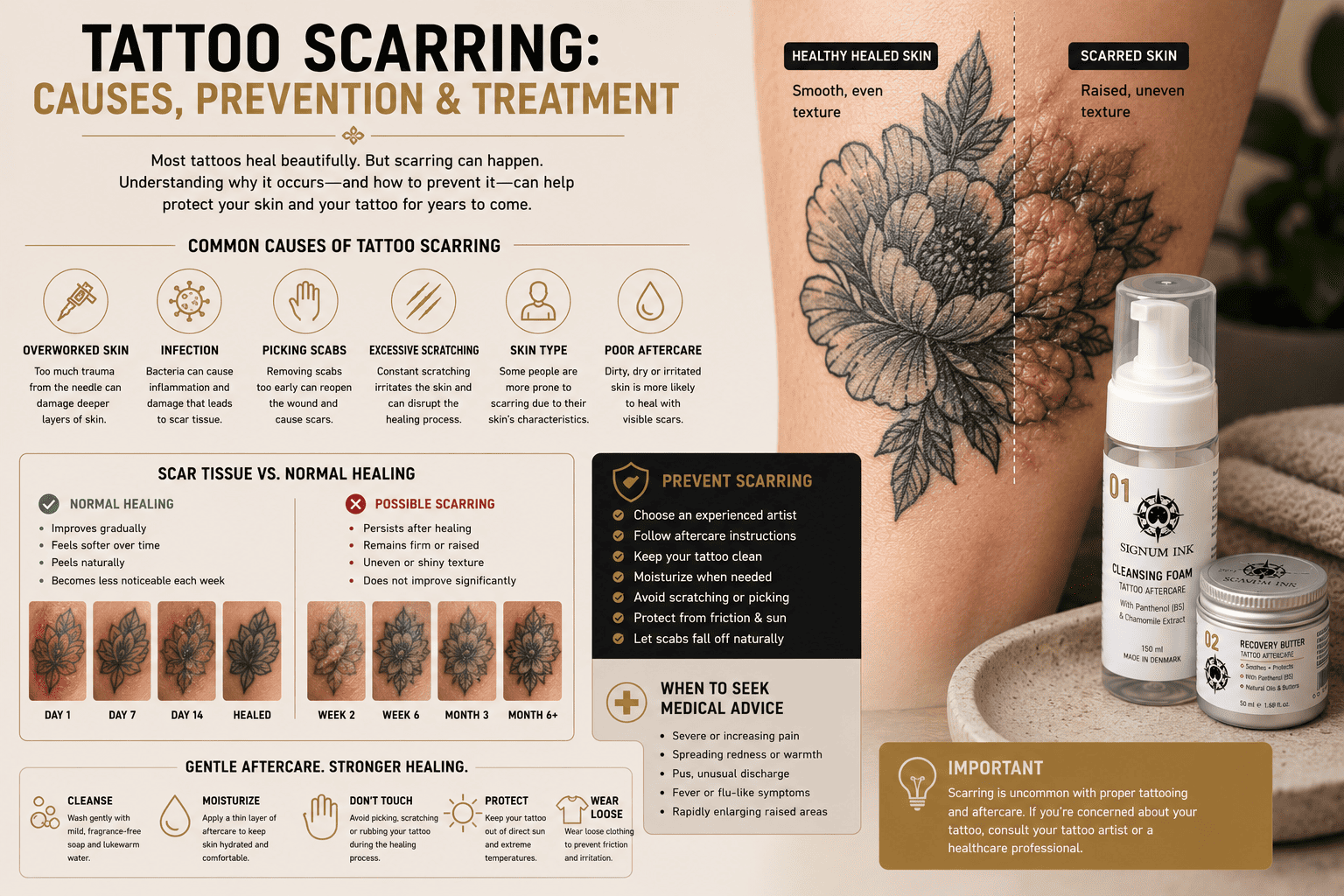
A scar forms when the skin repairs deeper damage than it can fully regenerate.
Instead of replacing the skin exactly as it was before, the body creates dense collagen fibers to close the wound.
This repair process can leave the skin with a different texture than the surrounding area.
A scarred tattoo may appear:
- Aufgewachsen.
- Thickened.
- Uneven.
- Slightly shiny.
- Firmer than nearby skin.
The appearance varies depending on the type and extent of the scar.
Is Scarring Normal After a Tattoo?
No—but temporary texture changes are.
During healing, it’s completely normal for a tattoo to feel:
- Slightly raised.
- Eng.
- Trocken.
- Uneven.
These changes are usually caused by inflammation and skin repair.
As healing progresses, the skin often becomes smoother.
True scarring generally remains after the tattoo has fully healed.
What Causes Tattoo Scarring?
Several factors can contribute to scar formation.
Overworked Skin
One of the most common causes is an overworked tattoo.
If the tattoo needle repeatedly traumatizes the same area, the skin may sustain deeper injury than intended.
This increases the likelihood of scar tissue forming during healing.
Infection
Although uncommon, untreated infections can damage deeper layers of skin.
As the body repairs this damage, permanent scar tissue may develop.
Prompt medical treatment reduces this risk.
Krusten aufkratzen
Scabs protect healing skin.
Removing them prematurely can reopen the wound and interfere with normal tissue repair.
Repeated picking increases the chance of permanent texture changes.
Excessive Scratching
Persistent scratching can damage fragile healing skin.
While occasional accidental scratching rarely causes scarring, repeated trauma may slow healing and increase irritation.
Individual Skin Characteristics
Some people naturally develop scar tissue more easily than others.
Individuals with a history of hypertrophic scars or keloids may have a higher likelihood of noticeable scarring following skin injuries, including tattoos.
What Does Tattoo Scarring Look Like?
Scar tissue often feels different before it looks different.
Possible signs include:
- Permanently raised lines.
- Thickened skin.
- Firm areas.
- Uneven texture.
- Glänzende Haut.
- Distortion of fine tattoo details.
Not every raised tattoo is scarred.
The timing and persistence of these changes are important clues.
Scar Tissue vs. Normal Healing
This distinction causes a great deal of unnecessary worry.
Normal healing:
- Improves gradually.
- Feels softer over time.
- Peels naturally.
- Becomes less noticeable each week.
Scar tissue:
- Persists after healing.
- Remains firm.
- Doesn’t flatten significantly.
- May permanently alter skin texture.
Waiting until healing is complete provides a much clearer picture.
Prevention Starts Before Healing
One of the best ways to reduce the risk of tattoo scarring begins before the tattoo is even finished.
Choosing an experienced tattoo artist who uses appropriate technique is one of the most effective ways to help minimize unnecessary trauma to the skin.
Once the tattoo is complete, proper aftercare becomes the next important step in supporting healthy healing.
Can Tattoo Scars Be Treated?
Treatment depends on the type and severity of the scar.
Some scars gradually soften and become less noticeable over time without any intervention.
Others may benefit from professional treatment.
Possible options include:
- Silicone gels or silicone sheets.
- Scar massage (only after the tattoo has fully healed and if appropriate).
- Prescription treatments recommended by a healthcare professional.
- Certain dermatological procedures for more significant scars.
The most appropriate treatment varies from person to person, so it’s best to seek professional advice if you’re concerned.
Can Scar Tissue Improve Over Time?
Ja.
Scar tissue doesn’t always remain the same.
During the months following healing, many scars naturally become:
- Softer.
- Flatter.
- Less noticeable.
- More flexible.
This process is known as scar remodeling and can continue for many months after the tattoo appears fully healed.
Patience is often an important part of recovery.
Wann sollten Sie einen Arzt aufsuchen?
Most tattoos heal without significant scarring.
However, it’s sensible to seek medical advice if you notice:
- Severe or worsening pain.
- Increasing redness after the initial healing period.
- Persistent swelling.
- Pus or unusual discharge.
- A rapidly enlarging raised area.
- Fever or other signs of illness.
These symptoms may indicate infection or another condition that requires assessment.
How to Reduce the Risk of Tattoo Scarring
Although no tattoo is completely risk-free, several simple habits help support healthy healing.
Dazu gehören:
- Choosing an experienced tattoo artist.
- Following aftercare instructions carefully.
- Das Tattoo sauber halten.
- Moisturizing when needed.
- Kratzen oder Zupfen vermeiden.
- Schutz des Tattoos vor unnötiger Reibung.
- Allowing scabs to fall away naturally.
Healthy healing begins with gentle, consistent care.
Common Myths About Tattoo Scarring
Myth 1: Every Raised Tattoo Is Scarred
Falsch.
Temporary swelling and inflammation often make healing tattoos feel raised.
Only after complete healing can permanent scar tissue be assessed.
Myth 2: Picking Scabs Doesn’t Matter
Falsch.
Scabs protect healing skin.
Removing them too early may interfere with normal tissue repair and increase the risk of scarring.
Myth 3: Scar Tissue Always Ruins a Tattoo
Nicht unbedingt.
Many scars become less noticeable over time, and some tattoos continue to look very good despite mild texture changes.
Myth 4: Moisturizer Prevents All Scarring
Nein.
Moisturizer supports skin comfort and healthy healing, but it cannot completely prevent scar formation if deeper skin injury occurs.
Häufig gestellte Fragen
Can tattoos leave permanent scars?
Yes, but permanent scarring is relatively uncommon when tattoos are applied correctly and heal without complications.
How do I know if my tattoo is scarred?
If the tattoo remains firm, raised or uneven long after healing has finished, scar tissue may be present.
A healthcare professional or experienced tattoo artist may be able to help assess it.
Can tattoo scars fade?
Many scars become softer and less noticeable over time, although they may not disappear completely.
Does scratching cause tattoo scars?
Repeated scratching can damage healing skin and increase the risk of complications.
Occasional accidental scratching is much less likely to result in permanent scarring.
Can scar tissue be tattooed again?
In vielen Fällen, ja.
However, tattooing over scar tissue requires experience and should be discussed with a skilled tattoo artist once the scar has fully matured.
Fazit
Permanent tattoo scarring is much less common than many people fear.
Most tattoos heal with only temporary swelling, peeling and texture changes that gradually settle as the skin recovers.
The best way to reduce the risk of scarring is to combine skilled tattooing with consistent aftercare.
If you suspect scar tissue has formed, remember that many scars improve over time, and professional treatment options are available for more significant cases.
Understanding how scar tissue develops helps you make informed decisions and support your tattoo’s long-term appearance.
Weiterlernen
Wondering whether your tattoo is simply raised or if scar tissue has developed?
 English
  German
  Dutch
Dutch  Danish
  Swedish
  French
  Italian