Einleitung
Getting a new tattoo is exciting—but what you do over the next few weeks can have a significant impact on how well it heals.
A fresh tattoo is essentially an open wound. While your body begins repairing the skin immediately, the healing process takes time. During this period, certain habits and activities can increase irritation, slow healing or raise the risk of complications.
The good news is that most tattoo aftercare is straightforward.
Knowing what nicht to do is often just as important as knowing what you should do.
This guide explains the most common mistakes to avoid after getting a tattoo and why giving your skin the right conditions to heal is worth the patience.
Why Avoiding Certain Activities Matters
Every stage of tattoo healing depends on your skin rebuilding itself.
Your body needs time to:
- Close the tiny wounds created during tattooing.
- Die Hautbarriere wiederherstellen.
- Reduce inflammation.
- Protect the tattoo pigment beneath the surface.
- Produce healthy new skin.
Activities that repeatedly irritate the area can interrupt this process.
While most mistakes won’t permanently ruin a tattoo, they may delay healing and make recovery less comfortable.
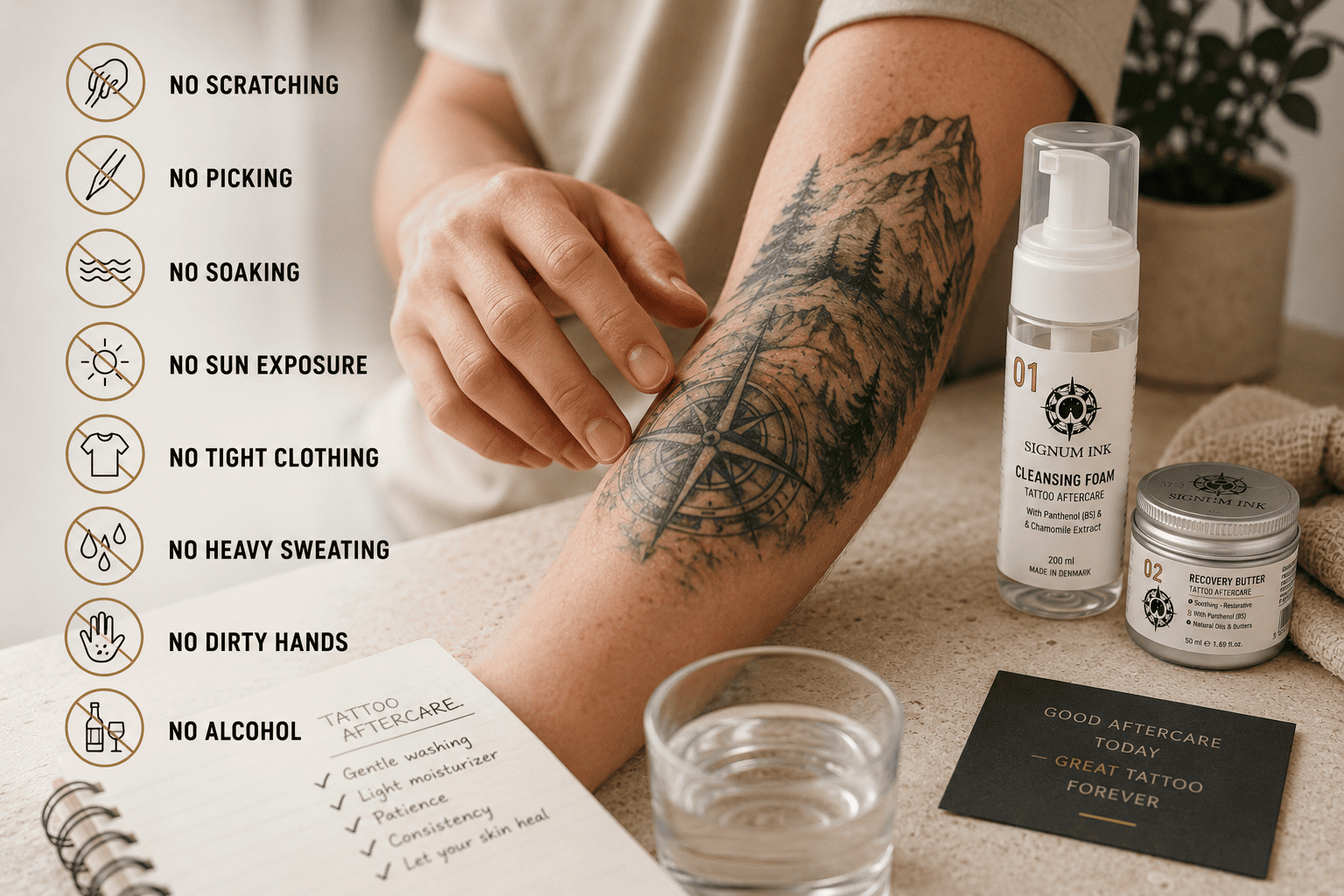
1. Don’t Scratch Your Tattoo
Itching is one of the most common parts of healing.
Although scratching may provide temporary relief, it can damage delicate healing skin, remove peeling flakes too early and introduce bacteria from your fingernails.
Instead of scratching:
- Apply a light layer of moisturizer if the skin feels dry.
- Gently tap around the itchy area.
- Keep the tattoo cool.
- Be patient—the itching will gradually improve.
2. Don’t Pick at Peeling Skin or Scabs
Peeling is completely normal.
As your tattoo heals, old damaged skin naturally sheds while healthier skin replaces it.
It can be tempting to peel loose flakes away, but doing so may:
- Irritate the skin.
- Unnötige Blutungen verursachen.
- Heilung verzögern.
- Increase the chance of uneven healing.
Allow peeling skin to come away naturally.
Your body knows when it’s ready.
3. Don’t Over-Moisturize
Moisturizer supports healing—but more isn’t always better.
Applying excessive amounts can leave the skin feeling overly wet or greasy.
Stattdessen
- Apply a thin layer.
- Let the product absorb.
- Reapply only when the skin feels dry.
Healthy healing skin should feel comfortable, not heavily coated.
4. Don’t Soak Your Tattoo
One of the biggest aftercare mistakes is keeping a tattoo submerged in water.
Vermeiden:
- Schwimmbäder.
- Whirlpools.
- Seen.
- Flüsse.
- Long baths.
Extended soaking softens healing skin and increases exposure to bacteria and other contaminants.
Short showers are generally a much better choice during the early healing period.
5. Don’t Wear Tight Clothing
Friction is another common source of irritation.
Tight clothing may:
- Rub against the tattoo.
- Trap sweat.
- Increase discomfort.
- Slow the skin’s recovery.
Whenever possible, choose soft, breathable clothing that doesn’t constantly rub against the tattoo.
6. Don’t Expose It to Direct Sunlight
Fresh tattoos are especially sensitive to UV exposure.
Direct sunlight may:
- Reizung verstärken.
- Dry the skin.
- Slow healing.
- Affect how comfortable your tattoo feels during recovery.
If you’re spending time outdoors, keep the tattoo covered with loose clothing until it has fully healed.
7. Don’t Ignore Signs of Infection
Most tattoos heal without any problems.
However, it’s important to recognize when something isn’t following the normal healing pattern.
Seek medical advice if you notice:
- Increasing redness after several days.
- Erhebliche Schwellung.
- Dicker gelber oder grüner Ausfluss.
- Starke Schmerzen.
- Fieber.
- Rote Streifen, die sich vom Tattoo weg erstrecken.
Prompt attention can help prevent more serious complications.
Good Aftercare Is Mostly About Consistency
Many people worry about finding the “perfect” aftercare routine.
In reality, consistency matters far more than perfection.
Keeping your tattoo clean, moisturized when needed and protected from unnecessary irritation gives your skin the best opportunity to heal naturally.
Simple habits practiced every day often produce the best results.
8. Don’t Exercise Too Hard Too Soon
Light movement is generally fine, but intense exercise immediately after getting a tattoo may create unnecessary stress on the healing skin.
Heavy workouts can:
- Increase sweating.
- Cause friction from clothing or equipment.
- Stretch the tattooed area.
- Make the skin more irritated.
If your tattoo is located over a joint or an area that moves frequently, giving it a few days of relative rest can make healing more comfortable.
9. Don’t Let Your Tattoo Become Too Dry
Some people believe a tattoo heals faster if it’s left to “dry out.”
This is a common misconception.
While you don’t want to over-moisturize, allowing the skin to become excessively dry can increase:
- Enge
- Juckreiz
- Peeling
- Discomfort
The goal is balanced hydration—keeping the skin comfortable without leaving a heavy layer of product on the surface.
10. Don’t Touch Your Tattoo with Dirty Hands
During the first days of healing, your tattoo is more vulnerable to bacteria.
Before washing or applying aftercare products:
- Waschen Sie Ihre Hände gründlich.
- Use clean towels.
- Avoid unnecessary touching throughout the day.
This simple habit can significantly reduce the risk of contamination.
11. Don’t Let Pets Lick or Rub Against Your Tattoo
As much as we love our pets, they can introduce bacteria to a healing tattoo.
Avoid letting dogs or cats:
- Lick the tattoo.
- Sleep directly on it.
- Rub against the healing area.
Keeping the tattoo clean and protected helps reduce unnecessary risks.
12. Don’t Wear Dirty or Sweaty Clothing
Fresh clothing isn’t just about comfort—it also helps keep the healing area cleaner.
If your clothes become:
- Sweaty
- Dirty
- Damp
Change them as soon as possible, especially if they’re rubbing against your tattoo.
Breathable fabrics such as cotton are often more comfortable during the healing process.
13. Don’t Compare Your Healing to Someone Else’s
Every tattoo heals differently.
Factors that influence healing include:
- Tattoo-Größe.
- Platzierung.
- Hauttyp.
- Alter.
- General health.
- Aftercare routine.
It’s perfectly normal for one person’s tattoo to peel more, itch longer or heal more slowly than another’s.
Focus on how your tattoo is progressing rather than comparing it to photos online.
Common Myths About Tattoo Aftercare
Myth 1: More Cream Means Faster Healing
Falsch.
Applying excessive amounts of aftercare products won’t speed up healing and may leave the skin feeling overly greasy.
A thin, even layer is usually all that’s needed.
Myth 2: Peeling Means Something Is Wrong
Gern geschehen.
Peeling is one of the most common stages of normal tattoo healing.
The skin is simply shedding damaged outer layers as new skin develops underneath.
Myth 3: Fresh Air Is Better Than Moisturizer
Partly true—but only to a point.
Your tattoo benefits from breathing naturally, but skin that becomes excessively dry can feel tight and itchy.
The goal is balance, not extremes.
Myth 4: Once the Tattoo Stops Peeling, It’s Fully Healed
Nicht unbedingt.
The surface may look healed after a few weeks, while deeper layers of skin continue recovering for several more weeks.
Proper aftercare remains important even after peeling has finished.
Häufig gestellte Fragen
What is the biggest mistake people make after getting a tattoo?
One of the most common mistakes is irritating the tattoo by scratching, picking peeling skin or exposing it to excessive friction, water or sunlight before it has healed.
Can I go back to my normal routine immediately?
Some activities can resume quickly, while others—such as swimming or prolonged sun exposure—should wait until your tattoo has fully healed.
Is sweating bad for a new tattoo?
Light sweating is usually not a problem.
Heavy sweating combined with friction or tight clothing can make the healing skin more uncomfortable.
How long should I be careful with my tattoo?
The most sensitive period is generally the first two to four weeks.
Even after the surface appears healed, deeper layers of skin continue recovering for several more weeks.
What’s the best thing I can do for my tattoo?
Keep it clean, avoid unnecessary irritation, moisturize appropriately and allow your body time to heal naturally.
Fazit
Healing a tattoo isn’t about following dozens of complicated rules.
It’s mostly about avoiding the habits that interfere with your skin’s natural recovery.
By protecting your tattoo from unnecessary irritation, excessive moisture, prolonged soaking, friction and sunlight, you give it the best chance to heal cleanly and comfortably.
Patience and consistency are your greatest allies.
Most healing problems aren’t caused by what people forget to do—they’re caused by doing too much, too soon.
Weiterlernen
Want a complete overview of every stage of tattoo healing?
→ Read: Die vollständige Wissenschaft der Tattoo-Heilung: Was mit Ihrer Haut vom 1. bis zum 60. Tag passiert
 English
  German
  Dutch
Dutch  Danish
  Swedish
  French
  Italian