Ingredient Classification
| Property | Classification |
|---|---|
| Origin | Plant-derived |
| Function | Emollient |
| Water Soluble | ❌ No |
| Oil Soluble | ✅ Yes |
| Skin Barrier Role | Supports the surface lipid layer |
| Natural or Synthetic | Naturally derived |
When people think of skincare oils, they often imagine rich, greasy ingredients that sit heavily on the skin.
Jojoba Oil is different.
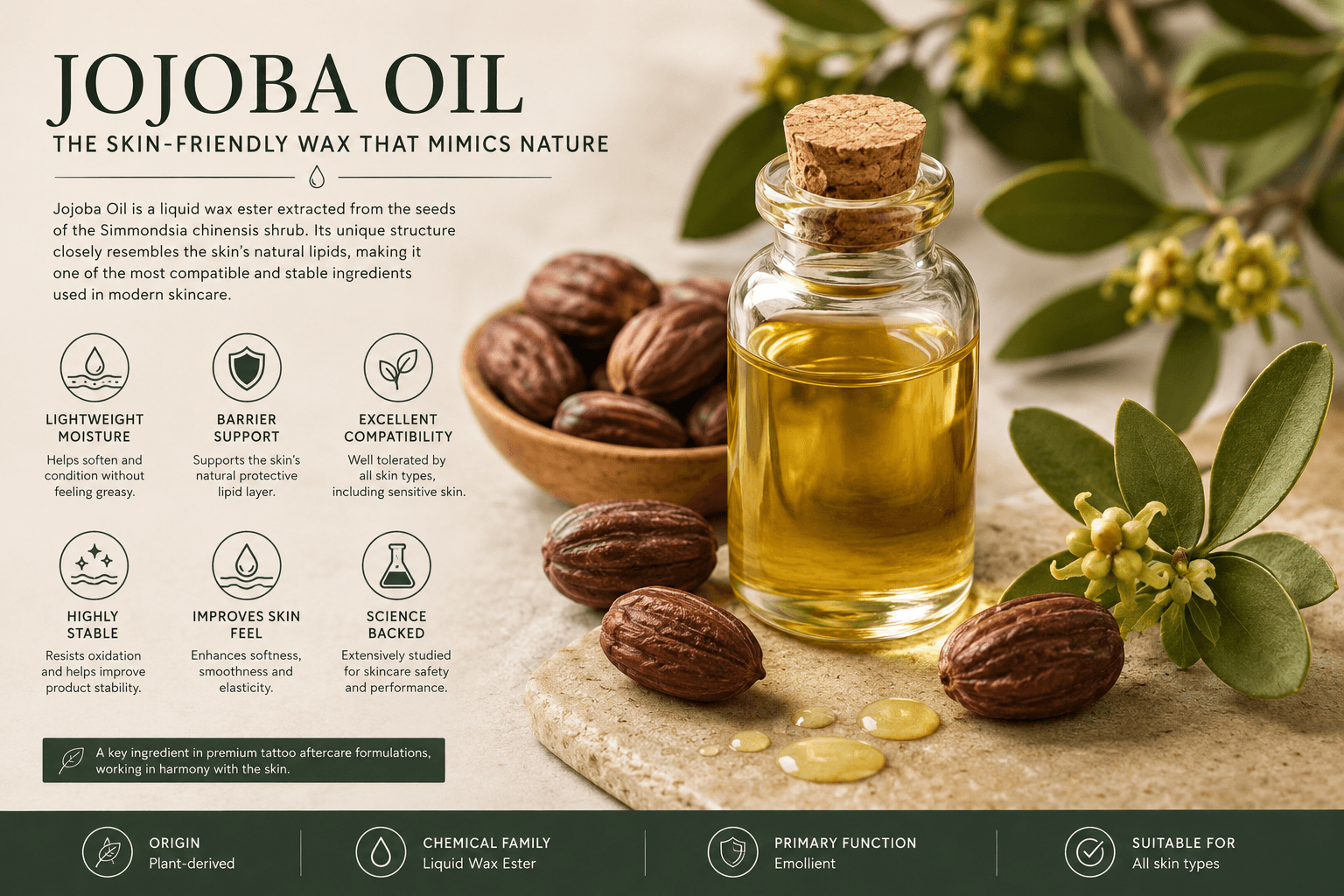
In fact, despite its name, Jojoba Oil is not technically an oil at all. It is a liquid wax ester—a unique type of lipid whose structure closely resembles the natural wax esters found in healthy human skin.
This remarkable similarity is one of the reasons why Jojoba Oil has become one of the most respected ingredients in modern skincare.
Rather than simply coating the skin, it blends naturally with the skin’s surface, helping improve softness while supporting the skin’s natural protective barrier.
For freshly tattooed skin, this makes Jojoba Oil particularly interesting.
During tattoo healing, the skin temporarily loses part of its natural barrier, allowing moisture to evaporate more easily. A balanced aftercare routine therefore combines ingredients that attract moisture, strengthen the skin barrier, and help reduce moisture loss.
Within this system, Jojoba Oil contributes lightweight conditioning without leaving the heavy feeling associated with many traditional plant oils.
Rather than replacing scientifically established ingredients such as Glycerin, Panthenol, or Ceramides, Jojoba Oil complements them by improving skin feel and supporting long-lasting comfort throughout the healing process.
Quick Facts
Ingredient Type
Liquid Wax Ester (commonly called a plant oil)
Primary Benefits
Skin Conditioning • Lightweight Moisture • Barrier Support
Best For
Fresh Tattoos • Sensitive Skin • Dry Skin • Daily Moisturising
Found In
Recovery Creams • Facial Oils • Moisturisers • Tattoo Aftercare • Body Care
Suitable For
All Skin Types, including Oily and Sensitive Skin
Typical Cosmetic Concentration
2–15%
Pairs Well With
Glycerin • Panthenol • Ceramides • Shea Butter • Beta-Glucan • Squalane
Scientific Support
★★★★★ Excellent
Did You Know?
Jojoba Oil can remain stable for many years without becoming rancid because it is composed primarily of wax esters rather than triglycerides. This exceptional stability makes it one of the most reliable natural lipids used in skincare.
What Is Jojoba Oil?
Jojoba Oil is extracted from the seeds of the Simmondsia chinensis shrub, a hardy desert plant native to the southwestern United States and northern Mexico.
Although commonly referred to as an oil, its chemical structure is fundamentally different from most vegetable oils.
Where traditional oils are made primarily of triglycerides, Jojoba Oil consists almost entirely of long-chain liquid wax esters.
This distinction gives it several unique advantages.
It is:
- Highly stable.
- Naturally oxidation resistant.
- Lightweight on the skin.
- Easily absorbed.
- Exceptionally compatible with the skin’s surface.
Because of these characteristics, Jojoba Oil has become one of the most widely used natural lipids in premium skincare formulations.
Its remarkable similarity to the skin’s own surface lipids also explains why it is suitable for virtually every skin type.
How Does Jojoba Oil Work?
Healthy skin depends on a balanced mixture of water and lipids.
While humectants attract moisture into the outer layers of the skin, emollients and protective lipids help maintain softness and reduce moisture loss.
Jojoba Oil functions primarily as an emollient.
It spreads easily across the skin, helping smooth the surface while supporting the skin’s natural barrier.
Unlike heavier botanical oils, Jojoba Oil leaves a light, silky finish that many people describe as almost invisible after application.
This elegant skin feel explains why it has become a favourite ingredient in premium facial skincare as well as tattoo aftercare.
Because its structure resembles the skin’s own wax esters, Jojoba Oil integrates naturally into formulations designed to support healthy-looking skin without creating an overly greasy finish.
Why Fresh Tattoos Benefit from Jojoba Oil
Fresh tattoos require products that help maintain hydration while keeping the skin feeling comfortable.
As the skin barrier gradually rebuilds itself, reducing moisture loss becomes increasingly important.
Jojoba Oil contributes by helping soften the skin while complementing ingredients responsible for hydration and barrier support.
Rather than acting as a heavy occlusive ingredient, it provides lightweight conditioning that allows recovery creams to feel rich without becoming overly greasy.
Professional tattoo aftercare formulations often combine Jojoba Oil with:
- Glycerin
- Panthenol
- Ceramides
- Shea Butter
- Beta-Glucan
- Allantoin
Each ingredient performs a different function, creating a complete moisturizing system that supports the skin throughout the healing process.
Why Jojoba Oil Has Become a Favourite Among Professional Formulators
The skincare industry offers hundreds of botanical oils.
Yet Jojoba Oil occupies a unique position.
Professional formulators continue to choose it because it combines exceptional stability with outstanding skin compatibility.
Mimics the Skin’s Natural Lipids
Few natural ingredients resemble the skin’s own surface waxes as closely as Jojoba Oil.
This contributes to its comfortable skin feel and excellent compatibility.
Lightweight Yet Nourishing
Unlike richer plant oils, Jojoba Oil absorbs quickly while helping leave the skin soft and conditioned.
Exceptional Stability
Because it is a wax ester rather than a traditional oil, Jojoba Oil is highly resistant to oxidation.
This improves product stability and shelf life.
Works Beautifully with Modern Skincare Ingredients
Jojoba Oil combines particularly well with:
- Glycerin
- Panthenol
- Ceramides
- Shea Butter
- Beta-Glucan
- Squalane
- Allantoin
- Centella Asiatica
Together these ingredients create formulations that balance hydration, barrier support, and long-lasting skin comfort.
Why Professional Skincare Continues to Rely on Jojoba Oil
Although countless new botanical ingredients have entered the skincare market, Jojoba Oil remains one of the most respected natural emollients available.
Its unique chemical structure, remarkable stability, and compatibility with the skin make it exceptionally versatile.
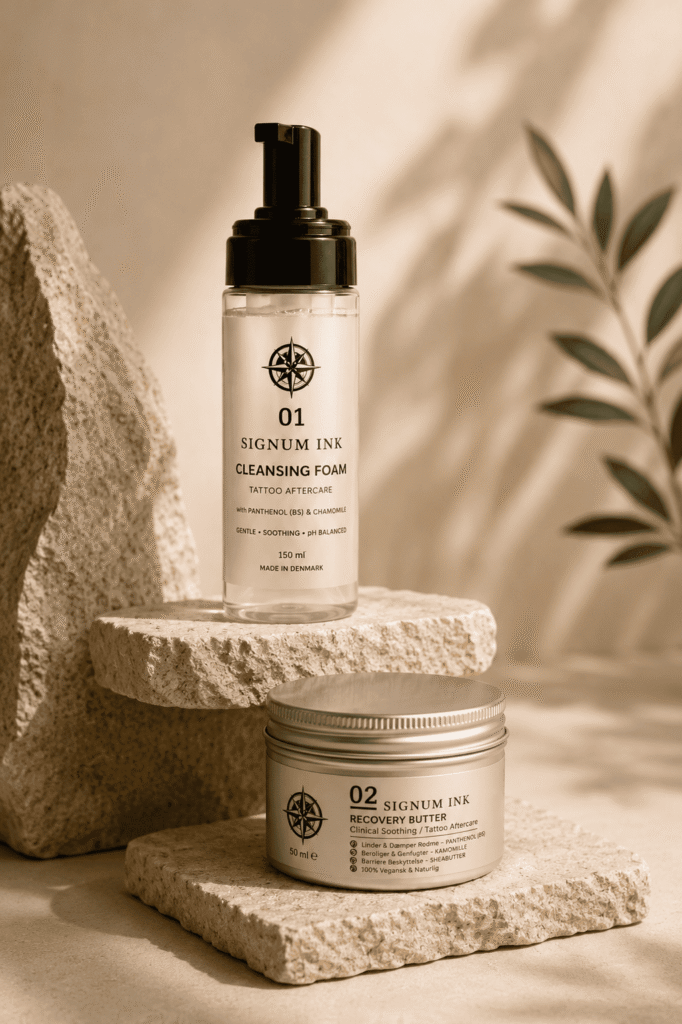
For tattoo aftercare, Jojoba Oil contributes softness, flexibility, and lightweight conditioning while working alongside humectants and barrier-supporting ingredients.
Rather than acting as the centrepiece of a formulation, it demonstrates one of the most important principles in cosmetic science:
The best skincare products are built by combining ingredients with complementary functions—not by relying on a single “hero ingredient.”
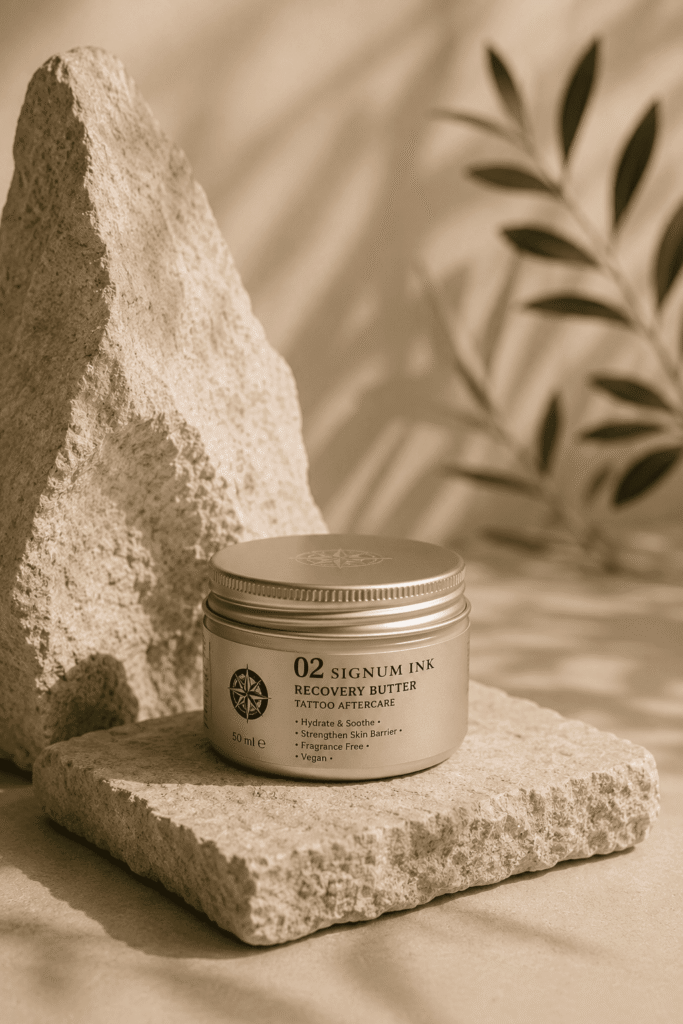
Jojoba Oil in Recovery Cream: Lightweight Conditioning That Works with Your Skin
An effective recovery cream is designed to support healing skin through multiple mechanisms rather than relying on a single ingredient.
Following a tattoo session, the skin temporarily loses some of its natural barrier function. Moisture escapes more easily, the skin may feel tight, and maintaining flexibility becomes increasingly important during the healing process.
This is where Jojoba Oil contributes to a well-balanced formulation.
Unlike heavier plant oils, Jojoba Oil spreads easily across the skin, creating a lightweight protective layer that improves softness without leaving an overly greasy finish.
Its unique wax ester structure allows it to integrate naturally with the skin’s own surface lipids, making recovery creams feel comfortable even with repeated daily application.
Professional formulators value Jojoba Oil because it enhances both the performance and the sensory experience of a product.
In modern tattoo aftercare formulations, Jojoba Oil often works alongside:
- Glycerin to attract moisture.
- Panthenol to support hydration and barrier function.
- Ceramides to reinforce the skin’s natural lipid structure.
- Shea Butter to reduce moisture loss.
- Beta-Glucan to complement hydration and barrier support.
Each ingredient contributes a specific role, creating a formulation that feels balanced rather than overly rich.
Jojoba Oil in Tattoo Foam Soap
Foam cleansers have a very different purpose than recovery creams.
Because a cleanser remains on the skin for less than a minute before being rinsed away, ingredients that primarily protect and soften the skin have less opportunity to perform their full function.
For this reason, Jojoba Oil is less common in tattoo foam soaps than in leave-on products.
However, some premium cleansers include small amounts of Jojoba Oil or Jojoba esters to improve the skin feel during cleansing.
These ingredients help reduce the sensation of dryness that can occur after washing while contributing to a smoother, more comfortable cleansing experience.
In tattoo foam soaps, Jojoba Oil should therefore be viewed as a supporting ingredient rather than the primary active component.
Its greatest value remains in products that stay on the skin, where it can continue supporting the skin’s surface throughout the day.
What Does the Research Say?
Jojoba Oil has been studied extensively because of its unusual chemical composition and exceptional compatibility with human skin.
Unlike most botanical oils, its wax ester structure closely resembles the natural lipids found in the outermost layer of healthy skin.
Research suggests that topical Jojoba Oil may:
- Help improve skin hydration by reducing moisture loss.
- Support the skin’s natural barrier.
- Improve skin softness and elasticity.
- Enhance the spreadability and sensory characteristics of skincare formulations.
- Be well tolerated by a wide range of skin types.
Researchers also highlight Jojoba Oil’s remarkable oxidative stability.
Because it resists degradation far better than many traditional vegetable oils, it helps improve both product stability and long-term formulation performance.
This stability is one reason why Jojoba Oil remains a preferred ingredient in premium skincare products designed for regular daily use.
Key Research Findings
Current cosmetic research indicates that Jojoba Oil:
- Mimics the skin’s natural wax esters.
- Supports long-lasting skin softness.
- Helps reduce transepidermal water loss (TEWL).
- Improves formulation stability.
- Works exceptionally well with barrier-focused skincare ingredients.
- Is suitable for most skin types, including sensitive skin.
Rather than functioning as a highly active treatment ingredient, Jojoba Oil enhances the overall quality and performance of a skincare formulation.
Research Snapshot
| Research Area | Evidence |
|---|---|
| Skin Compatibility | ★★★★★ |
| Moisture Retention | ★★★★★ |
| Cosmetic Stability | ★★★★★ |
| Barrier Support | ★★★★☆ |
| Sensitive Skin | ★★★★★ |
| Tattoo Aftercare | ★★★☆☆* |
*Direct clinical studies evaluating Jojoba Oil specifically for tattoo aftercare remain limited. Most available evidence relates to skin conditioning, barrier support, and moisture retention in cosmetic skincare.
Jojoba Oil Compared with Other Popular Lipids
Although many botanical oils appear similar, they perform very differently inside a formulation.
Professional formulators select oils based on their specific properties rather than simply choosing the most popular ingredient.
Jojoba Oil vs. Argan Oil
Both ingredients are lightweight and widely used in premium skincare.
Argan Oil is rich in triglycerides and naturally occurring fatty acids.
Jojoba Oil, by contrast, is composed primarily of wax esters, making it more chemically stable and more similar to the skin’s natural surface lipids.
This exceptional stability gives Jojoba Oil a distinct advantage in long-term formulation performance.
Jojoba Oil vs. Coconut Oil
Although both originate from plants, they behave very differently on the skin.
Coconut Oil creates a richer, more occlusive layer.
Jojoba Oil provides lightweight conditioning with a much drier finish.
For tattoo aftercare, many formulators prefer Jojoba Oil because it leaves the skin feeling conditioned without becoming excessively heavy.
Jojoba Oil vs. Shea Butter
Both ingredients function primarily as emollients.
However, Shea Butter creates a richer protective layer, while Jojoba Oil offers lighter conditioning and faster absorption.
Many premium recovery creams combine both ingredients to achieve an ideal balance of comfort and moisture retention.
Jojoba Oil vs. Squalane
These two ingredients are often compared because they both leave a lightweight finish.
Squalane is a saturated hydrocarbon that closely resembles one of the skin’s own lipids.
Jojoba Oil is a liquid wax ester that mimics another important component of healthy skin.
Rather than competing, they complement one another beautifully in sophisticated skincare formulations.
Why Jojoba Oil Remains One of the Most Stable Natural Lipids
Many natural oils gradually oxidize when exposed to oxygen, heat, and light.
Jojoba Oil behaves differently.
Because of its wax ester structure, it remains remarkably stable over time, helping products maintain their quality throughout their intended shelf life.
For formulators, this stability offers several important advantages:
- Longer formulation stability.
- Reduced risk of oxidation.
- Excellent compatibility with active ingredients.
- Consistent sensory performance.
- Reliable long-term product quality.
These characteristics explain why Jojoba Oil continues to be one of the most trusted natural lipids in premium skincare.
Ingredient Classification
| Property | Classification |
|---|---|
| Origin | Plant-derived |
| Chemical Type | Liquid Wax Ester |
| Primary Function | Emollient |
| Water Soluble | ❌ No |
| Oil Soluble | ✅ Yes |
| Barrier Role | Supports the skin’s surface lipid layer |
| Oxidative Stability | ★★★★★ Excellent |
Frequently Asked Questions About Jojoba Oil
What is Jojoba Oil?
Jojoba Oil is a liquid wax ester extracted from the seeds of the Simmondsia chinensis shrub. Although it is commonly called an oil, its chemical structure is very different from traditional vegetable oils and closely resembles the natural wax esters found on healthy human skin.
Why is Jojoba Oil used in tattoo aftercare?
Fresh tattoos temporarily weaken the skin’s protective barrier, making moisture loss more likely.
Jojoba Oil helps soften the skin, improve flexibility, and support the skin’s natural surface lipids while complementing ingredients responsible for hydration and barrier repair.

Is Jojoba Oil suitable for sensitive skin?
Yes.
One of the reasons Jojoba Oil is widely used in premium skincare is its excellent compatibility with sensitive skin.
Its wax ester structure closely resembles naturally occurring skin lipids, making it comfortable for most skin types.
Does Jojoba Oil moisturize the skin?
Not by attracting water.
Unlike Glycerin, Jojoba Oil functions primarily as an emollient.
It helps soften the skin and reduce moisture loss while improving the overall feel of the formulation.
Is Jojoba Oil actually an oil?
Technically, no.
Despite its common name, Jojoba Oil is composed primarily of liquid wax esters rather than triglycerides.
This unique chemistry explains its remarkable stability and skin compatibility.
Can Jojoba Oil clog pores?
Jojoba Oil is generally considered to have a low comedogenic potential, making it suitable for many skin types, including combination and oily skin. Individual responses can vary, but its lightweight texture is one reason it is frequently chosen for facial skincare as well as tattoo aftercare.
Why is Jojoba Oil so stable?
Unlike many botanical oils, Jojoba Oil resists oxidation exceptionally well.
Its wax ester structure makes it far less likely to become rancid, helping improve both product quality and shelf life.
Can Jojoba Oil replace Shea Butter?
No.
Although both are emollients, they perform differently.
Jojoba Oil provides lightweight conditioning.
Shea Butter provides richer moisture retention.
Many premium formulations combine both to achieve an ideal balance.
Why is Jojoba Oil often combined with Ceramides?
These ingredients complement one another.
Ceramides reinforce the skin’s natural barrier.
Jojoba Oil helps support the skin’s surface lipids while improving softness and flexibility.
Together they create balanced barrier-focused formulations.
Why do formulators love Jojoba Oil?
Professional formulators value Jojoba Oil because it combines:
- Exceptional chemical stability.
- Excellent skin compatibility.
- Lightweight sensory performance.
- High formulation versatility.
- Outstanding compatibility with modern skincare actives.
Common Myths About Jojoba Oil
Myth 1: Jojoba Oil is just another plant oil.
Reality:
Chemically, Jojoba Oil is a liquid wax ester, making it fundamentally different from most vegetable oils.
This unique structure contributes to its stability and skin compatibility.
Myth 2: Natural oils always feel greasy.
Reality:
Jojoba Oil is widely appreciated for its lightweight, silky finish.
When formulated correctly, it absorbs quickly while leaving the skin feeling conditioned rather than oily.
Myth 3: Jojoba Oil replaces moisturizers.
Reality:
Professional formulations use Jojoba Oil alongside humectants, barrier-supporting ingredients, and emollients.
Each ingredient performs a different role within the formulation.
Myth 4: All botanical oils perform the same.
Reality:
Every botanical lipid has its own fatty acid profile and chemical structure.
The wax ester composition of Jojoba Oil makes it one of the most unique natural lipids used in skincare today.
Research Snapshot
| Research Area | Evidence |
|---|---|
| Skin Compatibility | ★★★★★ |
| Moisture Retention | ★★★★★ |
| Cosmetic Stability | ★★★★★ |
| Sensitive Skin | ★★★★★ |
| Barrier Support | ★★★★☆ |
| Tattoo Aftercare | ★★★☆☆* |
*Most scientific evidence relates to skin conditioning, barrier support, and cosmetic formulation rather than tattoo-specific clinical studies.
Level of Evidence
| Evidence Source | Strength |
|---|---|
| Traditional Use | ★★★★☆ |
| Modern Cosmetic Science | ★★★★★ |
| Clinical Dermatology | ★★★★☆ |
| Tattoo-Specific Studies | ★★☆☆☆ |
Why this matters:
Jojoba Oil is supported by strong cosmetic research demonstrating its stability, excellent skin compatibility, and emollient properties. While direct tattoo-specific studies remain limited, its role in reducing moisture loss and improving skin feel makes it highly relevant for tattoo aftercare.
Ingredient Classification
| Property | Classification |
|---|---|
| Origin | Plant-derived |
| Chemical Family | Liquid Wax Ester |
| Primary Function | Emollient |
| Water Soluble | ❌ No |
| Oil Soluble | ✅ Yes |
| Skin Barrier Role | Supports the surface lipid layer |
| Oxidative Stability | ★★★★★ Excellent |
How It Works in a Formula
| Role | Function |
|---|---|
| Humectant | ❌ |
| Emollient | ✅ Primary |
| Occlusive | ⚪ Moderate |
| Barrier Support | ✅ Complementary |
| Skin Conditioning | ✅ Strong |
| Antioxidant Support | ⚪ Naturally occurring tocopherols |
Formulation Insight:
Jojoba Oil enhances the feel, spreadability, and flexibility of a cream while helping reduce moisture loss. It does not replace humectants or barrier lipids but helps create a smoother, more elegant formulation that feels comfortable on healing skin.
Ingredient Performance Snapshot
| Category | Rating |
|---|---|
| Skin Compatibility | ⭐⭐⭐⭐⭐ |
| Lightweight Feel | ⭐⭐⭐⭐⭐ |
| Moisture Retention | ⭐⭐⭐⭐☆ |
| Barrier Support | ⭐⭐⭐⭐☆ |
| Sensitive Skin | ⭐⭐⭐⭐⭐ |
| Formulation Stability | ⭐⭐⭐⭐⭐ |
| Scientific Evidence | ⭐⭐⭐⭐⭐ |
Formulator’s Perspective
Jojoba Oil is one of the best examples of how chemistry matters more than marketing.
Although commonly referred to as an oil, its wax ester structure makes it behave differently from almost every other botanical lipid used in skincare.
Professional formulators value Jojoba Oil because it improves the elegance of a formulation while supporting the skin’s natural surface lipids. Combined with Glycerin, Panthenol, Ceramides, Shea Butter, and Beta-Glucan, it contributes to products that feel lightweight, balanced, and comfortable throughout tattoo healing.
Expert Tip
A high-quality tattoo aftercare cream should contain ingredients that work at different levels of the skin.
Humectants draw moisture into the skin. Barrier lipids strengthen the skin’s protective structure. Emollients such as Jojoba Oil smooth the skin’s surface and help reduce moisture loss.
When these ingredient types are combined correctly, the result is a formulation that supports hydration, barrier function, and long-lasting skin comfort.
Ingredient Synergy
| Combines Especially Well With | Why |
|---|---|
| Glycerin | Attracts water while Jojoba Oil helps maintain a smooth, conditioned skin surface. |
| Panthenol | Supports hydration and barrier function while Jojoba Oil improves softness and flexibility. |
| Ceramides | Reinforce the skin barrier while Jojoba Oil supports the surface lipid layer. |
| Shea Butter | Creates a balanced combination of lightweight conditioning and longer-lasting moisture retention. |
| Beta-Glucan | Supports hydration and barrier-focused formulations for sensitive skin. |
| Squalane | Combines two highly stable lipids that provide elegant, non-greasy skin conditioning. |
Ingredient Verdict
| Category | Rating |
|---|---|
| Overall Rating | ⭐⭐⭐⭐⭐ |
| Best For | Sensitive skin, fresh tattoos, lightweight moisturizers |
| Scientific Confidence | High |
| Formulator Recommendation | One of the most versatile natural emollients in skincare |
| Works Best With | Glycerin, Ceramides, Panthenol, Shea Butter, Squalane |
Final Thoughts
Jojoba Oil stands apart from most botanical skincare ingredients because it is not truly an oil. Its unique wax ester structure closely resembles the skin’s own surface lipids, giving it exceptional compatibility with healthy and healing skin alike.
For tattoo aftercare, Jojoba Oil provides lightweight conditioning that helps improve skin softness and reduce moisture loss without leaving a heavy or greasy finish. While it does not replace humectants or barrier-repair ingredients, it enhances their performance as part of a well-balanced formulation.
Its remarkable stability, elegant skin feel, and ability to work seamlessly alongside ingredients such as Glycerin, Panthenol, Ceramides, and Shea Butter have made it one of the most respected natural emollients in modern skincare.
Rather than relying on trends, Jojoba Oil demonstrates how thoughtful ingredient selection and balanced formulation create products that truly support the skin throughout every stage of tattoo healing.
 English
  German
  Dutch
Dutch  Danish
  Swedish
  French
  Italian