Some skincare ingredients perform one specific job.
Others support several different biological processes within the skin.
Niacinamide belongs to the second group.
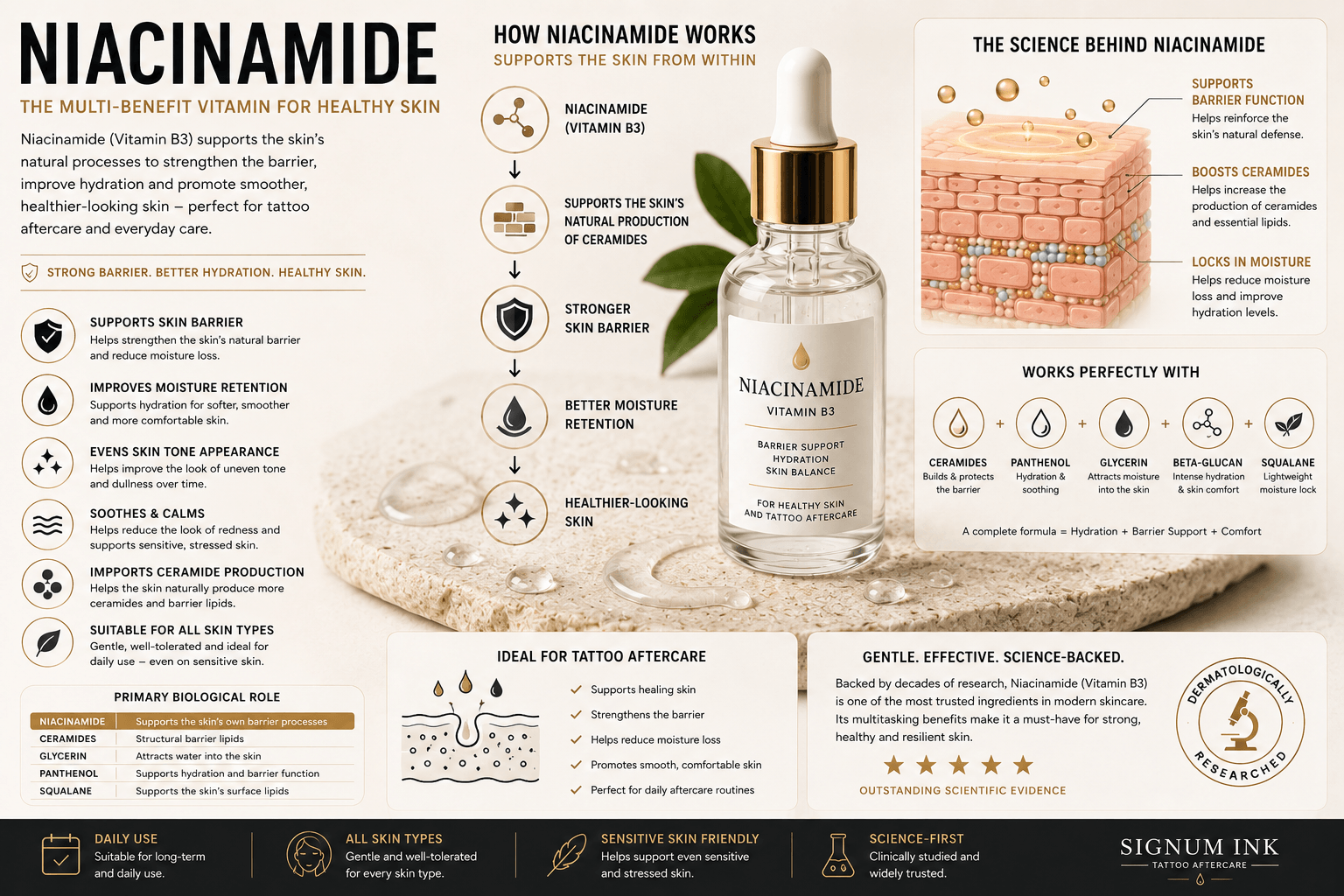
Also known as Vitamin B3, Niacinamide has become one of the most respected ingredients in modern dermatology because it helps support the skin’s natural barrier while contributing to healthier-looking skin overall.
Unlike oils that soften the skin or humectants that attract moisture, Niacinamide works by supporting the skin’s own biological functions.
For freshly tattooed skin, this makes it particularly interesting.
During tattoo healing, the skin temporarily experiences increased moisture loss while rebuilding its protective barrier.
A well-designed recovery cream therefore benefits from ingredients that support hydration, reinforce the barrier, and help maintain overall skin comfort.
Within this formulation strategy, Niacinamide complements ingredients such as Ceramides, Glycerin, Panthenol, and Beta-Glucan, creating a comprehensive approach to barrier-focused tattoo aftercare.
Rather than replacing these ingredients, Niacinamide helps optimize the environment in which they work.
Quick Facts
Ingredient Type
Vitamin (Vitamin B3)
Primary Benefits
Barrier Support • Skin Conditioning • Moisture Balance
Best For
Fresh Tattoos • Sensitive Skin • Dry Skin • Daily Barrier Care
Found In
Recovery Creams • Facial Moisturisers • Serums • Barrier Creams • Tattoo Aftercare
Suitable For
All Skin Types
Typical Cosmetic Concentration
2–5%
Pairs Well With
Ceramides • Panthenol • Glycerin • Beta-Glucan • Allantoin • Squalane
Scientific Support
★★★★★ Outstanding
Did You Know?
Niacinamide has been studied in hundreds of scientific publications and is one of the most extensively researched cosmetic ingredients available today. It is valued not because it performs one dramatic function, but because it supports multiple aspects of healthy skin at the same time.
What Is Niacinamide?
Niacinamide is a biologically active form of Vitamin B3.
Unlike botanical oils or plant extracts, Niacinamide is a vitamin that participates in numerous biochemical processes within the skin.
In cosmetic skincare, it is widely used because of its ability to support the skin barrier while helping maintain healthy-looking skin.
One of its best-documented effects is its ability to support the production of important skin lipids, including Ceramides.
This relationship explains why Niacinamide and Ceramides are frequently included together in premium skincare formulations.
Rather than functioning independently, they complement one another as part of the skin’s natural barrier system.
How Does Niacinamide Work?
Healthy skin depends on a strong protective barrier.
This barrier relies on both water and lipids to function properly.
Research suggests that topical Niacinamide supports several natural skin processes associated with maintaining this barrier.
Among its most studied cosmetic benefits are its ability to:
- Support the skin’s natural barrier.
- Help improve moisture retention.
- Contribute to smoother-looking skin.
- Help maintain overall skin comfort.
- Support the production of barrier lipids such as Ceramides.
Unlike ingredients that primarily remain on the skin’s surface, Niacinamide supports the skin’s own biological processes, making it one of the most versatile ingredients in modern skincare.
Why Fresh Tattoos Benefit from Niacinamide
Following a tattoo session, the skin begins rebuilding its protective barrier.
During this period, maintaining hydration while supporting normal barrier function is an important part of a balanced aftercare routine.
Niacinamide contributes by helping support the skin’s own barrier mechanisms rather than simply coating the skin.
Professional tattoo aftercare formulations often combine Niacinamide with:
- Ceramides — to reinforce the skin’s lipid barrier.
- Glycerin — to attract moisture.
- Panthenol — to support hydration and barrier function.
- Beta-Glucan — to complement hydration and skin comfort.
- Squalane — to improve moisture retention and skin feel.
- Allantoin — to support skin conditioning.
Together these ingredients provide hydration, barrier support, and long-lasting skin comfort while the skin recovers.
Why Niacinamide Has Become One of Modern Skincare’s Most Respected Ingredients
Few cosmetic ingredients combine such a broad range of documented benefits.
This versatility explains why Niacinamide has become a cornerstone of dermatology-inspired skincare.
Supports the Skin Barrier
One of Niacinamide’s best-established roles is supporting the skin’s natural barrier function.
A healthy barrier helps maintain hydration while protecting the skin from everyday environmental stress.
Works Alongside Ceramides
Research suggests that Niacinamide supports the skin’s natural production of Ceramides, making these ingredients highly complementary within barrier-focused skincare.
Suitable for Daily Use
Niacinamide is generally well tolerated across a wide range of skin types.
Its excellent compatibility explains why it is frequently included in moisturizers intended for long-term daily use.
Excellent Formulation Compatibility
Professional formulators regularly combine Niacinamide with:
- Ceramides
- Panthenol
- Glycerin
- Beta-Glucan
- Allantoin
- Squalane
- Centella Asiatica
Each ingredient contributes a different function, creating balanced formulations designed to support healthy-looking skin.
Why Professional Formulators Continue Choosing Niacinamide
Niacinamide has become one of the defining ingredients of modern skincare because it supports the skin’s own biology rather than simply providing temporary surface benefits.
Its compatibility with virtually every major skincare ingredient makes it exceptionally versatile.
For tattoo aftercare, Niacinamide contributes to formulations designed to support the skin barrier, improve hydration, and maintain long-term skin comfort throughout the healing process.
Rather than serving as a stand-alone “hero ingredient,” it becomes even more effective when combined with Ceramides, Panthenol, Glycerin, Beta-Glucan, and other barrier-supporting ingredients.
Niacinamide in Recovery Cream: Supporting the Skin from Within
A premium recovery cream should do more than simply hydrate the skin.
Following a tattoo session, the skin’s protective barrier has been temporarily disrupted. As moisture escapes more easily, maintaining hydration and supporting normal barrier function become essential parts of the healing process.
This is where Niacinamide offers something unique.
Unlike emollients that soften the skin or humectants that attract water, Niacinamide supports several of the skin’s own biological processes that contribute to a healthy barrier.
One of its most well-documented cosmetic benefits is supporting the skin’s natural production of barrier lipids, including Ceramides.
For this reason, professional formulators frequently combine Niacinamide with Ceramides rather than viewing them as alternatives.
A modern tattoo recovery cream may therefore include:
- Glycerin to attract moisture.
- Panthenol to support hydration and barrier function.
- Ceramides to reinforce the lipid barrier.
- Niacinamide to support the skin’s natural barrier processes.
- Squalane to improve skin comfort.
- Shea Butter to reduce moisture loss.
- Beta-Glucan to complement hydration and skin conditioning.
Rather than performing identical functions, these ingredients work together to support healing skin from multiple directions.
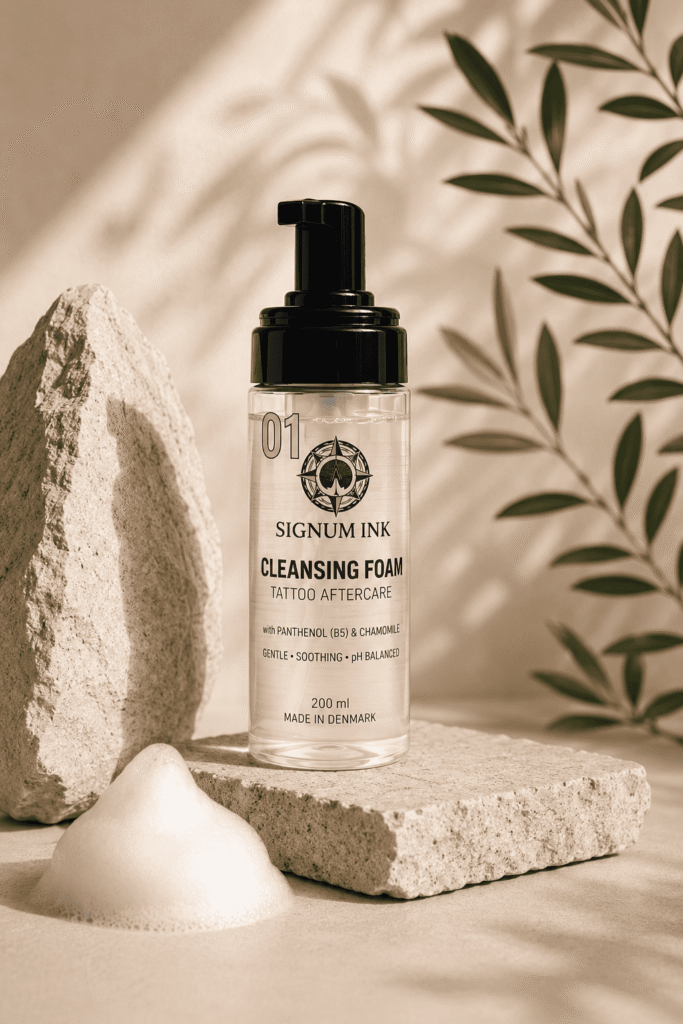
Niacinamide in Tattoo Foam Soap
Foam cleansers have a different purpose than leave-on skincare.
Their primary role is to gently cleanse the tattooed area without unnecessarily disturbing the skin barrier.
Because they remain on the skin only briefly, ingredients such as Niacinamide have less opportunity to perform their full biological role.
For this reason, Niacinamide is much more commonly found in recovery creams and serums than in tattoo foam soaps.
Some premium cleansers nevertheless include small amounts of Niacinamide to contribute to an overall gentle cleansing experience.
Combined with mild surfactants and humectants, it helps create formulations designed to respect the skin’s natural moisture balance.
What Does the Research Say?
Among vitamin-based cosmetic ingredients, Niacinamide has one of the strongest scientific foundations available.
Over the past several decades, numerous clinical and cosmetic studies have investigated its effects on the skin barrier, hydration, and overall skin appearance.
Research suggests that topical Niacinamide may:
- Support the skin’s natural barrier.
- Increase the production of barrier lipids, including Ceramides.
- Reduce transepidermal water loss (TEWL).
- Improve skin hydration.
- Enhance skin smoothness.
- Improve overall skin comfort.
- Be suitable for long-term daily use.
Unlike ingredients that produce only a single cosmetic effect, Niacinamide contributes to multiple interconnected biological processes.
This broad activity explains why dermatologists and cosmetic scientists continue to regard it as one of the most valuable skincare ingredients available today.
Why Niacinamide and Ceramides Work So Well Together
One of the most interesting aspects of Niacinamide is its relationship with Ceramides.
While Ceramides help reinforce the skin barrier directly, research indicates that Niacinamide supports the skin’s own synthesis of Ceramides.
In simple terms:
- Niacinamide helps the skin produce more barrier lipids.
- Ceramides become part of the barrier itself.
This complementary relationship explains why both ingredients are frequently included in premium barrier creams.
Rather than competing, they strengthen different parts of the same biological system.
Research Snapshot
| Research Area | Evidence |
|---|---|
| Skin Barrier Support | ★★★★★ |
| Ceramide Production | ★★★★★ |
| Moisture Retention | ★★★★★ |
| TEWL Reduction | ★★★★★ |
| Sensitive Skin | ★★★★★ |
| Tattoo Aftercare | ★★★☆☆* |
*Direct clinical research on Niacinamide specifically in tattoo aftercare remains limited. However, its extensive evidence supporting skin barrier function and hydration makes it highly relevant for formulations intended for healing skin.
Niacinamide Compared with Other Barrier Ingredients
Understanding Niacinamide becomes easier when compared with other well-known skincare ingredients.
Niacinamide vs. Panthenol
Both ingredients support healthy skin but in different ways.
Panthenol primarily contributes to hydration and skin conditioning.
Niacinamide supports several biological processes involved in maintaining the skin barrier.
Together they create an excellent combination for recovery creams.
Niacinamide vs. Ceramides
These ingredients are often misunderstood.
Ceramides are structural lipids that become part of the skin barrier.
Niacinamide helps support the skin’s natural production of these barrier lipids.
One supports the process.
The other supports the structure.
Niacinamide vs. Vitamin C
Both ingredients are widely used in skincare.
Vitamin C is often chosen for its antioxidant properties and its role in supporting collagen synthesis.
Niacinamide is primarily valued for its barrier-supporting effects, excellent compatibility, and versatility.
Modern formulations may include both ingredients when formulated appropriately.
Niacinamide vs. Hyaluronic Acid
Hyaluronic Acid functions primarily as a humectant, attracting water into the skin.
Niacinamide supports the skin’s natural barrier and complements hydration by helping the skin retain moisture more effectively.
Together they create a balanced hydration system.
Why Niacinamide Has Become a Dermatology Favourite
Few skincare ingredients have achieved the level of acceptance that Niacinamide enjoys today.
Its popularity is based on decades of scientific investigation rather than marketing trends.
Professional formulators value Niacinamide because it offers:
- Excellent skin compatibility.
- Broad scientific support.
- Strong barrier-focused benefits.
- Outstanding formulation versatility.
- Compatibility with nearly every major skincare ingredient.
These characteristics explain why Niacinamide has become a cornerstone of premium moisturizers, dermatology-inspired skincare, and advanced tattoo aftercare formulations.
Ingredient Classification
| Property | Classification |
|---|---|
| Origin | Vitamin (Vitamin B3) |
| Chemical Family | Water-Soluble Vitamin |
| Primary Function | Barrier Support |
| Water Soluble | ✅ Yes |
| Oil Soluble | ❌ No |
| Skin Barrier Role | Supports natural lipid synthesis |
| Scientific Support | ★★★★★ Outstanding |
Frequently Asked Questions About Niacinamide
What is Niacinamide?
Niacinamide, also known as Vitamin B3, is a water-soluble vitamin widely used in modern skincare.
Unlike oils or botanical extracts, Niacinamide supports the skin’s own biological processes, making it one of the most versatile cosmetic ingredients available today.
Why is Niacinamide used in tattoo aftercare?
Fresh tattoos temporarily weaken the skin’s protective barrier.
Niacinamide helps support the skin’s natural barrier function, contributes to moisture retention, and works alongside ingredients such as Ceramides and Panthenol to promote healthy-looking skin during the healing process.
Is Niacinamide suitable for sensitive skin?
Yes.
Niacinamide is generally well tolerated by most skin types, including sensitive skin.
Its gentle nature and broad compatibility explain why it is frequently included in dermatologist-inspired skincare formulations.
Does Niacinamide hydrate the skin?
Not directly.
Unlike Glycerin, which attracts water into the skin, Niacinamide supports the skin’s ability to maintain hydration by strengthening normal barrier function.
Does Niacinamide increase Ceramides?
Research suggests that topical Niacinamide supports the skin’s natural synthesis of Ceramides and other barrier lipids.
This is one reason why these ingredients are commonly used together in barrier-focused skincare products.
Can Niacinamide be used every day?
Absolutely.
Daily use is one of Niacinamide’s greatest strengths.
It is commonly found in moisturizers, serums, and recovery creams intended for long-term use.
What concentration of Niacinamide is best?
Most cosmetic formulations contain 2–5% Niacinamide.
This range is widely used because it offers excellent skin compatibility while delivering well-documented skincare benefits.
Higher concentrations are available but are not necessarily more effective for every individual.
Can Niacinamide be combined with other skincare ingredients?
Yes.
Niacinamide is one of the most formulation-friendly ingredients available.
It combines particularly well with:
- Ceramides
- Glycerin
- Panthenol
- Beta-Glucan
- Squalane
- Hyaluronic Acid
- Allantoin
Is Niacinamide the same as Niacin?
No.
Although both belong to the Vitamin B3 family, Niacinamide and Niacin (nicotinic acid) are different compounds.
Niacinamide is the form most commonly used in cosmetic skincare because it is generally well tolerated and does not typically produce the flushing effect associated with Niacin.
Why do formulators value Niacinamide?
Professional formulators appreciate Niacinamide because it combines:
- Outstanding scientific support.
- Excellent skin compatibility.
- Broad formulation versatility.
- Compatibility with nearly every major skincare ingredient.
- Long-term suitability for daily skincare.
Common Myths About Niacinamide
Myth 1: Niacinamide is simply another vitamin.
Reality:
Although it is Vitamin B3, Niacinamide supports multiple biological processes involved in maintaining healthy skin, making it far more versatile than most vitamin ingredients.
Myth 2: Niacinamide replaces Ceramides.
Reality:
These ingredients perform different roles.
Niacinamide helps support the skin’s natural production of barrier lipids.
Ceramides become part of the barrier itself.
They work best together.
Myth 3: Higher concentrations always produce better results.
Reality:
Most premium skincare products use moderate concentrations because they provide an excellent balance between effectiveness and skin compatibility.
Well-designed formulations matter more than simply increasing the percentage of a single ingredient.
Myth 4: Niacinamide only benefits facial skincare.
Reality:
Any area of skin with a compromised or weakened barrier can benefit from barrier-supporting ingredients.
This makes Niacinamide highly relevant in body care and tattoo aftercare as well.
Research Snapshot
| Research Area | Evidence |
|---|---|
| Skin Barrier Support | ★★★★★ |
| Ceramide Production | ★★★★★ |
| Moisture Retention | ★★★★★ |
| TEWL Reduction | ★★★★★ |
| Sensitive Skin | ★★★★★ |
| Tattoo Aftercare | ★★★☆☆* |
*Most scientific evidence focuses on skin barrier biology and cosmetic dermatology. Dedicated clinical studies in tattoo aftercare are still limited, but the mechanisms are directly relevant to healing skin.
Level of Evidence
| Evidence Source | Strength |
|---|---|
| Skin Biology | ★★★★★ |
| Clinical Dermatology | ★★★★★ |
| Cosmetic Science | ★★★★★ |
| Traditional Use | ★☆☆☆☆ (Niacinamide is a science-driven vitamin rather than a traditional botanical ingredient.) |
| Tattoo-Specific Studies | ★★☆☆☆ |
Why this matters:
Niacinamide is one of the best-researched skincare ingredients available. Its ability to support the skin barrier, reduce transepidermal water loss (TEWL), and complement other barrier-supporting ingredients is supported by decades of dermatological and cosmetic research.
Ingredient Classification
| Property | Classification |
|---|---|
| Origin | Vitamin (Vitamin B3) |
| Chemical Family | Water-Soluble Vitamin |
| Primary Function | Barrier-Supporting Active |
| Water Soluble | ✅ Yes |
| Oil Soluble | ❌ No |
| Skin Barrier Role | Supports natural lipid synthesis |
| Scientific Support | ★★★★★ Outstanding |
How It Works in a Formula
| Role | Function |
|---|---|
| Humectant | ❌ |
| Emollient | ❌ |
| Occlusive | ❌ |
| Barrier Support | ✅ Primary |
| Skin Conditioning | ✅ Strong |
| Supports Ceramide Synthesis | ✅ Documented |
Formulation Insight:
Niacinamide is included because it supports the skin’s own biological processes rather than simply coating the skin. It complements humectants, emollients, and structural lipids by helping maintain a healthier, more resilient skin barrier.
Ingredient Performance Snapshot
| Category | Rating |
|---|---|
| Barrier Support | ⭐⭐⭐⭐⭐ |
| Daily Use | ⭐⭐⭐⭐⭐ |
| Sensitive Skin | ⭐⭐⭐⭐⭐ |
| Scientific Evidence | ⭐⭐⭐⭐⭐ |
| Formulation Versatility | ⭐⭐⭐⭐⭐ |
| Overall Skin Health | ⭐⭐⭐⭐⭐ |
Why Formulators Choose Niacinamide
| Formulation Benefit | Why It Matters |
|---|---|
| Extensive scientific evidence | One of the most thoroughly researched cosmetic ingredients. |
| Supports the skin barrier | Complements Ceramides and other barrier lipids. |
| Excellent compatibility | Works well with almost every major skincare ingredient. |
| Daily use | Suitable for long-term barrier-focused skincare. |
| Premium positioning | Widely used in advanced dermatology-inspired formulations. |
Formulator’s Perspective
Niacinamide represents one of the most significant advances in modern skincare because it supports the skin’s own biology rather than simply providing temporary surface effects.
Professional formulators rely on Niacinamide because it works in harmony with ingredients such as Ceramides, Glycerin, Panthenol, Beta-Glucan, and Squalane. Together these ingredients create formulations that help maintain hydration, reinforce the skin barrier, and support healthy-looking skin throughout the tattoo healing process.
This systems-based approach is what distinguishes premium skincare from products built around a single “hero ingredient.”
Expert Tip
Think of Niacinamide as the skin’s support manager.
It does not replace Ceramides, moisturizers, or emollients. Instead, it helps the skin maintain the biological processes that keep the barrier functioning effectively.
Combined with ingredients that hydrate and protect, Niacinamide helps create a recovery cream designed for both immediate comfort and long-term skin health.
Ingredient Synergy
| Combines Especially Well With | Why |
|---|---|
| Ceramides | Supports the skin’s natural production of barrier lipids while Ceramides reinforce the barrier itself. |
| Glycerin | Glycerin attracts moisture; Niacinamide helps the skin retain it through improved barrier function. |
| Panthenol | Together they support hydration, skin comfort, and barrier resilience. |
| Beta-Glucan | Complements hydration and helps create formulations suitable for sensitive skin. |
| Squalane | Squalane conditions the skin while Niacinamide supports barrier biology. |
| Allantoin | Enhances skin comfort in formulations designed for compromised skin. |
Ingredient Verdict
| Category | Rating |
|---|---|
| Overall Rating | ⭐⭐⭐⭐⭐ |
| Best For | Barrier-focused skincare, fresh tattoos, daily moisturizers |
| Scientific Confidence | Outstanding |
| Formulator Recommendation | Essential active ingredient in modern recovery creams |
| Works Best With | Ceramides, Glycerin, Panthenol, Beta-Glucan, Squalane |
Final Thoughts
Niacinamide has become one of the defining ingredients of modern skincare because it supports the skin’s own biological processes rather than simply providing temporary cosmetic effects.
Its exceptional scientific foundation, outstanding skin compatibility, and ability to work alongside virtually every major skincare ingredient make it one of the most versatile actives available today.
For tattoo aftercare, Niacinamide is particularly valuable because it complements hydration and barrier-supporting ingredients such as Ceramides, Glycerin, Panthenol, and Squalane. Together, these ingredients create formulations that help maintain moisture, reinforce the skin’s protective barrier, and support healthy-looking skin throughout every stage of healing.
Rather than acting alone, Niacinamide demonstrates one of the central principles of modern formulation science: the most effective skincare products are built from ingredients that work together in harmony.
 English
  German
  Dutch
Dutch  Danish
  Swedish
  French
  Italian