Introduction
Choosing the right tattoo aftercare products can feel overwhelming.
Search online and you’ll find countless recommendations for creams, lotions, soaps, butters, balms and oils—each claiming to be the best solution for healing tattoos.
The reality is much simpler.
Healthy tattoo healing isn’t about using dozens of different products.
It’s about selecting products that support your skin’s natural recovery while avoiding unnecessary irritation.
In this complete guide, you’ll learn:
- Which tattoo aftercare products are actually useful.
- What each product is designed to do.
- Which ingredients are worth looking for.
- Which ingredients may not be ideal for healing skin.
- How to build a simple and effective tattoo aftercare routine.
Whether this is your first tattoo or your fiftieth, understanding how different products work makes it easier to care for your skin with confidence.
Why Tattoo Aftercare Products Matter
A new tattoo is more than artwork.
It’s healing skin.
During the first several weeks, your skin works to:
- Repair thousands of microscopic needle punctures.
- Restore the skin barrier.
- Reduce temporary inflammation.
- Replace damaged skin cells.
- Retain healthy moisture levels.
Appropriate aftercare products don’t perform this healing themselves.
Instead, they help create an environment in which your skin can recover comfortably and efficiently.
The Three Core Product Categories
Despite the huge number of tattoo products available, almost every aftercare routine can be simplified into three categories.
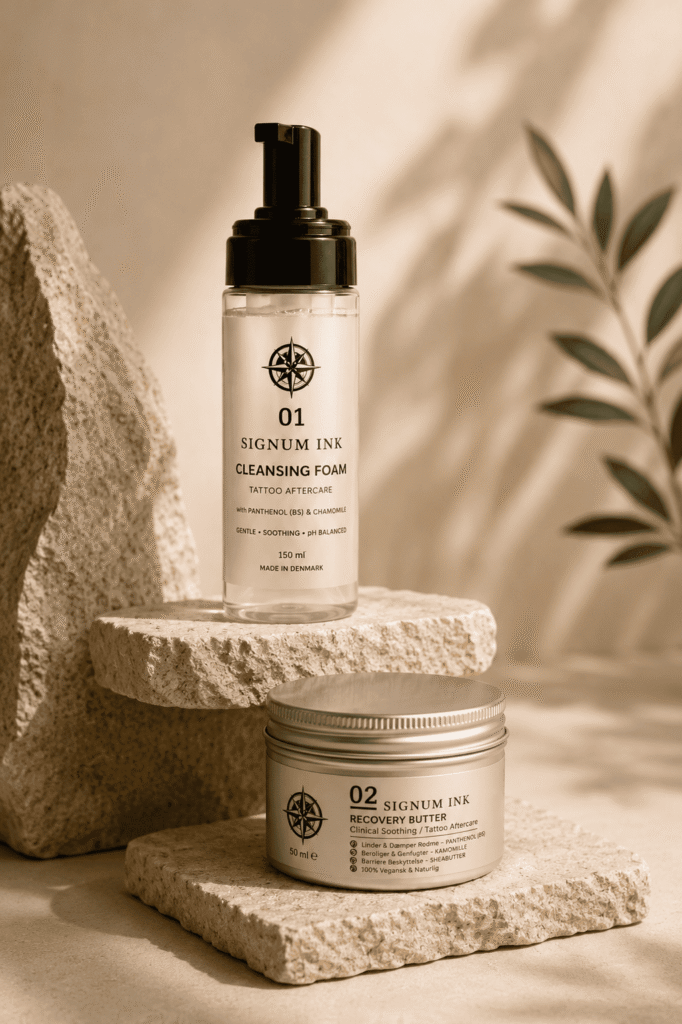
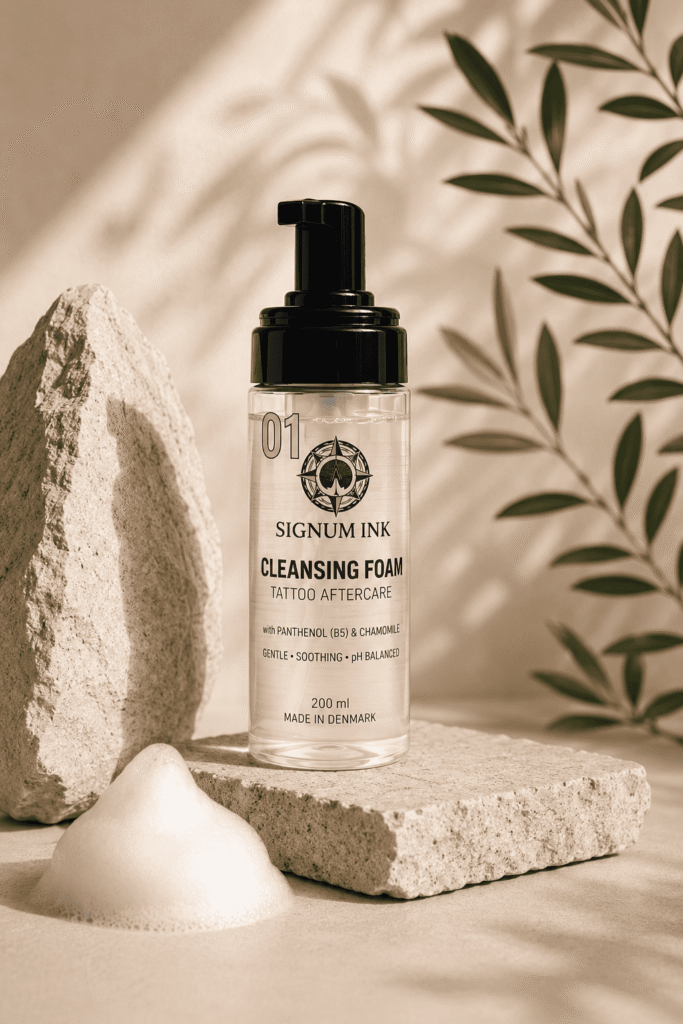
1. Cleansers
A gentle cleanser removes:
- Sweat.
- Dirt.
- Excess ink.
- Plasma.
- Everyday bacteria.
Without stripping the skin of its natural protective oils.
The best cleansers clean effectively while remaining gentle enough for healing skin.
2. Moisturizers
Healing skin naturally loses moisture.
A moisturizer helps support the skin barrier by:
- Reducing dryness.
- Improving comfort.
- Minimizing tightness.
- Supporting hydration.
Moisturizers don’t make tattoos heal faster.
They help keep healing skin balanced and comfortable.
3. Protective Skin Care
As healing progresses, products that help maintain long-term skin health become increasingly important.
These may help support:
- Skin hydration.
- Skin flexibility.
- Overall skin comfort.
- Long-term tattoo appearance.
Healthy skin is one of the best foundations for maintaining a vibrant-looking tattoo.
Do You Need Special Tattoo Products?
This is one of the most common questions.
The answer depends on the product.
Some skincare products designed for sensitive skin may be perfectly suitable during tattoo healing.
However, tattoo-specific products are often formulated with healing skin in mind.
They frequently prioritize:
- Gentle cleansing.
- Skin barrier support.
- Easy absorption.
- Minimal unnecessary ingredients.
Rather than asking whether a product is marketed specifically for tattoos, it’s often more useful to ask whether its formulation is appropriate for healing skin.
What Makes a Good Tattoo Aftercare Product?
Regardless of the category, high-quality tattoo aftercare products often share similar characteristics.
They are typically:
- Gentle.
- Suitable for sensitive skin.
- Easy to apply.
- Non-abrasive.
- Free from unnecessary irritants whenever possible.
Simple formulations are often easier for healing skin to tolerate than overly complex ingredient lists.
Why Ingredients Matter More Than Marketing
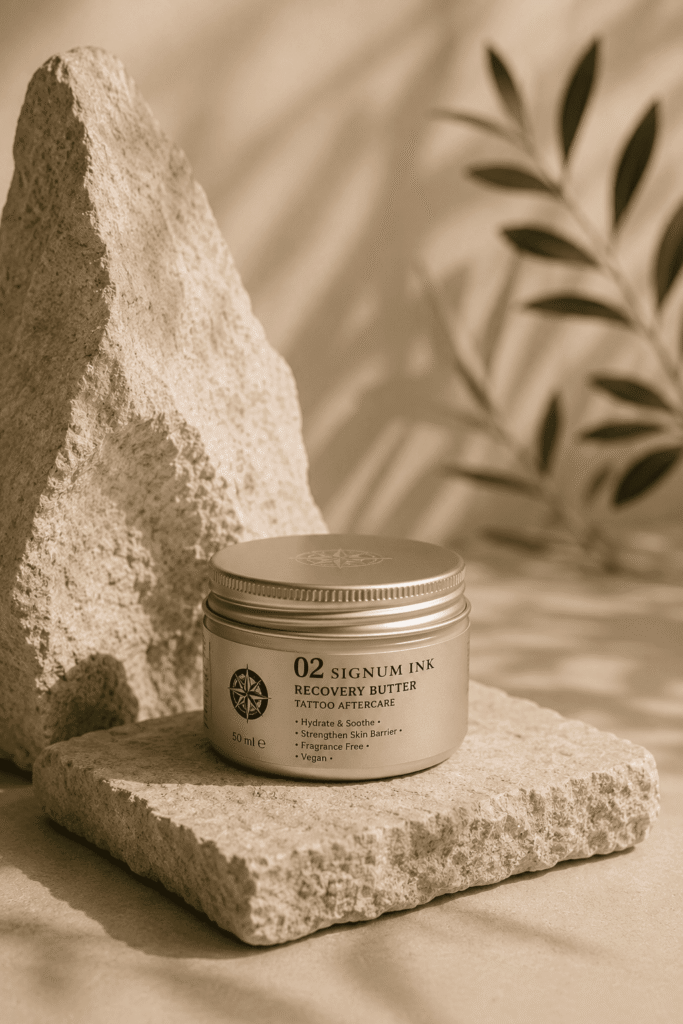
Beautiful packaging doesn’t guarantee an effective product.
Instead of focusing on marketing claims, pay attention to the ingredient list.
Many of the most respected tattoo aftercare products contain ingredients commonly used in modern skincare because of their ability to support the skin barrier and maintain hydration.
Examples include:
- Panthenol.
- Glycerin.
- Shea Butter.
- Jojoba Oil.
- Allantoin.
- Beta-Glucan.
- Centella Asiatica.
- Vitamin E.
We’ll explore each of these ingredients in dedicated articles throughout this cluster.
Building a Simple Aftercare Routine
Many people believe effective tattoo aftercare requires numerous different products.
In reality, most successful routines are surprisingly simple.
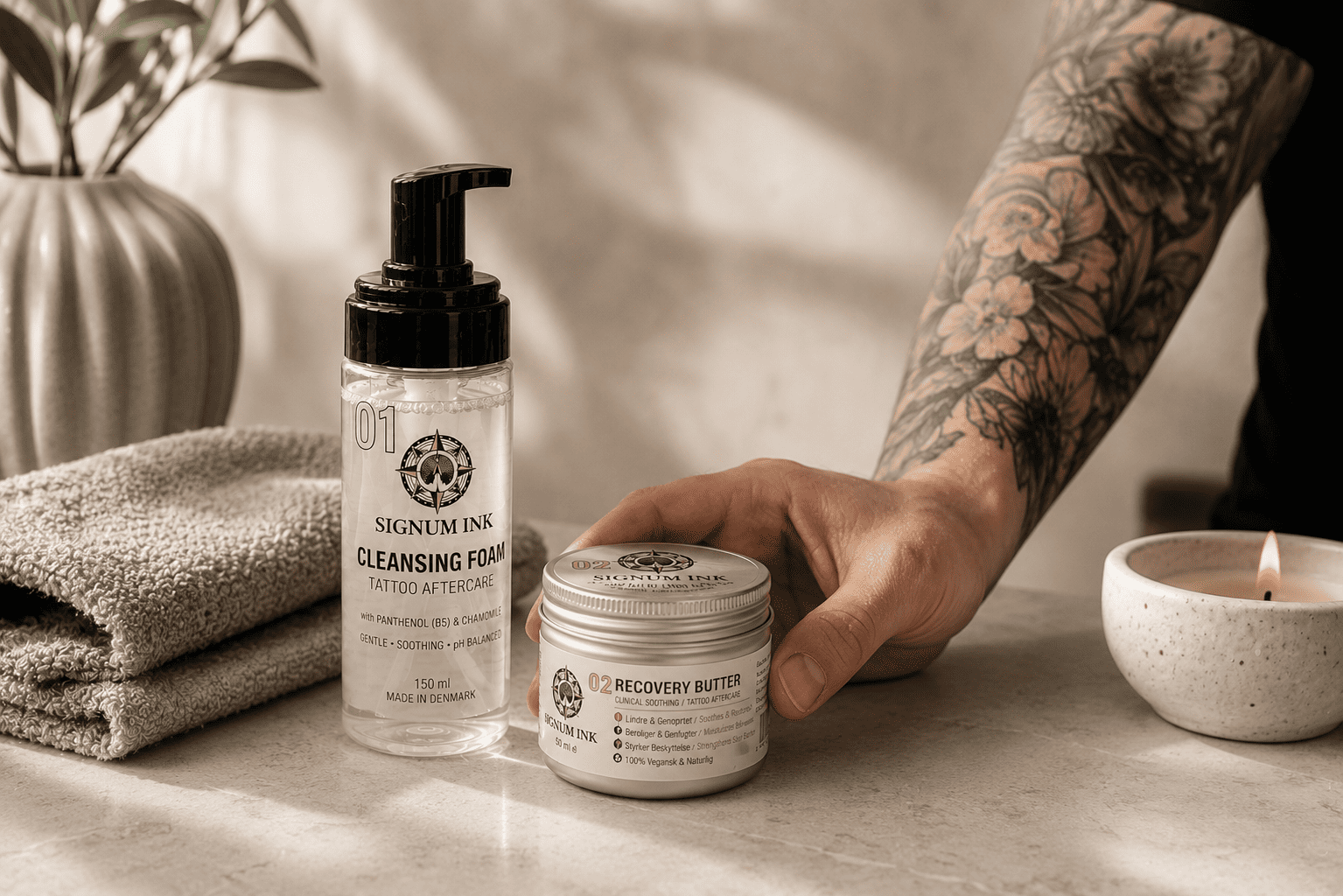
For many people, a complete routine consists of:
- A gentle cleanser.
- A quality moisturizer or tattoo butter.
- Consistent daily care.
Keeping your routine straightforward often makes it easier to stay consistent throughout the healing process.
Good Products Support Healing—They Don’t Replace It
Perhaps the most important principle of tattoo aftercare is this:
Your products don’t heal your tattoo.
Your body does.
The role of aftercare products is to support your skin while it carries out its own natural repair process.
Choosing appropriate products, following a consistent routine and giving your skin enough time to recover usually have a far greater impact than constantly changing products in search of a miracle solution.
How to Choose the Right Tattoo Aftercare Products
With so many options available, choosing the right products can seem confusing.
Instead of focusing on brand names alone, consider whether the product is suitable for healing skin.
Look for products that are:
- Gentle.
- Designed for sensitive skin.
- Easy to rinse away or absorb.
- Free from unnecessary irritants whenever possible.
- Comfortable to use consistently.
The best tattoo aftercare routine is one you’ll actually follow every day.
Understanding Common Tattoo Aftercare Ingredients
Many high-quality tattoo aftercare products contain ingredients that support skin hydration and barrier function.
Here are some of the most common.
Panthenol (Provitamin B5)
Panthenol is widely used in skincare because it helps support the skin barrier and improve moisture retention.
It’s commonly included in tattoo aftercare products to help keep healing skin comfortable.
Glycerin
Glycerin is a powerful humectant.
It attracts water to the outer layers of the skin, helping maintain hydration without leaving a heavy feeling.
Shea Butter
Shea Butter is valued for its rich emollient properties.
It helps soften the skin while supporting the skin’s natural moisture barrier.
Jojoba Oil
Although called an oil, jojoba closely resembles the skin’s natural sebum.
It spreads easily, absorbs well and helps reduce feelings of dryness.
Allantoin
Allantoin is frequently used in products for sensitive skin.
It helps support skin comfort and is commonly included in aftercare formulations.
Beta-Glucan
Beta-Glucan is a polysaccharide derived from sources such as oats or yeast.
It is valued for its skin-conditioning properties and its ability to support the skin barrier.
Centella Asiatica
Centella Asiatica has been used in skincare for decades.
It is widely recognized for helping support the skin’s natural repair processes and maintaining skin comfort.
Vitamin E
Vitamin E acts as an antioxidant and is often included in moisturizers to help protect skin from oxidative stress.
Ingredients That May Not Be Ideal
Healing skin can be more sensitive than usual.
Many people choose to avoid products containing:
- Strong fragrances.
- High concentrations of alcohol.
- Harsh exfoliating acids.
- Abrasive scrubs.
- Highly perfumed essential oils used in large amounts.
Simple formulations are often easier for healing skin to tolerate.
Is More Expensive Always Better?
Not necessarily.
A higher price doesn’t automatically mean a better tattoo aftercare product.
Instead, evaluate products based on:
- Ingredient quality.
- Skin compatibility.
- Ease of use.
- Product consistency.
- Whether you’ll use it correctly every day.
Consistency almost always matters more than price.
Common Tattoo Product Mistakes
Many tattoo aftercare problems begin with unnecessary complexity.
Common mistakes include:
- Using too many products at once.
- Changing products every few days.
- Applying excessive amounts of moisturizer.
- Using harsh soaps.
- Following unverified internet advice.
- Believing one product can dramatically speed up healing.
A simple, consistent routine usually delivers the best results.
Frequently Asked Questions
Do I need tattoo-specific products?
Not always.
Some skincare products formulated for sensitive skin may also be suitable.
The important factor is whether the formulation is appropriate for healing skin.
Is tattoo butter better than tattoo cream?
Neither is universally better.
The best choice depends on your skin type, personal preference and the product’s formulation.
We’ll compare them in detail in a dedicated article.
Can I use regular body lotion?
Some fragrance-free lotions designed for sensitive skin may be appropriate.
Avoid products that contain ingredients likely to irritate healing skin.
Should I use several tattoo products together?
Usually, no.
Most people only need:
- A gentle cleanser.
- A suitable moisturizer or tattoo butter.
- A consistent daily routine.
Keeping things simple often works best.
Can aftercare products prevent infections?
No.
Good hygiene and proper aftercare help reduce risk, but no cosmetic product can guarantee prevention of infection.
If you suspect an infection, seek advice from a qualified healthcare professional.
Conclusion
Choosing the right tattoo aftercare products doesn’t have to be complicated.
The most effective routines are usually built around a few well-formulated products that support your skin’s natural healing process without overwhelming it.
Focus on gentle cleansing, balanced hydration and consistent daily care rather than chasing miracle ingredients or constantly switching products.
Remember:
The best tattoo aftercare products don’t heal your tattoo.
They help create the conditions in which your skin can heal itself.
 English
  German