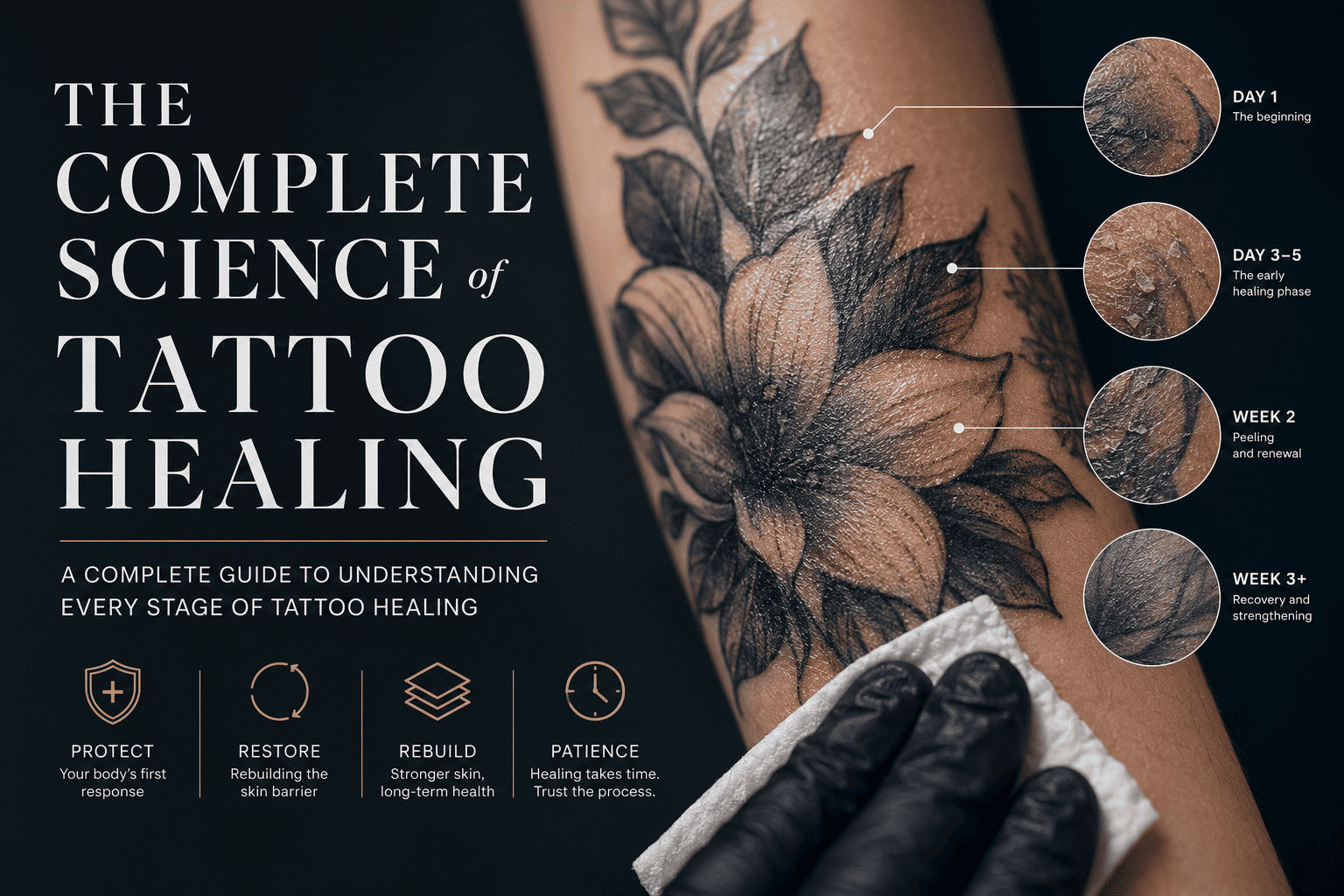
What is tattoo healing?
Tattoo healing is the biological process in which the skin protects, restores, and rebuilds itself after tattooing. Healing begins within seconds of the final needle stroke and continues long after the tattoo appears healed on the surface. Understanding every stage of recovery helps support healthy tattoo aftercare and skin barrier restoration.
From the First Drop of Ink to Complete Skin Recovery
Understanding Tattoo Healing Begins Here.
BEFORE YOU BEGIN
There are few things more exciting than leaving the tattoo studio with a brand-new tattoo.
After weeks—sometimes months—of anticipation, it’s finally yours.
The lines are sharp. The colors are vibrant. The artwork is complete.
Or at least, that’s how it appears.
What most people don’t realize is that while their tattoo may look finished, their body’s most remarkable work has only just begun.
Before you’ve unlocked your phone to look at your tattoo for the very first time, millions of biological processes have already begun unfolding beneath the surface of your skin.
Blood vessels immediately begin responding to microscopic trauma. Specialized immune cells start moving toward the tattooed tissue. Your skin begins rebuilding the protective barrier that has temporarily been disrupted during tattooing.
And remarkably, it does all of this without waiting for you.
Your body doesn’t wait for tattoo cream.
It doesn’t wait for your first wash.
And it certainly doesn’t wait until tomorrow morning to begin healing.
It simply begins.
This guide was created to help you understand exactly what happens next.
From the first drop of ink to complete skin recovery, we’ll explore the extraordinary biological processes that make tattoo healing possible—and explain why healthy healing is often less about doing more and more about understanding what your body is already doing remarkably well.
Whether this is your first tattoo or your fiftieth, our goal is simple:
To help you understand tattoo healing better than when you arrived.
HOW TO READ THIS GUIDE
This guide has been written as a complete journey through tattoo healing.
You can read it from beginning to end or return to individual chapters whenever questions arise during your own healing process.
Every chapter has been written to answer one simple question:
What is my body doing right now?
By understanding what happens beneath the surface of your skin, tattoo healing becomes easier to understand—and often far less intimidating.
WHAT YOU’LL DISCOVER
Throughout this guide you’ll discover:
- What happens during the very first seconds after tattoo needles touch your skin.
- Why inflammation is an essential part of healthy healing.
- Why tattoos become red, swollen, dry, and sensitive.
- Why peeling and itching are often completely normal.
- How your skin barrier repairs itself over time.
- Why moisture balance matters throughout every stage of tattoo healing.
- Why biological healing continues long after visible healing appears complete.
- The most common misconceptions surrounding tattoo aftercare.
- The science behind building a healthy tattoo healing routine.
Most importantly, you’ll discover that tattoo healing isn’t simply measured in days or weeks.
It’s measured in biology.
CHAPTER 1
Before Your Tattoo Begins to Heal
Your tattoo may be only a few seconds old. Your body has already begun healing it.
When most people think about tattoo healing, they think about what happens tomorrow.
Will it become red?
Will it start peeling?
Should it feel warm?
How often should it be washed?
But tattoo healing doesn’t begin tomorrow.
It begins now.
The moment tattoo needles penetrate the skin, your body immediately begins responding to what it recognizes as microscopic trauma. Within seconds, blood vessels react, inflammatory signals are released, and specialized immune cells begin their work beneath the surface of the skin.
Remarkably, almost none of this is visible to us.
Long before your tattoo begins peeling or itching, your body has already begun protecting, repairing, and rebuilding the tattooed tissue.
Healing doesn’t begin when we decide to start caring for our tattoo.
Healing begins when our body decides it cannot afford to wait any longer.
For thousands of years, human skin has evolved to perform one extraordinary task: to protect us.
Every single day it shields us from dehydration, harmful microorganisms, environmental stress, and physical trauma. At the same time, it continuously repairs itself in ways most of us never stop to consider.
Tattooing temporarily interrupts that remarkable system.
The moment the skin barrier is disrupted, your body immediately begins working toward three remarkably simple goals:
Protect. Restore. Rebuild.
Everything that happens during tattoo healing stems from these three priorities.
Redness is often evidence that your body is responding appropriately.
Peeling is frequently part of healthy healing.
Even itching—one of the most frustrating stages of recovery—is often evidence that extraordinary biological processes are quietly continuing beneath the surface of your skin.
Understanding these principles changes how we think about tattoo healing entirely.
Modern tattoo aftercare isn’t about forcing the skin to heal faster or applying as many products as possible. More often than not, it’s about creating an environment that allows your body to do what it already does exceptionally well.
Healthy tattoo healing begins with understanding.
And understanding always begins beneath the surface.
CHAPTER 2
The Biology of Tattoo Healing
Your skin doesn’t know you’ve been tattooed. It only knows that it has work to do.
Every tattoo tells a story.
Some represent memories. Others symbolize important moments, people, or personal milestones. To us, tattoos are deeply personal and often profoundly meaningful.
To your body, however, a tattoo means something very different.
It means work.
Your skin doesn’t recognize beautiful artwork, intricate shading, or vibrant colors. It doesn’t know whether you’ve spent six months planning your tattoo or decided to get it on a spontaneous afternoon with friends.
It simply recognizes that its protective barrier has been temporarily disrupted.
And immediately, it begins responding.
One of the most remarkable things about tattoo healing is that your body already knows exactly what to do. You don’t need to teach it how to heal. The biological processes involved in skin repair have been refined over millions of years of human evolution.
The moment tattoo needles penetrate the skin, your body begins coordinating an extraordinary response involving blood vessels, inflammatory signals, immune cells, connective tissue, and millions of skin cells working together toward a common goal:
Protect. Restore. Rebuild.
Everything that follows during tattoo healing stems from these three priorities.
Your Skin Is More Than Just Skin
We often think of our skin as little more than the surface we can see in the mirror each morning.
In reality, it is one of the most sophisticated organs in the human body.
Every day your skin performs countless tasks without ever asking for your attention. It regulates temperature, protects against harmful microorganisms, prevents excessive water loss, communicates with the immune system, and continuously repairs itself throughout your lifetime.
Perhaps most remarkably of all, it never stops working.
Even as you’re reading these words, millions of skin cells are quietly carrying out their responsibilities beneath the surface.
Tattooing temporarily interrupts this remarkable system—but it doesn’t stop it.
Instead, your body immediately begins adapting to its new circumstances.
The First Response: Protection
The body’s first priority is protection.
Within moments of tattooing, blood vessels begin responding to microscopic injury while inflammatory signals are released throughout the surrounding tissue. This early inflammatory response is often misunderstood, largely because the word “inflammation” tends to sound negative.
In reality, inflammation is one of your body’s greatest allies during healthy tattoo healing.
Without it, healing simply wouldn’t occur.
Inflammation helps coordinate the remarkable biological processes required to begin repairing the skin. It allows specialized cells to travel toward the tattooed tissue and helps initiate the rebuilding process that continues throughout the days and weeks ahead.
This is why mild redness, warmth, and sensitivity are often completely normal during the early stages of tattoo healing.
Your body isn’t overreacting.
It’s responding.
The Second Response: Restoration
While your body is protecting the tattooed tissue, it is simultaneously working to restore what has been temporarily disrupted.
Your skin barrier is extraordinary.
Its primary role is deceptively simple: to keep what belongs inside your body inside, and what belongs outside your body outside.
Tattooing temporarily challenges that barrier.
As a result, your body immediately begins rebuilding and restoring its protective functions.
This restoration process continues long after visible healing appears complete. In fact, one of the most common misconceptions surrounding tattoo healing is the belief that healing ends when peeling stops or redness disappears.
Biological healing often continues quietly beneath the surface for considerably longer.
Your tattoo may look healed before your skin has fully completed its work.
The Third Response: Rebuilding
Finally, your body begins rebuilding.
Millions of skin cells continue communicating, repairing, and adapting throughout the healing process. The skin barrier gradually strengthens, sensitivity begins to improve, and the remarkable biological processes that began within seconds continue long after most people stop thinking about their tattoo.
This is why patience remains one of the most important aspects of healthy tattoo healing.
Healing is rarely a single moment.
It is a process.
And like all remarkable biological processes, it takes time.
Understanding Tattoo Healing Changes Everything
When we understand the biology of tattoo healing, something interesting happens.
Many of the questions we ask about tattoo aftercare begin changing.
Instead of asking:
“How can I make my tattoo heal faster?”
We begin asking:
“How can I best support what my body is already doing?”
It’s a subtle difference, but an important one.
Modern tattoo aftercare isn’t about controlling the healing process.
It’s about understanding and supporting it.
The remarkable truth is that your body has been preparing for this moment for millions of years.
Long before tattoo cream existed, your skin already knew how to protect, restore, and rebuild itself.
Healthy tattoo healing begins with understanding that remarkable process.
And perhaps that’s the most fascinating part of tattoo healing of all:
Your body has been preparing to heal your tattoo for far longer than you’ve been preparing to get one.
CHAPTER 3
The First Hour
Long before your tattoo begins peeling or itching, your body has already begun protecting it.
For most people, the first hour after getting a tattoo is filled with excitement.
You admire the artwork for the first time. You take photographs. Perhaps you’re already thinking about showing it to family and friends or planning your next tattoo before you’ve even left the studio.
It’s an exciting moment.
But beneath the surface of your skin, something equally remarkable is taking place.
While you’re admiring the finished artwork, your body is quietly beginning one of its most extraordinary biological responses.
The healing process has already begun.
Within seconds of tattooing, blood vessels respond to microscopic trauma and inflammatory signals are released throughout the tattooed tissue. Specialized immune cells immediately begin coordinating the complex biological processes that will continue throughout the days and weeks ahead.
Your body doesn’t wait for tomorrow.
It doesn’t wait until you get home.
And it certainly doesn’t wait until you’ve begun your aftercare routine.
Healing has already begun.
Your Tattoo Is More Than Ink
It’s easy to think of a tattoo simply as ink placed beneath the skin.
In reality, tattooing is considerably more complex than that.
A tattoo artist may spend several hours creating beautiful lines, gradients, and shading, but every movement of the tattoo machine also creates thousands of microscopic punctures within the skin. These tiny injuries are what allow tattoo pigment to be deposited beneath the surface.
Your body immediately recognizes this.
To us, a tattoo represents art.
To our skin, it represents something that requires immediate attention.
This isn’t something to fear. In fact, it’s precisely what makes healthy tattoo healing possible.
Without this remarkable biological response, tattoo healing simply wouldn’t occur.
Why Your Tattoo May Feel Warm
One of the most common questions during the first few hours after tattooing is surprisingly simple:
“Why does my tattoo feel warm?”
The answer is equally simple.
Because your body is working.
Increased blood flow is one of the earliest responses during healthy healing. Blood vessels naturally respond to microscopic trauma by helping coordinate the biological processes involved in skin repair.
This is one of the reasons why freshly tattooed skin may feel:
- Warm.
- Sensitive.
- Slightly swollen.
- Tender to the touch.
For many people, these early changes can feel concerning, particularly if it’s their first tattoo.
More often than not, however, they are evidence that your body is doing exactly what it has evolved to do.
Healthy tattoo healing isn’t silent.
Sometimes, you can feel it happening.
Understanding Plasma Leakage
Another part of early tattoo healing that often surprises people is plasma leakage.
You may notice small amounts of clear or slightly yellow fluid collecting beneath your protective covering during the first hours after tattooing. This is frequently a completely normal part of early healing.
Plasma is one of the many remarkable components involved in your body’s healing response. It helps transport nutrients, proteins, and other important substances throughout the body while contributing to the complex biological processes involved in tissue repair.
Seeing small amounts of plasma during the early stages of healing isn’t necessarily something to fear.
Once again, your body is simply doing what it has always done remarkably well.
It is protecting, restoring, and rebuilding.
What Your Body Is Doing Right Now
While you’re reading this chapter, your body is remarkably busy.
Millions of cells are communicating with one another beneath the surface of your skin. Specialized immune cells continue moving toward the tattooed tissue while your skin begins rebuilding the protective barrier that has temporarily been disrupted during tattooing.
And remarkably, all of this happens automatically.
You don’t need to remind your body to begin healing.
You don’t need to tell your skin what to do next.
Your body already knows.
Perhaps that’s one of the most fascinating aspects of tattoo healing.
Long before we’ve learned how to care for our tattoos, our skin has spent millions of years learning how to care for us.
The First Hour Matters
The first hour after tattooing isn’t particularly important because of what we do.
It’s important because of what our body is already doing.
Understanding this changes how we think about tattoo aftercare.
Healthy healing isn’t about trying to take control of every biological process taking place beneath the surface of the skin. More often than not, it’s about understanding those processes and supporting them appropriately throughout every stage of recovery.
Tattoo healing isn’t something that suddenly begins tomorrow morning.
It began before you finished reading the first page of this guide.
And at this very moment, it quietly continues beneath the surface of your skin.
CHAPTER 4
The First Day
Your tattoo may look the same as it did yesterday. Beneath the surface, however, almost everything has changed.
For many people, the first day after getting a tattoo is filled with questions.
Should it still feel warm?
Why is it becoming red?
Is slight swelling normal?
Should it look this shiny?
Is it supposed to feel tight?
And perhaps the most common question of all:
“Is my tattoo healing normally?”
The honest answer is that healthy tattoo healing rarely looks exactly the same from one person to another. Age, skin type, tattoo placement, size, aftercare practices, and even your body’s natural healing response can influence what you experience during the first twenty-four hours.
There is no such thing as a perfectly identical healing process.
There is, however, something remarkably consistent taking place beneath the surface of the skin.
Your body continues doing exactly what it began doing within seconds of the final needle stroke.
It protects.
It restores.
And it rebuilds.
Why Your Tattoo Looks Different Today
One of the most surprising aspects of tattoo healing is how quickly a tattoo can change during the first twenty-four hours.
A tattoo that looked calm and vibrant when you left the studio may feel warmer, appear slightly redder, or look shinier by the following morning.
This is often a completely normal part of early healing.
Healthy tattoo healing isn’t static. It is a constantly changing biological process.
Your tattoo may feel:
- Warm.
- Tight.
- Sensitive.
- Slightly swollen.
- More noticeable than it did immediately after tattooing.
All of these changes simply reflect the fact that your body remains remarkably busy beneath the surface of your skin.
Healing isn’t slowing down.
It’s continuing.
Why Redness Isn’t Always a Bad Thing
Redness is perhaps one of the most misunderstood aspects of tattoo healing.
For many people, redness immediately causes concern. We naturally associate redness with irritation or something having gone wrong. During healthy tattoo healing, however, mild redness is often evidence that your body is responding appropriately.
Healing requires communication.
It requires blood flow.
And it requires millions of biological processes working together throughout the tattooed tissue.
Without these responses, healing simply wouldn’t occur.
This doesn’t mean that every type of redness should automatically be considered normal. Tattoo healing exists on a spectrum, and everyone’s experience is different. Understanding what is typical—and recognizing when something feels significantly different from what you might reasonably expect—remains an important part of tattoo aftercare.
Most importantly, however, healthy tattoo healing should never be judged by a single symptom alone.
Your tattoo tells a much larger story than redness itself ever could.
Your Skin Is Working Overtime
During the first day after tattooing, it’s easy to focus entirely on what we can see in the mirror.
The redness.
The shine.
The sensitivity.
What we don’t see is often far more fascinating.
At this very moment, your skin is continuously communicating with itself. Specialized cells continue carrying out their individual responsibilities while your body works tirelessly to restore the protective functions that were temporarily disrupted during tattooing.
And remarkably, none of this requires conscious thought.
Your body has performed these extraordinary tasks every single day of your life.
Tattoo healing simply gives us an opportunity to witness these biological processes more closely than we normally would.
Perhaps that’s why understanding tattoo healing changes how we think about aftercare entirely.
We stop asking:
“How can I make my tattoo heal?”
And begin asking:
“How can I best support what my body is already doing?”
It’s a subtle difference, but an important one.
Why Your Tattoo May Feel Tight
Another common experience during the first twenty-four hours is a feeling of tightness or mild discomfort.
Freshly tattooed skin has experienced thousands of microscopic injuries during the tattooing process. As your body continues responding to this temporary disruption of the skin barrier, it’s perfectly understandable that your tattoo doesn’t immediately feel like the rest of your skin.
Healthy tattoo healing isn’t always comfortable.
Sometimes healing feels warm.
Sometimes it feels sensitive.
And sometimes it simply feels different.
Perhaps one of the greatest misconceptions surrounding tattoo healing is the belief that healthy healing should feel completely effortless from beginning to end.
The reality is often much more interesting than that.
Healing is active.
And active processes are rarely invisible.
Tomorrow Will Look Different Again
If there’s one thing we’d like you to remember throughout the first day of tattoo healing, it’s this:
Your tattoo will continue changing.
Tomorrow it may look slightly different than it does today.
By the end of the week, it may feel different once again.
And several weeks from now, your skin will still be quietly continuing the remarkable work that began within seconds of the final needle stroke.
Tattoo healing isn’t a single event.
It’s a constantly evolving biological process.
The first day is simply one chapter of a much larger story.
And that story is only just beginning.
CHAPTER 5
Days 2–7: When Your Tattoo Begins to Change
Perhaps the most surprising part of tattoo healing isn’t how quickly it begins—it’s how quickly it changes.
If this is your very first tattoo, the days that follow can feel surprisingly dramatic.
A tattoo that looked vibrant and almost flawless just a few days ago may suddenly begin looking dry, shiny, or slightly dull. The skin may start feeling tighter than before. Small flakes might begin appearing on the surface, and what once looked like fresh ink can suddenly appear softer or less vibrant than it did when you left the tattoo studio.
For many people, this is also the stage where questions begin appearing almost as quickly as the changes themselves.
Is my tattoo supposed to look like this?
Why is it becoming dry?
Am I losing ink?
Should it be peeling already?
Is it healing normally?
The answer, more often than not, is remarkably reassuring.
Your tattoo isn’t becoming less beautiful.
It’s becoming healthier.
The Week Everything Changes
During the first week of healing, your tattoo may change more visibly than at any other stage of the recovery process.
What felt warm and sensitive during the first twenty-four hours may now begin feeling dry or tight. What once appeared incredibly vibrant may temporarily appear softer or slightly cloudy. Some tattoos may begin peeling earlier than others, while some may take several more days before noticeable changes occur.
Healthy tattoo healing isn’t a straight line.
It’s a process of constant change.
And perhaps one of the most important things to remember during this stage is that change is often exactly what we should expect.
Your tattoo isn’t becoming worse.
It’s becoming different.
And beneath the surface of your skin, healing continues remarkably uninterrupted.
Why Tattoos Become Dry
One of the most common experiences during days two through seven is dryness.
Freshly tattooed skin has temporarily lost part of the protective barrier it relies upon every single day. Throughout the healing process, your body continues working to restore that barrier while simultaneously adapting to the biological changes taking place within the tattooed tissue.
It’s therefore perfectly understandable that your tattoo may feel different than the surrounding skin.
It may feel:
- Tight.
- Dry.
- Sensitive.
- Slightly uncomfortable.
- More noticeable than it did just a few days earlier.
These changes aren’t necessarily signs that something has gone wrong.
More often than not, they are signs that healing continues exactly as it should.
Why Tattoos Begin Peeling
Few things cause more unnecessary concern than tattoo peeling.
For many people, the first small flakes of skin can feel alarming. It’s not uncommon to wonder whether ink is being lost or whether something has gone wrong during healing.
In reality, peeling is frequently one of the most visible signs that healthy healing continues beneath the surface.
Your skin is extraordinary.
It continuously renews and repairs itself throughout your lifetime, quietly replacing what has been damaged while strengthening what remains. Tattoo healing simply allows us to observe these remarkable processes more closely than we normally would.
Healthy peeling isn’t your tattoo falling apart.
It’s your skin continuing its remarkable work.
And while peeling may temporarily make your tattoo appear less vibrant than it did on the first day, appearances can be wonderfully deceptive during tattoo healing.
Your body’s priorities remain exactly the same as they were during the very first seconds after tattooing:
Protect. Restore. Rebuild.
Nothing has changed.
Healing simply looks different now than it did before.
Why Healing Sometimes Feels Slower Than Expected
One of the greatest misconceptions surrounding tattoo healing is the belief that healing should follow an identical timeline for everyone.
It doesn’t.
Two people may receive similar tattoos on the very same day and experience remarkably different healing journeys throughout the following weeks.
Factors such as tattoo placement, skin type, size, lifestyle, and your body’s natural healing response all contribute to how healing unfolds over time.
Tattoo healing isn’t a race.
Your body’s only concern is healing appropriately—not healing quickly.
Patience therefore remains one of the most underrated aspects of healthy tattoo aftercare.
Looking Beyond What You Can See
By now, you’ve probably noticed a common theme throughout this guide.
Tattoo healing isn’t simply about what we can see.
It’s about understanding what we cannot.
During days two through seven, it’s easy to become preoccupied with peeling, dryness, or temporary changes in appearance. Yet beneath the surface, millions of biological processes continue quietly carrying out the same remarkable work they began during the very first seconds after tattooing.
Your body hasn’t changed its priorities.
It continues protecting.
It continues restoring.
And it continues rebuilding.
Everything else is simply part of the journey.
Healing Is Rarely Beautiful Before It Becomes Beautiful
There is perhaps one final misconception surrounding tattoo healing that’s worth remembering.
We often expect healing to look beautiful from beginning to end.
More often than not, it doesn’t.
Healthy healing can sometimes look imperfect.
It can involve temporary dryness, peeling, sensitivity, or moments where your tattoo simply doesn’t look as vibrant as it did when you first admired it in the tattoo studio.
And that’s perfectly normal.
Healing isn’t a beauty contest.
It’s biology.
The remarkable thing isn’t that your tattoo changes throughout the first week.
The remarkable thing is that your body knows exactly what to do when it does.
CHAPTER 6
Weeks Two to Four: When Healing Becomes Invisible
One of the greatest misconceptions about tattoo healing is that it ends when your tattoo begins looking normal again. More often than not, that’s simply when the next stage begins.
By now, your tattoo may look dramatically different than it did during the first few days.
The redness has often subsided. The peeling may have ended—or at least begun slowing considerably. Your tattoo feels more comfortable than it did during the first week, and perhaps for the first time since leaving the tattoo studio, you’re beginning to relax.
Many people reach this point and naturally ask themselves:
“I guess it’s healed now?”
The answer is both wonderfully simple and surprisingly complex.
Yes.
And no.
Visible healing and biological healing are rarely the same thing.
Your tattoo may look almost completely healed on the surface while remarkable biological processes continue quietly beneath it.
In many ways, weeks two through four represent one of the most misunderstood stages of tattoo healing—not because so much is happening, but because so little of it is visible to us.
When Healing Becomes Difficult to See
The first week of tattoo healing constantly reminds us that our skin is recovering.
It’s warm.
It’s sensitive.
It’s peeling.
It’s changing.
Weeks two through four are different.
Healing becomes quieter.
And perhaps because it’s quieter, it’s also easier to forget that it continues.
Your skin, however, hasn’t forgotten.
Millions of cells continue communicating, repairing, and rebuilding beneath the surface long after visible signs of healing begin fading away. The skin barrier continues strengthening itself while the extraordinary biological processes that began during the very first seconds after tattooing quietly continue their work.
Healing hasn’t stopped.
It has simply become more difficult to see.
Why Your Tattoo Sometimes Looks Dull
One of the most common questions during this stage of healing is:
“Why doesn’t my tattoo look as vibrant as it did when I first got it?”
There are several reasons why tattoos can temporarily appear softer, slightly duller, or less vibrant during the healing process.
Perhaps most importantly, appearances can be wonderfully deceptive during tattoo healing.
Your tattoo doesn’t move from one perfectly healed stage to the next overnight. Healing is gradual. Your skin continues adapting and recovering over time, and what you see on the surface today may look slightly different next week.
Patience therefore remains one of the most important principles throughout every stage of tattoo healing.
Healthy healing isn’t measured by how quickly your tattoo returns to looking beautiful.
It’s measured by how appropriately your skin continues recovering over time.
The Skin Barrier Continues Its Work
Throughout this guide we’ve spoken repeatedly about the skin barrier.
There is a simple reason for that.
It is extraordinary.
Your skin performs countless tasks every single day without ever asking for your attention. It helps regulate moisture balance, protects against environmental challenges, communicates with the immune system, and continuously repairs itself throughout your lifetime.
Tattoo healing temporarily asks even more of it.
By weeks two through four, your skin continues strengthening and restoring many of the protective functions that were temporarily disrupted during tattooing.
And remarkably, it continues doing so without asking anything from us except a little patience.
Healthy tattoo healing has never been a competition between your body and your aftercare routine.
Your aftercare routine exists for one reason only:
To support what your body is already doing remarkably well.
Understanding this changes how we think about tattoo healing entirely.
The Forgotten Stage of Tattoo Healing
The first day receives most of our attention.
The first week receives most of our questions.
Weeks two through four, however, are frequently forgotten.
Ironically, they are also among the most important.
This is often the stage where people stop paying attention to their tattoo entirely. It looks better. It feels better. Life becomes busy again.
And that’s perfectly understandable.
Your body, however, remains wonderfully unconcerned with your schedule.
Healing continues whether we’re thinking about it or not.
It continues while we’re asleep.
It continues while we’re at work.
And it continues long after we’ve stopped looking at our tattoo quite so often in the mirror.
Healing has always belonged to your body.
We’re simply fortunate enough to witness part of the journey.
Healing Is a Process—Not a Deadline
Perhaps one of the most important things we’ve learned from modern wound-healing science is that biological processes rarely follow the timelines we create for them.
Our bodies don’t own calendars.
They don’t know whether it’s day seven or day twenty-one.
They simply continue doing what they have spent millions of years learning to do remarkably well.
They protect.
They restore.
And they rebuild.
Tattoo healing is no different.
Some tattoos may appear almost completely healed after only a few weeks. Others may take longer before they begin looking and feeling entirely like the surrounding skin.
Neither experience necessarily tells us very much on its own.
Healing has never been about reaching an arbitrary deadline.
It’s about allowing your body the time it needs to complete its remarkable work.
Healing Continues Long After We Stop Thinking About It
There is something wonderfully reassuring about tattoo healing.
Long before we learned how to care for tattoos, our bodies already knew how to care for us.
Throughout every stage of healing, millions of biological processes continue quietly working together toward remarkably simple goals.
Protect. Restore. Rebuild.
Those goals haven’t changed since the very first second after tattooing.
And they haven’t changed now.
Perhaps that’s why understanding tattoo healing matters so much.
The more we understand what our bodies are already doing, the more comfortable we become allowing them to do exactly that.
Healing has never been about perfection.
It’s about patience.
And sometimes, patience is simply another way of saying trust.
Trust your body.
Trust the process.
And allow healing the time it deserves.
CHAPTER 7
Complete Skin Recovery: The Final Stage of Healing
Perhaps the most remarkable thing about tattoo healing is that it continues long after we’ve stopped paying attention to it.
There comes a moment during every tattoo’s healing journey when we stop thinking about it quite so often.
We no longer examine it in the mirror every morning. We stop wondering whether it’s healing correctly. We become less aware of the skin surrounding it and more aware of the artwork itself.
For many people, this moment feels like the end of tattoo healing.
More often than not, however, it isn’t.
It is simply the beginning of the final stage.
By now, your tattoo may feel entirely different than it did during its first few days. The warmth has disappeared. The peeling has become a distant memory. The sensitivity that once demanded your attention has quietly faded away.
Your tattoo finally feels like part of you.
And perhaps that’s exactly why this stage of healing is so fascinating.
For the first time since leaving the tattoo studio, we stop paying attention.
Our bodies don’t.
What Does “Healed” Actually Mean?
Few words are used more frequently in tattoo aftercare than the word healed.
Yet remarkably, it is also one of the least understood.
Does healed mean:
- No more peeling?
- No more redness?
- No more sensitivity?
- Four weeks?
- Six weeks?
The truth is wonderfully unsatisfying.
Healing isn’t a moment.
It’s a process.
Visible healing and biological healing have never been exactly the same thing. Throughout this guide we’ve returned repeatedly to one important principle:
Your tattoo may look healed before your skin has completed its remarkable work.
The same remains true during the final stage of recovery.
Your skin doesn’t work according to our timelines. It simply continues doing what it has always done remarkably well—quietly, patiently, and continuously.
Your Skin Never Stops Healing
There is perhaps one final misconception surrounding tattoo healing worth addressing.
We often speak about healing as though it eventually comes to an end.
In reality, our skin never truly stops healing.
Every single day of our lives it continues repairing itself, replacing damaged cells, strengthening its protective barrier, and adapting to the world around us. Tattoo healing isn’t separate from this remarkable process—it’s simply one small chapter within it.
Perhaps that’s why understanding tattoo healing becomes so fascinating the deeper we explore it.
This guide was never simply about tattoos.
It’s also about skin.
And perhaps, in a small way, it’s about learning to appreciate one of the most extraordinary organs within the human body.
Long after you’ve forgotten which day your tattoo stopped peeling or exactly when it stopped feeling sensitive, your skin will continue quietly caring for both you and the artwork you’ve entrusted to it.
The Difference Between Looking Healed and Being Healed
Human beings are wonderfully visual creatures.
We naturally trust what we can see.
If our tattoo looks healthy, we assume it must therefore be completely healed.
More often than not, that’s true enough for everyday life.
Biology, however, is rarely interested in our definitions of complete.
Healing doesn’t occur in perfectly organized chapters. It doesn’t stop at midnight because four weeks have passed. And it doesn’t become less remarkable simply because we no longer notice it.
Tattoo healing has never really been about arriving at a finish line.
It’s about allowing our bodies the time they need to complete an extraordinary biological process.
Sometimes that process is dramatic and impossible to ignore.
Sometimes it becomes wonderfully invisible.
Both are equally remarkable.
Perhaps We’ve Been Asking the Wrong Question
Throughout tattoo healing, one question follows us more than almost any other:
“When will my tattoo be healed?”
It’s a perfectly reasonable question.
But perhaps it isn’t the most interesting one.
Perhaps a better question might be:
“What is my body doing right now?”
That single question has quietly guided every chapter of this guide.
What is my body doing during the first hour?
What is my body doing during the first week?
What is my body doing during weeks two through four?
And now, what is my body continuing to do long after my tattoo appears healed?
The answer has remained remarkably consistent throughout every stage of tattoo healing.
Your body continues to:
- Protect.
- Restore.
- Rebuild.
Everything else has simply been part of the story.
Looking Back at the Journey
When we began this guide, your tattoo was only seconds old.
Before you had unlocked your phone for the first time, healing had already begun.
Since then we’ve explored:
- The biology of tattoo healing.
- The body’s extraordinary inflammatory response.
- The first hour.
- The first day.
- The first week.
- The quieter weeks that follow visible healing.
And throughout every chapter we’ve discovered something remarkably reassuring:
Your body has known how to heal far longer than we have known how to care for tattoos.
Modern tattoo aftercare matters.
Understanding our skin matters.
Supporting healthy healing matters.
But perhaps the most extraordinary discovery of all is that our bodies have been quietly performing these remarkable biological processes throughout human history without ever asking for recognition.
Healing has never been ordinary.
We’ve simply become accustomed to its extraordinary nature.
The Story Doesn’t End Here
If there’s one thing we’d like you to remember after reading this guide, it’s this:
Healthy tattoo healing isn’t about perfection.
It isn’t about finding the perfect timeline.
And it isn’t about forcing your body to heal more quickly than it was ever intended to.
Healthy tattoo healing begins—and ends—with understanding.
Understanding what your body is doing.
Understanding why patience matters.
And understanding that some of the most extraordinary things happening beneath the surface of our skin are the very things we never notice at all.
Your tattoo may eventually become just another beautiful part of who you are.
Your skin, however, will continue quietly caring for it for many years to come.
And perhaps that’s the most remarkable part of tattoo healing of all.
Long after you’ve stopped thinking about healing, your body hasn’t.

CHAPTER 8
Tattoo Peeling: Why Your Tattoo Looks Worse Before It Looks Better
Perhaps one of the greatest ironies of tattoo healing is this: one of the clearest signs that your tattoo is healing well is often the very thing that causes the most unnecessary concern.
A few days ago, your tattoo looked almost perfect.
The colors appeared vibrant. The lines were sharp. The artwork looked exactly as you imagined it would when you finally left the tattoo studio.
Today, however, something has changed.
The surface feels different.
Your tattoo may look dry or slightly dull. Small flakes of skin may have started appearing, and what looked beautifully saturated just days ago may suddenly appear softer or less vibrant than before.
Naturally, one question immediately follows:
“Am I losing ink?”
For most people, the answer is wonderfully reassuring.
No.
You’re watching your body do exactly what it was designed to do.
Peeling Is Often a Sign of Healthy Healing
Tattoo peeling is one of the most misunderstood stages of the healing process.
Perhaps that’s because peeling doesn’t look particularly beautiful.
We naturally associate peeling skin with damage, dryness, or something having gone wrong. Healthy tattoo healing, however, frequently tells a very different story.
Peeling is often evidence that your skin continues carrying out one of its most remarkable responsibilities:
Renewing itself.
Every single day of your life, your skin quietly replaces millions of cells without ever asking for your attention. Tattoo healing simply allows us to witness part of that extraordinary process more closely than we normally would.
Your tattoo isn’t falling apart.
Your skin is moving forward.
Why Your Tattoo Looks Less Vibrant
One of the most surprising experiences during tattoo healing is discovering that your tattoo doesn’t necessarily look its best immediately after it’s finished.
In fact, many tattoos temporarily appear less vibrant during the healing process.
This can understandably feel concerning.
After waiting weeks—or perhaps months—for your appointment, it’s difficult not to become protective of something so personal and meaningful.
Fortunately, appearances can be wonderfully deceptive during tattoo healing.
What you’re seeing during this stage is not simply ink beneath the skin. You’re also seeing the remarkable biological processes taking place above it.
Healing changes how your tattoo looks.
It doesn’t necessarily change how beautifully your body is caring for it.
Patience therefore remains one of the most important principles throughout every stage of tattoo healing.
Healthy Peeling Doesn’t Always Look the Same
There is no such thing as one universal tattoo healing experience.
Some tattoos peel very lightly.
Others may shed slightly larger flakes of skin.
Some people experience noticeable peeling for several days, while others experience remarkably little at all.
Tattoo placement, skin type, individual healing responses, and countless other factors can influence what healthy healing looks like from one person to another.
This is why comparisons can sometimes become surprisingly unhelpful.
Your friend’s tattoo may heal differently than yours.
And that’s perfectly normal.
Healthy healing has never been about looking identical.
It’s about allowing your body the time and support it needs to recover appropriately.
The Problem With Judging Healing by Appearance Alone
Throughout this guide we’ve returned repeatedly to one important principle:
Visible healing and biological healing are not always the same thing.
Tattoo peeling is perhaps one of the best examples of this.
A peeling tattoo may look less beautiful today than it did yesterday while simultaneously healing remarkably well beneath the surface.
Biology rarely concerns itself with appearances.
Its priorities remain wonderfully unchanged:
Protect. Restore. Rebuild.
Everything else is secondary.
Understanding this changes how we experience tattoo healing entirely.
We become less concerned by temporary changes in appearance and more appreciative of the extraordinary biological processes quietly continuing beneath the surface of our skin.
Healing Rarely Looks Beautiful Before It Becomes Beautiful
Perhaps one of the greatest misconceptions surrounding tattoo healing is the belief that healthy healing should look beautiful every single day.
More often than not, it doesn’t.
Healing can look:
- Dry.
- Flaky.
- Slightly dull.
- Imperfect.
- Entirely different than it did just a few days earlier.
And remarkably, all of these experiences may still be perfectly compatible with healthy tattoo healing.
Healing isn’t a straight line.
It evolves.
And sometimes, it becomes temporarily less beautiful before becoming beautiful once again.
Looking Beyond the Surface
Tattoo peeling has never really been about peeling at all.
It’s about understanding what peeling represents.
It represents a body that continues repairing itself.
It represents skin quietly carrying out the extraordinary responsibilities it has performed every single day of your life.
And it represents something we’ve returned to throughout every chapter of this guide:
Healing continues whether we notice it or not.
Long before peeling begins, your body has already started rebuilding.
And long after peeling ends, that remarkable work quietly continues beneath the surface of your skin.
Perhaps that’s why tattoo healing becomes so fascinating the more we understand it.
What initially appears imperfect is often evidence of something extraordinary happening exactly as it should.
There Is Beauty in the Process
When people think about tattoos, they naturally think about beautiful artwork.
Rarely do we think about beautiful biology.
Perhaps we should.
Tattoo healing reminds us that the human body is remarkably patient, remarkably intelligent, and remarkably resilient.
The peeling stage simply allows us to witness a small part of that extraordinary process.
And perhaps that’s why tattoo peeling deserves something other than concern.
Perhaps it deserves our patience instead.
Your tattoo isn’t becoming less beautiful. Your body is quietly helping it become what it was always meant to be.
CHAPTER 9
Tattoo Itching: When Healing Begins to Demand Your Patience
Few things test our patience during tattoo healing quite like an itch we know we shouldn’t scratch.
There is something almost wonderfully ironic about tattoo healing.
During the first few days, we’re concerned because our tattoo feels warm, sensitive, or slightly swollen. A week later, we find ourselves wishing it would simply stop itching.
And then it happens.
Without warning, your tattoo suddenly demands your full attention once again.
It itches.
At first, perhaps only occasionally. Then a little more persistently. Before long, you may find yourself wondering whether it’s normal, whether something is wrong, or whether scratching just a tiny little bit could possibly make that much difference.
If you’ve ever experienced tattoo itching, you already know the answer.
It usually can.
And perhaps that’s why itching has become something of a rite of passage during tattoo healing.
Fortunately, it is also frequently one of the most reassuring signs that healing continues exactly as it should.
Why Does a Healing Tattoo Itch?
One of the most fascinating things about tattoo healing is that our bodies rarely remain silent while they work.
Sometimes healing feels warm.
Sometimes it peels.
And sometimes it asks us for something surprisingly difficult:
Patience.
Itching is frequently part of the remarkable biological processes involved in skin recovery. As your skin continues repairing itself and restoring its protective barrier, temporary changes in sensation are entirely understandable.
Healthy healing doesn’t always feel comfortable.
And that’s perfectly normal.
Perhaps one of the greatest misconceptions surrounding tattoo healing is the belief that if something feels unusual, something must therefore be wrong.
More often than not, the opposite is true.
Healing frequently feels different precisely because healing is happening.
Your Tattoo Is Asking for Patience
Throughout this guide we’ve spoken repeatedly about your body’s extraordinary ability to protect, restore, and rebuild itself.
Tattoo itching represents another small chapter within that remarkable story.
Ironically, itching often appears precisely when we’re beginning to feel more confident about the healing process. The redness has improved. The sensitivity has become less noticeable. Everything appears to be progressing beautifully.
And then your tattoo decides it has one final lesson to teach us:
Healing takes time.
Perhaps that’s why tattoo itching feels so uniquely frustrating. It isn’t usually dramatic enough to cause genuine concern, yet it’s often impossible to ignore entirely.
It quietly reminds us that healing continues whether we’re thinking about it or not.
Not Every Tattoo Itches the Same Way
Just as no two tattoos heal in exactly the same way, no two people experience tattoo itching identically.
Some tattoos itch only briefly.
Others may remain noticeably itchy throughout several stages of healing.
For some people, the sensation is little more than a mild curiosity. For others, it becomes one of the most memorable parts of the healing journey.
All of these experiences may fall comfortably within the wonderfully broad spectrum of healthy tattoo healing.
Human biology has always been beautifully individual.
Tattoo healing is no exception.
Why Healing Sometimes Feels Strange
Tattoo healing can occasionally feel wonderfully contradictory.
A tattoo may look significantly better than it did just a few days ago while simultaneously feeling more noticeable than before.
It may look calmer while feeling itchier.
It may appear almost healed while reminding us every few hours that healing quietly continues beneath the surface.
Once again, appearances tell only part of the story.
Biological healing has always been considerably more fascinating than visible healing alone.
The deeper we explore tattoo healing, the more we begin discovering that our bodies rarely communicate through appearances alone.
Sometimes they communicate through sensation instead.
Your Body Hasn’t Changed Its Priorities
By now, we’ve returned repeatedly to the same three priorities throughout every stage of tattoo healing.
Your body continues to:
Protect. Restore. Rebuild.
Tattoo itching doesn’t represent a change in those priorities.
It simply represents another stage of the same remarkable process.
Long before the first itch appears, healing has already begun.
And long after the itching disappears, healing may quietly continue beneath the surface of your skin.
Everything remains wonderfully connected.
This is perhaps one of the most beautiful things we’ve discovered throughout this guide.
Tattoo healing isn’t a collection of separate events.
It’s one continuous story unfolding over time.
Peeling isn’t separate from healing.
Itching isn’t separate from healing.
And patience isn’t separate from healing either.
They are all simply different chapters of exactly the same remarkable biological process.
Learning to Trust the Process
Perhaps more than any other stage of tattoo healing, itching teaches us something important.
It teaches us patience.
Modern life has made us wonderfully impatient creatures. We expect answers immediately and results as quickly as possible. Tattoo healing, however, remains wonderfully unconcerned with our expectations.
It asks us to slow down.
To observe.
To understand.
And occasionally, to resist scratching.
The remarkable thing about tattoo healing has never been how quickly it happens.
It’s that our bodies continue performing these extraordinary biological processes at all.
Long before we understood skin biology, our bodies already understood healing.
And long after we’ve stopped paying attention to every small change in our tattoo, they continue quietly caring for it.
Healing Sometimes Asks Us to Do Less
Throughout tattoo healing there is a natural temptation to believe that doing more must somehow produce better results.
More attention.
More intervention.
More control.
Tattoo healing quietly teaches us a different lesson.
Sometimes healthy healing simply asks us to provide our bodies with the time, patience, and support they need to continue doing what they already do remarkably well.
Perhaps that’s why understanding tattoo healing changes how we think about aftercare entirely.
We stop asking:
“What should I do next?”
And begin asking:
“What is my body doing right now?”
That question has guided every chapter of this guide.
And once again, the answer remains beautifully simple.
It is healing.
There Is Something Beautiful About Patience
Tattoo itching isn’t particularly beautiful.
Patience, however, might be.
Because patience is ultimately another expression of trust.
Trust that healing continues.
Trust that change is part of the process.
And trust that your body understands remarkably more about healing than we sometimes give it credit for.
Your tattoo will eventually stop itching.
The remarkable work taking place beneath the surface of your skin, however, will continue quietly for much longer.
And perhaps that’s what tattoo healing has been teaching us all along.
Healthy healing isn’t about doing everything perfectly. It’s about understanding, supporting, and trusting one of the most extraordinary things your body has always known how to do.
CHAPTER 10
Tattoo Dryness: Finding the Balance Between Too Much and Too Little
Perhaps one of the greatest misconceptions surrounding tattoo healing is that our skin is constantly asking for more. More cream. More products. More intervention. More often than not, healthy healing asks for something entirely different: balance.
By now, you’ve probably noticed that tattoo healing is full of contradictions.
A tattoo can look beautifully healed while still feeling slightly dry.
It can feel tight despite appearing perfectly normal.
It can look calm on the surface while remarkable biological processes continue quietly beneath it.
Tattoo dryness is no different.
For some people, dryness becomes one of the most noticeable stages of healing. For others, it may be little more than a temporary sensation that quietly comes and goes throughout the recovery process.
Either experience may be entirely compatible with healthy healing.
And perhaps that’s the first thing worth understanding about tattoo dryness:
Dryness isn’t necessarily something to fear.
More often than not, it’s simply something to understand.
Your Skin Was Never Designed to Do This Alone
Every single day of your life, your skin performs an extraordinary balancing act.
It helps retain moisture where it belongs while simultaneously protecting you from the world around you. It regulates, communicates, repairs, and continuously adapts to its environment without ever asking for your attention.
Tattooing temporarily asks even more of it.
The protective barrier that normally performs these remarkable tasks has been temporarily disrupted. Your body immediately begins restoring and rebuilding that barrier, but biological processes require something we have returned to repeatedly throughout this guide:
Time.
Healing has never been a single event.
And neither is restoring healthy moisture balance.
When Dryness Is Simply Part of Healing
Few experiences during tattoo healing cause as much unnecessary concern as dryness.
A tattoo that felt perfectly comfortable yesterday may suddenly feel:
- Tight.
- Dry.
- Slightly rough.
- More noticeable than before.
Naturally, questions begin appearing almost immediately.
“Should my tattoo feel this dry?”
“Am I doing something wrong?”
“Should I be applying more aftercare products?”
There is rarely a single answer that applies to every tattoo and every person.
Healthy tattoo healing exists across a remarkably broad spectrum of experiences.
What matters most isn’t whether healing looks exactly like someone else’s experience.
What matters most is understanding that change itself is frequently part of healthy healing.
Your tattoo is changing because your skin is changing.
And that’s exactly what healing is supposed to do.
The Problem With Extremes
Tattoo aftercare advice on the internet often suffers from the same problem.
Everything becomes an extreme.
Some people advocate keeping tattoos completely dry.
Others believe tattoos should remain continuously covered with aftercare products throughout the healing process.
Biology, however, rarely concerns itself with extremes.
More often than not, healthy biological systems exist remarkably comfortably somewhere in the middle.
Your skin has always preferred balance over excess.
Tattoo healing is no exception.
Modern wound-healing science has taught us that healthy healing environments are rarely defined by extremes alone. Understanding how to support the skin barrier appropriately throughout recovery is often considerably more important than attempting to force healing in one direction or another.
Perhaps this is why one of the most important words in tattoo aftercare isn’t:
Moisture.
It’s:
Balance.
Understanding Moisture Balance
Throughout tattoo healing, moisture balance quietly influences how comfortable your skin feels during recovery.
Too little support may leave the skin feeling unnecessarily dry or uncomfortable.
Too much may not always provide the additional benefits we might naturally assume.
Healthy healing has never been a competition to determine how much aftercare is enough.
It’s about understanding what your skin needs throughout different stages of recovery.
And remarkably, those needs may continue changing throughout the healing process itself.
Patience matters.
Observation matters.
Understanding matters.
Tattoo healing has always been considerably more interesting than simply applying products according to a schedule.
Your Skin Is Constantly Communicating With You
One of the most fascinating discoveries throughout tattoo healing is that our bodies communicate remarkably well when we learn how to listen.
Sometimes that communication appears as:
- Warmth.
- Redness.
- Peeling.
- Itching.
- Dryness.
- Sensitivity.
None of these experiences exist entirely independently from one another.
They are simply different expressions of the same remarkable biological story unfolding beneath the surface of your skin.
Tattoo dryness isn’t necessarily a problem waiting to be solved.
Often, it is simply another chapter asking us to pay attention.
Healing has never been silent.
We’ve simply become better at understanding what it has been telling us.
Healthy Healing Is Rarely About Doing More
Perhaps one of the most surprising lessons tattoo healing teaches us is that healthy recovery isn’t always improved by doing more.
Modern life encourages us to optimize almost everything.
Faster.
Better.
More.
Tattoo healing quietly teaches us something rather different.
Sometimes healthy healing simply asks us to provide:
- Time.
- Patience.
- Understanding.
- Appropriate support.
And then allow our bodies to continue doing what they have always done remarkably well.
Your skin doesn’t need perfection from you.
It simply asks for the opportunity to heal.
Finding the Balance
If there is one idea we’d like you to remember from this chapter, it’s this:
Healthy tattoo healing rarely exists at the extremes.
Healthy healing isn’t necessarily about keeping your tattoo completely dry.
Nor is it necessarily about constantly applying more aftercare products throughout every stage of recovery.
More often than not, it exists quietly somewhere between those two extremes.
That place has a name.
Balance.
The remarkable thing about tattoo healing has never been discovering the perfect product or the perfect timeline.
It’s learning to better understand one of the most extraordinary things your body has always known how to do.
Healing doesn’t ask for perfection.
It asks for patience.
And occasionally, it asks us to simply do a little less—and understand a little more.
There Is Wisdom in Balance
Throughout this guide we’ve discovered that your body has remained remarkably consistent in what it is trying to achieve.
It continues to:
Protect. Restore. Rebuild.
Tattoo dryness doesn’t change those priorities.
It simply reminds us that healthy healing has always been about finding balance between what our bodies are already doing and how we choose to support them throughout recovery.
Long before tattoo aftercare products existed, your skin already understood the remarkable biology of healing.
Today, we simply have the privilege of understanding a little more about the extraordinary work it continues performing every single day.
And perhaps that’s the most remarkable discovery of all.
Healthy tattoo healing isn’t found in doing everything. More often than not, it’s found in understanding what matters most.
CHAPTER 11
Tattoo Healing Myths: The Advice We’ve Been Getting Wrong
Perhaps the most fascinating thing about tattoo healing isn’t how much we’ve learned over the years—it’s how much we’re still learning.
Ask ten people how to heal a tattoo and you may very well receive ten different answers.
Keep it dry.
Keep it moisturized.
Wash it twice a day.
Wash it four times a day.
Let it breathe.
Keep it covered.
Apply more cream.
Apply less cream.
Perhaps nowhere else in tattoo aftercare will you find more conflicting advice than when discussing how tattoos should heal.
And perhaps that’s perfectly understandable.
Tattoo healing exists at the intersection of biology, individual experience, evolving wound-healing science, and traditions that have been passed from one generation of tattoo enthusiasts to the next.
Some advice has stood the test of time remarkably well.
Some advice continues evolving alongside our understanding of skin biology.
And some advice may simply be considerably more complicated than a simple “always” or “never.”
Throughout this guide we’ve discovered something remarkably reassuring:
Healthy tattoo healing rarely exists at the extremes.
Perhaps the same is true of tattoo advice itself.
Myth #1: There Is Only One Right Way to Heal a Tattoo
Human beings love certainty.
We love simple answers to complicated questions.
Tattoo healing, however, has quietly reminded us throughout every chapter of this guide that biology is rarely interested in simplicity.
Your tattoo is unique.
Your skin is unique.
And your body’s healing response is wonderfully individual.
This doesn’t mean that healthy healing principles don’t exist. They do.
Understanding your skin matters.
Patience matters.
Supporting healthy healing matters.
What it does mean, however, is that healthy tattoo healing isn’t necessarily about discovering a single perfect formula that applies equally to every tattoo, every person, and every stage of recovery.
Biology has always been considerably more interesting than that.
Myth #2: Healing Should Follow a Perfect Timeline
One of the most common questions surrounding tattoo healing is beautifully simple:
“How long will my tattoo take to heal?”
It’s also surprisingly difficult to answer precisely.
Throughout this guide we’ve intentionally spoken about stages of healing rather than promising exact timelines.
There is a simple reason for that.
Human bodies don’t own calendars.
They don’t know whether today is day three or day twenty-three.
They simply continue protecting, restoring, and rebuilding according to their remarkably sophisticated biological priorities.
Healthy healing isn’t a race toward an arbitrary finish line.
It’s a process.
And processes deserve patience.
Myth #3: If It Looks Strange, Something Must Be Wrong
Tattoo healing can occasionally look surprising.
Peeling can feel alarming.
Dryness can feel uncomfortable.
Itching can feel frustrating.
And temporary changes in appearance can sometimes cause unnecessary concern.
Throughout this guide we’ve repeatedly returned to one important principle:
Visible healing and biological healing are not always the same thing.
What appears unusual today may simply represent another entirely normal stage of healing tomorrow.
Understanding this changes how we experience tattoo healing.
We become less concerned with whether our tattoo looks exactly the same every day and more interested in understanding the remarkable biological story quietly unfolding beneath the surface of our skin.
Healing has never been perfectly linear.
And that’s perfectly normal.
Myth #4: More Is Always Better
Modern life has taught us something wonderfully misleading:
If something is good, more of it must surely be better.
Tattoo healing quietly disagrees.
Throughout this guide we’ve explored:
- Balance over extremes.
- Understanding over assumptions.
- Patience over unnecessary intervention.
Healthy healing has rarely been about doing more.
More products aren’t always better.
More intervention isn’t always better.
And more anxiety certainly isn’t better.
Perhaps one of the greatest gifts understanding provides is permission to occasionally do less.
Healing has never asked us for perfection.
It has simply asked us for understanding.
Myth #5: Your Tattoo Stops Healing When You Stop Thinking About It
There is one final misconception worth addressing.
We naturally assume that once our tattoo begins looking and feeling normal again, healing has therefore ended.
More often than not, healing simply becomes invisible.
Your skin has quietly continued repairing and protecting itself every single day of your life.
Tattoo healing was never separate from that remarkable process.
It was simply another opportunity to witness it more closely than we usually do.
Perhaps that’s why this guide has never really been about teaching people how to heal their tattoos.
It’s about helping people understand that healing has been quietly happening throughout their entire lives.
Tattoos simply allow us to appreciate it more consciously.
Perhaps We’ve Been Asking the Wrong Questions
Throughout the tattoo community, certain questions have been asked repeatedly for decades.
Should tattoos dry out?
How often should I apply tattoo cream?
How long will my tattoo take to heal?
They are all wonderfully reasonable questions.
Perhaps, however, they are not always the most interesting ones.
Throughout every chapter of this guide we’ve returned repeatedly to one simple question instead:
What is my body doing right now?
That question has quietly transformed how we’ve approached tattoo healing entirely.
The answer has remained remarkably consistent throughout every stage of recovery.
Your body continues to:
Protect. Restore. Rebuild.
Everything else has simply been another chapter within that remarkable story.
The Most Important Truth About Tattoo Healing
After exploring the biology of tattoo healing, the first hour, the first day, peeling, itching, dryness, and the many misconceptions surrounding aftercare, we are left with one remarkably simple truth.
Healthy tattoo healing isn’t about perfection.
It isn’t about discovering one magical product, one perfect timeline, or one universal healing method that applies equally to everyone.
More often than not, healthy healing begins with something considerably less exciting—and considerably more important.
It begins with understanding.
Understanding what your body is doing.
Understanding why patience matters.
Understanding why balance matters.
And understanding that perhaps the most extraordinary thing about tattoo healing is that our bodies have always known considerably more about healing than we have.
Long before we learned how to care for tattoos, our skin had already spent millions of years learning how to care for us.
And perhaps that’s the most beautiful tattoo healing myth of all.
Healing was never something we needed to teach our bodies. It was something our bodies have been patiently teaching us all along.
CHAPTER 12
The Complete Tattoo Healing Routine
Healthy tattoo healing doesn’t begin with products. It begins with understanding what your skin needs throughout every stage of recovery.
Throughout this guide we’ve explored something remarkable.
We’ve discovered that tattoo healing begins within seconds—not days. We’ve learned that healing continues long after it becomes invisible and that your body has quietly spent millions of years learning how to protect, restore, and rebuild itself.
Perhaps more importantly, we’ve discovered that healthy healing is rarely found at the extremes.
Not too much.
Not too little.
More often than not, healthy healing is found somewhere in between.
That place has a name:
Balance.
And perhaps no chapter demonstrates that more beautifully than understanding what healthy tattoo aftercare is truly trying to achieve.
What Is The Purpose of Tattoo Aftercare?
This question may appear wonderfully simple.
The answer, however, changes everything.
Tattoo aftercare does not exist to replace your body’s remarkable ability to heal itself.
Its purpose is considerably more modest than that.
Healthy tattoo aftercare exists to support what your body is already doing remarkably well.
Nothing more.
Nothing less.
Throughout every stage of recovery, your skin continues attempting to:
- Protect itself.
- Restore its protective barrier.
- Rebuild what has been temporarily disrupted during tattooing.
Healthy aftercare simply supports those priorities.
Perhaps that’s why understanding tattoo healing must always come before understanding tattoo aftercare.
Without understanding one, the other makes remarkably little sense.
The Four Principles of Healthy Tattoo Healing
Throughout every chapter of this guide, four principles have quietly followed us from beginning to end.
Protect
Healthy healing begins by respecting what your skin is trying to achieve.
Cleanse
Clean skin matters throughout every stage of tattoo healing.
Supporting healthy healing begins with understanding that tattooed skin deserves both gentleness and consistency during recovery.
Balance
Healthy healing rarely exists at the extremes.
Understanding appropriate moisture balance throughout recovery often matters considerably more than simply doing more.
Patience
Perhaps the most underrated aspect of tattoo healing has accompanied us throughout every chapter of this guide.
Healing takes time.
And remarkably, biological processes have never been particularly interested in our schedules.
Healthy Healing Is a Journey—Not a Checklist
Modern life has conditioned us to look for perfect routines.
Three steps.
Five steps.
Seven easy rules.
Tattoo healing quietly reminds us that biology rarely works that way.
There are no magical shortcuts hiding within healthy tattoo aftercare.
There is only:
- Understanding.
- Observation.
- Balance.
- Patience.
Healthy healing asks us to pay attention.
Sometimes our skin asks for more support.
Sometimes it asks for less.
And sometimes it simply asks for time.
Perhaps one of the greatest misconceptions surrounding tattoo aftercare is the belief that successful healing is achieved by doing everything perfectly.
More often than not, healthy healing is simply about consistently supporting what your body is already trying to achieve.
Understanding Your Skin Matters More Than Any Product
Throughout this guide we’ve intentionally spent thousands of words discussing tattoo healing before discussing tattoo aftercare.
That decision was never accidental.
Products matter.
Healthy routines matter.
Understanding moisture balance matters.
But none of these things matter more than understanding your skin itself.
Healthy tattoo healing existed long before tattoo aftercare products did.
Long before modern wound-healing science began teaching us more about skin biology, our bodies already knew how to heal remarkably well.
Today’s aftercare products simply provide us with additional opportunities to support that remarkable process appropriately.
They do not replace it.
And they should never attempt to.
The Most Important Part of Every Healing Routine
There is one final misconception surrounding tattoo aftercare worth addressing.
We often assume that the most important part of any healing routine must surely be the products themselves.
Perhaps we’ve been looking in the wrong place.
The most important part of every healthy healing routine isn’t found inside a bottle or a jar.
It’s found here:
Understanding.
Understanding why tattoos peel.
Understanding why they itch.
Understanding why moisture balance matters.
Understanding why patience matters.
And understanding that healthy tattoo healing has never been about perfection.
It has always been about support.
When we understand these principles, healthy aftercare becomes remarkably less complicated than we often make it.
Looking Back at the Journey
When we began this guide, your tattoo was only seconds old.
Before you had unlocked your phone for the very first time, healing had already begun.
Since then we’ve discovered:
- Why healing begins immediately.
- How remarkably sophisticated our skin truly is.
- What happens during the first hour and the first day.
- Why tattoos peel, itch, and become dry.
- Why balance matters throughout every stage of recovery.
- Why patience may be one of the greatest gifts we can offer our skin during healing.
And throughout every chapter, one truth has quietly remained unchanged.
Your body continues to:
Protect. Restore. Rebuild.
Everything else has simply been our attempt to better understand that remarkable process.
One Final Thought
If there is one thing we’d like you to remember after reading this guide, it is this:
Healthy tattoo healing has never been about finding the perfect product.
It has never been about discovering one magical healing routine.
And it has never been about doing everything perfectly every single day.
Healthy tattoo healing begins with understanding.
It continues with patience.
And it succeeds when we learn to support what our bodies have always known how to do remarkably well.
Long before tattoo aftercare existed, your body already knew how to heal.
Perhaps all we’ve really done throughout this guide is learn to appreciate that extraordinary truth a little more deeply.
Your tattoo may tell your story. Your skin has been quietly protecting it from the very beginning.
 English
  German
  Dutch
Dutch  Danish
  Swedish
  French
  Italian