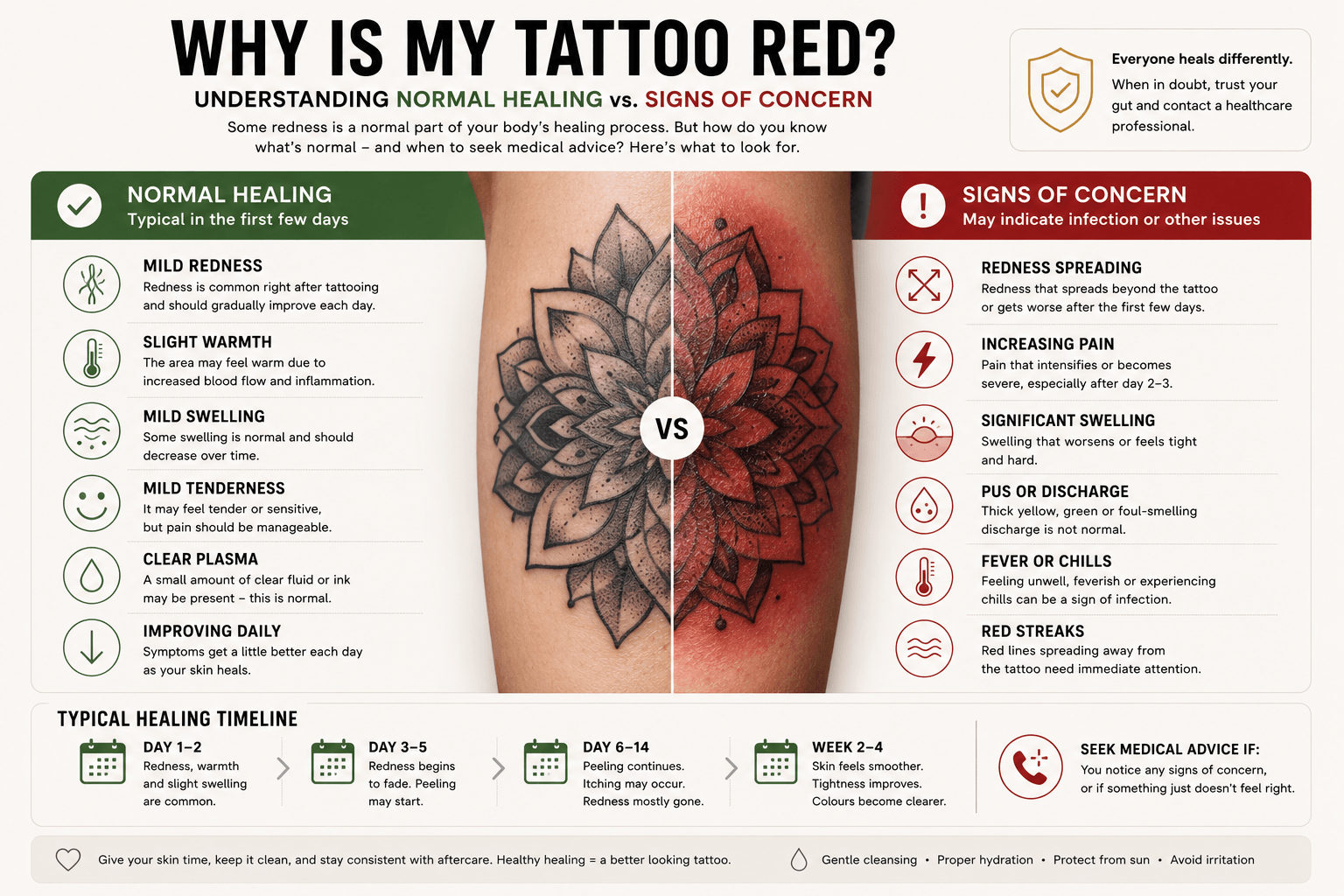
A new tattoo almost always looks red.
In fact, redness is one of the earliest and most common signs that your skin has started its natural healing process.
For many people, seeing a bright red tattoo for the first time can be worrying. Questions such as “Is this normal?” or “Is my tattoo infected?” are among the most common concerns during the first few days after getting tattooed.
The reassuring news is that mild redness is usually a completely normal response.
Tattooing creates thousands of microscopic punctures in the skin, triggering a carefully coordinated healing response that begins within seconds. As blood flow increases and immune cells move into the area, the tattoo often appears red, warm, and slightly swollen.
These changes are part of the body’s normal repair process.
However, while some redness is expected, not all redness should be ignored.
Persistent, worsening, or unusually severe redness—especially when accompanied by increasing pain, swelling, pus, fever, or red streaks spreading away from the tattoo—may indicate a complication that should be assessed by a healthcare professional.
Understanding the difference between normal healing and warning signs can help you care for your tattoo with confidence.
Quick Answer
Is redness after a tattoo normal?
Yes.
For most people, mild to moderate redness is a normal part of tattoo healing during the first few days.
It usually improves gradually as inflammation decreases.
Quick Facts
Most Common Cause
Normal inflammatory response
Usually Starts
Immediately after tattooing
Typically Improves
Within 2–4 days
Can Last
Up to one week in some people, depending on tattoo size, placement, and individual healing
Normal Symptoms
✔ Mild redness
✔ Slight warmth
✔ Mild swelling
✔ Tenderness
✔ Clear plasma leakage
Seek Medical Advice Promptly If You Notice
- Redness that continues to spread after the first few days.
- Increasing rather than decreasing pain.
- Thick yellow or green discharge.
- Fever or chills.
- Red streaks extending away from the tattoo.
- Significant swelling that worsens instead of improving.
Why Does a Fresh Tattoo Become Red?
Redness is caused by inflammation, one of the body’s first responses to skin injury.
Although inflammation often sounds negative, it is actually essential for healing.
Immediately after tattooing:
- Tiny blood vessels widen.
- Blood flow increases.
- White blood cells migrate into the area.
- Immune cells begin clearing damaged tissue.
- Growth factors are released to begin repair.
This increased blood flow is what gives the skin its characteristic red appearance.
Rather than indicating that something is wrong, it usually means your body’s repair system is working exactly as expected.
What Happens Beneath the Skin?
Every tattoo needle creates a microscopic wound.
Your immune system immediately begins coordinating several repair processes at once.
These include:
Increased Blood Flow
Extra blood delivers oxygen and nutrients needed for tissue repair.
Immune Cell Activation
White blood cells help remove damaged cells while supporting the healing process.
Barrier Repair Begins
The skin barrier becomes temporarily disrupted, increasing moisture loss.
This is why a new tattoo often feels tight and dry.
Collagen Production Starts
Fibroblasts begin rebuilding connective tissue within the dermis.
This process continues for several weeks after the tattoo appears healed.
What Does Normal Tattoo Redness Look Like?
Normal redness usually has several characteristics.
It is typically:
- Localized to the tattoo.
- Fairly even across the tattooed area.
- Most noticeable during the first 24–48 hours.
- Gradually improving each day.
- Accompanied by mild tenderness rather than severe pain.
As healing progresses, the redness slowly fades while peeling and mild itching may begin.
This transition is a reassuring sign that the healing process is moving into its next stage.
Factors That Can Make a Tattoo Look Redder
Not every tattoo heals exactly the same way.
Several factors influence how much redness you may experience.
Tattoo Size
Large tattoos naturally create more tissue injury than small tattoos.
Tattoo Placement
Areas with thinner skin or frequent movement—such as ribs, feet, hands, or elbows—may appear red for longer.
Tattoo Style
Heavy colour packing or large areas of shading can produce more temporary inflammation than fine-line tattoos.
Individual Skin Response
Everyone’s immune system responds differently.
Some people develop only mild redness, while others remain visibly red for several days despite perfectly normal healing.
Why Proper Aftercare Matters
While redness itself is a normal part of healing, good aftercare helps support the skin as inflammation gradually resolves.
A balanced aftercare routine includes:
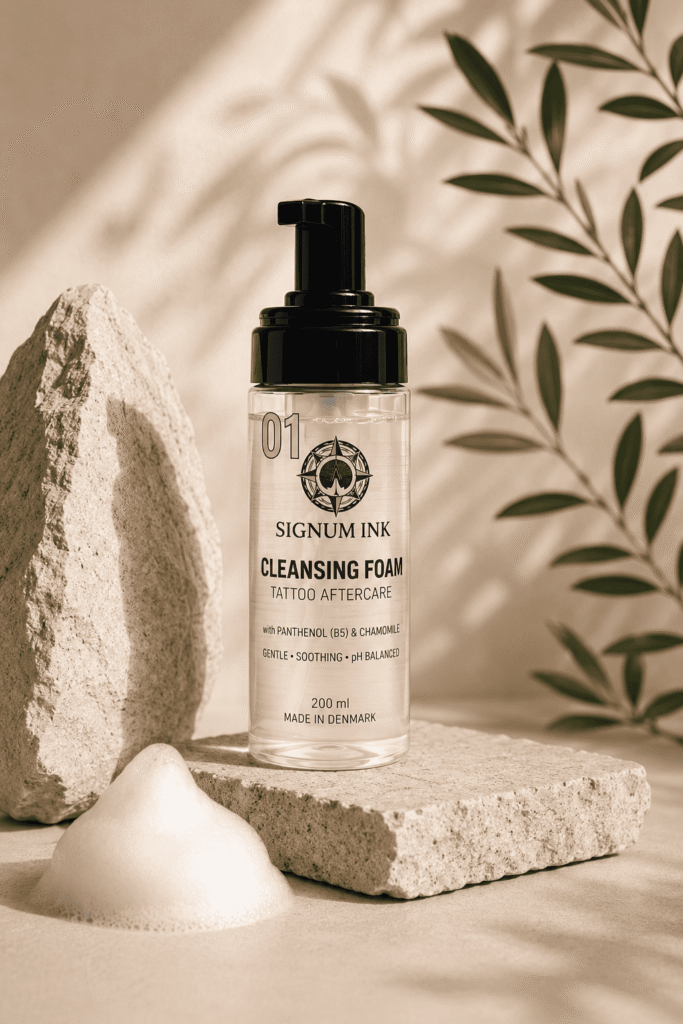
- Gentle cleansing with a mild tattoo-friendly foam soap.
- Applying a thin layer of a recovery cream to help maintain hydration.
- Avoiding unnecessary friction or scratching.
- Wearing loose clothing that doesn’t rub against the tattoo.
- Protecting the tattoo from excessive sun exposure.
The goal is not to eliminate inflammation completely—because inflammation is necessary for healing—but to support the skin while its natural repair processes take place.
When Tattoo Redness Is Not Normal
Although redness is one of the most common signs of normal tattoo healing, there are situations where it deserves closer attention.
The most important thing to remember is that normal healing usually improves a little every day.
If the redness becomes more intense instead of fading, or if new symptoms develop, it may indicate that something else is happening.
Pay attention to the overall pattern rather than a single symptom.
Normal Redness vs. Signs of Concern
| Normal Healing | May Need Medical Assessment |
|---|---|
| Mild to moderate redness | Redness that spreads well beyond the tattoo |
| Improves each day | Redness continues to worsen |
| Mild warmth | Significant heat that increases |
| Mild tenderness | Severe or increasing pain |
| Slight swelling | Swelling that rapidly worsens |
| Clear plasma | Thick yellow or green discharge |
| No fever | Fever or chills |
Important: These signs do not automatically mean there is an infection, but they do warrant prompt medical assessment.
Tattoo Redness vs. Infection
One of the biggest concerns after getting a tattoo is the possibility of infection.
The challenge is that both normal healing and infection can involve redness.
The difference is usually how the symptoms develop over time.
Normal Healing
Typically:
- Redness is greatest during the first 24–48 hours.
- Swelling gradually decreases.
- Pain becomes milder each day.
- The tattoo begins peeling after several days.
- Overall appearance slowly improves.
Possible Infection
Possible warning signs include:
- Redness spreading beyond the tattoo.
- Increasing pain after initial improvement.
- Thick yellow or green discharge.
- Fever or chills.
- Red streaks extending away from the tattoo.
- Increasing swelling rather than gradual improvement.
If you experience these symptoms, seek medical advice promptly rather than attempting to treat the problem yourself.
Tattoo Redness vs. Allergic Reaction
Although uncommon, some people develop an allergic reaction to tattoo pigment or skincare products used during healing.
Unlike normal inflammation, allergic reactions may include:
- Persistent itching that is severe.
- Raised bumps.
- Widespread rash.
- Redness extending beyond the tattoo.
- Symptoms that appear days or even weeks later.
Because allergic reactions can have many causes, including ingredients in skincare products, professional medical evaluation is the safest approach if symptoms persist or worsen.
How Long Should Tattoo Redness Last?
There is no single answer because healing varies from person to person.
However, a general timeline looks like this:
| Time After Tattoo | What Is Usually Expected |
|---|---|
| First 24 hours | Redness is often at its strongest. |
| Days 2–3 | Redness usually begins to decrease. |
| Days 4–7 | Peeling often starts while redness continues to fade. |
| Week 2 | Most visible redness has resolved. |
| Weeks 3–4 | Surface healing is usually complete. |
Large tattoos, heavy colour saturation, and areas with frequent movement may remain mildly red for slightly longer than small tattoos.
Why Some Tattoos Stay Red Longer
Several factors influence healing.
Tattoo Size
Larger tattoos create more microscopic skin injury, resulting in a longer inflammatory response.
Placement
Areas such as the ribs, ankles, hands, elbows, and feet often heal more slowly because the skin experiences more movement and friction.
Heavy Colour Packing
Solid colour tattoos generally involve more repeated needle passes than fine-line tattoos, which may increase temporary redness.
Sensitive Skin
Some people naturally develop stronger inflammatory responses than others.
This variation is usually normal.
What Does the Research Say?
Inflammation is the body’s natural response to tissue injury.
During tattoo healing, increased blood flow delivers oxygen, nutrients, and immune cells to the affected area, supporting repair of the skin.
Studies in wound healing consistently show that this early inflammatory phase is essential for normal recovery.
The goal of tattoo aftercare is not to eliminate inflammation but to support healthy healing by:
- Keeping the tattoo clean.
- Maintaining appropriate hydration.
- Supporting the skin barrier.
- Minimizing unnecessary irritation.
Common Mistakes That Can Make Redness Worse
Even a normally healing tattoo can become more irritated if the skin is repeatedly stressed.
Common mistakes include:
Overwashing
Excessive washing may dry the skin and temporarily increase irritation.
Using Harsh Soaps
Strong cleansers can disrupt the skin barrier while it is rebuilding.
Choose a gentle cleanser formulated for sensitive or healing skin.
Applying Too Much Ointment
A very thick layer may trap excess moisture and make the tattoo feel uncomfortable.
A thin, even layer is generally sufficient.
Scratching the Tattoo
Itching is common, but scratching can damage newly forming skin and increase irritation.
Sun Exposure
Fresh tattoos are particularly sensitive to UV radiation.
Protect the tattoo from direct sunlight during healing.
Tight Clothing
Repeated rubbing from tight clothing may prolong irritation, especially on tattoos located on the ribs, thighs, or shoulders.
Recovery Tips
While you cannot eliminate the body’s natural inflammatory response, you can support healthy healing by following a consistent routine.
A simple approach includes:
✔ Wash the tattoo gently with lukewarm water and a mild cleanser.
✔ Pat the area dry with a clean towel—avoid rubbing.
✔ Apply a thin layer of recovery cream to maintain hydration.
✔ Avoid scratching or picking peeling skin.
✔ Wear loose, breathable clothing whenever possible.
✔ Protect the tattoo from excessive sun exposure.
These steps help maintain a healthy environment while the skin repairs itself.
Frequently Asked Questions About Tattoo Redness
Why is my tattoo still red after three days?
For many people, mild redness is still completely normal after three days.
The duration depends on several factors, including:
- Tattoo size.
- Placement on the body.
- Amount of shading or colour packing.
- Individual healing response.
As long as the redness is gradually improving rather than worsening, it is usually part of the normal healing process.
Why does my tattoo feel warm?
A healing tattoo often feels warmer than the surrounding skin during the first few days.
This happens because inflammation temporarily increases blood flow to the area.
As healing progresses, the warmth should gradually decrease.
If warmth becomes more intense instead of improving—especially if accompanied by increasing pain, swelling, fever, or discharge—seek medical advice promptly.
Why is my tattoo red around the edges?
Slight redness around the outline of a fresh tattoo is common.
The tattoo needle affects not only the exact pigment location but also the surrounding skin.
This mild inflammation usually settles over the first several days.
Is redness worse after a large tattoo?
Yes.
Larger tattoos involve more needle passes and affect a greater area of skin.
As a result, they often produce more redness, swelling, and tenderness than smaller tattoos.
Can a recovery cream reduce redness?
A good recovery cream helps maintain hydration and supports the skin barrier, which may improve overall skin comfort during healing.
However, a recovery cream should not be expected to eliminate the body’s normal inflammatory response, because inflammation is an essential part of wound healing.
Does redness mean my tattoo is infected?
No.
Redness alone is not enough to indicate an infection.
Many perfectly healthy tattoos are visibly red during the first few days.
What matters is whether the redness gradually improves or continues to worsen, and whether it is accompanied by concerning symptoms such as fever, increasing pain, thick discharge, or rapidly spreading redness.
Why is one part of my tattoo redder than another?
Different parts of the tattoo may have required more needle passes.
Areas with heavier shading or solid colour often appear slightly redder than fine-line sections during early healing.
Can exercise make my tattoo look red again?
Sometimes.
Exercise increases blood circulation, which may temporarily make a healing tattoo appear slightly redder.
This short-lived increase in redness usually settles once your body cools down.
Avoid strenuous exercise that causes excessive stretching, friction, or sweating over a very fresh tattoo during the early healing period.
Is redness different on darker skin tones?
Yes.
Inflammation may appear differently depending on your natural skin tone. Instead of looking bright red, it may appear darker, purple, brownish, or less visually obvious.
Regardless of skin tone, changes over time—whether symptoms improve or worsen—are generally more informative than colour alone.
When should I contact a healthcare professional?
You should seek medical advice promptly if you experience symptoms such as:
- Redness that spreads rapidly beyond the tattoo.
- Increasing pain after the first few days.
- Thick yellow or green discharge.
- Fever or chills.
- Red streaks extending away from the tattoo.
- Significant swelling that continues to worsen.
- Any symptom that causes concern or seems markedly different from a typical healing tattoo.
Common Myths About Tattoo Redness
Myth 1: Every red tattoo is infected.
Reality:
Mild redness is one of the most common and expected signs of normal tattoo healing.
Myth 2: If redness lasts more than two days, something is wrong.
Reality:
Many tattoos remain mildly red for several days, especially larger tattoos or tattoos located on areas that move frequently.
Myth 3: You should try to remove all redness as quickly as possible.
Reality:
Inflammation is an essential part of wound healing.
The goal is to support healthy healing—not eliminate the body’s natural repair response.
Myth 4: Thick ointment heals redness faster.
Reality:
More product is not necessarily better.
Applying a thin, even layer of a suitable recovery cream helps maintain hydration without unnecessarily overloading the skin.
Research Snapshot
| Research Area | Evidence |
|---|---|
| Normal Inflammatory Response | ★★★★★ |
| Skin Barrier Recovery | ★★★★★ |
| Moisture Balance | ★★★★★ |
| Wound Healing Biology | ★★★★★ |
| Tattoo Aftercare | ★★★★☆ |
| Tattoo Infection Recognition | ★★★★☆ |
Normal Healing Timeline
| Time | What Is Usually Normal |
|---|---|
| Day 1 | Redness, warmth, mild swelling |
| Days 2–3 | Redness begins improving |
| Days 4–7 | Peeling starts, redness fades |
| Week 2 | Most redness resolved |
| Weeks 3–4 | Surface healing largely complete |
Expert Tip
Don’t judge your tattoo by how it looks on a single day—judge it by the direction it is moving.
A healing tattoo should gradually become less red, less swollen, and more comfortable over time. Looking for steady improvement is usually more helpful than focusing on temporary day-to-day changes.
Signs of Healthy Healing
✔ Mild redness that gradually fades.
✔ Slight warmth during the first few days.
✔ Mild tenderness that improves.
✔ Peeling after several days.
✔ Itching during later healing.
✔ Colours becoming clearer as healing progresses.
Signs That Need Prompt Medical Assessment
⚠️ Redness spreading beyond the tattoo.
⚠️ Pain becoming more severe instead of improving.
⚠️ Thick yellow or green discharge.
⚠️ Fever or chills.
⚠️ Red streaks extending away from the tattoo.
⚠️ Rapidly worsening swelling.
These signs do not necessarily mean there is an infection, but they should be evaluated by a healthcare professional as soon as possible.
Why Modern Tattoo Aftercare Focuses on the Skin Barrier
Modern aftercare is no longer just about “keeping the tattoo moist.”
Research has shown that maintaining a healthy skin barrier is central to comfortable healing.
A well-formulated recovery cream supports this by combining ingredients with complementary roles:
| Function | Example Ingredient |
|---|---|
| Attracts moisture | Glycerin |
| Supports cellular hydration | Betaine |
| Reinforces the barrier | Ceramides |
| Supports barrier function | Niacinamide |
| Skin conditioning | Panthenol |
| Lightweight emollient | Caprylic/Capric Triglyceride |
| Softens the skin | Squalane |
| Botanical support | Madecassoside |
| Antioxidant protection | Vitamin E |
Each ingredient contributes to maintaining hydration and supporting the skin while its natural healing processes continue.
Final Thoughts
Seeing redness after getting a tattoo can be unsettling, especially if it is your first tattoo. Fortunately, mild redness is one of the most common and expected signs that your body has begun repairing the tiny wounds created during the tattooing process.
In most cases, the redness gradually fades over the first several days as inflammation decreases, the skin barrier begins to recover, and new skin forms over the tattoo.
The most important thing to watch is progress. Healthy healing usually moves in the right direction each day, even if improvements are gradual.
Understanding what is normal—and recognizing when symptoms deserve medical attention—allows you to care for your tattoo with greater confidence and peace of mind.
With gentle cleansing, appropriate hydration, and patience, your skin can complete the remarkable biological process that transforms a fresh tattoo into a lasting piece of body art.
 English
  German
  Dutch
Dutch  Danish
  Swedish
  French
  Italian